
On Welcoming Jesus

Advent is a time when we anticipate God’s coming into our lives in mysterious ways. But are we really looking forward to God coming to us, or are we expecting business as usual, even if business isn’t all that good? Do we believe that God can affect our lives, or do we live on the assumption that such does not happen?

During a time of crisis, King Ahaz is urged to ask a sign of God but refuses to do so. (Is. 7: 1-12) Why? Asking God for a sign would alert him to the possibility that God might enter his life in some way. Business is bad, with the Assyrians threatening Jerusalem, but maybe he would rather be trampled by a powerful army then open himself up to what God might do. In the face of the king’s closing himself off, the prophet Isaiah announces a sign whether the king likes it or not. The sign doesn’t seem like much up against an invading army. How is a new born child going to solve the problem? Well, it isn’t exactly the baby who solves the problem; it’s God who solves the problem with a nudge that sends the invading army away. The baby was a sign of hope for the future, as babies often are. Nothing happens here that conflicts with the laws of nature. After all, God can accomplish much with the laws of nature. (The old translation that had a “virgin” conceiving in Isaiah’s time is considered by almost all scholars to be a mistranslation.) Now God’s little but decisive nudge wasn’t so bad was it? The only problem was that the king wasn’t in control of the situation. Not letting God control his situation would lead to Assyria controlling the situation. Is it easier to cope with being controlled by other humans that in some mysterious way being controlled, or at least led, by God? That is a particularly good question for us to ask ourselves during Advent.

Fast forward to Joseph confronted with a betrothed woman who has become pregnant, but not by him. Knowing the laws of nature as well as any modern gynecologist, Joseph decides to divorce Mary discretely, but before he can carry out his resolve, he is challenged by a dream to believe that God has intervened directly in violation to normal natural law. One could say it is once again just a little nudge. Once the conception of the child has taken place, the child develops in Mary’s womb like any other child and, when born, is just as fully human as any other child. But this little wedge, or nudge, is a big one, even a cosmic one. It is a nudge that has fundamentally changed the world for all time. And yet this little nudge, in spite of being contrary to natural law, did not send an army away. The Roman army stuck around and did its work, including the crucifixion of criminals, one of whom turned out to be the child conceived by the Holy Spirit. On the surface it doesn’t look like much of an intervention.

At this point we might ask ourselves: Do we need a decisive intervention from God such as Matthew claims to have happened with the conception of Jesus in the womb of Mary? Maybe business as usual has been bad, but at least we’re used to it. St. Paul, however, insisted that humanity had become a train wreck and needed the direct presence of God within humanity before anything could get better. St. Augustine and subsequent theologians have seconded the motion. The modern thinker René Girard has offered us anthropological insights to suggest that we are too entangled in rivalrous relationships for any of them to be disentangled unless there is intervention from outside the system, which to say: from God. So, business is bad, as I said, but do we prefer the bad business as usual to the unknown possibilities that might emerge if we embrace the child born of the Virgin Mary? Christmas is coming. Do we really want Christ to come?

Church as Family

HolyFamilybyGutierrezAnother set of images of the Church is drawn from family. As with other images, only more so here, there are strengths and weaknesses. Most important, they bring to remembrance our families of origin. If our family experiences are, on balance, good, then the images reinforce that, but if the experiences are seriously bad, then the images become stumbling blocks. These can be at least as hard to overcome as the stumbling blocks parents and/or siblings have put before us, especially in our earliest years. If the latter is the case, we need to remember that healing was a major ministry on the part of Jesus and healing familial brokenness continues to be part of that.

The Fatherhood of God is an important familial image in Christian spirituality as the Lord’s Prayer reminds us every time we say it. But it is important to remember that God is addressed as “Father” (better yet: Papa) by Jesus before God is addressed that way by us. Jesus is alerting us to the paternal care given all of us by God, but God’s paternity comes to us through Jesus. At the Annunciation, the Heavenly Father, who already has begotten the Son from all Eternity, begets the human child in Mary’s womb. As a conscious human, Jesus experienced the love of his Heavenly Father most strongly when he was baptized in the Jordan by John. The voice from Heaven said: “You are my Son, the Beloved; with you I am well pleased.” This pre-emptive love of the child is fatherhood at its best. It is like the happy parent who is overjoyed with the birth of a child simply because the child is. It is this pre-emptive Love that is the Foundation of the Church, the rock on which the Church is built.

The image of Mother, Jesus’ earthly mother, has often been used as an image for the Church. As a particular flesh-and-blood mother she is Mother Church without being an abstraction. That she would nourish the baby Jesus from her own body makes her a perfect image of nurturing. When confronted with the mysteries surrounding Jesus’ birth, she pondered them in her heart. Little else is told us about her from Scripture but she stood by Jesus at the cross, making her the archetype of many more grieving mothers whose sons have been treated the way her son was. The nurturing we receive from our mothers has a lot to do with having a basic sense of security that helps us resist rivalrous mimetic desire as we grow up. Failures in early nurturing create basic insecurities that are difficult to overcome. The Church as a whole is called to delight in every child and to nurture every child during maturation.

Important as these paternal and maternal relationships are, they belong to Jesus first and to the rest of us secondarily. That is to say, Jesus relates to us as our brother and we are all Jesus’ brothers and sisters. Considering the history of sibling rivalry in scripture, this is of immense significance. Jesus is the keeper of his brother that Abel never had and he is Cain’s keeper as well. In her book Intimate Domain, Martha Reineke discusses the tension and fundamental choice a child is faced with when a sibling is born: whether to compete or to welcome the sibling as “more of me” rather than less. There is no competing with Jesus over mama or papa so we might as well be civil brothers and sisters with him and with each other in the bargain.

There is a curious story in the Gospels that hint of possible tensions even in the Holy Family. Jesus is told that his mother and brothers and sisters are outside wanting to speak to him. Jesus points to the people who are listening to him and says that they are his mother and brothers and sisters. This indicates that even during his lifetime, Jesus is building a kinship network based not on bloodlines but on obedience to God’s Desire. There are people from broken families who find family through the Church. (Here I mean Church in the broadest sense! Where this nurturing takes place, there is Church, when it doesn’t, there is no church.) Building deep kinship ties through Jesus happens when we allow Jesus to bring us into the arms of his Mother and the Presence of the Heavenly Father who is so well-pleased with us that our hearts melt and we really want to be pleasing to our brothers and sisters.

Mimetic Blessing through Abraham (2): Abraham’s Offspring

Jacob_Blessing_the_Children_of_Joseph_-_WGA19117[Continuation of Mimetic Blessing through Abraham (1): Cain and Abel

God promised Abraham that he would have as many descendants as the dust of the earth. (Gen. 13:16) I like the later image of the stars in the sky and the grains of sand on the seashore (Gen 22:17) but the earlier image ties in with the creation of humanity out of dust, thus making it clear that descendants of Abraham (like us) are part of God’s ongoing creation. That’s how expansive God’s blessing and being God’s blessing can be.

When Abraham and his nephew Lot found there was tension between their herdsmen, Abraham suggested that they separate and he gave Lot the choice of taking the land to the left or the land to the right. This is quite the opposite from what most of us do which is the first see what the other desires and then desire it for ourselves. Instead, Abraham renounces desiring what his nephew desires and goes in the other direction. (The better-looking land turned out to have its liabilities but that is another story.)

Unfortunately, Abraham does not renounce mimetic desire and rivalry when it comes to his sons Ishmael and Isaac. In spite of being called to be a blessing and promised as many descendants as the dust of the earth, Abraham fails to believe that both of his sons can inherit the blessing he has been given by God. Far from fighting each other, Ishmael and Isaac play well together but they fall victim to the rivalry between their mothers. (Women are equal participants in the mimetic rivalry game in Genesis.) Abraham casts Ishmael out so that his favorite son born of Sarah can inherit the blessing. God, however, makes it clear that there is a blessing for Ishmael, too, even if Abraham did not believe it.

Following his father’s example, Isaac assumes that only one of his two sons can receive his blessing and, like Abraham, he wants to give it to his favorite son. Rebekah’s involvement in this rivalry causes this Isaac’s scheme to misfire. This time, it is the son who receives (takes) the blessing who is exiled where Jacob spends many years in rivalry with his kinsman Laban. When Esau re-enters the story on Jacob’s return, we can see that Esau has done well for himself and has no need to envy his brother’s success. Apparently there was a lot more of a blessing left for Esau than Isaac thought.

Jacob stubbornly upholds the family tradition of disbelief in the scope of God’s blessing and singles out his favorite, Joseph, over/against his ten older brothers. This time the fratricidal strife has enough brothers to create a scenario of collective violence. In contrast to the primitive sacred, however, the unanimity is not complete. Both Reuben and Judah, separately, make plans to save Joseph but they both fail. If they had stood up to their brothers, the mimetic process would likely have been redirected in a peaceful direction. The upshot of the story is that Joseph ends up becoming a blessing to Egypt and to lands far beyond and he saves his own family through his foresight in collecting food during the years of plenty. (Joseph’s making the Egyptians buy back the food that had been taken from them does make Joseph less generous than his God.)

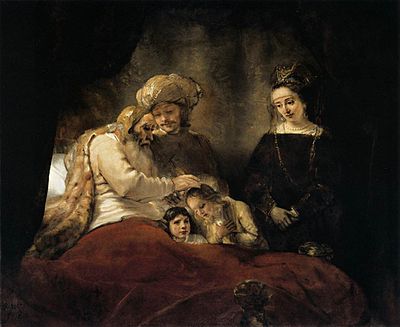
Before he dies, Jacob blesses the two sons of Joseph: Ephraim and Manasseh. He crosses his hands to indicate that Ephraim will be greater than his elder brother, but he gives both boys the same blessing. Finally, through excruciatingly painful experience, Jacob has learned that God has blessings for all of Abraham’s offspring.

Unwrapping the Future

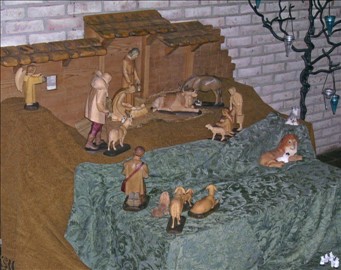
crecheThe yearly cycle of celebrations and commemorations adds solidarity to our experience of time. Christmas, a holiday especially laden with traditions, is a particularly strong anchor, assuring us that everything is as it should be for all eternity. Amen.

One of the traditions of Christmas, however, is the giving of charity. That is a very good thing, considering the needs for generosity, and it helps that once a year, people have a custom of dwelling on such matters. But the need for such charitable giving suggests that not everything is as it should be. If huge efforts by charitable organizations have to be made to assure that no child is deprived of a Christmas, then obviously there are serious social problems that need to be addressed. That is, this cozy traditional holiday poses a challenge for the future.

Manger scenes with the new-born Jesus lying in the straw tug the hearts of many and have been a focus of devotion since St. Francis of Assisi introduced the custom in the twelfth century.  But the whole point of this nativity story is that Jesus was born in the stable because nobody had room for his mother, father, and himself. This is not business as usual. It raises the question: do we really have room for Jesus in our lives? Do we really have room for all the children being born and for their families?

The angel announced to the shepherds proclaimed that this newborn child was the savior, the Lord who was going to usher in a new era of peace. That may sound innocent when we hear this read in church today, but at the time, the Caesar thought he was the savior and he didn’t have room for somebody else to do his job! Of course, he was a savior and keeper of the peace his way, with military and cultural might. The story of the shepherds, then, challenges us to consider who really is our savior and the model of peace for us. Do we keep peace the imperial way though violence to keep everybody in line? We don’t have to have imperial armies to take this approach. All it takes is a drive to control people, by force if necessary. Or do we follow peace Jesus’ way, through vulnerability as a newborn child all the way to the cross and then the Resurrection where Jesus creates peace through forgiveness.

A major cog in the engine of Caesar’s peace in Jesus’ neck of the woods was King Herod. Killing all the baby boys in Bethlehem may not look like a peaceful action, but Herod was keeping the peace, imperial style. Most of us may think Herod a bit extreme, but if we are willing to sacrifice anybody who seems to threaten our control of life, especially the young, we are going the way of Herod, the way of Caesar. Jesus, although he had the power to send legions of angels against Herod, remained vulnerable, dependent on human protection until the time came to suffer the fate the boys of Bethlehem suffered.

All of this may be a downer for a joyful holiday, but the good news is that Christmas is a yearly wakeup call for renewal of life, a renewal fueled by the divine energy of a human child born over two thousand years ago. Everything that was wrong with the world at the time is wrong with the world now and a lot more. We can keep on going in circles if we want, but we have the chance to step off the not-so-merry-go-round and embrace the Christ Child. We will find that the Christ Child has a gift for us. If we dare to open it up, it is a gift for an open future that we can have if we really want it.

See also, Celebrating the Prince of Peace and The Word Became Vulnerable Flesh