
During the Christmas season, we celebrate the Incarnation: the mystery of God becoming a human being. For such a thing to happen, there must be an intersection of time and Eternity. Understanding time is easy, Or is it? I think we can all sympathize with St. Augustine of Hippo when he said he understood time until you asked him to explain it. Maybe we can’t explain time but it has familiarity in that we live in it the way a fish lives in the water. Eternity is something else. We don’t live in it and we really can’t conceive of living in it. We might be tempted to say that Eternity is the opposite of time, but that isn’t right. My theology professor said that Eternity has nothing to do with time. That means Eternity can’t even be the opposite of time as that would be to relate the two and that is what can’t be done. We could say that Eternity is for God and time is for us and leave it at that. But once Jesus was born, time is for God as well as for us. Does this mean that Eternity will be for us some day? But if Eternity should be a future possibility, it would be connected with time after all. Does that mean Eternity won’t be Eternity any more? Maybe we just haven’t begun to grasp what Eternity is all about.
God’s being eternal is one of the reasons that God is usually thought to be unchanging and unchangeable. But to consider the notion of God changing, or not changing, relates God to time yet again. More to the point, there is the Biblical record of God’s interacting with time bound creatures such as we. So whatever it might mean for God to be unchanging, it doesn’t mean that God is some cosmic blob that never does anything. The first chapter of Ephesians offers us a powerful vision of what an unchanging but dynamic God is like. The “God and father of our Lord Jesus Christ” has “blessed us in Christ with every spiritual blessing in the heavenly places.” (Eph. 1: 3) Moreover, we have been chosen “before the foundation of the world” and destined for adoption as God’s children “according to the good pleasure of his will.” (Eph. 1: 4-5) A God who blesses and chooses us from the foundation of the world is infinitely active rather than infinitely motionless. But Paul is also telling us that this will of blessing and choosing is constant. It may be active, infinitely active, but it is steady, unchanging.
We have a powerful example of the effect of God’s active, steady blessing and choosing in the 31st chapter of Jeremiah. Israel’s experience in time has been nothing short of catastrophic. Babylon invaded Jerusalem, destroyed the temple, and deported the more important people to Babylon, leaving Jerusalem in ruins. Jeremiah himself proclaimed Yahweh’s presence in the midst of this disaster because of the sins and apostasy of the people. But in the 31st chapter, Jeremiah is prophesying the return from the Babylonian exile: “See, I am going to bring them from the land of the north, and gather them from the farthest parts of the earth, among them the blind and the lame, those with child and those in labor, together; a great company, they shall return here.” (Jer. 31: 8) With God interacting in time, a great new thing is about to happen, but what, in time, is great and new, and unheard of, is a result of a steady act of blessing and choosing on the part of God. This steady and unchanging will shows itself both in bringing Israel to repentance and restoring Israel to its homeland.
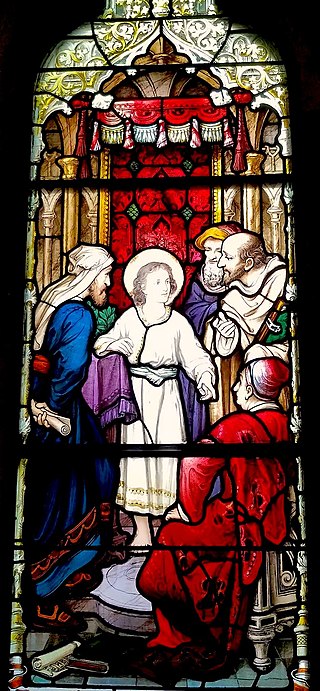
On Christmas Day, we celebrated the birth of Jesus. The Logos who was with God in the beginning, became a human baby as vulnerable as any other baby. (Jn. 1: 1) On this second Sunday after Christmas, we see Jesus at the age of twelve, talking with the elders in the temple and asking them questions. That is, we are seeing a child asking questions about life and seeking answers as children are apt to do as soon as they are old enough to think about such things. This brings us into the paradox of an unchanging God developing in time as a human being. That God would do such a thing tells us that for us, living in time as we do, developing over time by asking questions is a good thing to do. We are also alerted to the significance, in the context of Eternity, of every little thing we do now in time. Here, we are at the beginning of Jesus’ life, but over the next few months, we’ll follow him to the end and beyond. Indeed, Paul says that it is through Jesus Christ that we are adopted as God’s children in God’s unwavering will and choice. That is, Paul is presupposing both the Cross and the Resurrection when he proclaims the destiny chosen for us by God. It is good for us that God’s will is not changeable, but what about us who are changeable? Insofar as our will isn’t so good, it is a good thing that it is changeable with a chance of a change for the better. This is what Israel needed when the consequences of their apostasy brought about the Babylonian Exile. Asking questions and listening to the answers as Jesus did can help bring us to abiding in God’s will that will not change in relation to any one of us or in relation with anybody else.
See also As Jesus Grew
 Imaginary Visions of True Peace