
The Call to Contemplation

The brief story of Jesus visiting Martha and Mary, when Martha serves Jesus and Mary sits at his feet, listening to him, (Lk. 10: 38-42) has been interpreted as contrasting the active and contemplative lives since the early church. The contrast between Martha being so frantically active and Mary so still a listener firmly calls for attention. In any case, the relationship between activity and contemplation is one with which Christians have struggled since the Early Church. Although the Desert monastics embraced an ardent contemplative lifestyle, there are stories about the need for Martha, such as the amusing story of a visitor to a monastery who said he would not help with the work because he had, like Mary, chosen the better part, but was upset when he wasn’t called to dinner.

On the face of it, though, the contrast of action and contemplation doesn’t seem to be an issue for Luke or the other Gospel writers, which raises the question of whether or not the use of this story for evaluating the relationship between action and contemplation might be a bit anachronistic, even if congruent to the story. So I thought about what the story might have met to Luke–-but came up empty. I couldn’t think of any other meaning than the traditional one, which raises the question of whether it is so anachronistic after all.

First, I reflected on the pace of each of the four Gospels. Mark, considered the earliest, is very fast paced, breathlessly narrating the healing miracles and overwhelming the reader (or listener) with the power of Jesus’ ministry. Matthew and Luke slow the pace considerably, mainly by including long episodes of Jesus’ teaching, teachings that require reflection to begin taking them in. Although Luke’s pace is roughly the same as Matthew’s, it is instructive that he stresses more the times Jesus went off alone to pray, suggesting that Jesus had to balance his active life with contemplation. John, most likely the latest Gospel, is much the most contemplative Gospel as it unfolds at a very slow pace and suggests deeper meanings to the events in the narration. Such a progression suggests a growing awareness of those who developed the Gospel traditions of the need to contemplate the meaning of Jesus’ life that culminated in the shocks of the crucifixion and Resurrection, as well as absorbing the teachings which seem to have puzzled Jesus’ closest followers at the time. So, the traditional interpretation of this brief story doesn’t seem anachronistic after all.

When we look at the opening chapter of the Epistle to the Colossians, we encounter profoundly contemplative insights on the part of Paul, or whoever else might have written the epistle. (I favor Pauline authorship, but if somebody else shared the same contemplative insights as Paul demonstrated in his undoubted epistles, that attests all the more to the contemplative development of the early church.) Paul connects Jesus, whom he encountered on the Road to Damascus, to the Creator of the world, (Col. 1: 15–17) perhaps sensing the same creative activity on the part of God in Genesis as in the re-creation Paul experienced when Jesus called him out. This same Jesus is also the head of the Church, (Col. 1: 18) the specific group of humans who have responded to Jesus as Paul has. All this convinces Paul that the fullness of God dwells within Jesus. (Col. 1: 19) Most important, Paul realizes that Jesus’ reconciliation with him, who had formerly been hostile to Jesus, is part of a general reconciliation Jesus has made with all people, a reconciliation made not through the military, political, and cultural force of the Pax Romana, but the Peace of Christ who suffered at the hands of the Roman Empire. (Col. 1: 20) The very persecution Paul engaged in was flipped to a reconciliation by the suffering of Jesus. In this dense passage, we see the fruits of profound contemplation, a sitting at the feet of Jesus in quiet prayer. This gives us all the more reason to believe that Luke, probably writing two or three decades later than Paul, was passing on a caution traced back to Jesus that the action required by charity, such as in the Parable of the Good Samaritan that directly precedes this story of Mary and Martha, and the need to proclaim the Kingdom of God, be grounded in quiet contemplation of what the Kingdom ix really about.

In Genesis, we have the incident when Abraham and Sarah welcome three men who turn out to be angels. (Gen. 18: 1–10) Although there is much activity, we don’t see the frantic movements of Martha, and certainly not a trace of the resentment on Martha’s part. Starting with the Early Church, there has been a tendency to interpret the angels as the Holy Trinity come to visit the patriarch and matriarch. That interpretation really is anachronistic, but Paul’s proclamation that “the mystery that has been hidden throughout the ages and generations but has now been revealed to his saints” (Col. 1: 26) suggests that some interpretations of scripture will transcend time. The well-known icon of the Trinity by Andrei Rublev, inspired by this scene, leads us into the deep contemplation, not only of the hospitality of Martha, Sarah, and Abraham, but also of the hospitality of Mary who invited Jesus deeply into her heart. Such a presence of God within us can never be taken away from us and will remain with us for all eternity.

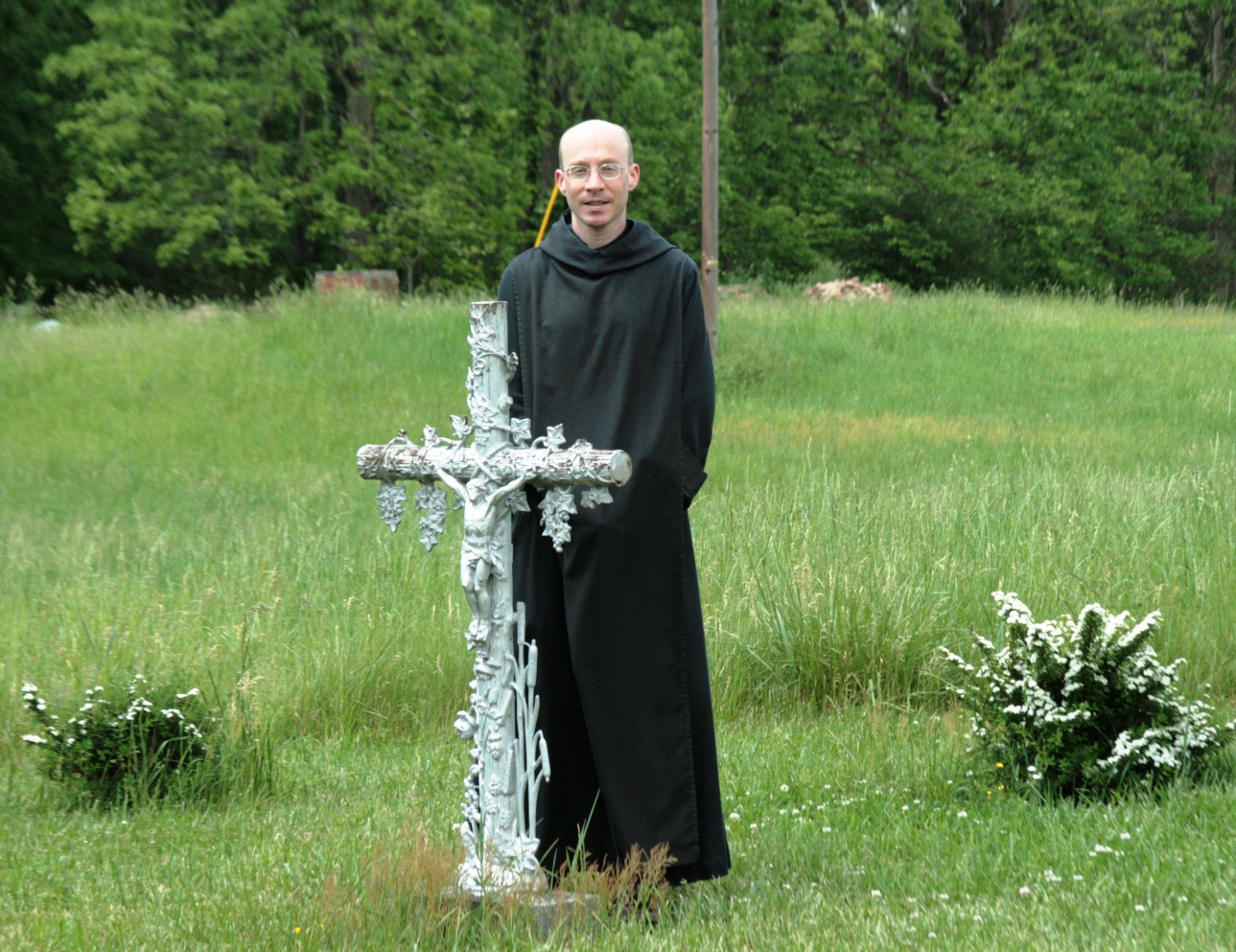
Brought Near by the Blood of Christ

In the second chapter of Ephesians, Paul presents a powerful vision of human unity and reconciliation: a household of God with Jesus the cornerstone. What beautiful words for sore ears, ears sore from the discord and violence breaking out in the world even as we celebrate the Holy Mysteries of the altar. This fact of discord and violence makes it clear that we have not reached this vision. Moreover, there is more than a hint of violence in the fact that the reconciliation has been brought by the blood of Christ. (Eph. 2: 13) The blood of Christ is often skimmed over as a formula to set up something more pleasant, but it refers to a death by torture on a cross of a man who spent a life trying to offer healing and reconciliation.

The French thinker René Girard suggested that from the dawn of history, human society has had a tendency to resolve social tensions through focusing on one person who is blamed for the social tensions. When the person is put to death, things are more peaceful—for a time. The root problem, the entanglement of human desires that leads to violence when it is believed that the objects of desire cannot be shared, does not change, so the cycle starts all over again until, once again, the shared desire reaches concord through focusing the blame on one person, or a group of persons. Girard called it “unanimity minus one.”

This is precisely the story that the Gospels tell: the story of a society ripped apart by many tensions until, suddenly, miraculously, all of the parties that are at each others’ throats suddenly come to an agreement that Jesus must die. But the Gospels proclaim this victim to be innocent, not the one who tore society apart, but the one who tried to bring reconciliation. Indeed, the tensions in Jesus’ time were not resolved with the result that Jerusalem was destroyed in A.D. 70. That this was so was not by chance. The cycle of collective violence only “worked” because the truth was covered up and denied. The Gospels blew the cover, making sure that it will never “work” again, no matter how hard we try.

And yet Paul proclaims a cosmic reconciliation as a result of this violent death. Why? Because Jesus was raised from the dead as the forgiving victim. Paul himself experienced Christ’s forgiveness in a powerful way on the road to Damascus. Jesus did not just preach about forgiving one’s enemies; Jesus practiced it as the risen victim. In so doing, Jesus inaugurated what Paul calls a new creation, a new humanity, a chance for humanity to start over and get it right this time. But when we look at the discord and violence, it is clear we haven’t gotten it right yet. There is some good news inspired by the Good News that is the Gospel, however, namely the massive amounts of charitable work done around the globe to build up dignity for people who are ground down by the discord and violence.

In Mark, we see Jesus having compassion on the people “because they were like sheep without a shepherd.” (Mk. 6: 34) Jeremiah castigated the shepherds who destroy and scatter the sheep. (Jer. 23: 1) When there is no shepherding or bad shepherding, humanity falls into the cycle of violence that resolves on a victim, the scapegoat. Jeremiah conveyed God’s promise of real shepherds who will care for them. (Jer. 23: 4) Paul insists that Christ is this shepherd, but not a shepherd who nags and scolds but one who shepherds through forgiveness. As the Gentiles and Jews had united in putting Christ to death, Paul says that Christ unites Jews and Gentiles through forgiveness as the risen victim. So Jesus has reconciled Jew and Gentile “to God in one body through the cross, thus putting to death that hostility through it.” (Eph. 2: 16)

Throughout his preaching, Paul proclaimed this reconciliation of Jew and Gentile, hoping and believing it could happen soon and be the consummation of creation. Yet, that did not happen. Jewish persecution of Christians embittered the early church and anti-Jewish attitudes wrecked havoc on the Church, culminating in the Nazi Holocaust.

Although Gentile-Jewish relations continues to be a burning issue, in the U.S., relations between white and black people is front and center. Black people have been victimized beginning with the slave trade, but it is important to realize that committing such atrocities destroys the humanity of those of us who perpetrate it just as the persecution of Jews destroyed not only Jews but persecutors. Julia Robinson Moore, a black historian and theologian who uses Girard’s thought, has found evidence that the enslavement and suppression of blacks correlates with increased tensions between white people. So it is that blacks become collective victims of social problems among whites. As the Afro-American theologian James Cone said, Jesus is most present on the lynching tree.

In many ways it is frustrating to have Paul’s great vision of reconciliation when the reality of the present time hits us in the face. But it is important to be profoundly grateful for the vision. Proclaiming peace to those who are far off and those who are near is a guiding star, a way for us to be oriented. This vision gives us something to aim for, to hope for. Among other things, this vision gives us a means to test the shepherds who would lead us. Who is more apt to gather and build up? Who is more apt to scatter and destroy? Jesus became such a shepherd by getting all the people to sit together and eat together with what seemed very few loaves of bread and fishes. Such a vision challenges us to want it, really want it. Since this vision means that all of us will be changed, even changed radically, it can be frightening enough for us to hold back. All the more reason to pray to want to want this vision of reconciliation.

This vision can also point to both big and small ways to live it out. Julia Robinson Moore leads a reclamation project for the graves of enslaved persons. She takes students on field trips to spruce up the slave graveyards and she bring the descendants of slaves and enslavers together when they are ready for that move, giving all a chance to affirm the full humanity of the other and to seek mutual healing.

For an introduction to the thought of René Girard see: Living Stones in the House of the Forgiving Victim and Living Together with our Shared Desires.

The Nonviolent Messiah

KatrinaCrossAbraham1Simon Joseph’s book The Nonviolent Messiah is another helpful study on the question of whether or not Jesus truly preached peace and is a complementary study to A Peaceable Hope by David Neville. Whereas the latter worked from the final version of the New Testament and made a mathematical study of how much violence there was and how much peace, with peace being much the more preponderant element, Joseph uses examination of the Q document and the Adamic model of the Messiah in Enochic literature to argue that the historical Jesus consistently preached peace.

Like some atomic particles that are never seen but are inferred from visible reactions, Q has never been seen but is inferred from a study of the canonical Gospels and other non-canonical material. There may be some guess-work and there remains controversy as to what actually is in Q but there is enough evidence to work with what we have so far.

With a stress on the inaugural sermon in Q which would include the proclamation of the Jubilee and material used in the Sermon on the Mount in Matthew and the Sermon on the Plain in Luke, Joseph builds a case that Jesus preached nonviolence and a violent eschatology was added later by the Q community.

The lesser known Enochic literature is examined for a lesser-known element: the Adamic model that emerged in some of this literature in contradistinction to the Davidic Messiah who would be a political and military figure. The Adamic model posits the hope of a renewed creation that would involve all people and would be achieved by totally peaceful means. The Animal Apocalypse, so-called because animals signify the figures, is a particularly strong example of this. We can easily see the influence of this model on Paul’s use of the New Adam in his epistles. Joseph provides much evidence to suggest that this Adamic model, which was very well-known at all levels of Jewish society in Jesus’ time, strongly influenced Jesus’ self-understanding of the kind of Messiah he was.

If we take Joseph’s historical-critical work and bring it to the final result analyzed by Neville, he get the following plausible historical trajectory on the issue of peace in the formation of the New Testament: 1) The early Q community with its collections of sayings by Jesus preaching peace, 2) The community of Mark’s Gospel proclaiming the peaceful, crucified Messiah, 3) the preaching of Paul stressing peace & using the Adamic model of Messiah, 4) a later stage of the Q community where persecution and rejection led to a vengeful eschatology where God would do the vengeance, 5) The community of Matthew’s Gospel using Mark & Q, including the vengeful material but also the peace teachings, 5) The community of Luke’s Gospel mostly rejecting the violent eschatology & stressing peace with many unique elements stressing peace, 6) community of John’s Gospel with a very strong emphasis on peace.

Although a meticulous examination, the book is readable and is an important contribution to the investigations on Jesus’ attitude to peace and violence.