
Abraham out on Highway 61

sideAltarsIcons1The near-sacrifice of Isaac by his father Abraham, the Father of Faith, is the most troubling of stories. It should be. Chaim Potok’s young protagonist Asher Lev remembers the shiver he felt when he first heard the story. What is most troubling is the suspicion that Abraham was right to be willing to sacrifice his son. But was he? Jeremiah says Yahweh denounced the sacrifice of children, saying “that such a thing had never entered my mind.” (Jer. 19:5) Perhaps we are right to be troubled by any notion that Abraham was right to even let the idea enter his mind and even more troubled by any thought it ever entered into God’s mind.

Bob Dylan makes a bitter burlesque of the story in his song “Highway 61 Revisited.” The “god” who requires the sacrifice is a bully, warning Abraham that if he doesn’t comply: “Next time you see me, you’d better run.” To the question: “Where do you want to see this killing done? God said out on Highway 61”, the place for “a thousand telephones that don’t ring” and where to “put some bleachers out in the sun” to stage the start of the next world war. As with so many Dylan songs, the imagery reveals a society filled with mimetic rivalry and victimization where sacrifice and war become a spectator sport.

Soren Kierkegaard’s searing Fear and Trembling is at least as troubling as the biblical story. SK’s category of the “teleological suspension of the ethical” raises fears that the author celebrates Abraham’s willingness to do the deed. (What the fancy phrase means is: anything at all God says to do is right—end of story.) However, this troublesome category is coupled with what SK called “infinite resignation.” This is what Abraham had when he was willing to kill his son by God’s command. However, infinite resignation falls far short of faith and faith is what the biblical story and SK’s book is all about. Faith is receiving back what is given with infinite resignation “by virtue of the absurd.” Still troubled?

The most clear and piercing critique of this “infinite resignation” I know of comes in the powerful poem retelling this story by the World War I poet Wilfred Owen. Abraham builds parapets and trenches around the wood, suggesting the sacrifice of sons sent off to the war. But when the angel of the Lord admonishes Abraham to “slay the ram of pride instead of him . . . the old man would not so, but slew his son,/ and half the seed of Europe one by one.” This poet, one of many young victims of the war, and the creator of the bitter irony that poets like Bob Dylan use so well, has revealed once and for all the sacrificial horror of “infinite resignation.” That is, anyone infinitely resigned to sacrifice oneself without faith will also sacrifice others, especially one’s own children, also without faith.

The typological interpretation of the story where it stands for God the Father’s being willing to sacrifice His only begotten son is also troubling. But Jesus did not go to the cross with infinite resignation. Rather, by “virtue of the absurd,” he believed that God, being the God of Abraham, Isaac, and Jacob was God, not of the dead, but of the living.” (Mt. 22:32) St. Paul says we are saved by the faith of Christ, the faith that, on the cross, embraced not death, but the life of his heavenly father. The virtuous absurd, then, is the ecstatic embrace of God’s love so filled with life that there is no room for death for anybody.
What Humans Willed: the Passion Story

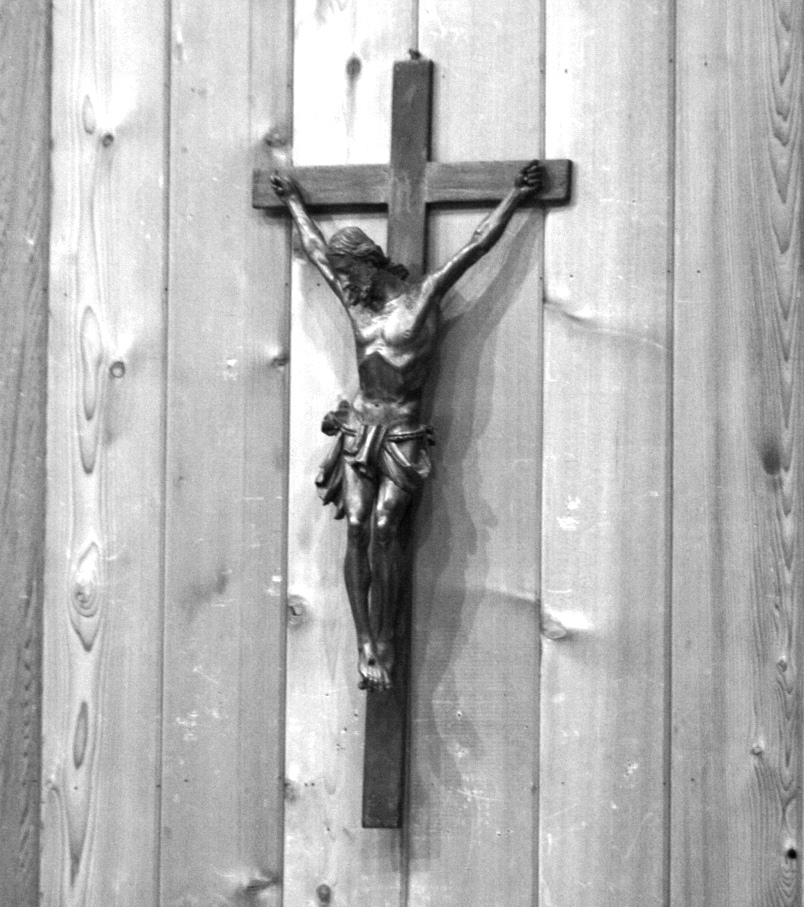
crucifix1At the abbey where I live, I preach at the Maundy Thursday liturgy and the Easter Vigil. I do not preach on Palm Sunday and Good Friday, the two liturgies where we chant the Passion. The Passion is long enough without added sermons and the Passion speaks for itself. That is, it speaks for itself as long as we don’t add things it does not say that undermine what the Passion does say.

To belabor what should be the obvious, the Passion Story tells us what human beings chose to do. Jesus chose to drive the money changers from the temple and teach the people there. The Jewish authorities chose to plot to have Jesus arrested and handed over to the Roman authorities. Judas chose to betray Jesus, thus facilitating the arrest and handing over. Pilate, to varying degrees in the four Gospels, vacillated but in the end chose to sentence Jesus to crucifixion. Meanwhile, the people who had cheered Jesus upon entering Jerusalem ended up crying for his crucifixion. The Roman centurions nailed Jesus to the cross where he died. The Passion narratives say nothing to suggest that anything that was done to Jesus, from the arrest to harassment and flogging to nailing him to the cross was in any way the will of God.

In all this, God does not do anything. Why do I bother to make a big point of this? The reason is that many Christians have suggested that God positively willed the sacrifice of Jesus for some cosmic purpose, usually because God was upset with wayward humans and was somehow incapable of forgiving humans unless somebody took the punishment for human sin. If Jesus, innocent of sin, should take the punishment, well and good. Well, not well and good. What kind of god demands punishment and doesn’t care who gets punished as long as somebody does? The Passion Story never says anything of the kind.

If God did not will Jesus’ violent death, what did God will? What was God’s plan? Jesus understood the heavenly Father’s plan to be that he Jesus knew that if he defeated Caiaphas and Pontius Pilate with force would only keep the world forever embroiled in retaliatory violence. The only way to avoid that was to gather people peacefully no matter the outcome, even if it meant death.

But Death, much as it was the plan of humans, was not God’s plan as a group of women found out early in the morning on the first day of the week.

See also Two Ways of Gathering


Crying out with Palm Branches in our Hands

AndrewPalmSunday1Jesus entered Jerusalem to the acclaim of crowds strewing branches before him and proclaiming him the king. A few days later, the same crowd gathered before Pilate to cry out for Jesus’ crucifixion. What happened?

Before answering this question, it is helpful to recall another crowd that went out into the desert to see John the Baptist. “What did you come out to see?” John asked them. “A reed blowing in the wind?” John suspects that people have come out in droves because people were coming out in droves. That is, it was the “in” thing to do. Fast forward a few months and we have a crowd at Herod’s palace supporting Salome’s request for John’s head on a dish. What did they come to see?

The post Ignominious Glory—Glorious Ignominy: a Doxology goes a long way in explaining this phenomenon. One can’t help but suspect that people are crying out because everybody else is crying out, no matter what the outcry is about. Advertising usually does not advertise the product but its alleged popularity. Political campaigns do the same thing. What would happen if people stopped to listen to what people were actually saying instead of crying out what they think everybody else is crying out?

It so happens that the Gospels do precisely this. The suggestion that the Gospels are Passion narratives with long introductions gives short shrift to what the Gospels are about. What these “long introductions” do is tell us at great length what Jesus actually said and what he taught. They also tell us what Jesus did before he was nailed to the cross, i.e. he healed people and cast out demons and he unilaterally forgave sins. These “long introductions” also tell us why the power brokers in Judea and Jerusalem wanted Jesus dead. By reading these “long introductions” to the Passion narrative, we are drawn away from crying out what everybody else is crying out and waving signs that only proclaim what the current fashion is believed to be. Instead, we are drawn into a very different social mimetic process, a process that builds up mutual respect between people, seeing people as they really are and as they really can become when they receive the unilateral forgiveness that Jesus gives them, a social process of not retaliating for wrongs done, a socially mimetic process of forgiving debts, of sharing what we can, of offering healing to others.

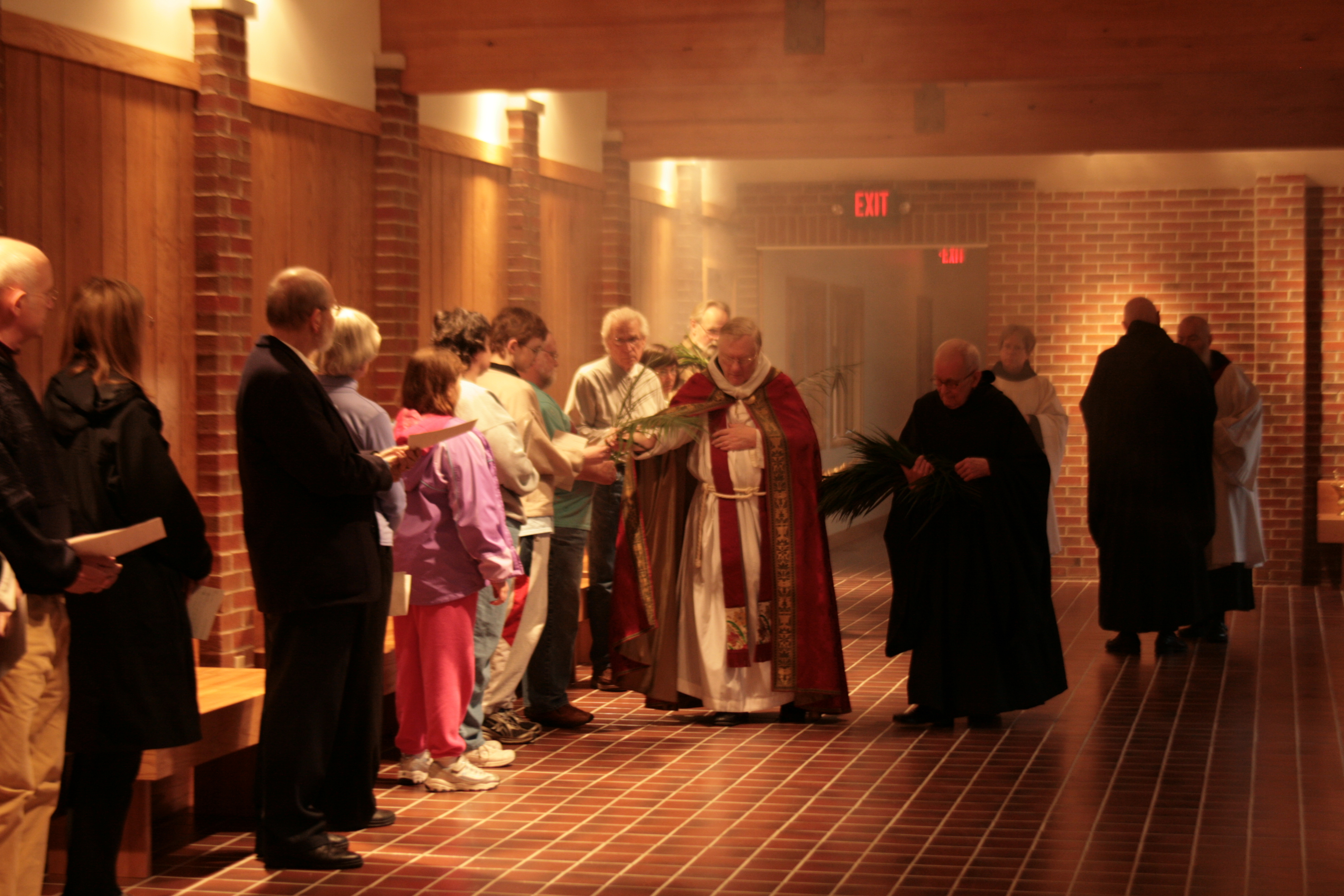
It is instructive that the Palm Sunday liturgy begins with everybody playing the part of the crowd welcoming Jesus with palms and then, a bit later, we hold these palms while acting the part of the crowd in crying out for Jesus’ death during the reading or chanting of the Passion. What we need to do afterward is return to the “long introductions” to see what the fuss was about and hopefully, hear the cock crow as did Peter.

I develop these ideas in my book Tools for Peace.

A Scandalous Woman as Extravagant as Jesus

churchDistanceBlossoms - CopyThe synoptic Gospels interlace Jesus’ disciples’ infighting as to who is the greatest with Jesus’ predictions that he will be handed over to the authorities to be crucified. The disciples consistently fail to understand or accept what Jesus is saying to them. Interestingly, the disciples suddenly come to an agreement when a woman enters the house of Simon the Leper in Bethany and pours an enormous amount of costly oil over Jesus. It is telling that it is a corporate condemnation of a marginal person that has united the disciples. To their chagrin, Jesus defends the woman, saying that she has prepared him for burial, precisely the destiny Jesus is facing and the disciples are denying. It is quite possible, however, that for Judas Iscariot, Jesus’ defense of the woman was the last straw. In both Gospels, Judas’ fateful interview with the chief priests follows immediately.

Curiously, Luke has a version of the same story that is detached from the passion narrative. That this woman had a bad name in the town suggests uneasiness with this woman and her extravagant actions. That she shamelessly washes Jesus’ feet with her tears doesn’t help matters. If the disciples were there, one wonders if they agreed with Simon in thinking that Jesus should have known that the woman was a sinner and therefore unworthy of offering such an extravagant gift.

John has a similar, but different account of the anointing of Jesus. The woman is Mary of Bethany and, far from being an intruder into somebody else’s house, she is herself the hostess along with her sister Martha. As in the Lucan story, Mary wipes Jesus’ feet with her hair. This time the gesture is all the more suggestive of things to come as John places the incident just before the Last Supper when Jesus of washes the feet of his disciples. This time, Judas alone objects to the waste. John goes on to say that Judas was upset, not because he cared for the poor, but because he wanted more money in the common treasury for him to steal. The question is: if the disciples unanimously censured the woman as they unanimously opposed Jesus’ predictions of his death, was Judas really the only betrayer? Chances are, Judas was saying out loud what the other disciples were thinking.

The parable of the Prodigal Father tells of the extravagant love of our heavenly father. Isaiah 43 proclaims God’s extravagant gesture of bringing God’s people through a desert overflowing with water. In Philippians, Paul insists that the cross and resurrection are so extravagant that all of his human qualifications are reduced to rubbish. Mary of Bethany shows the same extravagance, an extravagance that makes us uncomfortable to this day. This is the extravagance that embraces the cross and Jesus’ resurrected life and leads to truly caring about the poor and raising them up into a life of generosity for everyone.

The Prophet Between the Fox and the Hen

turkeys1We often think of a prophet as a person who speaks the word of God such as Elijah and Isaiah do, but Jesus gives us a deeper definition of what a prophet at the climax of his diatribe against the scribes and Pharisees in Mathew: “so that upon you may come all the righteous blood shed on earth, from the blood of righteous Abel to the blood of Zechariah son of Barachiah, whom  you murdered between the sanctuary and the altar.” (Mt. 23:35) Here, the prophet is one who says not a word but speaks the Word of God nonetheless in the sense that Abel’s blood cries from the ground.

This diatribe is often cited as a proof that Jesus, at least at times, was violent. It is worth noting, however, that Jesus didn’t shoot an automatic rifle at anybody; he spoke truth to presumptive power with a two-edged sword for a tongue. More importantly, these harsh words are followed by Jesus’ wish that he could gather his “children together as a hen gathers her brood under her wings.” Here we see very clearly the Two Ways of Gathering outlined in my blog post of that title.

In Luke, the lament over Jerusalem is put in a different, but similar, context. Warned by some Pharisees that Herod wants to kill him, Jesus calls him “that fox.” (Lk. 13:32) In preaching on this Lukan text, Prior Aelred here at St. Gregory’s, drew out the comparison of the fox and the hen. In the face of a threatening fox, Aelred suggested that Jesus might have been a better protector by being a tougher animal, such as the Lion of Judah. But no, Jesus assumed the role of a vulnerable hen gathering her chicks. Aelred went on to extoll Vicki Soto and her colleagues at Sandy Hook who covered as many of their small pupils with their bodies as they could to protect them, a contemporary embodiment of Christ the vulnerable, protective hen.

A fox scatters, while a hen gathers. What if Jesus had chosen to be a lion to deal with that fox Herod? It occurs to me that a lion would scatter all foxes who might threaten the chicks. Sort of like a superhero crushing the bad guys so that good guys like us can get on with our lives. Aelred noted that Jesus the Hen is not a popular image in Christian lore as is the Lion of Judah. The problem is, if Jesus the Hen gathers, then not only is Jesus the Hen trying to gather the scribes and Pharisees,  but Herod and his court as well, thus robbing us of more favorite enemies.

Outcasts at the Manger

altarXmasStar1We like to be insiders and hate to be outsiders, don’t we? Well, let’s look at some insiders and outsiders in the Christmas story. The people who stayed at the inn in Bethlehem were insiders. A betrothed couple and their newborn baby were outsiders. Shepherds were outsiders, hated and distrusted by all. So why would the angel of the Lord show such bad taste in revealing the birth of the Savior to them?

The Magi were highly-placed insiders in their own country, most likely top advisors of royalty. So why would they travel to another land where they were outsiders? If the star was up there for all to see, why did these foreigners from without and outcasts from within Jewish society respond when others did not?

The Magi, used to being insiders, went straight to the top, to the ultimate insider, King Herod, to inquire about which newborn child the star was indicating. Ironically, Herod was an Idumean, not a full-blooded Jew. He had power, but he was an outsider. Herod’s reaction to the Magi’s inquiry showed Herod to be an outsider to humanitarian feelings once he thought his power was threatened. Mixed racial background aside, being rich and powerful pushes one to the margins of society as much as the poverty of the despised shepherds.

These days, we easily see Herod as an outsider, an intrusive foreign element entering the story only to stir up trouble and grief. The shepherds and the Magi are insiders, like us. How did that happen?

There is a certain sleight of hand that turns us and certain chosen others into insiders when it suits us. Not only do we not wish to be outsiders, we don’t like to be challenged by outsiders. If we realize that the shepherds and Magi and the Holy Family themselves are outsiders, our identities are shaken at a deep level. If it is outsiders who appreciated the richness of the Christ Child, maybe the same thing happens today. After all, some nonbelievers care more about the poor than rich Christians and a Hindu early in the twentieth century believed in the Sermon on the Mount more than the Christians of his time.

The greatest irony is that Christ was born to save all people, to make insiders of all of us. The problem is, we don’t want to be insiders with those who are outsiders and we certainly don’t want outsiders to join us. After all, what would we do if there were no outsiders?