
Serving as Equals
1


John 3: 16: “God so loved the world that he gave his one and only son” seems to be almost everybody’s favorite Bible verse. I don’t mind being a non-conformist when called to be and I have been known to get a conceited pleasure out of being one, but this is among my favorite verses too. However, the very popularity and familiarity of the verse can perhaps dull us to its power to impact our lives.
I will work with what seems an innocuous question: What is the world that God loved enough to send the Son into it? The word kosmos in normal usage had a neutral connotation, meaning the world in general, the world that happens to be. This corresponds to normal usage in English. In John’s Gospel, however, the word has a highly negative connotation, closer to the negative connotations of “worldly,” only much stronger than that. Most New Testament scholars interpret the word as John uses it as “the world-against-God, the world in rebellion against God,” as I learned it in seminary. Curiously, much preaching on this particular verse, including my own, seems to make it an exception; thinking of the world in a neutral way. But what if this isn’t an exception? What does this verse look like then? What does the world hostile to God look like, and what kind of deity would want to get messed up with it?
The reading from Numbers gives us a snapshot of the world against God. One would think that their deliverance from Egypt would earn some gratitude on the part of the Israelites, but all they do is grumble angrily about the hardships in the wilderness. (Num. 21: 5) When attacked by poisonous snakes that image their poisonous behavior, they repent. That’s something, but they Israelites show a pattern of turning against God time and time again when things get tough. The snake Moses puts on a pole saves the people. This smacks of sympathetic magic but surely God is telling us something here. What we have is poison driving out poison. Many medicines operate on the same principle; the Greek word pharmakon from which we get the word “pharmacy” means both medicine and poison. Somehow, God uses the poison of rebellion to cure the rebellion, perhaps because the plague reveals the truth of the poison of their rebellion. Paul writes that to the Ephesians that they “followed the ways of the world”—using “world” in much the way John does—following the desires and thoughts of “the flesh.” (Eph. 2: 2–3) One could say they were deserving of wrath because they embodied it.
In the John’s Gospel, we see much of “the world” in the sense of the rebellious world. The debates between Jesus and the enemies John calls “The Jews” are very intense. Their accusations that Jesus is possessed of a demon when he offers them freedom from sin make them look demon-possessed themselves. (Jn. 8: 48) These debates make painful reading on account of their ferocious character. In contrast to the frenzied emotive outburst of rebellion in these debates, John also shows us the cold calculating style of rebellion. When Lazarus is raised from the dead, they react to the resurrected life with a plot to kill Lazarus as well as Jesus since people are following Jesus because of this resurrection. And then there is the cold calculation of Caiaphas who says that it is better that one man die for the people than that the whole people perish. (Jn. 11: 50) John seems to have no love for these enemies of Jesus. Surely God can have no love for them. John’s dramatic portrayal of their enmity tends to reinforce our own rejection of these enemies. But these enemies are the kosmos. They are the kosmos God loved deeply enough to send his beloved son into it.
Right before John declares this love on God’s part, Jesus alludes to the serpent in the desert: “Just as Moses lifted up the snake in the wilderness, so the Son of Man must be lifted up, that everyone who believes may have eternal life in him.” (Jn. 3: 14–15) Jesus has turned this unsettling and cryptic gesture into a prophecy. The poison of rebellion on the part of Jesus’ enemies leads to Jesus being raised on a cross and the poison of this rebellion becomes the cure for the very same rebellion. In Ephesians, Paul, who himself had been a rebellious enemy of Jesus, experiences this very same love that motivated God to give God’s only begotten Son to make him, and us, who were dead in transgressions, alive in Christ. Not only alive, but raised up with Christ and seated with him in the heavenly realms. (Eph. 2: 4–6)
All of this sounds great–and it is beyond great–but John warns us of the judgment that the Light came into the world and we preferred darkness to light. (Jn. 3: 19 ) As the kosmos works to protect its rebellion to this blinding light, it falls into blinding darkness. How? If we slip into the default neutral understanding of “world” in the great verse proclaiming God’s love, we think this “world” is us—the good guys, and the world in rebellion is some other world—the bad guys who rebelled against Jesus. Paul had no illusions of this sort after his Damascus experience. But do we see the truth of our own grumbling in the deserts in life? Do we see ourselves as part of the kosmos Jesus loves in spite of our rebellion? Asking ourselves these questions as honestly as we can is a fundamental Lenten practice. Further on in Ephesians, Paul stresses that Christ’s raising us to His life has destroyed the barrier that had polarized Jew and Gentile–the ultimate embodiment of an us vs. them spirituality in Paul’s day. If we think this love is intended for us and not for them, we have fallen deeply into the darkness, preferring it to the Light that came into the world. Being among those who believe and have eternal life, then, is not a mental act of thinking something is true; it is about opening our eyes to the light, letting that light blind us, and then stumbling in the light instead of in the dark. It is this bumbling and stumbling that leads into the quality of life that is eternal life where there are many rooms in the Father’s house. (Jn. 14: 2)

When Jesus speaks of himself as a shepherd, he says that the sheep “hear his voice” and they follow him because they “know his voice.” (Jn. 10: 3-4) Interestingly, although this seems fairly straightforward, John says that his listeners “did not understand what he was saying to them.” (Jn. 10: 6) We get an important clue as to the problem if we note that Jesus is speaking to the same people who had taken umbrage at his healing of the man born blind, people who said they could see when they really couldn’t. It is not surprising if these people were hard of hearing as well.
Thinking of hearing the “voice” of the shepherd reminds me of one of the anecdotes told by Oliver Sachs in one of his books about neurological patients. A group of patients recovering from strokes were listening to the speech by a president (several years past now). Most of them were laughing although they could not understand a word of it as they were suffering from aphasia. They were laughing because they knew the president was lying. It seems that undistracted by any intelligibility of the words, they could sense the tone of the voice with great clarity. One woman had the opposite problem. She could not hear the inflections but she could understand the words. Undistracted by the inflection, she knew that the words were incoherent.
Many times, Sachs demonstrates that we learn how the brain works through various malfunctions. Normally, hearing the content and the inflection is one seamless phenomenon but the separation caused by events such as a stroke show that each is done by a separate part of the brain. Although the two functions are distinct, and there are advantages to noting the distinction, we want them to work well together. In some ways, the distinction between the two helps us use them well together.
This suggests that there are two dimensions to the art of hearing the voice of Jesus the Good Shepherd. There is the intelligible content, but there is also the intonation, the way the voice modulates and sounds in the heart. Let us start with the image of the shepherd that references many passages in the Hebrew Bible. There is David, who fought lions and bears to save his sheep, Psalm 23 where the Lord as shepherd guides us through the dark valley, and most of all, Yahweh as the true shepherd in Ezekiel 34 who cares for his sheep. We have the content, then, of caring, and the intonation would also need to convey the same degree of caring, even self-risking and self-sacrificial caring. Maybe the other lections can give us more guidance.
The image of the shepherd does not appear in the vision of the early church in Acts 2, but this vision shows each member caring for all the others, giving of their own substance to those who have need. The tone of voice of caring is matched by actions of caring. In a sense, each member is a shepherd for all the others.
In First Peter, we have the theme of caring taken to extremes. The suffering Christ is the touchstone for how each of us should suffer injustice. It is not mere meekness, for it takes great courage to endure such suffering and shame when one has the power to retaliate and gain the upper hand, something Jesus did not do. In John’s Gospel, this self-sacrificial style of being the shepherd is set up at the beginning when John the Baptist calls Jesus “the Lamb of God.” At the end of John’s Gospel, Jesus asks Peter three times if he loves him and when Peter says yes he loves Jesus, Jesus says “Feed my lambs.” In Revelation, Jesus is again the Lamb slain since the foundation of the world. Jesus, then, leads the sheep as the sacrificial lamb, rather than as the sacrificer, something even King David turned out to be in the case of Uriah the Hittite. Again, the tone of voice and the action must coincide with this sense of self-giving.
Edifying and powerful as the passage in First Peter is, there is a disturbing element here. In the verse immediately preceding this passage, Peter admonishes slaves to obey their masters. Does this passage, then, condone slavery? Here is a test case for tone of voice and content. A master may well consider himself a shepherd of his slaves, but what kind of shepherd would such a master be? Does such a master share of his material substance the way that they early Christians in Acts are said to have done? If a master acted in this way, could he even really be a master? Does a master sacrifice himself on behalf of the slave as Jesus sacrificed himself for his sheep? On the contrary, doesn’t the master expect the slaves to sacrifice their lives for his sake? A master who talks a good game of caring for his slaves would come across like the president whom the aphasic patients knew was lying, and the content of his words would be fundamentally incoherent unless he really acted like the Lamb of God, in which case, he would be the slave and the slave would be free. It needs to be noted that it is a lot easier to see this passage in First Peter in this way than it was when the letter was penned or in the US before 1865. That is to say, social pressures can drown out the voice of the shepherd when he calls to us and tries to lead us in new paths.
Perhaps these thoughts can help give us a sense of Jesus’ voice and help us recognize the voice of Jesus in the words and tone of speech of those who speak to us. And perhaps these thoughts, too, can help us speak with the tone of voice of one who will follow the Lamb of God wherever he goes. And if we do try to speak in this way, let us be honest if we halt and waver. After all, Jesus halted and wavered at Gethsemane. Being a Lamb of God is not a challenge to take lightly.

Often my father would say: “I see, said the blind man.” He wasn’t making fun of blind people; he wasn’t the kind of person. But he was indicating that he understood something conceptually. It is this same kind of seeing that is at work in the story of Jesus’ healing of the man born blind in John’s Gospel.
I recently came across a story out of the sixth century Gaza monastic tradition that offers a profound commentary on this Gospel narrative. A monk had developed a profound hatred of a fellow monk and decided he would find a way to get this fellow monk into trouble. Since the fellow monk was a bad monk, he was obviously guilty of something, so getting him into trouble should be no trouble at all.
This hateful monk kept a sharp eye out for anything his hated fellow monk did wrong and–sure enough!–he saw this fellow monk wandering among the fig trees, picking figs, and eating them. This sort of gluttony was most unbefitting a monk! He ran straight away to the abbot and told him what he had seen.
The monk’s vengeful glee did not last long. The abbot informed the monk that he had sent the slandered monk off on an errand for the monastery and there was no chance that he was eating figs at the time when the vengeful monk saw–or thought he saw–him doing that. The vengeful monk was proven to have been seriously deluded and was shamed before the community for his slanderous accusation.
In the world view of the sixth century monastics, the illusion was caused by demons and the story was told to warn monastics of the tendency of demons to cause such illusions. What we can see easily enough today, just as the sixth-century monastics could, is that it was hatred on the part of the monk that inspired the demons to give him such an illusory sight. The monk thought he could see, but was blinded by his own hatred. We see much the same dynamic at work in the Gospel story: the accusatory “Jews” thought they could see but were blinded by their hatred of Jesus and, by extension, of the man Jesus had healed. The formerly blind man loved Jesus for what Jesus had done and could see clearly at all levels. Imagine what this vengeful monk could have seen if he had loved his follow monk! Did he learn to see after this incident as God meant him to see?
 The Good Shepherd is a reassuring image. The shepherd is in charge and the sheep follow the shepherd’s guidance. When thieves and robbers and wolves come to threaten the sheep, the shepherd deals with them in no uncertain terms. Jesus’ claim to be the gate, the way in and out of the fold, gives us another reassuring image: some of us are in and certain other people are out, just the way it should be.
But in my reflections on John 10 from a year ago, I noted that the Good Shepherd is the Lamb of God who lays down his life for the sheep. With this realization, the hierarchical picture breaks down. The Good Shepherd is not above the sheep but is one of the sheep. Whereas even the most compassionate and conscientious shepherds end up eating or sacrificing the sheep, Jesus shares the fate of the sheep by becoming the Paschal Lamb in place of the sheep.
The Lamb of God is also an odd gate. Rather than keeping the lambs inside, he leads the lambs in and out with so much movement that the idea of there being a gated sheepfold ceases to make sense. Rather than keeping the bandits and robbers away, Jesus lays down his life for the flock when the bandits attack. If Jesus is the gate, than his willingness to lay down his life is the way in to this abundant pasture for all who would join his flock.
In an essay on the Eucharistic Christ, James Alison explores these paradoxes with great insight. After taking us through stages where we fixate on the bad shepherds and feel righteous about identifying and hating them, Alison takes us to a stage where the fixations fall away:
There is no definitive inside and outside for the Good Shepherd, there are places of shelter and of feeding, different places to which the door gives access, and which presuppose movement, non-fixity, and confidence in being neither in nor out. It is assumed that the best feeding place might not be one that seems to be “in,” yet the good shepherd is able to make that place available to his sheep.
The mixup that Alison envisages reaches the point where we are all sheep and all wolves, not in a negative sense where each of us supposedly good people find the wolf within, but rather a recreation of abundant life where nobody needs to be a sheep who is devoured or sacrificed or a wolf who does the devouring and sacrificing. This is where our baptism into the death of Jesus leads us further into the abundant life of Jesus.
It is in the space of this abundant life that we hear the true voice of the Good Shepherd as the Lamb of God, which Alison suggests is the still small voice that Elijah heard in the wilderness. When we hear this still small voice, the strident voices of bandits are drowned out and our own voices can take on the same stillness that others need to hear.

“I came into this world for judgment so that those who do not see may see, and those who do see may become blind.” (Jn. 9: 39)
This is one of the harder of the hard sayings of Jesus. It suggests that if we can see, we really can’t and if we can’t see, then actually we can. In the story of Jesus’ healing of the blind man in John 9, the blind man sees pretty well in many ways even while he is still blind whereas the “Jews” prove to be blind as to what is really happening right before their eyes. The overt irony throughout the narrative makes it clear that physical sight is symbolic of the ability to see at other levels. We say “I see” all the time to indicate that we have understood something.
The trouble is that most of us think we can see very well at this figurative level. That is, we think our worldviews are correct, or at least mostly so. Jesus’ admonition should make us stop and think about that. If we are sure that we see, we are actually being pretty sure about ourselves, which gives us a pretty good chance, amounting to a certainty, that what we think we see is wrong, at least in important respects. So how can we truly see?
I think we are helped by the famous admonition from the Sermon on the Mount: “Do not judge, so that you may not be judged. For with the judgment you make you will be judged, and the measure you give will be the measure you get. Why do you see the speck in your neighbor’s eye, but do not notice the log in your own eye?” (Mt. 7: 1–3) Jesus makes it quite clear that judging other people automatically blinds us severely. This fits exactly with the story of the blind man in John. The assumption on the part of the disciples that either the blind man or his parents had sinned makes them blind on account of the judgmental attitude. The “Jews” are highly judgmental of the blind man for letting himself be healed on the Sabbath and all the more judgmental when the formerly blind man doesn’t see things their way when they explain the matter to him.
The problem now is that I am getting a bit judgmental about “the Jews.” Jesus has exposed their blindness and since I can see that, I assume I can see. But if I can see what “the Jews” don’t see, then there is the possibility, I mean likelihood, that I am becoming blind. I am seeing the speck in the eyes of “the Jews” and not seeing the log in my own. This blindness is quite serious when I reflect on the centuries of persecution of the Jewish people with stories like this present one being a pretext for that.
If we really want to see, we have to really understand that judgmentalism is our favorite blood sport and it really can be bloody in a literal sense. If I see a speck in somebody’s eye, that speck is probably there, but seeing the speck should be fair warning of the log in my own eye. We need to take Jesus’ advice and go to Siloam to wash the log out of our own eyes. If we do that, we will be much less judgmental and a lot gentler about helping other people with the specks in their eyes.
See also: Seeing with more than the Eyes and Sight and Vision Recreated.
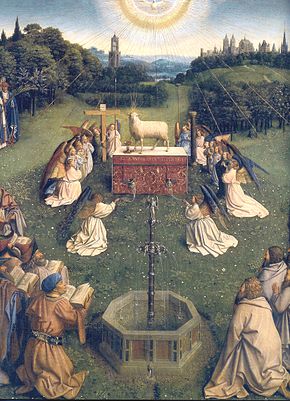 We usually understand a shepherd to be one who leads a flock of sheep and protects it from harm. But in Revelation, the author proclaims “the Lamb at the center of the throne” to be the shepherd of the multitude of worshipers from all nations. The worshipers are praising this Lamb whom they follow and the Lamb “will guide them to springs of the water of life.” (Rev. 7: 17) Their white robes have been made white in the blood of this Lamb because the Lamb has lead his followers through the ordeal. This is an odd sort of shepherd since normally it is the job of the shepherd to protect the flock from danger, not lead the flock into it.
In John 10, often referred to as the Good Shepherd Discourse, Jesus claims that he is the true shepherd who protects his sheep, even to the extent of laying his life down for his sheep. (Jn. 10: 11) Jesus is not only the leader, but he is the gateway into the fold, the only gateway safe from thieves who come to destroy. When Jesus says: “My sheep hear my voice. I know them, and they follow me,” (Jn. 10: 27) he is attesting to a much more intimate relationship between himself and the sheep than is usually the case. As the Good Shepherd, Jesus is not just leading us, his flock, externally by walking in front of us, Jesus is leading us from within, speaking in a voice that we learn to hear as quite distinct from bandits and robbers who come to destroy or hired hands who run away when there is danger.
Early in John’s Gospel, John the Baptist points to Jesus and calls him “the Lamb of God.” The reason that the sheep hear their shepherd’s voice and recognize it intimately is because their shepherd is a lamb, one of them. As the Lamb of God, Jesus protects his sheep from being snatched out of his hand. (Jn. 10: 28) But what does the Lamb of God protect the sheep from? We were not protected from bandits and robbers any more than the martyrs in white robes were protected from the ordeal. What the Lamb of God protects us from is being or becoming bandits and robbers. That is, we are protected from being people who shed the blood in which the white robes of the martyrs are washed. Most important, it is precisely by being the Lamb of God that this shepherd does not attack robbers and thieves with the violence they impose on him, but instead he lays down his life, not only for those of us in the sheepfold, but for those who attack him and the flock. This raises the question: In protecting us from becoming bandits and robbers, is Jesus laying down his life to turn those of us who have become bandits and robbers from what we have become? If the Lamb of God died for sinners as St. Paul claimed many times, then that is exactly what he has done and that is why, in following the Lamb of God as our shepherd, we do the same, secure in the sheepfold of our shepherd with the multitudes from every nation.
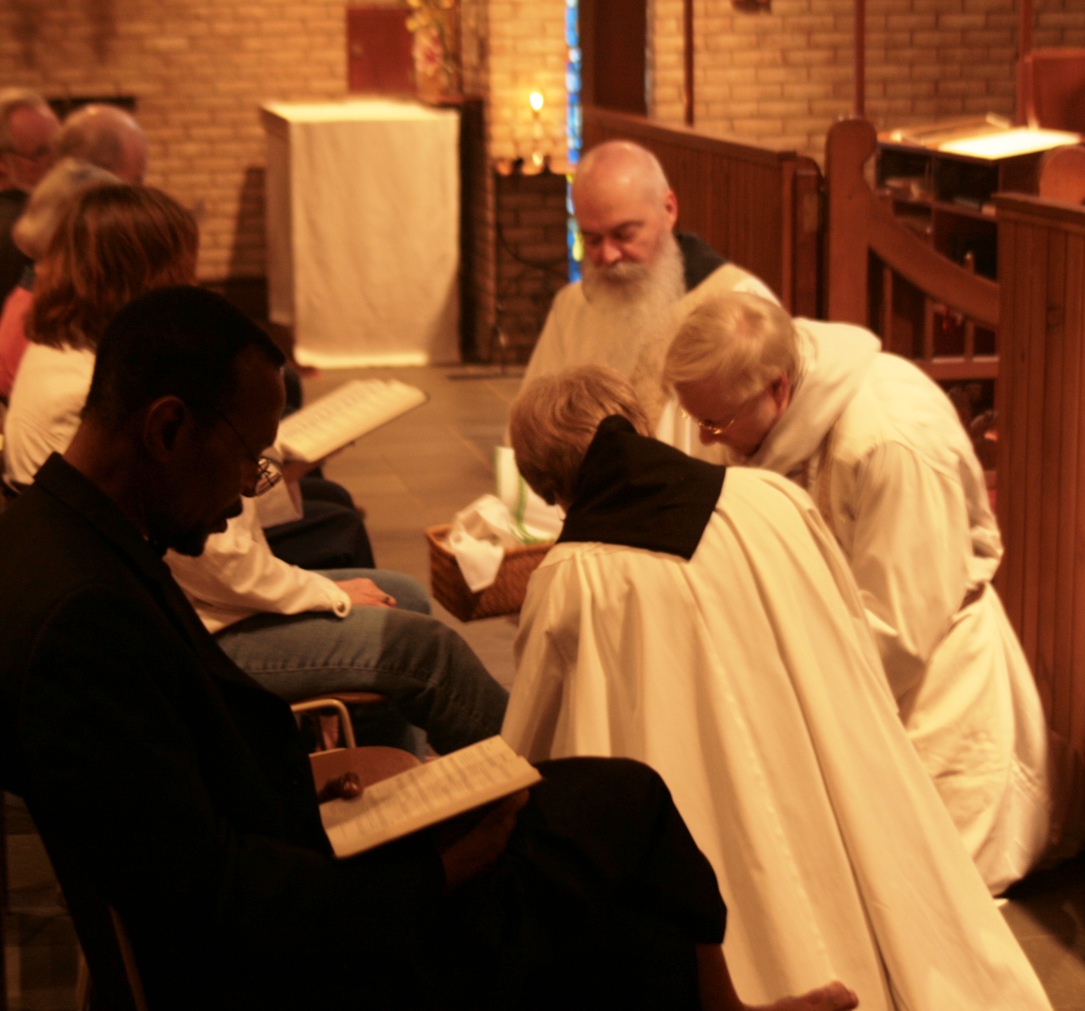 Probably nothing is more painful than betrayal. My own personal experiences of feeling betrayed are, so far, much smaller than what I know others have suffered, but even the smallest doses of betrayal are unspeakably painful. The pain of betrayal is a pounding discord in the Gospel narratives of Jesus’ Last Supper and Paul’s own short narrative of it. This discord is particularly prominent to the point of being unbearable in John’s Gospel where it overshadows Jesus’ loving act of washing the disciples’s feet. Right after leading into the story with these sublime words: “Having loved his own who were in the world, he loved them to the end,” (Jn. 13: 1) John says: “The devil had already put it into the heart of Judas son of Simon Iscariot to betray him.” (Jn. 13: 2) When Judas leaves the supper, John says “And it was night,” (Jn. 13: 30), meaning “night” in all of its most ominous meanings. Right after Judas’s departure, Jesus gives his disciples his great “new” commandment: “Love one another. Just as I have loved you, you also should love one another.” (Jn. 13: 34)
Does this new commandment cancel the night into which Judas has just walked? Or does the night cancel the light of the commandment? Hatred for Judas has echoed through the centuries with betrayers often called a “Judas.” So commonly is this epithet used that it can be hurled at a person for playing an electric guitar instead of an acoustic one, as Bob Dylan found out. The raging pain of Judas’s betrayal occasions several outbursts in the responses of the Tenebrae services of Holy Week. Most chilling is the “Judas mercator:” “Judas, the worst possible merchant, asked to kiss the Lord.” In the powerful setting by Tomas Victoria, the pain is unbearably searing. Where is the love we are supposed to have for one another? Even in the glory-filled High Priestly prayer of John 17, Jesus says he has guarded the ones entrusted to him “except the one destined to be lost.” (Jn. 17: 12) I feel those words as a shadow in the prayer of glory. The author of 1 John reaffirms this great commandment and insists that God is light with no darkness at all, (1 Jn. 1: 5) but then rages with the hurt received from several “antichrists”who have betrayed the community by going out from them. (1 Jn. 2: 19–20)
There have been attempts to vindicate Judas. One of the more thought-provoking attempts comes in Kazantzakis’s Last Temptation of Christ where Jesus entreats Judas to betray him because it is necessary that he be crucified. Kazantzakis appeals to the reader’s sympathy for the two millennia of opprobrium Judas has suffered for doing what his best friend asked him to do. I fear, though, that the paradoxes of John’s Gospel do not give us this out. We have to face the pain of the betrayal. This pain is all the greater and hits closest to home when we realize that all of Jesus’ disciples betrayed him except “the Beloved Disciple” in John’s account. This suggests that, like Judas, we are all betrayers of Jesus. This doesn’t make Judas right; it makes us as wrong as Judas. Would it have been better if none of us had been born? Our hatred of Judas distracts us from the truth of ourselves. Accusations of betraying Jesus fly between Christians, each convinced that it is other people who have betrayed Jesus while each of us is as faithful as the Beloved Disciple. I have my own list of traitors of Jesus that tempts me to dwell on them more than on myself.
John takes us into the “night” into which Judas walked because this is the night into which Jesus himself walked when he carried the cross to Golgotha and was crucified there because he had been handed over multiple times by the time he reached that destination. Does Jesus’ commandment to love one another as he has loved us extend to everybody who handed Jesus over to the next step towards the cross? Does it apply to each of us when we betray Jesus by disobeying this commandment? Does it apply to Judas? After Jesus’ Ascension, Peter announced that the gap left by Judas had to be filled and Matthias was chosen by lot to make the disciples twelve once more. (Acts 1: 21–26) Does Mathias rub Judas out, or does Mathias redeem Judas in a mysterious way by taking his place so that the Twelve Apostles can be the twelve tribes of a New Israel that embraces everybody? Does the Light shine in the darkness so powerfully that the darkness cannot overcome it, (Jn. 1: 5) not even the darkness into which Judas walked?
 Eating is among the most fundamental activities of civilization, perhaps the most fundamental. It is the practice that brings people together to share in nourishment and social nurturing. And yet, throughout the animal kingdom, sustenance requires feeding on other living beings. Sometimes it is other animals, sometime plants. That is, a group bonding through eating inevitably bonds at the expense of other living beings.
The Christian Eucharist builds on the social bonding with its celebration of a meal that binds people together. Being bound up with the sacrifice of Jesus on the cross, a sacrifice made so that all other people may live, it is a meal of human sacrifice. Yet it is made a bloodless sacrifice by the serving of bread and wine that in some mysterious way are identified with the body and blood of Jesus, thus sanitizing the Eucharist of the violence in the story that is told in the breaking of the bread.
Jesus’ strange words in his long monolog that follows the feeding in the wilderness connects this feeding with the Eucharist in words that are both comforting in that they promise a deep union with Jesus, but disturbing by thrusting the violence of Jesus’ death in our faces. English translations inevitably lose much of the force of the words as there is no English word that catches the connotations of trogein.“Gnaw” comes closest but even that is not strong enough. The German word fressen, which refers to the eating of non-human animals, comes much closer. When I used the word flippantly in conversation with a German acquaintance, his reaction was very strong, about as strong as our reaction to Jesus’ words ought to be. Which is precisely the way “the Jews” react to Jesus’ words.
In reply to “the Jews’s” anger, Jesus promises that his flesh and blood are “real food” and “real drink” without which we have no life in us. Jesus goes on to make the even more audacious claim that his body and blood do not nourish us as meat and vegetables nourish us. Such nourishment is not lasting and needs to be renewed by further eating and drinking as the manna God fed the Israelites in the desert needed to be re-gathered every day. But Jesus’ own flesh and blood feeds us in such a way that we will live forever.
If Jesus can be our food in a way that sustains us everlastingly, then his own life must also be constantly renewed. This is the claim he makes when he says that he abides in his Father and his Father abides in him. This amounts to the astounding claim that it is possible to be nourished in a way that it is not at the expense of any living being. How can this be?
Since Jesus’ promise of everlasting nourishment is tied so closely to his painful death, we might get some understanding by looking at sacrifice. Sacrifice is closely tied to eating. Deities feed on animals or vegetation, or at least the aroma of them, and the sacrificers usually eat the food that was sacrificed. The Passover lamb is sacrificed both to spare the Israelites from the plague that strikes the first-born of Egypt and a sacrifice to physical hunger, and thus a source of nourishment as well. Sacrifices need to be repeated, as the author of Hebrews says. (Heb. 7: 27; 9: 6) In his sacrificial death, Jesus has obtained “eternal redemption.” (Heb. 9: 12) Thus, this author is making the same claim on behalf of Jesus that Jesus is making in John’s Gospel.
René Girard is helpful here. His thesis that civilization is founded on sacrifice and thus needs to be fueled by repetition of the same alerts us to the ongoing “nourishment” civilization receives through the periodic deaths of victims. One sacrifice lasts only for so long and then social tensions require another. Caiaphas intended Jesus’s death to be such a life-giving sacrifice for the people, (Jn. 12: 50–52) but Caiaphas got more than he bargained for. Jesus was raised from the dead and so became empowered to continually offer his life for others while no longer being subject to death himself. This is how Girard would have us understand the Church’s claim that Jesus’ sacrifice is the final sacrifice. There is no longer a need for sacrificial victims because the way has been opened for us to be everlastingly nourished by the life that was given once for all.
The death and resurrection of Christ, then, are a pledge of the heavenly banquet where we will be nourished without need of taking any life, not even that of plants, but in this life, we still need to eat living beings of some sort. Even Lady Wisdom has to slaughter animals for her banquet. What we can do is let Christ nourish us deeply in the here and now so that we do not need to sacrifice other people as we are prone to do, but rather will feed others in anticipation of the heavenly banquet.
 The Trinity is a fundamental doctrine for Christianity but Christianity is a story of salvation before it is a set of doctrines. The Trinity is no exception. If we get the story right, we might get the doctrine right, but if we get the story wrong, then we get the doctrine wrong for sure.
John 3 tells of Nicodemus coming to see Jesus at night, suggesting he is in the dark. Jesus’ words to Nicodemus: “Very truly, I tell you, no one can see the kingdom of God without being born from above,” (Jn. 3:3) don’t seem to follow from what Nicodemus has just said. It sounds like the answer to a question that was not asked. Is there an implied question to what Nicodemus did say? The only implied question I can pick up is: “How do I do the signs that you do?” If so, Jesus is saying that Nicodemus is asking the wrong question. Jesus says first that Nicodemus must be born again, or born from above, most likely both. Jesus “clarifies” the matter by saying that Nicodemus must be “born of the Spirit,” which is a problem since, like the wind, nobody knows “where it comes from or where it goes..” (Jn. 3: 8) Here, one Person of the Trinity enters into this story.
So far, Nicodemus is showing difficulty in knowing what he really wants, further indicating that he is in the dark. We are tempted to laugh at him for his obtuseness, but we would do well to ask ourselves if we really know what we want? So asking ourselves inserts us into the story where all of us are in the same pickle as Nicodemus, which is to say, we are all in the dark. René Girard is helpful here when he suggests that all of us don’t know what we want and so we all look to other people to show us what we want. That is, if we see (rightly or wrongly) other people wanting something, we tend to want it too. Girard also gives us the insight that since none of us knows what we really want, we end up in a social muddle that is fraught with conflict. In Romans, Paul tells us that “all who are led by the Spirit of God are children of God.” (Rom. 8: 14) So, even though we don’t know what we want we can be born anew, from above, into the Kingdom if we let this Spirit, whom we can’t understand or grasp, lead us.
Then, in another non sequitur, Jesus tells us a mini-story: “No one has ascended into heaven except the one who descended from heaven, the Son of Man.” (Jn. 3: 13) While Nicodemus and the rest of us have been thinking of rising above our humanity, Jesus has come down to take on our humanity and only then did he rise back up to heaven. So, trying to do the signs that Jesus did by some human technique is bound to fail and will keep us in the dark. But Jesus then retells a mysterious story in Numbers as a variant of the first story. During a medical and social crisis of plague in the wilderness, the sort of crisis Girard warns us will happen when we don’t know what we want, Moses was instructed to raise a bronze serpent so that any who look upon it are healed. Jesus is now claiming that he is the “bronze serpent” raised up on the cross. Raising Jesus on the cross is the result of our muddle over not knowing what we want and falling into violence as did the Jews in the desert. Yet looking at Jesus on the cross to the point of really seeing what we have done offers us a cure of our violence. Not only that, but so looking at Jesus will give us eternal life. In John, this phrase does not refer primarily to life after death but to the quality of life here and now (and presumably after death as well.) Being cured of our violence certainly is a way to an improved quality of life. This is the way of being born again, from above, of being children of God. Once born from above, our desires become much clearer and they are focused on the well-being of other people. More important, after coming down from heaven, Jesus did not return there until after he was raised up on the cross. What is above and what is below has gotten thoroughly turned around. We now have two members of the Trinity in our story.
Then Jesus briefly tells the same story in a different way: “For God so loved the world that he gave his only Son, so that everyone who believes in him may not perish but may have eternal life.” (Jn. 3: 16) Jesus was not sent to condemn the world, although there was much to condemn, but Jesus was sent so that the world might be saved through him. Paul says that the Holy Spirit cries out within us: “Abba! Father!” This exclamation makes us joint heirs with Christ if we allow our desires to be formed by the Desire that flows through all three persons of the Trinity.
When presented as just a doctrine, the Trinity looks like an mutual admiration society of three. When presented as a story, the Trinity is a union of three persons dedicated to creating and re-creating humanity and all creation.
 Imaginary Visions of True Peace