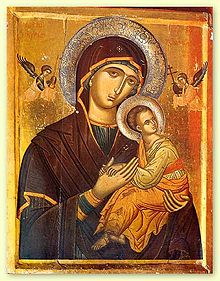
Few words of Mary, the Mother of Our Lord, are recorded in scripture. Among these few words, the most momentous are: “Let it be to me according to your word.” With these words, Mary accepted the conception of the Christ Child in her womb. It is a deep wonder that God, the Master of the Universe, would deign to be dependent on a human being in order to enter the world. It is this same deep wonder that God continues to depend on us to let the Christ Child continue to be born and live in the world that God has made.
In his poem The Blessed Virgin compared to the Air we Breathe, Gerard Manley Hopkins explores this mystery among many others with these lines:
Of her flesh he took flesh: He does take fresh and fresh, Though much the mystery how, Not flesh but spirit now And makes, O marvellous! New Nazareths in us, Where she shall yet conceive Him, morning, noon, and eve; New Bethlems, and he born There, evening, noon, and morn Bethlem or Nazareth, Men here may draw like breath More Christ and baffle death; Who, born so, comes to be New self and nobler me In each one and each one More makes, when all is done, Both God’s and Mary’s Son.
Note that Hopkins is telling us that saying Yes to God is not something done once and for all; saying Yes is something that must be said time and time again, every day, every hour, without ceasing. The New Self, the nobler us takes time.
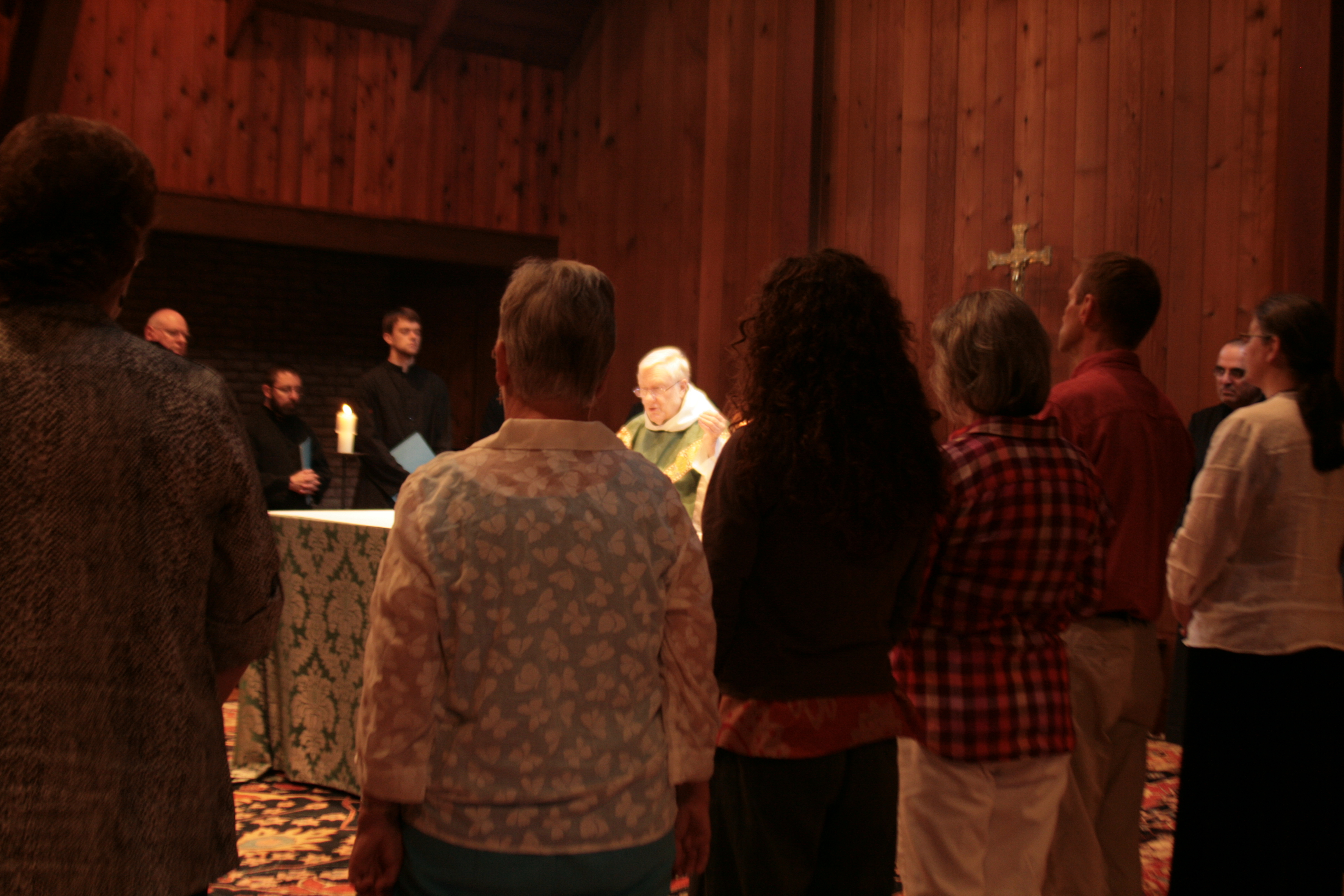
The Eucharist makes present the death and Resurrection of Jesus at each celebration, regardless of the occasion. So it is that we don’t even celebrate the birth of Jesus without celebrating his death as well. But in commemorating the Last Supper of Jesus, the Eucharist on Maundy Thursday is particularly close to the Passion, being the meal during which Jesus was suffering the anxiety he was soon to express at Gethsemane.
While reflecting on this matter, I came across a few lines on this very theme by Gerard Manley Hopkins, one of my favorite poets. They made up an epigraph of a chapter in Brian Zahnd’s new book The Wood Between the Worlds,” a powerful meditation on the Cross, Not only was I moved by the lines, but I was surprised to come across some lines by Hopkins that I didn’t recognize since I thought I had studied all of his poems multiple times. That little mystery was solved when I found out that it is an early work, one written while still a student at Oriel College in Oxford, and still an Anglican. So it is only included in the most complete collections of his works. I might have read it before without it registering, but the few lines singled out in Zahnd’s book really caught my attention, as I’ve said.
The poem is called “Barnfloor and Winepress” and it pulls together the Passion of Jesus and the Eucharist into an inextricable knot, making it most appropriate for Maundy Thursday. With wrenching, sometimes violent imagery embodied in hard sounds that put Hopkins, even in this early work, decades ahead of his time, the poem provides a powerful example of how the ugliness of Jesus’ crucifixion permanently affected the aesthetic possibilities in all of the fine arts as the ugliness is sublated in the moral beauty of Jesus’ self-sacrifice and his vindication in the Resurrection. The first stanza includes these lines that use the Eucharistic imagery of the making of bread:
Thou that on sin’s wages starvest, Behold we have the joy in harvest: For us was gather’d the first fruits, For us was lifted from the roots, Sheaved in cruel bands, bruised sore, Scourged upon the threshing-floor; Where the upper mill-stone roof’d His head, At morn we found the heavenly Bread, And, on a thousand altars laid, Christ our Sacrifice is made!
And in the second stanza, lines using grape and wine imagery to the same effect:
Thou whose dry plot for moisture gapes, We shout with them that tread the grapes: For us the Vine was fenced with thorn, Five ways the precious branches torn; Terrible fruit was on the tree In the acre of Gethsemane; For us by Calvary’s distress The wine was racked from the press; Now in our altar-vessels stored Is the sweet Vintage of our Lord.
We have in these powerful stanzas a kind of transubstantiation, not only of the Eucharistic elements that Hopkins was clearly believing in as a high-church Anglican, but a transubstantiation of the suffering of Christ into the Eucharistic elements. The violent human sacrifices throughout human history, both before Christ and after Christ up to the present day, are transmuted into the bloodless sacrifice on the altar. (The phrase “terrible fruit” reminds me of Billy Holiday’s “Strange Fruit.”) No wonder Brian Zahnd refers to this poem in a chapter that argues that the crucifixion of Jesus is the ultimate center of human history. Even while humans continue to commit the same old same old violence as we see most painfully in Ukraine and Gaza right now, God has transformed all of it for all time. Hopkins expresses this insight in poetry:
In Joseph’s garden they threw by The riv’n Vine, leafless, lifeless, dry: On Easter morn the Tree was forth, In forty days reach’d heaven from earth; Soon the whole world is overspread; Ye weary, come into the shade.
And then the profoundest transubstantiation of all: the transubstantiation of us into partricipation in the divine nature, one not untouched by the sufferings of Christ supporting our own:
The field where He has planted us Shall shake her fruit as Libanus, When He has sheaved us in His sheaf, When He has made us bear his leaf. – We scarcely call that banquet food, But even our Saviour’s and our blood, We are so grafted on His wood.
It is a source of insight that the word “glamor” normally refers to a pleasing quality, one that makes the rich and famous rich and famous, but it can also mean a spell that exerts power over other people. When we think of a Hollywood actress as glamorous, we think that is a good thing, but such an actress does tend to put a spell on those devoted to her. Such careers are considered glorious, also a good thing. The word “glory” has a rich ambiguity in biblical studies. When we read the word “glory” in scripture, especially as an attribute of God, we think it means something wonderful, and sometimes it does. But the Greek word doxa can mean the opposite: disgrace. As James Alison said in one of his writings, doxa actually means “reputation.” A reputation can be good or bad. When applied to humans, glory, doxa, is associated with human glory that tends to be violent, for example a victor in war. That was the kind of glory that Roman emperors strove for and often got. If we find life dull or downright oppressive, then we crave for some glamor and glory. We want to be bespelled by someone glamorous. The glory of a victory parade for a victorious football team makes life exciting and well, glorious. For the winners anyway. Not so much for the losers.
I have come to see that these concepts of glamor and glory were instilled in me before I had any way of knowing it was happening. They were two of many filters that informed my reactions to life and still do as reflex reactions. It is unavoidable that such a thing should happen to me and everybody else. Humans are cultural animals and that means we get cultured. Becoming aware of how we are cultured and then trying to change the culture when that is desirable, is a an important challenge. René Girard, gave us much insight into this phenomenon when he wrote about the natural way humans share desires. We don’t live with our own desires, as we think; rather, we live in a sea of desires of others all around us. The desires for glamor and glory are among the desires shared among all of us.
This inculturation had an affect on how I first reacted to the story of the Transfiguration of Jesus on Mount Tabor. One could say that the image of a resplendent Jesus cast something of a glamor on me, especially with the help of Raphael’s great painting. There was much that was theologically sound in this reaction. I took it as a vision of the potential transfiguration of all creation, as Gerard Manley Hopkins said: “the world is charged with the grandeur of God.” Many gloriously beautiful works of music also transfigure the world. The Transfiguration made Jesus look like a winner, what with hanging out with two heavyweight bigwigs from the Hebrew scriptures, and in a sense that was true, but Jesus was not the kind of winner who gets ticker tape parades down Fifth Avenue.
Countering this inculturation of glamor and glory was the awareness that Jesus was about to begin the trip to Jerusalem where he was going to die on the cross. Adding a celebration of the Transfiguration at the final Sunday of Epiphany, the last Sunday before Lent, did a lot to shift attention in that direction, but there was still a tendency to think of the Transfiguration as an encouragement to the disciples—and to us—before the grimness of Lent sets in and we follow the Way of the Cross. The reactions of the disciples—the closest disciples of Jesus—fits the same inculturation of glamor and glory that I grew up with two thousand years later.
What I have come to see–and I have to give credit to thinkers like René Girard and James Alison for this—is that the disgrace of crucifixion is the glamor and glory, not the transfigured light. That is, Jesus wins glory by losing. It is because Jesus became the victim of the religious and secular powers that Jesus showed his radiance as the transfigured human. This kind of transfiguration is ugly when we take the gold plate and jewels off so many crosses gilded by them and focus on the ugly death on the cross. But this ugliness shows us the truth of the violence we inflict on each other in our search for glamor and glory. In Mark, Jesus calls himself “The Son of Man.” Much ink has been spilled on defining the phrase, but the most convincing interpretation is that it means roughly the true human being. In order to be true, Jesus had to undergo an ugly death of suffering precisely because so many other people had suffered death and mutilation and humiliation before Jesus and continue to do so, up to the present day. Much of this inflicted suffering has resulted in glory and glamor for the winners but Jesus has shown us the truth of that glory and glamor, and it isn’t pretty.
Should we toss out all bejeweled crosses? I think not. The thing to do is discern the truth in the glitter. In the great hymn Crux fidelis, the cross is “richly jeweled” but it is consecrated by the Lamb’s blood when Jesus was “nailed and mocked and parched.” We can appreciate the glamor of movie stars and electrifying pianists, but we need to watch for victims when glory has rolled over them in its wake. To quote Paul: ‘For God, who said, “Let light shine out of darkness,’ made his light shine in our hearts to give us the light of the knowledge of God’s glory displayed in the face of Christ.” (2 Cor. 4: 6) The face of Christ is a crucified face. Paul confirms this when he says: “We always carry around in our body the death of Jesus, so that the life of Jesus may also be revealed in our body” (2 Cor. 4: 10) Yes, the Transfiguration does point to the Resurrection and Ascension, but the only route is through the cross. The ugly death of Jesus is the source, the stream of living water flowing by the tree of life whose leaves offer healing for all nations. (Rev. 22: 2)


 Imaginary Visions of True Peace