
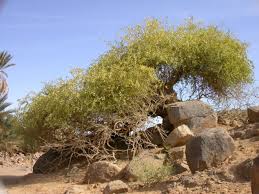
The Parable of the Mustard Seed is one of the most famous parables of Jesus, one that gives us hope that a small beginning can have an impressive ending, or so we think. This notion of an impressive ending comes from the versions of this parable in Matthew and Luke. ((Mt. 13: 31–32; Lk. 13: 18–19) There, the mustard seed grows into a tree, although Matthew does call it a shrub that turns into a tree. Mark, most likely the earliest version, and closest to Jesus, simply says that the mustard seed grows into the “greatest of all shrubs.” (Mk. 4: 3-32) A shrub, even a sizeable one, doesn’t seem so impressive, especially when we realize that mustard shrubs were considered intrusive weeds in Jesus’ time. What is Jesus getting at? We can get a lot of help by looking at some contexts for the parable.
This parable seems almost certainly to be inspired by a similar parable in Ezekiel: “This is what the Sovereign Lord says: I myself will take a shoot from the very top of a cedar and plant it; I will break off a tender sprig from its topmost shoots and plant it on a high and lofty mountain. On the mountain heights of Israel I will plant it; it will produce branches and bear fruit and become a splendid cedar. Birds of every kind will nest in it; they will find shelter in the shade of its branches. (Ezek. 17: 22-23) With the prophet, we have Yahweh taking something small, a twig, and making something great and impressive out of it: a tree on a mountaintop that shelters birds. So it is easy to see why later versions of Jesus’ parable would move in this direction. But in Mark, the seed is smaller and less impressive than a twig, and the mustard shrub is much less impressive than the splendid cedar. Moreover, cedars are cultivated for their wood; mustard shrubs are weeds. A triumphalist vision in Ezekiel has been downsized quite a bit by Jesus. So again, what is Jesus getting at?
In Mark, the Parable of the Mustard Seed is immediately preceded by The Parable of the Growing Seed where, after seed is scattered on the ground, “the earth produces of itself, first the stalk, then the head, then the full grain in the head.” (Mk. 4: 26-29) In this parable, the growth seems natural, something that happens by itself. We sense the mystery of God’s creation that brings plants into being and makes them grow. The mustard shrub also grows naturally, but it is an intrusion that is planted intentionally, perhaps an image of the intrusiveness of God’s kingdom. And yet the mustard shrub is also an image of welcoming, a place for birds to build their nests, an image of inclusiveness from what we might call an outcast plant.
The two parables of plant growth are preceded by a more elaborate parable with much the same imagery: the Parable of the Sower. Although analogies of natural growth are there, the emphasis is on failure. Most of the seeds fall on rocky soil or among thorns or on the roadside and bear no fruit. This parable coincides with the disciples’ first signs of failure; they do not understand the parable. As the Gospel progresses, the failures of the disciples increase, culminating in the desertion at Gethsemane, Peter’s denials, and then the women running from the empty tomb, saying nothing to nobody. The seed falling on paths, rocky ground, or thorns looks like the disciples. We don’t even have a mustard shrub; we only have scattered seeds that don’t grow at all.
But God can create out of nothing. God did this in the beginning, and God does it again after Jesus’ Resurrection. (Note that the first word of Mark’s Gospel is arche, beginning.) And St. Paul says that, in Christ, “the new creation has come.” (2 Cor. 5: 17) In Jesus’ parables, what little seed did fall on good soil yielded thirty, sixty or a hundredfold. The mustard shrub was just enough for the birds of the air to come and make their nests. How did even this much come from such massive failure? We have a hint at the New Creation when, in the face of the disciples’ failures to accept his coming death, Jesus tells his disciples that they will be handed over to councils and beaten in synagogues and will stand before governors and kings because him. (Mk. 13: 9) This prophecy leaps out of the frame of the Gospel narrative to the witness of the apostles recorded in Acts. The Parable of the Mustard Seed leaps even further out of the frame. In the face of our human failure, there will still be an intrusive, unimpressive kingdom that most people don’t want, a kingdom like a shrub which opens its branches to God’s people to further, with Paul, Christ’s ministry of reconciliation. (2 Cor. 5: 18)
See also Sowing Parables in our Hearts
 The Feast of Saints Peter and Paul celebrates the pastoral ministry of the Church initiated by two different personalities with some differences of opinion. Celebrating two formative pastors already points to pastoral ministry as one of relationships. Then there is the whole matter of shepherds, as we often call pastors, in relationship with their flocks.
 Imaginary Visions of True Peace