
Eating a Story

Corpus Christi is an odd feast. Almost all of the other feasts celebrate an event in the life of Jesus or the life of a saint. Corpus Christi is focused on the doctrine and devotion to the Eucharist. Only the Feast of the Trinity has a similar focus insofar as it celebrates a doctrine fundamental to Christianity. The trouble with celebrating either feast as primarily doctrinal is that doctrines in themselves seem lifeless. Who besides mathematicians can get excited about the paradoxes of one and three, and who but scholastic theologians can get excited about what the Real Presence in bread and wine is all about?

The Trinity, of course is not a doctrine, and it isn’t really a mathematical puzzle for that matter. The Trinity is a story of creation and redemption and sanctification. Not that each person of the Trinity is confined to one of those roles. All three Persons do all three and much, much more. The sacrament of the Eucharist also celebrates a story, the same story that is told about the Trinity. (See Trinity as Story and Song.) The Institution of the Eucharist, Jesus’ Last Supper with his disciples, is one important incident in the story of Jesus coming to earth as a helpless child, living a life of a human vulnerable to whatever other humans choose to do to him, dying on a cross when that is what humans chose to do, rising from the dead, and being seated at the right hand of the Father in the heavenly places. We have celebrated this story one step at a time, starting with the expectations of Advent all the way through to the coming of the Holy Spirit at Pentecost. Trinity Sunday puts the whole story together in one big celebration and then Corpus Christ does the same from a different angle.

St. Thomas Aquinas said that God relates to God’s creatures according to their mode of reality. In the case of humans, this means that God relates to us, material creatures that we are, through the material world in time and in history. The Eucharistic rite takes place in time. It incorporates past times, most particularly the times when Jesus suffered and died and then rose again, but also the time when the Israelites were delivered from the Egyptians at the Red Sea, an event recalled at the Passover for the Jews. The Eucharistic rite also takes place in the present moment when it is celebrated. Whatever events on both local and world fronts are incorporated into the celebration and offered to God. Moreover, God’s promises for the future when all will be made one in Christ are present as well. That’s a lot of time and history to be contained in a piece of bread and a sip of wine.

Discussions of real presence and dolling the sacrament up in a monstrance for Benediction both have some danger of reifying the Body and Blood of Christ. However, use of one’s intelligence to perceive some intelligibility in the holy Mysteries is part of what it means to be an embodied human being. This is salutary as long as one is willing to allow what intelligibility that emerges to remain surrounded by mystery. Dressing up to celebrate is another facet of our embodied way of living. It is the kind of celebration we engage in to honor people we love and respect. The important thing to realize is that we are eating and drinking some powerful stories when we partake of the bread and wine, and we are celebrating these same stories deep in our hearts as we pray before the dressed-up sacrament. These stories of deliverance from slavery and the suffering of the Prince of Peace inform the way we prayerfully incorporate contemporary events and they prepare us for how we should live out our stories as parts of the greater stories embodied in the sacrament. These same stories have prompted many liturgical theologians to stress the importance of social concerns and outreach as necessary outcomes of the Eucharistic celebration.

There is a human expression about eating our words. The implication is that our words come back to haunt us in some way. It is perhaps worth thinking about whether or not what we say is worth consuming for others, let alone ourselves. In any case, eating the words of Jesus is profound nourishment, nourishment to eternal life. When we receive the bread and wine at the altar and consume it, we are swallowing the story of Christ hook, line, and sinker. By swallowing this story, we live our own life stories within the life story given us by the Word made Flesh.
A Story Worth Swallowing

When someone believes a tall tale, we say that person swallowed it hook, line and sinker. A more skeptical person, on hearing what sounds like a tall tale might say: “That’s more than I can swallow.” Sometimes we say that a voracious reader devours books. When one goes to church, one often hopes to be fed by the preacher’s sermon. In The Phantom Tollbooth, the boy Milo wanders through a strange world where, upon being invited to a banquet, he starts to make a shallow speech and is dismayed when he has to eat his meager words. When Moses said that God had taught the Israelites that they don’t “live on bread alone but by every word that comes from the mouth of the Lord,” (Deut. 8: 3) he was witnessing to the power of words, of stories, to sustain us just as surely as food feeds and sustains us.

The Passover is a meal where the table fellowship is imbedded in a story, the story of the Angel of the Lord’s passing over the houses of Israel and the subsequent delivery from Pharaoh’s army at the Red Sea. The participants are nourished by the food served and they are also nourished by the story they celebrate. St. Paul reminds the Corinthians of the last meal Jesus had before he died, a meal that Jesus wanted to be repeated in his memory. (1 Cor. 11: 23-26) Like the Passover, with which Jesus’ meal is closely related, it seems to have normally been a meal for feeding the participants as well as celebrating the story of Jesus. Unfortunately, very bad manners on the part of some of the more affluent Corinthians led Paul to recommend separating the meal from the celebration of the story, an impoverishment that persists to this day. John, telescopes the meal and the story into an eternal present, as he does throughout his Gospel. Reliving the violence of Jesus’ passion by gnawing on the bread (such is the force of the Greek verb) and also reliving the Resurrection are made into a tight unity in the climax of Jesus’ discourse after the feeding of the people in the wilderness. (Jn. 6: 51-58)

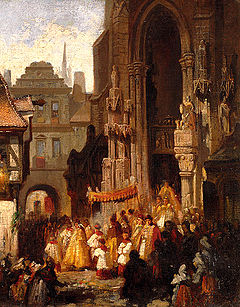
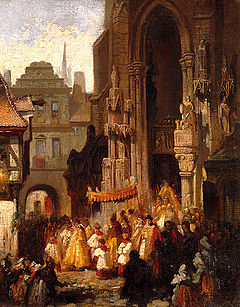
The Feast of Corpus Christi celebrates the Presence of Jesus in the Sacrament of the Body and Blood inspired by the visions of Juliana of Liège, a 13th century Norbertine canoness, and the thought of her contemporary St. Thomas Aquinas. The Thomistic term of “substantial presence” doesn’t seem to excite many people today, but the hymns Thomas wrote for the feast suggest that such terms did inspire a strong sense of devotion in the great Dominican thinker. For Thomas, the term “substance” was powerfully substantial. The elaborate Corpus Christi processions that evolved from this feast look more than a little triumphant when the Person present in the host is an Eternal Loser in the heavens but this is a loser still trying to make all of us winners for losing.

In any case, we need to remember that this presence in the sacrament is a person and a person lives a story. Is this a story we can swallow? It isn’t too hard to believe that a popular person was accused of many crimes and put to death. This is a story that has been told of many people many times, but this sort of story is a bitter pill to swallow. The Resurrection of Jesus sounds to many like a whopper that nobody can swallow, however nice it might be to swallow a story that gives us life. This is not the time or place to argue the truth of the Resurrection. Let it suffice that the death and Resurrection of Jesus is the story we swallow when we partake of the Eucharist. It is a story that touches on our vulnerability, both physical and moral, one that is sobering but also hopeful. It is a story that challenges us to be as life-affirming in the face of human death-dealing as Jesus was. There’s a lot of substance in all that!

Inside the Host

A Eucharistic host is usually small. At my first communion, it was about the size of a nickle and so thin I thought it was a sticker. The host that goes into a monstrance is closer to the size of a silver dollar but it’s still awfully thin. So why put such a small thing into a fancy monstrance? The word comes from the Latin monstrare meaning to show, indicating that a monstrance shows something hidden in the small host. As if the monstrance in itself were not enough, from medieval times up to recent modern times, the host was carried in elaborate processions through public places. Just a few years ago, I witnessed such a procession in Innsbruck that featured prayers given by the city dignitaries and rifle salutes by the Landwehr.

So what’s the big deal? Many religious thinkers not sympathetic to such devotions have asked the question and with a full heap of scorn and have complained of attempts to imprison Christ in a small piece of bread. This accusation misses the point. It isn’t that some evil bishop kidnaped Jesus and locked him up in the piece of bread. Rather, Jesus himself offered himself to us in the bread at the Last Supper. In a mysterious way, the piece of bead has become the Body of Christ. That really is a big deal.

But how can this be? How can a piece of bread ever become the Body of Christ? Jesus did not explain it, which is as good a reason as any for us not to try to explain it either. I personally find attempted explanations along the line of transubstantiation interesting as I savor the paradoxical reasoning of substance and accident becoming at odds with each other, but I have to admit this is more of a puzzle game than an act of devotion. After all, we aren’t saved by a metaphysical formula; we are saved by Jesus. And it is Jesus who invites us into the tiny home that he has made in the host. The very word expands:” “host” as in sacrifice (from hostias) as well as a host who invites us as a guest. (Any host knows that there is some sacrifice in inviting a guest.)

Just the notion of one person being invited by Jesus to an intimate meal as in George Herbert’s celebrated poem Love III would entail quite an expansion of space inside the a Eucharistic host. But there is much more. Jesus invited all twelve of his disciples to his Last Supper and it is possible that many more attended as well. In any case, Jesus invites not just one person, however individual and focused each invitation might be, but a multitude of people to the meal, so the inside of the host is more the size of an infinite banqueting hall. And the meal offered by Jesus has brought in the whole of creation that made the bread on the altar possible to begin with.

But there is much more. Since it is the person of Jesus who invites us in the sacrament, then we are meeting up with the whole person, not an outward persona such as what a maitre D’ in a restaurant would present us with. Besides meeting the person who healed the sick and the crippled, told mysterious parables, and commended the lilies of the field, we are meeting the person who was crucified on account of the social tensions we humans were not able to solve. The tomb in which Jesus was laid would have been a real prison except that it couldn’t hold him and it exploded inside out as Jesus was raised from the dead. So, inside the Eucharistic host, we are meeting the crucified and risen Jesus who is also glorified in Heaven. The inside just keeps on expanding.

There is still more. The crucifixion of Jesus is not an isolated act of one person: it is an act that absorbs every single unjust act of violence committed against every human being for all time. So all of the horrific atrocities we know of and many more are all included with the crucified Jesus inside the Eucharistic Host. This is the reason that the Eucharist has profound social significance. It isn’t just about me and Jesus; it’s about everybody and Jesus and we share with Jesus the suffering of everybody. And yes, there is still more. If every human atrocity is absorbed in the crucifixion which is present in the little host, then all the more is the redemption of the Resurrection present, a presence to raise every unjust act up to God for God to vindicate every injustice. The crucifixion absorbing all crucifixions is dark and unspeakable. It is all the space of infinite nothingness. (It has been asked if there can be poetry after the Holocaust.) The dazzling darkness of the Resurrection is even more unspeakable in its embrace of all crucifixions. This darkness is more infinite than the first. All of this inside a Eucharistic host no matter how small on the outside. Quite a lot to swallow.

Christ’s Dynamically Wild Presence

corpus christi processionThe Feast of Corpus Christi celebrates the presence of Christ’s body in the Eucharistic host. One of the events that inspired the institution of the feast was a vision granted Fr. Peter of Prague in 1263. He had doubted the presence of Christ in the sacrament until he had a vision of blood dripping from the host as he consecrated it. This vision, along with earlier visions of St. Juliana of Mont Cornillon, led Pope Urban IV to order the institution of this feast. Of other Eucharistic visions I’ve heard of, it is better to be silent rather than ruin today’s celebration.

I happen to have a high devotion to the real presence of Christ in the sacrament and the two great hymns that St. Thomas Aquinas wrote for the feast are edifying. But the problem with focusing on the presence of Christ in the Sacrament is that it circumscribes the consecrated host and seems to imprison Christ in it. This is to take the Eucharistic mystery out of context. After all, the phrase Corpus Christi is used in the New Testament to refer to the Church and not the sacrament by itself. Benediction has the danger of re-creating this isolation and its origins aren’t reassuring. It derives from a devotion to see the elevation of the Host at Mass, which is fine, except that this viewing was in place of receiving the Host or even of worshiping in community. There are stories of people who would rove from Mass to Mass to see as many elevations as possible! My theology professor in seminary, Arthur Vogel, railed against Benediction because it treated the sacrament as an object rather than an integral part of a dynamic celebration.

Corpus Christi processions have the same danger, but they do bring a communal aspect to the feast. Just a few years ago I found the custom alive and well in Innsbruck. I attended Mass at the cathedral where it was standing room only. After the Mass, there was a procession throughout the town with devotions read by the mayor and other dignitaries and the Landwehr fired off salutes with their rifles.

In John 6 Jesus speaks of his presence in the bread from Heaven in a dynamic way where those who eat his flesh and drink his blood abide in him as he abides in us. In isolation, these verses suggest a relationship with individual believers but the broader context is the feeding of the multitude in the wilderness, which was a communal event if there ever was one. Jesus, then, does not abide in us on an individual basis but abides in all of us as a sharing community. If we eat the Body of Christ, we are eating the very generosity and self-giving of Jesus. If we don’t give of ourselves, we have missed abiding in the community that abides in Jesus.

St. Paul’s recounting of the Last Supper begins with the solemn words that he is handing on the tradition as it was handed on to him. He then quotes what are called the Words of Institution, the words traditionally believed to change the bread and wine into the body and blood of Jesus. When put this way, we again have the sacrament restricted to a few words and Christ’s presence in the Eucharistic elements. St. Paul, however, provides many more words to the social context of the Eucharist, namely that the Corinthians should be sharing the food they bring to the celebration with the poorer members of the congregation rather than flaunting their feasting in front of those deprived. That is, it is not enough to discern the presence of Christ in the sacrament; it is also necessary to discern the body in all of God’s people.

The leaders of the Liturgical Movement of the last century, Lambert Beauduin in Belgium and Virgil Michel in the United States, grounded their liturgical principles, featuring engaged participation of the laity, with a theology of the Church as the Body of Christ. More importantly, they argued that the Eucharist is a sign and dynamic of social change, especially in ameliorating life for the poor. Dorothy Day and the Catholic Worker Movement worked very closely with Michel to this end. Far from being trapped in the bread and wine or in a monstrance, Christ is running wild throughout the world, changing not only bread and wine, but people and the whole fabric of society.