
 Mark tells us that immediately after his baptism, the Spirit drove Jesus out into the wilderness where he was tempted, or tested, by Satan.
Unlike Matthew and Luke, Mark tells us nothing else about the testing so we do not get a set of three drawn-out temptations to analyze. We are left with the bare fact of testing. What night the testing have consisted of in addition to, or underlying, the longer accounts?
René Girard has given us a new and profound way to understand “Satan” in scripture by noting that the word skandalon (the Satan) literally means a stumbling block. Girard has demonstrated the ways humans become stumbling blocks to one another when they become conflicted. (Satan is well known to be a sower of discord.) In this model, it takes at least two to have a stumbling block, so how could Jesus, alone in the wilderness, have dealt with conflict unless he was fighting a supernatural creature? I, for one, know that when I am alone, many other people are still with me, particularly anybody with whom I happen to have a conflictual relationship. In fact, being alone during a time of conflict is a great way to become obsessed with a rival—OR—to let go and listen to a deeper voice free of scandal, such as Jesus’ heavenly Abba.
As soon as Jesus began his public ministry, it was immediately clear that he knew scripture and the tradition of his people very deeply. Many biblical scholars suggest that Jesus’ forty days in the wilderness recapitulates the journey of the Israelites from Egypt to the Promised Land. Surely Jesus would have been deeply mindful of that journey: his people’s gratitude for the escape from slavery, their hopes for the future, but also their violent social conflicts and rebellions. These events in the journey would have given him much to reflect on as to how humans make themselves stumbling blocks to others.
Jesus also demonstrated from the start an acute awareness of what many of the Jewish leaders were like, surely enough to give him strong premonitions of how they might react to the religious vision inspired by the heavenly voice at his baptism and strengthened in the silence of the wilderness. He was most likely tempted to rehearse his arguments with the elders and think of ways to get the better of them. To overcome this challenge, he would need to find a way to interact with these leaders in a non-rivalrous way so as to embody the non-rivalrous character of his heavenly Abba. More important, he would have to begin facing possible outcomes of his ministry in the face of the Jewish and Roman leadership in Palestine. Since all of us have to deal with the small and great conflicts that tempt us to become stumbling blocks to others, Jesus was himself, as the author of Hebrews said, tempted in every way as we are. The uncanny way Jesus managed to deflect conflicts with the Jewish leaders away from escalations and, at the end, his willingness to die rather than use violence to save himself, show us that the Spirit, after driving Jesus into the wilderness, had indeed strengthened him to absorb the nonviolent ways of his heavenly Abba for the sake of our salvation.
For an introduction to René Girard, see my essay Violence and the Kingdom of God.
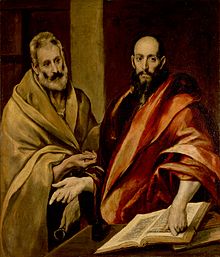 It is interesting and a bit ironic that we celebrate Saints Peter and Paul on the same day. Although there are famous icons of the two embracing one another in Christian love, the two seem not to have had an easy time getting along in real life. Although the two appeared to have been somewhat reconciled at the Council of Jerusalem in Acts 15, in his letter to the Galatians, Paul says that he opposed Peter “to his face” for backing down from what he thought they had agreed on. (Gal. 2: 11) The final chapters of John’s Gospel suggest tensions between the “Beloved Disciple” and Peter, and/or some tension between the two communities derived from them. The Beloved Disciple rests on Jesus’ breast at the Last Supper while Peter stubbornly tries to prevent Jesus from washing his feet. In her book Courting Betrayal,” Helen Orchard argues that Peter was resisting the slavish action of Jesus in washing his feet because he did not want to stoop so low himself. The episode of the Empty Tomb in John shows a rather awkward dance between the two where the Beloved Disciple gets there first but waits at the entrance and allows Peter to go in first. In this little tangle of a narration, both seem to have been first but not in the same way; which suggests some attempt to overcome the tension. In the final chapter of John, after the threefold question to Peter: “Do you love me?,” Peter points to the Beloved Disciple and asks” What about him?” Jesus answer basically tells us it is none of his business.


 Imaginary Visions of True Peace