God’s Christmas Gift

At Christmas, we celebrate the birth of a baby. Babies are born all the time but this one is different. The baby we celebrate this night is God incarnate. What’s so special about that? Don’t we tend to treat babies like little gods, revolving our lives around them? Weren’t the shepherds oohing and aahing the way people do when they see a pretty baby? Such is the appeal of Christmas.

However, the startling claim made by various church fathers, Irenaeus probably being the first and Athanasius another early witness, is that God became human so that humans could become God. The antiphon for the Feast of the Holy Name is: “O marvelous exchange! [Our] Creator has become [human], born of the Virgin. We have been made sharers in the divinity of Christ who humbled himself to share in our humanity.” It’s like a billionaire offering a person living homeless on the streets his or her bank account for the few coins the street person has collected that day. Who would do such a thing? The divine exchange is infinitely more lopsided that this. What kind of God would think of giving God’s divinity for the sake of our humanity? I suppose the answer is that only an infinitely and unbelievably generous god would do such a thing.

What these church fathers and the author of this antiphon are proclaiming is that our humanity has been radically altered for all time by this glorious exchange. There is a divine presence in each of us waiting for us to allow it to unfold in unbelievable and mysterious ways. Some people get the impression that the notion of humans becoming God leads to blurring distinctions between humans and God, or humans even supplanting God. There have been thinkers who have made suggestions along those lines, but in sound Christian doctrine that is not the case. In 2 Peter 1: 4, the phrase that inspired Irenaeus and Athanasius is “partakers of the Divine Nature.” That is, we participate in the divine nature. This leaves our humanity fully intact, just as Jesus’ humanity is fully intact even though he is fully divine. Moreover, this partaking of the divine nature is a gift from God, not an accomplishment on our part.

Before getting too excited about partaking of the divine nature, it behooves us to reflect on what we’re getting into. Since we don’t have any experience of being God, we don’t know much about it. All of us have fantasies about what we would do if we were God. For myself, I would readjust the social and political structures worldwide to my satisfaction. Never mind that everybody else with similar fantasies would do the same thing and we’d have an in infinite mess. However, the fact that God would exchange God’s divinity for our humanity does give us an important clue as to what being God, the true God, is about. The billionaire in the analogy who traded his or her bank account for the coins of a street person is amazingly generous, but God is infinitely generous. If I’m not so sure about being as generous as this fantasy billionaire, then maybe I’m not up to being as generous as God.

Partaking of the divine nature has some far-reaching consequences for our sense of identity. If I am inclined to clutch at what I think my identity is, I won’t want God coming in to mess with that and throw me off course; never mind that my own course is out of the ballpark. In order to partake of God’s nature, receiving it as a gift, I have to empty myself of all my favorite illusions about who I think I am. Mary pondered the mystery of her son’s birth in her heart. We, like Mary, need to spend time in stillness, pondering God’s Christmas gift to us, letting it sink into our depths with the new life it brings. As we ponder, we might think ahead to where the story of this birth took Jesus in a few years and where it will take us in a few months. Partaking of the divine nature entails partaking of the divine generosity of the Paschal Mystery.

God’s Eternal Choice

During the Christmas season, we celebrate the Incarnation: the mystery of God becoming a human being. For such a thing to happen, there must be an intersection of time and Eternity. Understanding time is easy, Or is it? I think we can all sympathize with St. Augustine of Hippo when he said he understood time until you asked him to explain it. Maybe we can’t explain time but it has familiarity in that we live in it the way a fish lives in the water. Eternity is something else. We don’t live in it and we really can’t conceive of living in it. We might be tempted to say that Eternity is the opposite of time, but that isn’t right. My theology professor said that Eternity has nothing to do with time. That means Eternity can’t even be the opposite of time as that would be to relate the two and that is what can’t be done. We could say that Eternity is for God and time is for us and leave it at that. But once Jesus was born, time is for God as well as for us. Does this mean that Eternity will be for us some day? But if Eternity should be a future possibility, it would be connected with time after all. Does that mean Eternity won’t be Eternity any more? Maybe we just haven’t begun to grasp what Eternity is all about.

God’s being eternal is one of the reasons that God is usually thought to be unchanging and unchangeable. But to consider the notion of God changing, or not changing, relates God to time yet again. More to the point, there is the Biblical record of God’s interacting with time bound creatures such as we. So whatever it might mean for God to be unchanging, it doesn’t mean that God is some cosmic blob that never does anything. The first chapter of Ephesians offers us a powerful vision of what an unchanging but dynamic God is like. The “God and father of our Lord Jesus Christ” has “blessed us in Christ with every spiritual blessing in the heavenly places.” (Eph. 1: 3) Moreover, we have been chosen “before the foundation of the world” and destined for adoption as God’s children “according to the good pleasure of his will.” (Eph. 1: 4-5) A God who blesses and chooses us from the foundation of the world is infinitely active rather than infinitely motionless. But Paul is also telling us that this will of blessing and choosing is constant. It may be active, infinitely active, but it is steady, unchanging.

We have a powerful example of the effect of God’s active, steady blessing and choosing in the 31st chapter of Jeremiah. Israel’s experience in time has been nothing short of catastrophic. Babylon invaded Jerusalem, destroyed the temple, and deported the more important people to Babylon, leaving Jerusalem in ruins. Jeremiah himself proclaimed Yahweh’s presence in the midst of this disaster because of the sins and apostasy of the people. But in the 31st chapter, Jeremiah is prophesying the return from the Babylonian exile: “See, I am going to bring them from the land of the north, and gather them from the farthest parts of the earth, among them the blind and the lame, those with child and those in labor, together; a great company, they shall return here.” (Jer. 31: 8) With God interacting in time, a great new thing is about to happen, but what, in time, is great and new, and unheard of, is a result of a steady act of blessing and choosing on the part of God. This steady and unchanging will shows itself both in bringing Israel to repentance and restoring Israel to its homeland.

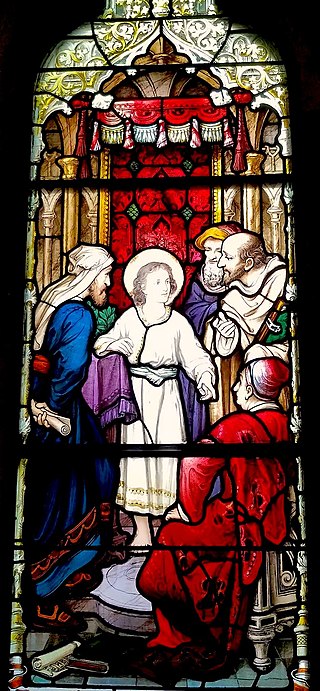
On Christmas Day, we celebrated the birth of Jesus. The Logos who was with God in the beginning, became a human baby as vulnerable as any other baby. (Jn. 1: 1) On this second Sunday after Christmas, we see Jesus at the age of twelve, talking with the elders in the temple and asking them questions. That is, we are seeing a child asking questions about life and seeking answers as children are apt to do as soon as they are old enough to think about such things. This brings us into the paradox of an unchanging God developing in time as a human being. That God would do such a thing tells us that for us, living in time as we do, developing over time by asking questions is a good thing to do. We are also alerted to the significance, in the context of Eternity, of every little thing we do now in time. Here, we are at the beginning of Jesus’ life, but over the next few months, we’ll follow him to the end and beyond. Indeed, Paul says that it is through Jesus Christ that we are adopted as God’s children in God’s unwavering will and choice. That is, Paul is presupposing both the Cross and the Resurrection when he proclaims the destiny chosen for us by God. It is good for us that God’s will is not changeable, but what about us who are changeable? Insofar as our will isn’t so good, it is a good thing that it is changeable with a chance of a change for the better. This is what Israel needed when the consequences of their apostasy brought about the Babylonian Exile. Asking questions and listening to the answers as Jesus did can help bring us to abiding in God’s will that will not change in relation to any one of us or in relation with anybody else.

See also As Jesus Grew

Following the Shepherds

The shepherds adoring the Christ Child are a staple presence at Christmas time, so much so that we perhaps take them for granted. Most manger scenes and the Christmas Gospel make them seem respectable. Well, real shepherds weren’t the sort that respectable people invited to come and ooh and aah over their newborn babies.

Some of the recent writings I read about Christmas toned down the alleged marginality of shepherds. One writer pointed out that a famous Talmudic statement citing the dishonesty of shepherds was made several centuries after Jesus’ life. Even so, I doubt that shepherds had been respectable bourgeois gentlemen who went downhill a few centuries later. More important, though, these writers drew our attention to the symbolism of shepherds and the biblical allusions in Luke’s Gospel, suggesting that marginality wasn’t such an issue.

Most importantly, the shepherds in the field who, prompted by the host of angels, came to visit the Christ Child point to Jesus’ ancestor King David. They were just outside the city of David, after all. The story of David’s anointing as king is particularly interesting in this regard. (1 Sam. 16) Samuel asked Jesse to bring all of his sons before him. When he brought seven sons, one would thing he had brought them all. After all, seven sons is quite a few, and seven is often taken to be a number of completion in a way that six or eight are not. And yet God told Samuel that not one of the seven sons who passed in front of him was the one chosen to be the king in place of Saul. So Samuel asked Jesse if there is yet another son and finally Jesse admitted that there was one more, the youngest, who was with the sheep. When David was fetched, Samuel knew that this was the one.

The point is, the shepherd boy had been marginalized out of existence until God called for him. This is just one of many, and one of the more subtle, examples of God’s trick of bringing something out of nothing. David then did become something and was, figuratively speaking, the shepherd of Israel for many years. To this day, he is the archetypal king, even if he wasn’t always the best of shepherds. Interestingly, the prophet Nathan used the parable of a sheep to speak a condemnatory word to the king when he acted wrongly in regards to Bathsheba. (2 Sam. 12) Later in his Gospel, Luke contrasts this episode with Jesus’ Parable of the Good Shepherd who left the ninety-nine sheep to seek out the one stray. (Lk. 15: 1-7) The Davidic symbolism, then, actually highlights the marginality of the shepherds, of King David, and therefore, of Jesus himself. In fact, in a more literal way, Jesus has come out of nothing, as Luke tells us that Mary, who had not known a man when Jesus’ birth was announced to her, yet gave birth to this child.

After two thousand years plus, the Christmas story is a part of world culture, although its appropriation by some, maybe even all cultural groups, sometimes seems far-fetched from its beginnings. But do we really adore Jesus as our true king? The news feeds on the Internet raise serious doubts about this. Perhaps Jesus is still as marginal as he was when he was placed in a manger because there was no room for him anywhere else. Can we let the marginal shepherds shepherd us to the manger where the even more marginal child lies? Can we keep our ordered and apparently complete lives open for the One conceived by the Holy Spirit to enter? Do we really have room for Jesus today? Given the troubles in the world, can we open our hearts for God to bring something out of the nothing that surrounds us in our time?

Taking Care of God

Children are being born all the time, so one might think there’s nothing special about it. But the birth of a child is special for those involved. Maybe all the other births happening all the time are ordinary, but the birth of one’s own child or the child of someone close to us is indeed special with all the hopes and fears the event arouses.

But the birth we celebrate at Christmas is both more special and unique than all other births. As with all other human births, a human being has into the world, a helpless human being who was totally dependent on the care of other people. If such care is not present, the newborn child will not survive long enough to grow up.

But this time, the human being is also God. That doesn’t compute. God is supposed to be the Master of the Universe, totally in charge and in need of nothing from nobody. If God can and does whatever God wills, as Psalm 135 says, than God could only have become a helpless newborn child by willing to do just that. Why would God do such a thing? Theologians, starting with St/ Paul, say that God became a human being in order to save the world. Indeed, Jesus’ dying on the cross and being raised from the dead is believed to have saving consequences for humankind. But the fact that Jesus was killed by humans in early adulthood makes it clear that, although he was/is God, Jesus was just as vulnerable and killable as any other human being. But what if Jesus had not been nurtured and protected as in infant? What then? Fortunately, we don’t have to explore that question further as we knew that at least Jesus grew up into early adulthood. But only because he was cared for in his most vulnerable years. This vulnerability on the part of Jesus has everything to do with how salvation works

There are many ways in which the Incarnation of our Lord can be said to have turned the world upside down. One of the most startling ways the Incarnation has done this is that, although we all depend on God for our very existence and for sustaining us in being, God has turned the tables by making Godself dependent on us. Mary and Joseph and probably a few other people held Jesus in their arms. In our devotions, we can imagine ourselves holding the baby Jesus in our arms, tenderly consoling him for any discomfort he might feel and trying to make it better. If anybody, such as Herod, should try to harm this helpless child, we would do anything possible to protect him.

The fact that God has entered humanity and become as dependent on other people jas ll other people deepens profoundly the notion that all people depend on other people and all people should cherish and protect everybody else.. That is, God has made every person, every newborn child, special.

God’s Christmas Gift

How can God possibly become a real and true human being? We don’t know. God knows, but God isn’t telling. That is probably because I can’t imagine God giving an answer that would be intelligible to humans. All we know is that God became a human being. Impossible, right? Well, if it really happened, then it isn’t really impossible; it just seems that way. And it is indeed impossible for humans. Only God can do this trick.

So what’s the big deal about God becoming a human being? The big deal, which is an infinitely big deal, is that humans can become God. Impossible! Well, yes. For humans it most certainly is impossible, notwithstanding the many people who have thought they could and failed for all their delusions. Once again, only God can do this trick.

Many Christians are astonished at the prospect although this belief goes back to the early Christian centuries and is enshrined in the second Epistle of St. Peter where Peter says that we become “partakers of the divine nature.” (2 Pet. 1:4) It sounds as presumptuous to some as it sounds impossible, and it is presumptuous and impossible if one thinks in terms of humans having divinity within themselves that they can tap into at will. (Hence the many failures.) But note that I said it is only God who can do this trick. And it doesn’t mean we become “god” in some sort of fusion. If we dissolve, there is no relationship between ourselves and God ,which is a prerequisite for participation in God’s nature. Becoming partakers of the divine nature is a gift which God makes possible by entering human nature and becoming a human being. The thing about a gift is that there must be both a giver and a receiver. So the question is: are we willing to receive the gift of God’s nature or not?

The question is pretty abstract in the terms discussed so far, but the story of Jesus’ birth in Luke brings the question down to earth. By setting the story in the context of the Roman Empire’s exertion of power through the census taken by Quirinius, Luke sets the stage for what the world is like, the world that will welcome Jesus and the gift of deification–or not. That the only shelter Joseph could find when Mary delivered her child was a stable, suggests that Jesus was not welcome to this world, a point made also in John’s Gospel. (Jn. 1: 11-12) The ubiquitous manger scenes make this setting very sweet and romantic, but if one were to feel the cold and smell the smells, it wouldn’t be so romantic. The story emphasizes the vulnerability of the child in spite of that child’s being God, capable of sharing his godhead with us. So far, only Mary and Joseph have welcomed the child into world and are taking care of him as well as they can. In contrast to this stark scene, we have the shepherds in the field seeing the Glory of the Lord and hearing the singing of the heavenly hosts. This reminds me of the double level in Revelation which draws the contrast between the human violence on earth and the rejoicing heavenly choruses in Heaven. For all their fear, the shepherds also receive the Christ Child. At this point, the only welcomers comes from the bottom of society, with the shepherds being the dregs. No red carpets from royalty or even a decent shelter offered by somebody of modest means. So if we think we are above the lowest rank of society, how about us? We should worry that it is easier for a camel to get through the eye of a needle than for a well-healed person to accept the gift of deification.

During Jesus’ life, we see much welcoming as crowds of people follow Jesus to receive healing and to listen to his words. Many of them are of the lowest classes but there are a few higher-ups who welcome Jesus, at least up to a point, with Simon the Leper being an example. But with the religious and political leadership, not so much. Religious and politicians should ponder this. When the Empire struck back after Jesus cleansed the temple, the welcome of just a few days before evaporated and Jesus died on the cross, alone, or almost alone. Not much of a welcome there.

There is more to welcoming God than welcoming a certain baby born in a stable some two thousand years ago. We can do this sentimentally in prayerful exercises and then get on with life. But if we really welcome God, we welcome everything Jesus said and did throughout his life. Which is to say we welcome the self-giving of God entering humanity, and we don’t try to become “god” on our own terms since welcoming God’s humanity involves welcoming our own. More challenging, we must welcome everybody else, even if they don’t welcome us, since Jesus welcomed them and still does. More challenging still, the gift of God’s nature means serving others, not asking them to serve us. Receiving the gift of God’s divinity gives us the gift of rejoicing with the heavenly hosts who sang to the shepherds, but it also gives us the gift of poverty and the vulnerability of a stable and then the vulnerability of the cross. The gift of participation in the divine nature is free, but it is also just as costly for us as it is for God.

In the Arms of Mary, in the Arms of Christ

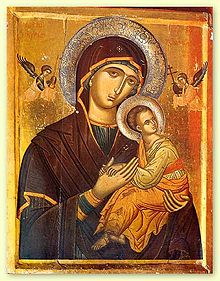
madonnaThe image of Mary holding her Child is arguably the defining image of the Christmas season. Its tenderness is comforting in a world where violence against the most vulnerable dominates the news. Vulnerability, such as that of a newborn baby tends to arouse either a gentle wish to nurture and protect, or it sets off an urge to take advantage of weakness in hard-hearted fashion as Herod did. We see both of these tendencies happening in the world about us and it is possible that we struggle between them within ourselves. If we let ourselves get caught up in the frantic conflicts occurring today, any weaknesses we see in our opponents become targets for increased aggression.
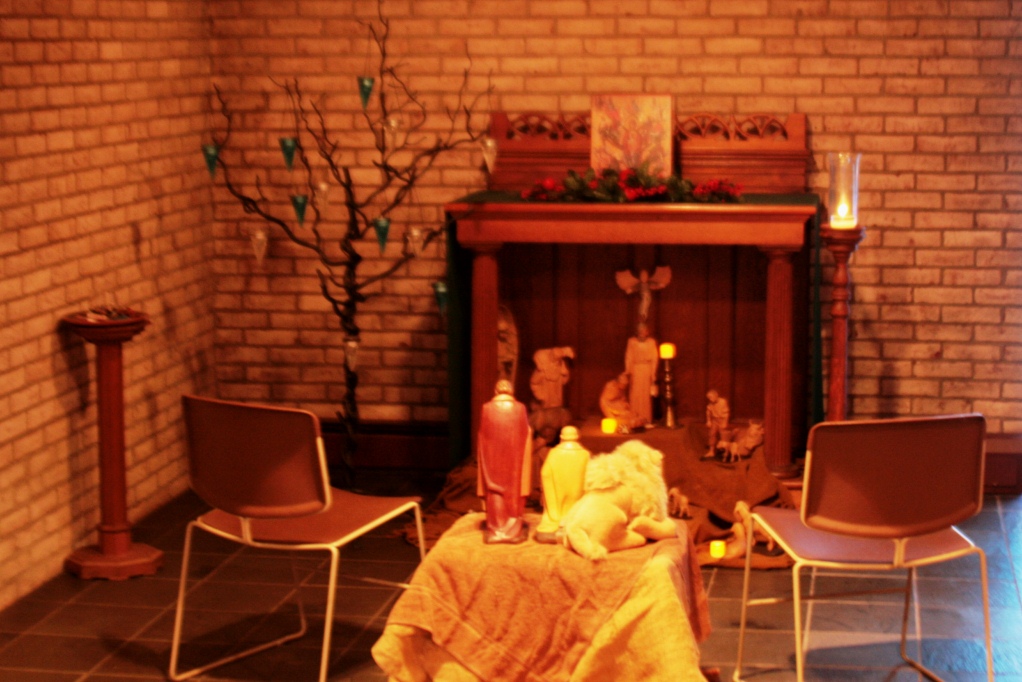
It takes a quiet, contemplative attitude to relax and let the tender, nurturing attitude take over, even in relation to our opponents. Like Mary, we need to ponder the birth of Jesus in our hearts. Mary could hardly have doubted that the baby was as human as any other baby as she suckled him at her breast, laid him down to sleep, and heard him cry when he woke up hungry. But as the famous song asks: Did Mary know that “when you kiss your little baby, you kiss the face of God?” Although a young parent knows that the day could come when the child takes care of the parent during helpless old age as the parent takes care of the helpless child, could she have known that the child she delivered “will soon deliver you?”

The mysterious annunciation was another contemplative moment for Mary as she had to be still and listen to what the angel was telling her, hard to believe as it was. That the child would be “great and the Son of the Most High” could have meant many things without necessarily meaning that the child was God. But conceiving the child without ever having “known man” would have made it clear that the child was not ordinary. Did she have to know or suspect that the child was God before she would hold him, kiss him, bathe him, and feed him? Surely not. The child needed her care and that was all the reason she needed.

When the child had grown, he would say that whoever fed a hungry person or clothed one who was naked did that the same to him. Mary actually did these things for Jesus himself, because she would have done them for anyone, which is how it should be.

And yes, the child she bore did come to hold her in his arms. Eastern Orthodox icons of the Dormition of Mary illustrate this insight when the soul of Mary, as she dies in the arms of the disciples, has turned into a baby girl held in the arms of Jesus.

Any time we hold a vulnerable person tenderly, we hold the vulnerable Jesus, who in turn holds us in his divine arms as we experience our own vulnerability during the challenges in our lives.

God-Is-With-Us: A Christmas Eve Meditation

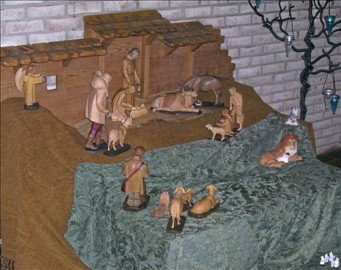
creche1-copyTonight, we celebrate the birth of a child. Usually, there is rejoicing when a child is born. One of my family stories is that my grandmother was so excited about my birth that she burned two pots of beans.
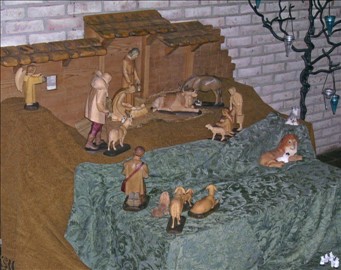
When we celebrate a birth, we celebrate the fact that a baby is. The simple act of coming to be is a cause of wonder and joy. So it is that we celebrate Jesus before he did anything at all except come out of his mother’s womb and maybe cry a bit and suckle some milk. As a friend of mine said once about newborn babies: “They don’t do much at that age.” We also celebrate our hopes for the future and for the future of that child. We know that in the case of Jesus, the future wasn’t all rosy. That Jesus was born in a stable because there was no room for him and his family and that Herod would be out to get him as soon as he found out about him shows that there was cause for anxiety from the very start. Unfortunately, many babies being born right now are born into much the same sort of anxiety that is mingled with hopes for the child. So not every birth leads to unequivocal rejoicing. Such anxiety is exacerbated by our tendency to focus on those who stir up fear in us, goading us on to adding further fuel to the violence growing all around us. We can see in news reports, Twitter, and Facebook that we are locked in violent systems of condemnation that stoke our fears exponentially.

Although we celebrate tonight the very being of Jesus, that Jesus is, when Jesus was apparently not doing much, God was and is already doing a great thing, an unprecedented thing: God had entered humanity. God chose to share, in frail human flesh, the very threats and anxieties that we all share. God has not left us to the human powers over which we have little or no control, powers we doubt we can trust with our well-being. Moreover, God shares the vulnerability other humans suffer from us on account of our fears and our own violence that we cannot see. In this way, God, in Jesus, lives up to the name: Emmanuel, which means “God is with us.”

God’s presence among us means many things. Tonight I will touch on one of them. By entering humanity, God has opened our human nature to God’s nature. We are no longer as trapped in our own human fear and violence as we often think we are. Later in life, Jesus spoke about God coming “like a thief in the night” but at the time of Jesus’ birth, God had already broken into the household of our humanity and started to sneak around, taking away bits of fear and violence and leaving bits of love behind.

This Christmas, let us celebrate the sneaky child who is already crawling around in the dark places of our lives, taking away the things we need to lose and giving us the gifts we need the most.

The Child Who Supplants Us All

crecheThe angels say to the shepherds: “Do not be afraid.” (Luke 2:10) They say the same to us today. What are we afraid of? The shepherds were afraid of the glory of the Lord shining about them. That sounds like a good thing, but most of us aren’t used to glorious light filling the night sky any more than the shepherds were. Even the most devout of us would at least be startled if such a light shone around us. When Herod heard of the birth of a child destined to be a king, he was afraid. Caesar Augustus would have been as afraid if he had been told about Jesus’ birth. His successors were sufficiently afraid to persecute the followers of Jesus for three centuries. What were they afraid of?

Herod and Caesar Augustus were afraid of being supplanted. They didn’t want to give up their imperial positions. The shepherds had a lot less to lose but if Jesus supplanted them as shepherds, how would they earn a living? As it turned out, no amount of fear would stop Jesus from supplanting all emperors and shepherds. The two jobs became one with the Good Shepherd who leads all of us, deposed emperors and shepherds included, through the sheep’s gate into safe pastures. Are we afraid of these safe pastures?

Here we have fear of the unknown (what is this strange light show all about?) and fear of being supplanted. Fear of being supplanted is a version of fear of the unknown; we don’t know what life will be like if we are supplanted. We might chuckle at lowly shepherds fearing they will lose their jobs and indulge in self-righteous laughter at horrid kings and emperors who don’t want to lose their power, but it seems to me that all of us should be afraid of having our imperial pretensions with which we makes ourselves little tin kings supplanted by the Christ Child.

The thought of being supplanted is frightening, but the angels’ song “Glory to God in the highest” seems to celebrate our supplanting as a wonderful thing. Can we believe the angels? The shepherds believed the angels enough to go and see the child for themselves, something Herod never did. Maybe glory to God in the highest is a much greater thing than glory to Me, Myself, and I. We won’t know if it is unless we try it. Can we accept the invitation that this Christmas celebration offers us?

The Name of Names

crecheOne important feature of a name is that it identifies us and sets us apart from other people. Names do not just identify us individually; they also give us context, such as where we come from. Medieval names such as Francis of Assisi were like this. Names also identify the culture we live in and come depending on where we have German names, Japanese names or Scottish names such as mine. Within a national identity, our names tell others what families we come from such as the Smith family or the Bach family. Not only the surname but our first and middle names often repeat names used in the family. My baptismal name Robert is also my father’s name, for example. In mythology, deities tend to have names such as Zeus, Thor or Vishnu. These names designate distinctive personalities which are basically human, if writ large. The thing about names in all these cases is that each person who has a name, whether a dog, a human, or a deity is finite, a part of the world.

When it comes to speculating about what being may have created the world, we suddenly become very shy about names. We might use a term such as The Father Who Made us All or a term such as God which precludes having a particular name such as Zeus. When Moses asked the deity who spoke to him out of the burning bush for a name, the answer was Yahweh, which really was a non-name as it meant something along the lines of: “I am being what I am being.”

These considerations make the following verse from Luke’s Gospel astounding: “And at the end of eight days, when he was circumcised, he was called Jesus, the name given by the angel before he was conceived in the womb.” This boy was/is also the Logos who was with God in the beginning and without whom nothing was made that was made according to the Prolog to John’s Gospel. The term Logos is another example of not naming the unnameable creator of the universe and yet this same Person without a name “emptied himself” as Paul said in Philippians, so as to be born as a human being. As a human baby, the unnameable was named, a name stamping him with a particular culture and a particular family. The circumcision of this body is yet one more cultural marker.

So deep was the Word’s immersion in humanity, that he humbled himself and was “obedient unto death, even the death of a cross.” The result of this descent was that the crucified Logos was raised up and the ordinary Jewish name he bore has become “a name above every name,” a name to which all humans should bow. And yet it is because the unnameable became human and nameable that this name is so exalted and awesome to us, all the more awesome in that we resist the lowliness of the Logos through whom we ourselves were made.

Unwrapping the Future

crecheThe yearly cycle of celebrations and commemorations adds solidarity to our experience of time. Christmas, a holiday especially laden with traditions, is a particularly strong anchor, assuring us that everything is as it should be for all eternity. Amen.

One of the traditions of Christmas, however, is the giving of charity. That is a very good thing, considering the needs for generosity, and it helps that once a year, people have a custom of dwelling on such matters. But the need for such charitable giving suggests that not everything is as it should be. If huge efforts by charitable organizations have to be made to assure that no child is deprived of a Christmas, then obviously there are serious social problems that need to be addressed. That is, this cozy traditional holiday poses a challenge for the future.

Manger scenes with the new-born Jesus lying in the straw tug the hearts of many and have been a focus of devotion since St. Francis of Assisi introduced the custom in the twelfth century.  But the whole point of this nativity story is that Jesus was born in the stable because nobody had room for his mother, father, and himself. This is not business as usual. It raises the question: do we really have room for Jesus in our lives? Do we really have room for all the children being born and for their families?

The angel announced to the shepherds proclaimed that this newborn child was the savior, the Lord who was going to usher in a new era of peace. That may sound innocent when we hear this read in church today, but at the time, the Caesar thought he was the savior and he didn’t have room for somebody else to do his job! Of course, he was a savior and keeper of the peace his way, with military and cultural might. The story of the shepherds, then, challenges us to consider who really is our savior and the model of peace for us. Do we keep peace the imperial way though violence to keep everybody in line? We don’t have to have imperial armies to take this approach. All it takes is a drive to control people, by force if necessary. Or do we follow peace Jesus’ way, through vulnerability as a newborn child all the way to the cross and then the Resurrection where Jesus creates peace through forgiveness.

A major cog in the engine of Caesar’s peace in Jesus’ neck of the woods was King Herod. Killing all the baby boys in Bethlehem may not look like a peaceful action, but Herod was keeping the peace, imperial style. Most of us may think Herod a bit extreme, but if we are willing to sacrifice anybody who seems to threaten our control of life, especially the young, we are going the way of Herod, the way of Caesar. Jesus, although he had the power to send legions of angels against Herod, remained vulnerable, dependent on human protection until the time came to suffer the fate the boys of Bethlehem suffered.

All of this may be a downer for a joyful holiday, but the good news is that Christmas is a yearly wakeup call for renewal of life, a renewal fueled by the divine energy of a human child born over two thousand years ago. Everything that was wrong with the world at the time is wrong with the world now and a lot more. We can keep on going in circles if we want, but we have the chance to step off the not-so-merry-go-round and embrace the Christ Child. We will find that the Christ Child has a gift for us. If we dare to open it up, it is a gift for an open future that we can have if we really want it.

See also, Celebrating the Prince of Peace and The Word Became Vulnerable Flesh