
When someone believes a tall tale, we say that person swallowed it hook, line and sinker. A more skeptical person, on hearing what sounds like a tall tale might say: “That’s more than I can swallow.” Sometimes we say that a voracious reader devours books. When one goes to church, one often hopes to be fed by the preacher’s sermon. In The Phantom Tollbooth, the boy Milo wanders through a strange world where, upon being invited to a banquet, he starts to make a shallow speech and is dismayed when he has to eat his meager words. When Moses said that God had taught the Israelites that they don’t “live on bread alone but by every word that comes from the mouth of the Lord,” (Deut. 8: 3) he was witnessing to the power of words, of stories, to sustain us just as surely as food feeds and sustains us.
The Passover is a meal where the table fellowship is imbedded in a story, the story of the Angel of the Lord’s passing over the houses of Israel and the subsequent delivery from Pharaoh’s army at the Red Sea. The participants are nourished by the food served and they are also nourished by the story they celebrate. St. Paul reminds the Corinthians of the last meal Jesus had before he died, a meal that Jesus wanted to be repeated in his memory. (1 Cor. 11: 23-26) Like the Passover, with which Jesus’ meal is closely related, it seems to have normally been a meal for feeding the participants as well as celebrating the story of Jesus. Unfortunately, very bad manners on the part of some of the more affluent Corinthians led Paul to recommend separating the meal from the celebration of the story, an impoverishment that persists to this day. John, telescopes the meal and the story into an eternal present, as he does throughout his Gospel. Reliving the violence of Jesus’ passion by gnawing on the bread (such is the force of the Greek verb) and also reliving the Resurrection are made into a tight unity in the climax of Jesus’ discourse after the feeding of the people in the wilderness. (Jn. 6: 51-58)
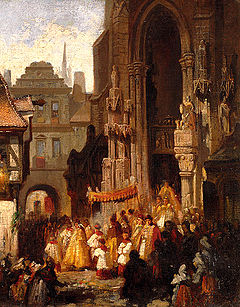
The Feast of Corpus Christi celebrates the Presence of Jesus in the Sacrament of the Body and Blood inspired by the visions of Juliana of Liège, a 13th century Norbertine canoness, and the thought of her contemporary St. Thomas Aquinas. The Thomistic term of “substantial presence” doesn’t seem to excite many people today, but the hymns Thomas wrote for the feast suggest that such terms did inspire a strong sense of devotion in the great Dominican thinker. For Thomas, the term “substance” was powerfully substantial. The elaborate Corpus Christi processions that evolved from this feast look more than a little triumphant when the Person present in the host is an Eternal Loser in the heavens but this is a loser still trying to make all of us winners for losing.
In any case, we need to remember that this presence in the sacrament is a person and a person lives a story. Is this a story we can swallow? It isn’t too hard to believe that a popular person was accused of many crimes and put to death. This is a story that has been told of many people many times, but this sort of story is a bitter pill to swallow. The Resurrection of Jesus sounds to many like a whopper that nobody can swallow, however nice it might be to swallow a story that gives us life. This is not the time or place to argue the truth of the Resurrection. Let it suffice that the death and Resurrection of Jesus is the story we swallow when we partake of the Eucharist. It is a story that touches on our vulnerability, both physical and moral, one that is sobering but also hopeful. It is a story that challenges us to be as life-affirming in the face of human death-dealing as Jesus was. There’s a lot of substance in all that!
 The image of the vine and the branches in John 15 gives us a powerful image of closeness both between ourselves and God and also with each other through our grounding in God.
 Imaginary Visions of True Peace