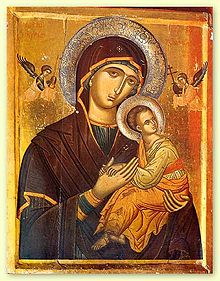
Few words of Mary, the Mother of Our Lord, are recorded in scripture. Among these few words, the most momentous are: “Let it be to me according to your word.” With these words, Mary accepted the conception of the Christ Child in her womb. It is a deep wonder that God, the Master of the Universe, would deign to be dependent on a human being in order to enter the world. It is this same deep wonder that God continues to depend on us to let the Christ Child continue to be born and live in the world that God has made.
In his poem The Blessed Virgin compared to the Air we Breathe, Gerard Manley Hopkins explores this mystery among many others with these lines:
Of her flesh he took flesh:
He does take fresh and fresh,
Though much the mystery how,
Not flesh but spirit now
And makes, O marvellous!
New Nazareths in us,
Where she shall yet conceive
Him, morning, noon, and eve;
New Bethlems, and he born
There, evening, noon, and morn
Bethlem or Nazareth,
Men here may draw like breath
More Christ and baffle death;
Who, born so, comes to be
New self and nobler me
In each one and each one
More makes, when all is done,
Both God’s and Mary’s Son.
Note that Hopkins is telling us that saying Yes to God is not something done once and for all; saying Yes is something that must be said time and time again, every day, every hour, without ceasing. The New Self, the nobler us takes time.
 Recently, I read the Scythe Trilogy by Neal Shusterman. (For Girardians: Shusterman has shown much insight into mimetic desire and scapegoating in his many young adult novels.) This trilogy envisions a future where a massive computer called The Thunderhead runs the world: coordinating work, managing the healing of sick and injured people, everything except for one thing. Since people no longer die of natural causes, the population is lessened somewhat by the institution of Scythes who randomly kill people gently and without malice. This is called gleaning. The Scythes and the Thunderhead are separate and do not interact. What would a trilogy like this have to do with the Annunciation of Our Lady?
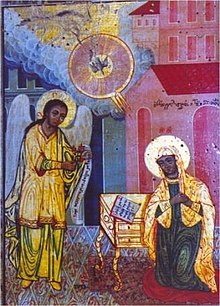
 When the angel Gabriel announced to Mary that she was to conceive and bear a son, the angel said that her son “will be great, and will be called the Son of the Most High, and the Lord God will give to him the throne of his ancestor David. He will reign over the house of Jacob forever, and of his kingdom there will be no end.” (Lk. 32–33) However, the prophet Nathan made this same promise to King David: “Your house and your kingdom shall be made sure forever before me; your throne shall be established forever.” (2 Sam. 7: 16) Likewise, Psalm 89 say that David’s “line shall continue forever, and his throne endure before me like the sun. It shall be established forever like the moon, an enduring witness in the skies.” (Ps. 89: 36–37)
 Imaginary Visions of True Peace