Will and God’s Desire Revisited

AndrewPalmSunday2

Some time in the past I published a post called “Will and God’s Desire.” I have just thoroughly revised this post so as to use it for a brief introduction to a book I am writing that will explore various ways that Girard’s insights into mimetic desire can help us understand and live the Christian life. Several other blog posts will also provide matter for this book. Since a pair of introductory pages are of crucial importance for making the rest of the book work, I am posting it here and asking for any suggestions I might consider to make it clearer and stronger. Here is the introduction as I have it currently:

Spiritual writing often place much emphasis on obeying God’s will. That is good, but I think we can deepen our relationship with God by shifting the emphasis from trying to do God’s will to sharing God’s Desire. The two seem to amount to the same thing: if God desires something, then God wills it. But the differing connotations of these two words have a big effect. The words “obey God’s will” suggest that God’s will is something we should allow God to impose God’s on us. The phrase “share God’s Desire” has a much gentler connotation. It suggests that God has a certain Desire that God wishes to share. Sharing a desire is a very different thing than giving us marching orders. God’s Desire extends an invitation to us to enter into a great mystery. I purposely use the singular form of desire for God because, although God could be said to desire many things, they all converge into one all-encompassing Desire for the well-being of all creation.
Thinking and praying in terms of God’s Desire is attractive in the sense that it opens up a collaborative relationship with God, such as what Abraham and Moses showed when they bargained with God on behalf of God’s people. But our desires are complex, stimulating, and troubling. This problematic aspect of our desires makes us want to exert our own wills against them and then ask God to take the same dictatorial approach on them as well. But if God shares God’s Desire with us instead, then trying to do to ourselves with our own will what God does not do to us is not likely to work. That Desire is something God shares with us rather than imposes on us tells us something important about desire: desire is shared.
Here we come up against the biggest problem we have with our desires. We think they originate within ourselves and so belong to us. This causes us to treat them in a proprietary manner through exerting our wills on them. The French polymath thinker René Girard has suggested that the desires within us are not exclusively our own. They do not originate within ourselves but they originate from the desires of others. That is, our desires are shared. Not only are they shared, they are contagious like an epidemic. We see this when rage flares up throughout a social network like a firestorm. Shared desire can also be as contagious as a gentle smile that floats through people like a soft breeze. Girard calls this shared desire mimetic desire. That is, desire that imitates the desires of others. Actually, as I shall show when I explore this trait in the course of this book, it is important not to think of imitation as an external copying like mimicking the actions of others. Rather, our desires our shared through a deep resonance that connects us with other people and with God. When we think of desires as our own, we are likely to treat them like weapons in battles with other people with the will acting as the general aspiring to be a war god. But the more we try to assert our desires as our own, the more they are governed by the desires of others. The more we rebel against the desires of others, the more subject we are to them. If we try to control the desires of others by trying to make them imitate us, we are still organizing our lives around their desires all the more. Meanwhile, the people who have us trapped into imitating their desires are just as trapped into imitating ours.
This phenomenon of shared desire is like a dizzying labyrinthine worm that boars to the depths of our personhood. This is why trying to control our own desires as if they were strictly our own is beating the air. (1 Cor. 9:26) On a broad social scale, this labyrinth of mimetic desire can lead to meltdowns that lead to collective violence such as the crucifixion of Jesus of Nazareth. For his part, as I will explain at length, Jesus nailed this persecutory meltdown to the cross, to quote Paul creatively (Col. 2:14).
God’s Desire enters into this dizzying matrix of human mimetic desire more deeply than the devouring worm ever could, probing far more deeply than the desires of other people so as to saves us from being overrun by these desires. The amazing thing about God’s Desire is its spaciousness, quite a contrast with the cramped nexus of human mimetic desire. In God’s Desire, there is all the room in the world. That is not surprising since God created all of the room in the world. While human mimetic desire creates scarcity through conflict, God’s Desire provides abundance such as the abundance Jesus that flowed from five barley loaves and two fishes in the wilderness. The gentleness of sharing God’s Desire might make it look like an easy option, but I find it highly challenging. Sharing God’s Desire asks of us nothing short of a total transformation of ourselves as we open our hearts to embrace the expansive Desire of God.
In bringing the shared aspect of desire to our attention, Girard and his many colleagues have opened up a powerful avenue for spiritual and social renewal. This small insight may not look like much but it has the power to help us understand how violence, especially violence connected with religion, occurs. This is especially true with the Paschal Mystery of Christ. More important, this small insight can help us learn how we can become living stones in the temple of God that explode into God’s Kingdom. In the pages that follow, I will explore these ideas as means of hearing God’s Word and making it flesh in our acts of service and prayer.

A Church of Living Stones

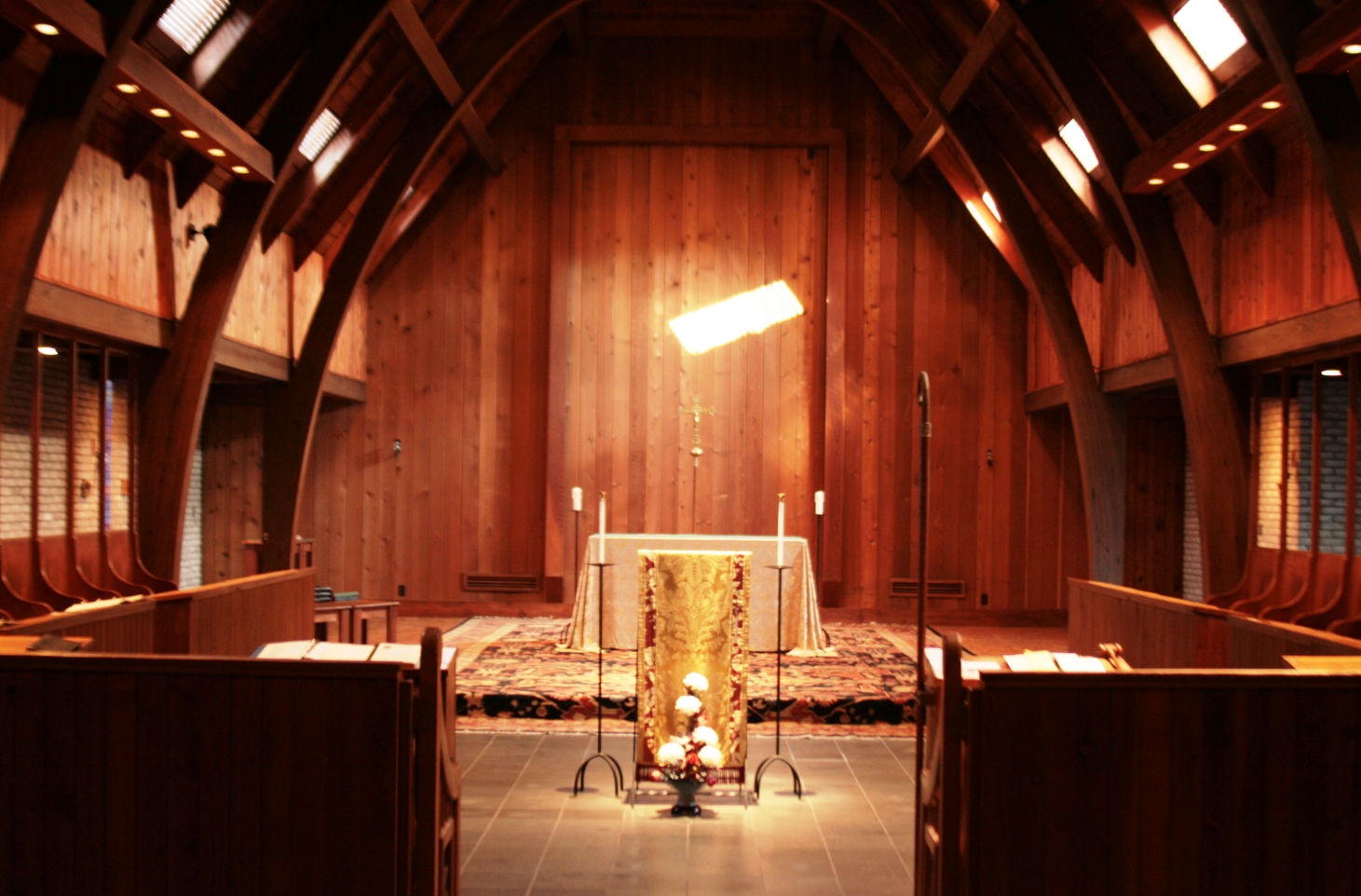
altarWhite 1When we celebrate an event like the anniversary of the consecration of the Abbey church, we are brought up short by the many negative things scripture says about temples and church buildings. Solomon humbly notes that not “even Heaven or the highest Heaven” can contain God, let alone a dinky temple in a backwater of civilization. Many of the prophets expressed discomfort or worse over the idea. David had wanted to build a temple but Nathan said God nixed it because David had fought too many battles that had made him impure for the task. A big part of the problem was that God wanted more elbow room than a temple would give. One of the more dramatic denunciations was Jeremiah’s admonition not to put any trust in stammering: “This is the temple of the Lord, the temple of the Lord, the temple of the Lord.” Fast forward to Jesus and we have him throwing the money changers and animals out of the temple.

What’s wrong with having a temple or a church building? Although Christians can and have worshiped in private houses, there are many practical reasons for having a building dedicated to worship, among them the problem of a host and hostess or their servants having to clean house before and after the service. Mircea Eliade famously pointed out humanity’s need of sacred space to draw attention to the Divine. St. Benedict affirmed the importance of the oratory in the monastery when he said that nothing else should be done there and nothing should be stored there so that there would be no mistaking this being the place for prayer and nothing but prayer. In throwing out the money changers, Jesus said that temple should not be a marketplace but a place of prayer.

There is an interesting detail in Matthew’s account of the cleansing of the temple that helps us understand Jesus’ actions in the temple. Jesus healed the blind and the lame who came to him there. We easily skip over this detail because Jesus was healing the blind and the lame all the time so yet another healing session doesn’t seem worthy of note. An obscure verse in Second Samuel sheds some light on this. When David brought his troops into Jerusalem, the Jebusites insulted David by saying that even the lame and the blind would turn him back. David reacts to the insult by heaping scorn on all lame and blind persons and barring them from the “house,” presumably once it was built. This was hardly fair to handicapped persons.

Jesus, by healing the lame and the blind was giving a strong signal that maybe he was the Messiah but if so, he was not a Davidic Messiah who would conquer by military might. More important, Jesus is giving us a positive teaching rather than simply denouncing the sacrificial cult. In short, Jesus was demonstrating, in action, the word of Hosea that God prefers mercy rather than sacrifice, a verse Jesus quoted more than once. In his first Epistle, Peter says we should rid ourselves of malice and all guile, insincerity, all slander and envy” so that we can become “living stones” “built into a spiritual house.” We are the ones who are called to be the temple of God, the Church grounded in Jesus who is the true temple. Being living stones that prefer mercy to sacrifice is how we do it. If we so allow ourselves by the grace of God to become such living stones, then having a place dedicated to precisely that is more than just fine.

Possessed by God

treeBlossoming1The First Epistle of John overflows with declarations of God’s preemptive love: “not that we loved God but that God loved us and sent his Son to be the atoning sacrifice for our sins” (1 Jn. 4: 10). This preemptive love of God is not just a vague benevolence but an action, and a sacrificial act at that. God did, and continues to act on our behalf. John goes on to describe God’s love as an abiding presence within us, what amounts to being possessed by God. Is this just an added treat in life? We can quickly see that being possessed by God is much more important than that. Many cases of possession of a different sort were recorded in the Synoptic Gospels where Jesus cast many demons out from people who were possessed by them. Without necessarily ruling out a supernatural provenance for some of these possessions, it is helpful to remember that René Girard’s theory of mimetic desire shows us how we can become possessed by other people, especially in rivalrous situations. (See Human See, Human Want.) We only need to reflect on how strongly another person we are at odds with has taken over us to realize how much another person can possess us. Crowds of people easily become possessed as the story of the Gerasene demoniac and the Passion narratives suggest. If we put John’s teaching of God’s indwelling love together with demonic possession, we are confronted with the conclusion that we are going to be possessed by somebody. It is not possible to remain aloof from the intentions and desires of other people. They will possess us whether we like it or not. The question is: By whom are we possessed? Jesus’ little parable about the evil spirit that was cast out but returned to the house “swept clean” with seven spirits “more evil than itself” (Mt. 12: 44-45) teaches us that casting out the spirit who has possessed someone is not enough. We must become possessed by the Spirit of one who is full of love, One who is not in rivalry with us or with anybody else.

Jesus’ image of the vine and the branches in John 15 gives us another take on the importance of being possessed by God’s love. Once again, we have the language of mutual abiding. The branches depend on the vine for both their lives and the vitality that gives them the power to act and bear fruit. This image reminds us of other vineyards in scripture. There is the song of the vineyard in Isaiah 5 which the owner prepared to bear good fruit, only to have it bear wild grapes. Jesus is surely referring to Isaiah’s song in his parable of the vineyard. The evil workers who killed the messengers and servants and then the owner’s son show us what a crowd possessed by rivalry looks like. Jesus’ teaching about the vine and the branches takes us much more deeply into the heart of this parable. The “wild grapes” who killed the owner’s son are branches that broke away from the vine. Having no life in them, they can only offer death to others. But if we do not break away, we are pruned of our competitive spirit so that we can bear fruit. Unlike the parable of the vineyard, the owner does not stop with laying out the groundwork; the owner continues to care for the vineyard over time, just as God sustains us so that we abide in God’s love and God’s love abides in us. This possession protects us from the possession of the persecutory crowd and frees us to bear fruit by acting on God’s preemptive love. This freedom opens our hearts and minds to discern what we can do with what resources we have to help others in need. This freedom is dangerous. It could strengthen us enough to follow Jesus into the depths of the collective evil spirit that had possessed the evil workers in the vineyard where Jesus pulled off the greatest exorcism of all time on the cross.

Longing for God’s Desire

treespath1In one way or another, human desire has always indicated that something is lacking. My stomach is empty so I desire to fill it with food. I don’t have as much money as I would like for the necessities and treats I want so I feel empty until I get enough money to get them. I lack the satisfaction of seeing my favorite baseball team win unless they win. If they do win, I am back to square one with the same emptiness and the same desire by the next day.

René Girard’s theory of mimetic desire pushes the lack that leads to desire a step further. We don’t just lack possessions or a girlfriend; we don’t know what food or what girl to desire until we see what food and what girl somebody else desires. As we learn from scientists’ study of our mirror neurons, we don’t necessarily desire what other people want because they want it or we think they want it. Rather our desires automatically resonate with the desires of others and we need to learn to navigate these resonances as part of human maturation. This prevents us from automatically copying every desire we see in others but the less conscious we are of the impact others’ desires have on us, the more likely we will be driven by others’ desires and the more empty we will be as a result.

Those desires of ours that are drawn from other people easily become conflictual. When that happens, the emptiness opened by mimetic desire deepens into an abyss. When we are wrapped up with a rival, it is never enough to have what the rival wants. As Girard points out, we need to become the other person. We believe (wrongly) that the other person has a certain fullness of being that we don’t have because they have—or seem to have—what we want but don’t have. So it is that we covet not just the ox or wife or car of another but the very being of another person. This is why we never have enough money or possessions or anything else as long as we are in rivalrous relationships. For Girard, this is not an ontological statement but an anthropological one. That is, it is about human relationships. The problem is that we can covet the being of another person until the end of the world and we’ll come up empty. Since the alleged fullness of being on the part of another is illusory, we are only “chasing after wind” (Eccl. 1:14).

Christian thinkers have consistently averred that we are instilled with a longing for God as a gift from God and that this longing means that we cannot be totally satisfied with anything else, no matter how wonderful. As the Psalmist says: our souls “thirst for the living God” (Psa. 42: 2).If we see mimetic desire as fundamental to humanity, it follows that this trait is willed by God and used by God in a fundamental way for our salvation. The certain lack of being caused by mimetic desire gives us an ongoing openness to God, an opening for God to enter into us and dwell within us as Jesus promised us in John’s Gospel. We are created to resonate with the desires of others so that we can resonate with the Desire of the other Other. The phrase “cdeep calls from deep: (Psa. 42: 7) has often been interpreted as the depths of our humanity crying out to the depths of God. This depth is our desire resonating mimetically with God’s Desire. While it is an illusion to think that a human rival has a plenitude of being, God really does have such plenitude. Moreover, God is infinitely generous with God’s plenitude of being. If we open ourselves to God’s Desire, we participate in that Desire is such a way that we can be equally generous with others.

Running Away from the Resurrected Life

yellowTulips1The ending of Mark’s Gospel is abrupt and enigmatic. So much so that the early Christian community added a “completion” that doesn’t connect well with what Mark wrote. There has also been speculation that the ending broke off from the manuscript or that Mark was nabbed by the Romans and thrown to the lions just before he could quite finish it.

The conclusion where the women run away because they are afraid is so strong that it is enough to make us forget that it is preceded by a ringing proclamation that Jesus has been raised and has already arrived in Galilee where he is waiting for them and the disciples. When we remember this proclamation and let it sink in, we realize that this enigmatic ending is not pessimistic or skeptical about the risen life about Jesus, but perhaps it is pessimistic, maybe even skeptical, about the ability of human beings to come to grips with the risen life of Jesus. After all, Mark’s Gospel was pessimistic about the ability of anybody to understand Jesus throughout, not least the closest disciples who made an especially poor showing of themselves with their obtuseness and in-fighting.

Mark is not unique in saying that the women at the tomb were afraid when they found the tomb empty. All of the Gospel accounts say as much. Moreover, whenever the risen Jesus appears to someone, he has to tell them not to be afraid once they recognize him (which they usually don’t at first.) What is unique to Mark is that he only says that the women were afraid as they ran off while Matthew says that the women left the tomb quickly with fear and great joy” (Mat. 28: 8). Moreover, in Matthew they did tell the disciples. What were they afraid of? What are we afraid of? Usually fear is our response to a threat. If I think a big dog might bite me, I am afraid of it. If someone drops some bombs over my house, I am afraid of being blown up. But what about Jesus who never bit anybody or blew anybody up? Well, we can be afraid of having our understanding of the world turned upside down and that is precisely what the Resurrection does. With Easter well-integrated into our yearly cycle of Christian worship, it can seem to be business as usual, but that is an illusion. The great value of Mark’s blunt proclamation followed by women the running off in fear like Goldilocks in triplicate is that it reminds us that the Resurrection is not business as usual; it is the bankruptcy of everything we thought kept us in the business of life.

But the Resurrection is a good thing, isn’t it? What is there to be afraid of? If the Resurrection is just a happy ending to a story we celebrate and then move on to the business of living, then the Resurrection isn’t much to worry about. But then it isn’t much to celebrate, either. There are other excuses for having a party. The women ran away from the tomb, not to have a party, but to get away from what had just broken apart their worldviews. And ours. So what worldview might we run away from? There is over two thousand years’ worth of theology to draw on to answer that question but the women at the tomb didn’t sit down and do a seminar on worldviews. They ran. What was so frightening was that they simply didn’t know what this new meant to them except that all bets were off. Remember, in Mark’s Gospel, nobody understood Jesus and the misunderstandings of him only got worse as the Gospel got on until the story ended with Jesus hanging on a cross. So, how could the women or the disciples understand what was happening to them? Maybe the disciples, maybe even the women who remained faithful to the end in tending to Jesus’ body, were relieved that the man they did not understand was gone. At least they could understand grief and resentment over what had happened. But Jesus wasn’t gone. They were going to have to go back to Galilee where the whole story started and try again.

Being sent back to the beginning suggests that God was giving them, and us, a second chance. They and we have the advantage of knowing the end of the story and we can use that as a key to what led up to it. We learn that the world was broken apart by a God who would choose to die on a cross rather than start a violent revolution but who remains alive in the face of such an appalling event and thus is a God who remains alive in the appalling events we face today. Worse than that, Jesus has broken the cycle of resentment and rage that, though painful, was tight and cozy and predictable. This means we havae to redefine the ways we relate to one another. Worse yet, we are threatened with the challenge of life that just isn’t going to let up now that death is broken apart. This Eastertide, let us go back to Galilee and see what else we can find.

Eating the Being of Jesus

AndrewWashingFeet - CopyThe Holy Eucharist has been accused of being a cannibalistic rite. René Girard would accept the accusation. In a snippet from an unpublished interview, he suggests that the Eucharist recapitulates the entire history of sacrifice and its violence and that history includes cannibalism. When I took a college course on African and Oceanic religions, one of the essay questions I was confronted with on the final exam was to discuss a few anthropological eyewitness accounts of cannibalistic practice. This was the first time I had encountered anything like it. What struck me about the accounts was how these people were intentionally absorbing, through ingestion, the being of the person, sometimes in mockery but more often in respect. (My take on these documents was affirmed by my professor with a top grade.) This is also Girard’s take. He ties this data into his analysis of the dynamics of mimetic rivalry where a rival moves beyond envying the possessions of another to envying the very being of the other. Interestingly, Jesus himself seems to agree with Girard and the anthropologists on this matter. In John 6, he uses strong language when he tells us that we must eat his body and drink his blood, words that suggest cannibalism and seem to have been interpreted as such by his grossed out hearers who, for the most part, went away so as not to hear anything more about it.

Cannibalistic language is often used figuratively in human speech and that is true of Holy Scripture as well. The psalmist affirms God’s deliverance from people who assail and devour his or her flesh (Psalm 27:2). St. Paul warns the Galatians that if they “bite and devour another,” they should take care that they “are not consumed by one another” (Gal. 5: 15). These examples refer to situations of serious mimetic rivalry and even if the psalmist’s enemies and the people of Galatia are “civilized” enough to rescind from literal cannibalism, they are indulging in the essence of that practice.

In what I have called the First Supper, Jesus reverses the cannibalism of devouring another person by freely offering himself, body and blood, in the bread and wine so that we may receive the being of Jesus as a free gift rather than as the spoils of a violent victory. This implies that his death on the cross is a Gift he gives to humanity and is not booty taken away from him against his will as is the booty taken by a conqueror.

What kind of personal being are we receiving when we receive the being of Jesus? In the early human centuries, people were absorbing the bravery and fighting skills of a worthy enemy who was defeated. With Jesus, what we get is something very different. This something very different is demonstrated in Jesus’ act of washing the feet of his disciples as a sign that we should serve one another in all ways. The personal being we receive in the Eucharist is one who, far from wishing to devour another person figuratively, would wish to build up another person in actuality. When we receive the being of Jesus, we receive personal courage beyond imagining, but it is not the courage of one who fights and wins battles against violent foes, but the courage of one brave enough to serve others, even to death on the cross.

God So Loved the World

NicodemusRight after Jesus had turned over the tables of the money changers in the temple and driven out the sacrificial animals, Nicodemus, a member of the Sanhedrin approaches Jesus by night. In the strange dialog that follows, we see Jesus reaching out to a member of the establishment that he has just challenged, but we also see this same establishment figure stammering as he tries to understand Jesus and fails. This is a time for stammering as it is a time of transition. Jesus has just ended the sacrificial age with his actions in the temple. The question is: What is the new age going to be?

Nicodemus is confounded when Jesus tells him that he cannot see the kingdom of God without being “born anew,” born “from above” by water and the Spirit. The water and the Spirit both suggest baptism. The Greek word baptizmo means to be overwhelmed and just as Jesus was overwhelmed by both water and Spirit in the river Jordan in the account in the synoptic Gospels. Jesus wishes for Nicodemus and all of us to be overwhelmed by both. In this dialogue, however, Nicodemus is overwhelmed with puzzlement and perhaps, so are we. Jesus then compounds Nicodemus’ puzzlement (and ours!) by suddenly shifting to Moses raising the bronze serpent in the wilderness, a mysterious event recorded in Numbers. The bronze serpent was raised during a social crisis driven by a plague. (Both the disease and the violence against Moses were contagious.) The phrase “lifted up” refers to Jesus being raised on the cross and then being raised from the dead. The bronze serpent, then, becomes an image of Jesus being raised on the cross to draw all people out of the society overwhelmed by violence into a new society as free of violence as Jesus is himself. It seems that being born “from above” entails being born from the raised up cross, which is the entry into a new way of living, what John calls “eternal life” several times in his Gospel. After all, St. Paul said that “we were buried therefore with him [Jesus] by baptism into death, so that as Christ was raised from the dead by the glory of the Father, we too might walk in newness of life” (Rom. 6:4).

This is the context of the famous words that follow in John’s Gospel: “For God so loved the world that he gave his only Son, that whoever believes in him should not perish but have eternal life.” (Jn. 3:17) These words echo, in a different key, the acclamation of the voice from heaven after the sky opened up declaring that Jesus is God’s beloved son in whom God is well pleased. Baptism, then, initiates us into this love of the heavenly father. If God so loves the world, then God is not bringing a winnowing fork or a rod of iron as John the Baptist expected, but is bringing only himself, wounds from the cross and all, to lift all of us out of the world’s overwhelming violence to overwhelm us with his love.

John goes on to assure us that God did not send the Son into the world “to condemn the world, but that in order that the world might be saved through him” (Jn. 3:18) These two verses should be strong enough to prevent us from thinking that the solemn verses that follow concerning condemnation take back even a smidgeon of the proclamation of God’s love. The judgment is not God’s judgment but the self-judgment of those who “loved darkness rather than light.” If God’s very Being is light and we don’t like it, what else can God do but keep on being the light until, hopefully, we learn to like it and then love it and so turn away from the darkness in our hearts and turn to the cross that gives us a new birth from above?

Treasures in Clay Jars: Veiled Missions

GregoryIcon1When Paul says that “we do not proclaim ourselves; we proclaim Jesus Christ as Lord and ourselves as your slaves for Jesus’ sake,” (1 Cor. 4: 5) he is forcefully rooting his identity not in himself but in Christ. We are easily prone to the illusion that we each have a self that belongs to me and is mine to do whatever I please with it.

This illusion of an individualistic self is the veil “that has blinded the minds of the unbelievers who are perishing.” It is the “god of this world” who has cast this veil. The veil is what René Girard identified as the persecutory mechanism that has marred humanity since the dawn of civilization. It was precisely this system that was exposed in the Gospels’ narratives of Jesus’ death and Resurrection. When Paul says that the Gospel is veiled to those who are perishing, he does not mean that God is casting people into hell; he means that as long as the Gospel is veiled, we perish in our own violence without even realizing it. When we are not rooted in Christ so as to proclaim Christ rather than ourselves, we are caught in the winds of human desires that carry us in all directions, all of them prone to collective violence. Moreover, we fall into cunning and falsification of God’s word and the shameful things we hide. These reflections seem to continue Paul’s discussion in the previous chapter of this epistle of the veil that covers the faces of Jews when they read the Torah, but by universalizing the veiling, Paul moves the unkind words about his own people. Universalizing the veil has the great advantage of showing that neither Jew nor Gentile has the thicker veil; all of us have it when we fall into systemic scapegoating violence.

Paul appeals to creation as providing the light that takes away the veil and gives us a glimpse of the world as it is meant to be. “For it is the God who said ‘Let light shine out of darkness’ who has shone in our hearts to give the light of the glory of God in the face of Jesus Christ our Lord” (2 Cor. 4: 6). It is the fall into systemic violence that has obscured this glory. It is inspiring that this glory of the created world shows us the face of Christ, a hint that Jesus planned to enter into Creation to enjoy the world with us and didn’t come up with the plan to be incarnate just to make repairs when things went wrong.

It is perhaps this vision of creation unveiled that inspired Pope Gregory to discern what elements of the English culture could be converted rather than rejecting them wholesale. He advised Augustine of Canterbury to convert the temples rather than destroy them. Of course, just as we have to practice discernment as to what must and can be converted and subverted in another’s culture, we have to practice the same discernment with the veils placed over our own faces by our own culture. The famous story of how Gregory, before he became pope, was inspired to promulgate an English mission is a case in point. Upon seeing some fair youths in the slave market in Rome, Gregory asked who they were. On being told that they were Angles, Gregory, in uttering one of the most famous of puns, said that instead, they should become angels. If anything embodies the persecutory mechanism, it is slavery. Chesterton suggested that Gregory could (or should) have meant: “not slaves, but souls.” The veil lifted enough for Gregory to see the youths as humans in need of salvation and, as pope, he sent a mission to do just that, but the veil did not lift enough for Gregory to agitate for the abolition of slavery, much as he was willing to be a slave himself for the sake of those in need of his pastoral care. That job was left to an energetic descendent of the people converted by Gregory: William Wilberforce.

Preaching in the face of such veils, not least our own, is a daunting task and it is no wonder Paul urges us not to lose heart in the process. It is enough to make us feel like clay and Paul tells us that feeling like clay is exactly the way we should feel when faced with the task of preaching the Gospel. When we realize that we are made of clay, as Genesis 2:7 teaches us, we appreciate what a great gift are the treasures inside the clay jars that are us, a gift from God so that we can “commend ourselves to the conscience of everyone in the sight of God” (2 Cor. 4:2).

Abolishing Sacrifice to Establish Mercy

Jesus_cleansing_templeThe story of Jesus knocking over the tables in the temple and driving out the animals shakes us up but then we wonder what we should be all shook up about. Jesus’ act can be seen as the climax of repeated protests of the Hebrew prophets against the sacrificial cult in the temple. Jeremiah mocked his listeners who jabbered: “This is the temple of the Lord! The temple of the Lord! The temple of the Lord!”  (Jer. 7:4). Then there is God’s mocking question from Psalm 50 and repeated elsewhere: “Do you think I eat the meat of bulls and drink the blood of goats?” Amos proclaims God’s hatred of festivals. Most telling are the words of Hosea that Jesus quoted: “I desire steadfast love and not sacrifice, the knowledge of God rather than burnt offerings” (Hosea 6:6.) There is much debate as to whether the prophets wanted the abolition of the sacrificial cult or a reformation that would bring it in line with moral values. In driving out not only the money changers but also the animals about to be sacrificed, I think Jesus is doing a bit of guerrilla theater to prophecy the end of the temple cult, a prophecy fulfilled in 70 A.D. when the combined violence of militant Jew and the imperialistic Romans resulted in its destruction.

When asked to explain his actions, Jesus said: “Destroy this temple and in three days I will raise it up” (John 2:19) This literalist interpretation is promptly debunked by the evangelist when he says that Jesus was “speaking of the temple of his body” (John 2: 21). So much for biblical literalism. The implication that Jesus is replacing the temple with his risen body is a strong indication that he intended to abolish the sacrificial cult. What was wrong with the sacrificial cult? The quote from Psalm 69 “zeal for your house will consume me” shows us the problem if we note the context. Psalm 69 begins with “Save me O God for the waters have risen up to my neck.” The psalmist tells God that he is suffering the same reproach people level against God: “the insults of those who insult you have fallen on me.” This psalm is referred to as one of the “passion psalms” and has been interpreted as a prophecy of Christ. However, I don’t think the psalmist was gazing into a crystal ball and seeing Christ’s Passion; I think the psalmist was complaining about collective violence that was happening to him at the time. The number of persecution psalms and the fate of many prophets, suggests that the Gospels are revealing the human tendency to solve social conflicts by uniting against a victim which is precisely the outcome Jesus predicts when he explains his actions at the temple. T

he prophets consistently denounced the sacrifices made on the “high places,” pagan sacrifices to deities like Moloch who even required the sacrifice of their children. The sacrifice in the temple was more humane in that it was restricted to animals, but the practice derived from the notion that “god” was angry and would be appeased only by sacrifices. The prophets’ denunciations of the temple cult were consistently coupled with denunciations of social violence and injustice where the poor were sold for a pair of sandals as Amos complained. Although it is argued that the prophets thought the temple sacrifices were acceptable, maybe even laudable, if accompanied with righteous actions in the social sphere, but they seem to have a sneaky suspicion that the practice of sacrifice tends to encourage social injustice. The temple setup was, after all, a terrible financial burden on the poor. (I think Jesus was not edified but outraged over the widow who gave the last two coins she had to live on.) The logic of sacrifice was that some living being was always dispensable precisely as the victims of collective violence at the times of social crises were dispensable and their deaths “necessary.” Caiaphas stated the sacrificial logic baldly when he said that it was better “to have one man die for the people than to have the whole nation destroyed” (John 11:50) In modern times this sacrificial logic is expressed by the regretful term “collateral damage.” These considerations suggest that the prophets were convinced that something was fundamentally wrong with sacrificial rites.

Jesus, on the other hand, has a totally different, opposite logic; a logic that Paul says is foolishness to the rest of the world. In John 6, Jesus says that everybody the Father gives him will come to him and nobody who comes to him will be driven away. The parable of the lost sheep makes the same point that it is not the will of our Father in Heaven that even one of his “little ones” should be lost. Jesus believed this so strongly that he would accept death on the cross to make the point and, more important, return as the forgiving victim to gather all who will come to him so that none of us should be lost. The pagan deities wanted sacrifices made to them. The prophets kept trying to get it across to everybody that God pours out sacrificial love to all of us through creation and redemption and that God wants the mercy God gives us in return, not sacrifices .  Caiaphas was willing to sacrifice Jesus and anyone else who put a spoke in the wheel of the sacrificial logic. Jesus was willing to sacrifice himself rather than sacrifice any of us. That is why we do not slaughter bulls on this altar but pass around the bread and wine through which Jesus gives His very self to each one of us.

Renouncing Self-Centered Renunciation

CrossofashesWith Ash Wednesday we begin a season of self-denial featuring prayer and fasting. We also renounce other pleasures to help us curb our desires a bit more than we do the rest of the year.

The asceticism of self-denial, especially that of fasting gives us an important of the interaction between mimetic realism. There is a paradoxical effect of self-denial that we can fall victim to if we are not careful. It is possible for self-denial to focus us upon ourselves in an unhealthy way. It is I who am fasting. I am giving up pleasures I normally indulge in. If we become so fixated on ourselves, we are puffing ourselves up rather than denying ourselves. Isaiah shows how such self-centered fasting leads to quarreling and fighting and striking others with their fists. (Isaiah 58:4) If self-denial has made us so grouchy that we have to make up for what we are giving up by giving ourselves the alternate pleasure of striking out at other people and putting them down, then it is grouchiness and lashing out at others that we must fast from.
Likewise, Jesus warns us against putting on long faces so that others will admire our fasting or blowing trumpets to call attention to our almsgiving (Mt. 6: 1-2). Once again, our self-denial is being compensated for by self-indulgence in other ways. When the admiration of others is filling our egos, then we need to fast from seeking such admiration. We may well find that this renunciation is harder than renouncing food and other pleasures. As we deepen renunciation, we become aware of deeper levels of our desires that need to be turned into a more positive direction.

Given this pitfall, I suggest that we emphasize the needs of other people and renounce ourselves by thinking of them rather than about ourselves. Isaiah suggests that a better fast would be to let the oppressed go free and loosen every yoke. (Is. 58: 6). Jesus echoes Isaiah’s sentiments at the beginning of his teaching ministry by proclaiming a Year of Jubilee that would free all people of their imprisonment to debt so as to give all a new start in life. (Luke 4: 16-20 Instead of puffing ourselves up, we should build up other people. Perhaps we will find this to be a greater renunciation that cutting back on our eating habits. In any case, renunciations of food and other pleasures will help us grow spiritually only if they are the basis for reaching out to other people. When we really think of others, we have less room in our hearts to think about ourselves.