
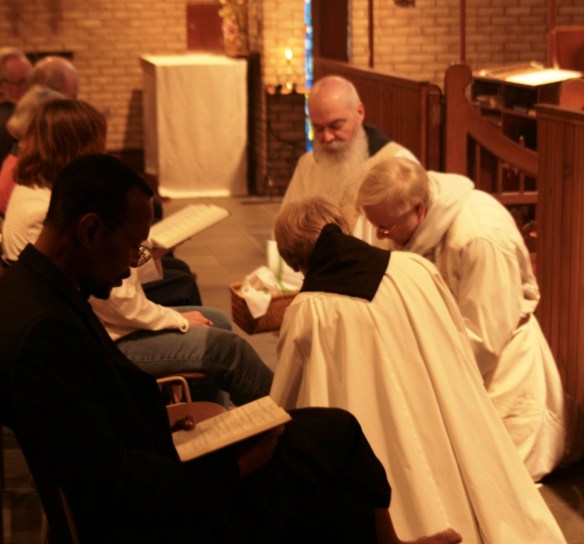
 The first verses of today’s Gospel (Lk. 12: 32–34) pick up from where we left off last week. That reading ended with Jesus’ little parable about the rich fool who tore down his barns to build bigger barns (Lk. 12: 12–21) only to find that his life was being demanded of him. This reading begins with Jesus’ soothing admonition to “sell our possessions and give alms” and “make purses for yourselves that do not wear out, an unfailing treasure in heaven, where no thief comes near and no moth destroys.” (Lk. 12: 32-33) This is quite a contrast to two brothers fighting over an inheritance or a rich person gloating over fabulous amounts of wealth. Lest we think Jesus is asking us to make ourselves miserable, Jesus assures us that it is our heavenly Abba’s pleasure to give us a treasure that is the kingdom. If this treasure, the kingdom, is the Abba’s pleasure, then it is our pleasure as well.
It is important to see that Jesus is not telling us to give up desires. The heavenly Abba has a profound Desire for a deep union of love with each of us, a union God would have us share with each other. If God is comprised of God’s Desire, than it follows that we creatures are created with desires. What Jesus is doing here is redirecting our desires from the desires of rivalrous avarice towards God’s Desire that is without rivalry. Isn’t every fight, ultimately, over what we think we are entitled to as our inheritance? Yet aren’t we all offered the whole world to be an inheritance rather than a bone for contention? Since these rivalrous desires embroil us with our rivals, the material inheritance we are fighting for is destroyed as if by moths. Of course, each rival blames the other for being the thief that has stolen the treasure.
Jesus then shifts to an admonition to be ready for the Master’s “return from the wedding banquet.” (Lk. 12: 36) If we servants are alert and ready to greet the master, the master will wait on us as Jesus waited on his disciples at the Last Supper. This little feast shared by master and servants is an image of the treasure our hearts should be set on. The progression of vignettes and admonitions throughout this chapter suggests that the best way to be prepared for God’s coming is to set our hearts on treasure that moths cannot consume and thieves cannot steal. Fundamentally, being alert for the “master” consists of serving one another in the same way that the master serves us when he comes.
The following little parable is comical and a bit threatening. The master who serves those who wait for him is transformed into a thief breaking into a house in the middle of the night. (Lk. 12: 39–40) If our hearts are not set on the treasure of serving one another, but instead we fight over our inheritance and try to gather it into bigger barns, then the God who serves us will be quite alien to us and will be perceived as a thief, a burglar. If our rivalry deepens as it does in the still more threatening parable that follows, so that our rivalry causes us to “beat the other slaves, men and women, and to eat and drink and get drunk,” (Lk. 12: 45), then the gracious master will indeed rob us of our victims.
God is both a burglar and a gracious master who serves. God only breaks in to take away all that draws our hearts away from God and from each other. What this burglar leaves in return is a treasure well worth setting our hearts on.
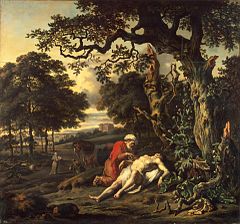 Many of us instinctively think that knowing is something we have in our heads, something we can recite, like a catechism. This is the sort of knowing that the lawyer demonstrates when he recites, correctly, the two great commandments when Jesus encourages him to answer his own question as to what he must do to inherit eternal life. (Lk. 10: 27) But then the lawyer shows a certain ignorance, a missing piece. He doesn’t know who or what his neighbor is. Jesus answers this question by telling a story that pinpoints exactly the missing piece in the lawyer’s cognition.
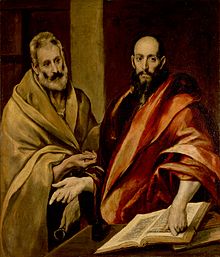 It is interesting and a bit ironic that we celebrate Saints Peter and Paul on the same day. Although there are famous icons of the two embracing one another in Christian love, the two seem not to have had an easy time getting along in real life. Although the two appeared to have been somewhat reconciled at the Council of Jerusalem in Acts 15, in his letter to the Galatians, Paul says that he opposed Peter “to his face” for backing down from what he thought they had agreed on. (Gal. 2: 11) The final chapters of John’s Gospel suggest tensions between the “Beloved Disciple” and Peter, and/or some tension between the two communities derived from them. The Beloved Disciple rests on Jesus’ breast at the Last Supper while Peter stubbornly tries to prevent Jesus from washing his feet. In her book Courting Betrayal,” Helen Orchard argues that Peter was resisting the slavish action of Jesus in washing his feet because he did not want to stoop so low himself. The episode of the Empty Tomb in John shows a rather awkward dance between the two where the Beloved Disciple gets there first but waits at the entrance and allows Peter to go in first. In this little tangle of a narration, both seem to have been first but not in the same way; which suggests some attempt to overcome the tension. In the final chapter of John, after the threefold question to Peter: “Do you love me?,” Peter points to the Beloved Disciple and asks” What about him?” Jesus answer basically tells us it is none of his business.
 We have a tendency to think of salvation as a personal matter. To some extent it is, but the way salvation is presented in scripture, it is never personal in an individualistic sense. In the case of the famous story of “The Sinful Woman,” we easily focus on the woman whose dramatic action is enough to grab our attention. However, her act is a public drama. Moreover, in very few words, Luke paints the social context of the woman’s behavior. She is a “sinful woman.” We are not told the nature of her sinfulness, so that is not relevant to what we should learn from the story. Simon, Jesus’ host at the dinner, assumes that Jesus should have known that the woman was a sinner and he should not have allowed her to anoint and dry his feet with her hair, actions that further proved the woman’s sinfulness in Simon’s mind. Simon may have been expecting Jesus to have supernatural discernment, but he may have simply expected Jesus to know who had a bad reputation and who didn’t. In any case, it is a social judgment that has labeled this woman as sinful. That is, this woman shows all the signs of being the community scapegoat who helps everybody else feel good about themselves.
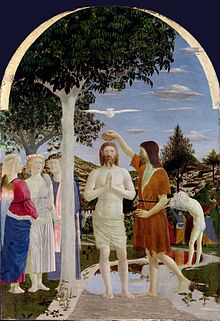 There is much theology that treats the Trinity as a mathematical game, trying to work out how three can be one and one can be three. But math, important as it is for many things, is not the way of salvation.

 An early Easter throws many things awry, not least the saints’ calendar. St. Benedict’s day is normally celebrated on March 21, but this year, it was transferred to Monday after Easter Week. Thinking about St. Benedict in terms of Easter reminds me of what he said about Lent in Chapter 49 of his Rule.
 Luke’s version of Jesus’ Resurrection is much the gentlest among the synoptic Gospels. No earthquakes and no women running off so afraid that they can tell nobody what they had seen at the empty tomb. The women were, indeed, terrified of the two men in “dazzling clothes” who appeared to them. But by the time, but before long they have remembered, with prompting from the men in white, Jesus’ words to them.
 Jesus’ prayer in the garden of Gethsemane may well have been the loneliest moment of all for Jesus. His disciples were not able to stay awake with him. Much worse, his disciples still seem not to have understood anything of what Jesus had tried to teach them. At what he knew would be his last meal with his disciples, a meal when he had poured himself into the bread and wine to give his life to his disciples and all others who would follow him, his disciples fought yet again about who was the greatest. (Lk. 22:24–26) As he had done many times before, he told his disciples that the one who would be first would be the one who served, but he must have realized his words had had the same effect as before.
 Imaginary Visions of True Peace