
Unfinished Story

We all like a story that ends happily with the loose ends tied together in satisfying ways. It makes us feel good, especially if the good guys had to overcome the machinations of the bad guys and the bad guys got what they deserved. Likewise, a symphony that ends triumphantly raises our spirits. The only thing wrong with these things is that real life isn’t like that. Yes, there are happy and satisfying moments and what we might call mini-happy endings, but happily ever after isn’t a sure thing, as Sondheim showed in his musical Into the Woods where we see just how grim the ever after can be. (Among many other things, Cinderella’s marriage with Prince Charming is on the rocks.) These thoughts suggest that the feel-good happy endings are illusory. The hard reality of real life can feel all the harder for it. A more positive way to look at it is to take the happy endings eschatologically. In God’s good time, everything really will be worked out. There is much comfort in this hope and it is fundamental to the Christian vision, but sometimes we need more direct and realistic encouragement and hope along the way. Sometimes an ending to a story that doesn’t resolve everything or even anything, or a symphony that ends with chords that hang in the ear, is actually more comforting (The sixth and ninth symphonies of Ralph Vaughan Williams are good examples of this.)

Easter Sunday tends to be celebrated as the ultimate happy ending. Yes, Jesus suffered a horrible death, but he came through alive and well and happy and the gates of eternal life have been opened to everybody. But with a lectionary that gives us Mark’s Resurrection story every three years, we get something very different. It ends with a group of frightened women running away from the empty tomb in spite of the angel’s announcement of Jesus’ Resurrection. All this after a totally bleak account of a god-forsaken Christ dying on the cross. What kind of happy ending is this? From the earliest Christian centuries to the present day many have had trouble believing Mark would end his Gospel this way. That is why there are a couple of additions clumsily attached to the end that don’t even remotely match the style of Mark’s writing and outlook.

For those of us who feel better with a happy ending, Mark is a real downer. But the advantage of an unresolved ending is that it can give us pause to think about some things we might not think about if blinded by a happy ending. The frightened women running from the empty tomb make it clear that the strife indeed isn’t over and the battle isn’t done as many horrifying current events make clear. The women thought they would anoint the dead body of Jesus, but that didn’t happen. Ending the Gospel with the women anointing the body to match the anointing of Jesus’ head at the house of Simon the Leper just before the passion would have been a satisfying bittersweet ending. But we don’t ever get that. So what hope do we get from the frightened women?

For one thing, a big thing, if we don’t really know what to make of the Resurrection, if we aren’t sure what it really means for our lives, we can take heart from these women who also didn’t know what to make of it. If we feel flat-footed and flat-brained about the Resurrection, these women in their awkward, frightened flight were obviously flat-footed and flat-brained themselves. This can give us space to ask ourselves what it really does mean that Jesus is risen from the dead. How do we live with a Jesus who died but who isn’t dead after all and is very much alive here and now? When we ask ourselves these questions, the answers are hardly obvious and we are then in a position to let the questions linger rather than prematurely clutching at a fully resolved happy ending.

Mulling over these questions can help us notice that the other Gospels also leave unresolved cracks in their narrations of the Resurrection. In Matthew and Luke, where the women are reported to have told the other disciples about the empty tomb and the angel’s message, the disciples think the women are out of their minds. Nobody seems to recognize Jesus at first when he appears. Why? The moving story of the journey to Emmaus is especially illuminating. The two disciples on the road are downcast, not the least cheered up by the rumors of what the women had said. But at least they are asking questions and this gives Jesus the opportunity to lead them into further insight as to what has happened. The story of Jesus becoming recognizable in the breaking of the bread and then disappearing leaves us hanging, but it leaves room for more to come. These disciples who listened to Jesus as he opened the scriptures to them have much more to learn and to look forward to, even if they don’t know what all of it is.

The ending in Mark is so abrupt because it isn’t really the end. It is the beginning. Galilee is where the story began. The disciples are told to go back and make a new start and we are told to do the same. The obtuseness and cowardice of the disciples throughout the Gospel aren’t the last word after all. Jesus isn’t finished with them and he isn’t finished with us either. Forgiveness is sneaking in right when we weren’t expecting it. With the stage cleared of Jesus, the disciples, the women, we are all that is left with the angel to prod us on. This Gospel is our story now and it will never have an end any more than the Risen Christ has an end. Will we return to the beginning of the story and live it ourselves? Let us sit quietly with the risen Christ with all our puzzlement and disorientation and prayerfully let the Risen Lord fill our hearts and minds with the Risen Life.

The Passion in the Eucharist

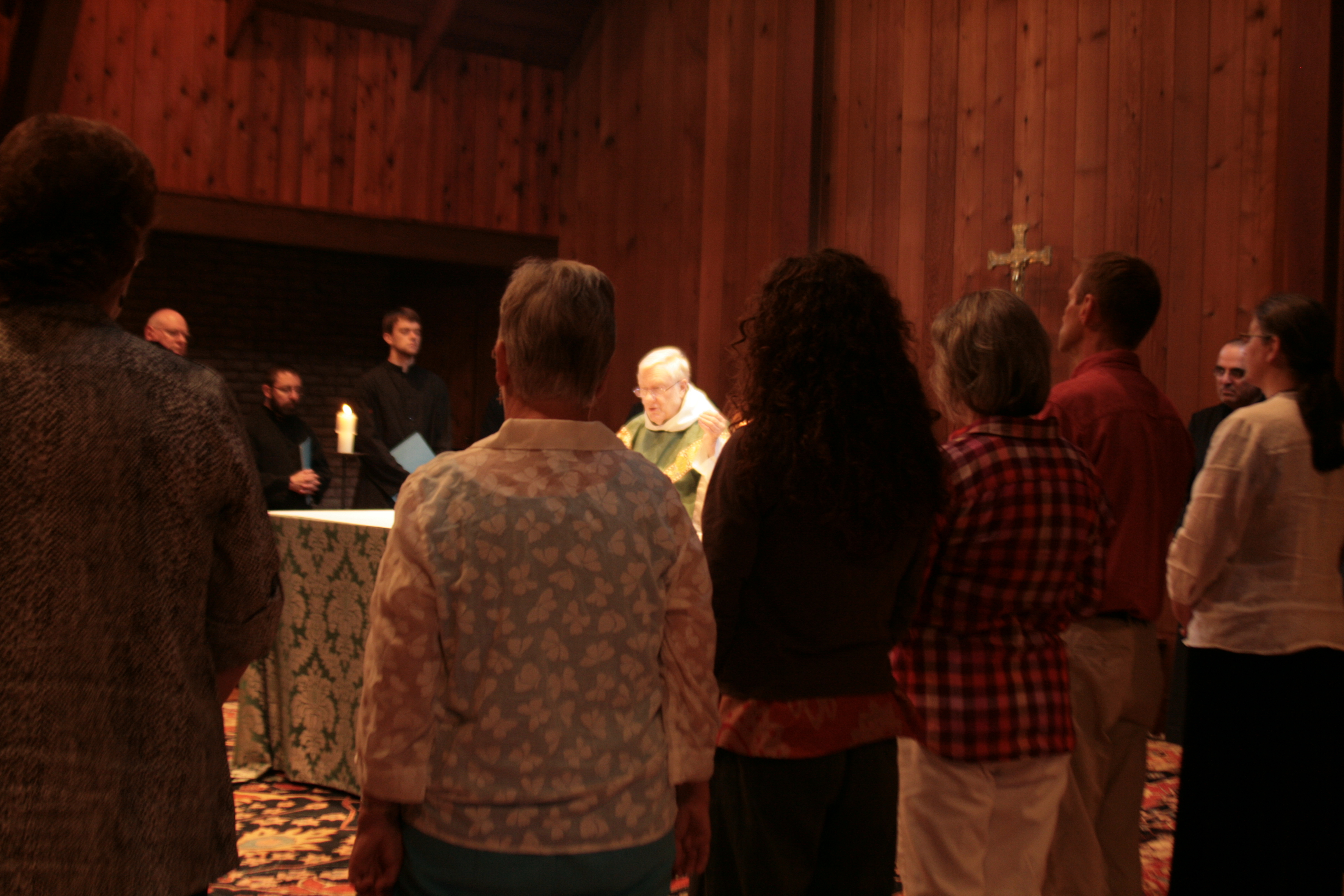
The Eucharist makes present the death and Resurrection of Jesus at each celebration, regardless of the occasion. So it is that we don’t even celebrate the birth of Jesus without celebrating his death as well. But in commemorating the Last Supper of Jesus, the Eucharist on Maundy Thursday is particularly close to the Passion, being the meal during which Jesus was suffering the anxiety he was soon to express at Gethsemane.

While reflecting on this matter, I came across a few lines on this very theme by Gerard Manley Hopkins, one of my favorite poets. They made up an epigraph of a chapter in Brian Zahnd’s new book The Wood Between the Worlds,” a powerful meditation on the Cross, Not only was I moved by the lines, but I was surprised to come across some lines by Hopkins that I didn’t recognize since I thought I had studied all of his poems multiple times. That little mystery was solved when I found out that it is an early work, one written while still a student at Oriel College in Oxford, and still an Anglican. So it is only included in the most complete collections of his works. I might have read it before without it registering, but the few lines singled out in Zahnd’s book really caught my attention, as I’ve said.

The poem is called “Barnfloor and Winepress” and it pulls together the Passion of Jesus and the Eucharist into an inextricable knot, making it most appropriate for Maundy Thursday. With wrenching, sometimes violent imagery embodied in hard sounds that put Hopkins, even in this early work, decades ahead of his time, the poem provides a powerful example of how the ugliness of Jesus’ crucifixion permanently affected the aesthetic possibilities in all of the fine arts as the ugliness is sublated in the moral beauty of Jesus’ self-sacrifice and his vindication in the Resurrection. The first stanza includes these lines that use the Eucharistic imagery of the making of bread:

Thou that on sin’s wages starvest,
Behold we have the joy in harvest:
For us was gather’d the first fruits,
For us was lifted from the roots,
Sheaved in cruel bands, bruised sore,
Scourged upon the threshing-floor;
Where the upper mill-stone roof’d His head,
At morn we found the heavenly Bread,
And, on a thousand altars laid,
Christ our Sacrifice is made!

And in the second stanza, lines using grape and wine imagery to the same effect:

Thou whose dry plot for moisture gapes,
We shout with them that tread the grapes:
For us the Vine was fenced with thorn,
Five ways the precious branches torn;
Terrible fruit was on the tree
In the acre of Gethsemane;
For us by Calvary’s distress
The wine was racked from the press;
Now in our altar-vessels stored
Is the sweet Vintage of our Lord.

We have in these powerful stanzas a kind of transubstantiation, not only of the Eucharistic elements that Hopkins was clearly believing in as a high-church Anglican, but a transubstantiation of the suffering of Christ into the Eucharistic elements. The violent human sacrifices throughout human history, both before Christ and after Christ up to the present day, are transmuted into the bloodless sacrifice on the altar. (The phrase “terrible fruit” reminds me of Billy Holiday’s “Strange Fruit.”) No wonder Brian Zahnd refers to this poem in a chapter that argues that the crucifixion of Jesus is the ultimate center of human history. Even while humans continue to commit the same old same old violence as we see most painfully in Ukraine and Gaza right now, God has transformed all of it for all time. Hopkins expresses this insight in poetry:

In Joseph’s garden they threw by
The riv’n Vine, leafless, lifeless, dry:
On Easter morn the Tree was forth,
In forty days reach’d heaven from earth;
Soon the whole world is overspread;
Ye weary, come into the shade.

And then the profoundest transubstantiation of all: the transubstantiation of us into partricipation in the divine nature, one not untouched by the sufferings of Christ supporting our own:

The field where He has planted us
Shall shake her fruit as Libanus,
When He has sheaved us in His sheaf,
When He has made us bear his leaf. –
We scarcely call that banquet food,
But even our Saviour’s and our blood,
We are so grafted on His wood.

The World God Loves

John 3: 16: “God so loved the world that he gave his one and only son” seems to be almost everybody’s favorite Bible verse. I don’t mind being a non-conformist when called to be and I have been known to get a conceited pleasure out of being one, but this is among my favorite verses too. However, the very popularity and familiarity of the verse can perhaps dull us to its power to impact our lives.

I will work with what seems an innocuous question: What is the world that God loved enough to send the Son into it? The word kosmos in normal usage had a neutral connotation, meaning the world in general, the world that happens to be. This corresponds to normal usage in English. In John’s Gospel, however, the word has a highly negative connotation, closer to the negative connotations of “worldly,” only much stronger than that. Most New Testament scholars interpret the word as John uses it as “the world-against-God, the world in rebellion against God,” as I learned it in seminary. Curiously, much preaching on this particular verse, including my own, seems to make it an exception; thinking of the world in a neutral way. But what if this isn’t an exception? What does this verse look like then? What does the world hostile to God look like, and what kind of deity would want to get messed up with it?

The reading from Numbers gives us a snapshot of the world against God. One would think that their deliverance from Egypt would earn some gratitude on the part of the Israelites, but all they do is grumble angrily about the hardships in the wilderness. (Num. 21: 5) When attacked by poisonous snakes that image their poisonous behavior, they repent. That’s something, but they Israelites show a pattern of turning against God time and time again when things get tough. The snake Moses puts on a pole saves the people. This smacks of sympathetic magic but surely God is telling us something here. What we have is poison driving out poison. Many medicines operate on the same principle; the Greek word pharmakon from which we get the word “pharmacy” means both medicine and poison. Somehow, God uses the poison of rebellion to cure the rebellion, perhaps because the plague reveals the truth of the poison of their rebellion. Paul writes that to the Ephesians that they “followed the ways of the world”—using “world” in much the way John does—following the desires and thoughts of “the flesh.” (Eph. 2: 2–3) One could say they were deserving of wrath because they embodied it.

In the John’s Gospel, we see much of “the world” in the sense of the rebellious world. The debates between Jesus and the enemies John calls “The Jews” are very intense. Their accusations that Jesus is possessed of a demon when he offers them freedom from sin make them look demon-possessed themselves. (Jn. 8: 48) These debates make painful reading on account of their ferocious character. In contrast to the frenzied emotive outburst of rebellion in these debates, John also shows us the cold calculating style of rebellion. When Lazarus is raised from the dead, they react to the resurrected life with a plot to kill Lazarus as well as Jesus since people are following Jesus because of this resurrection. And then there is the cold calculation of Caiaphas who says that it is better that one man die for the people than that the whole people perish. (Jn. 11: 50) John seems to have no love for these enemies of Jesus. Surely God can have no love for them. John’s dramatic portrayal of their enmity tends to reinforce our own rejection of these enemies. But these enemies are the kosmos. They are the kosmos God loved deeply enough to send his beloved son into it.

Right before John declares this love on God’s part, Jesus alludes to the serpent in the desert: “Just as Moses lifted up the snake in the wilderness, so the Son of Man must be lifted up, that everyone who believes may have eternal life in him.” (Jn. 3: 14–15) Jesus has turned this unsettling and cryptic gesture into a prophecy. The poison of rebellion on the part of Jesus’ enemies leads to Jesus being raised on a cross and the poison of this rebellion becomes the cure for the very same rebellion. In Ephesians, Paul, who himself had been a rebellious enemy of Jesus, experiences this very same love that motivated God to give God’s only begotten Son to make him, and us, who were dead in transgressions, alive in Christ. Not only alive, but raised up with Christ and seated with him in the heavenly realms. (Eph. 2: 4–6)

All of this sounds great–and it is beyond great–but John warns us of the judgment that the Light came into the world and we preferred darkness to light. (Jn. 3: 19 ) As the kosmos works to protect its rebellion to this blinding light, it falls into blinding darkness. How? If we slip into the default neutral understanding of “world” in the great verse proclaiming God’s love, we think this “world” is us—the good guys, and the world in rebellion is some other world—the bad guys who rebelled against Jesus. Paul had no illusions of this sort after his Damascus experience. But do we see the truth of our own grumbling in the deserts in life? Do we see ourselves as part of the kosmos Jesus loves in spite of our rebellion? Asking ourselves these questions as honestly as we can is a fundamental Lenten practice. Further on in Ephesians, Paul stresses that Christ’s raising us to His life has destroyed the barrier that had polarized Jew and Gentile–the ultimate embodiment of an us vs. them spirituality in Paul’s day. If we think this love is intended for us and not for them, we have fallen deeply into the darkness, preferring it to the Light that came into the world. Being among those who believe and have eternal life, then, is not a mental act of thinking something is true; it is about opening our eyes to the light, letting that light blind us, and then stumbling in the light instead of in the dark. It is this bumbling and stumbling that leads into the quality of life that is eternal life where there are many rooms in the Father’s house. (Jn. 14: 2)

Singing Jesus to Sleep

In Christian devotion (and in many other religious traditions as well) there is much praise to God for creating the world. That God would consider it worth while to make a world with living creatures in it is astounding; an occasion for contemplative awe. According to the Psalter, the rivers clap their hands and the mountains sing together for joy. (Ps. 98: 8) Needless to say, the Psalmist expects humans to praise God at least as much as that if not more.

The traditional celebration of the Christ Child is enriched by the inclusion of nature. It is true that Luke doesn’t mention animals except for the sheep tended by the shepherds, but where there is a manger, there are animals, and the Magi probably didn’t walk great distances when camels were available. The tradition of farm animals being present to welcome Jesus into the world is inspired by the words of Isaiah: “The ox knows its master, the donkey its owner’s manger, but Israel does not know, my people do not understand.” (Is. 1: 3) Isaiah obviously thinks the animals are better at praising God than humans. Meanwhile, the angels really show us how to whoop it up over the pastures where the shepherds are tending their flock.

It is amazing that in spite of all the human failure to praise and obey God, the Creator entered God’s own creation as a human being, as frail as any other. That is quite a lot of downward mobility for one in whom “all things were created: things in heaven and on earth, visible and invisible, whether thrones or powers or rulers or authorities.” (Col. 1: 16) It really is too much for us to take in. Like Mary, we need to treasure these things and ponder them in our hearts. (Lk. 2: 19)

In addition to all the carols about ox and ass tending the baby Jesus and the lovely carol Angels We Have Heard on High, there seem to be more Christmas lullabies than there are stars in the sky. The lullaby for Jesus, Schlaf, mein Jesu,” (Sleep my Jesus) sung by the alto soloist in Bach’s Christmas Oratorio is among the most beautiful. As a choir boy, I sang several lullaby carols. One of my favorites was a Czech carol called the “Rocking Carol” with flowing melodic lines accompanying the lovely melody.

From the dawn of humanity, mothers have been lulling their babies to sleep. It seems quite possible that lullabies may be among the oldest songs conceived by humanity. They are among the first songs that children learn. I still remember several from early childhood, especially the Irish lullaby: “Too-ra-loo-ra-loo-rah.” It is both fitting and a deeply sound intuition to assume that the infant Jesus would have been lulled to sleep like every other baby, his divinity notwithstanding. Nothing could more deeply affirm his full humanity. The lullaby Christmas carols give us entry into a devotion of rocking Jesus to sleep as an act of devotion.

Because God became a child who was lulled to sleep, every child is Jesus, just as each person is the least (and therefor the most) of his brethren. Like every baby, Jesus was fragile and needed to be handled with care. When he grew up, nails could be driven into his hands just as easily as with any other human. Because of Jesus, every baby, every person, needs to be handled with the same gentle care expressed in these Christmas lullabies. The same applies to the whole eco-system, which is both resilient and frail, so that heaven and nature can have something to sing about. Quite a lot for us, like Mary, to ponder in our hearts.

Czech Rocking Caro lhttps://www.youtube.com/watch?v=wpa2qjIxolY

How to Look Forward to God

From time to time, some of us, probably most of us, are overcome with a feeling that something is about to happen. What it is that is coming is usually vague as in the celebrated song from West Side Story: “Something’s coming, I don’t know what it is/ But it is gonna be great.” Perhaps this longing turns out to be wishful thinking, or maybe something comes but it turns out not to be as great as hoped for. But then there are times when something really does come. John the Baptist proclaimed in the desert a conviction that something momentous was about to happen, even if he didn’t know exactly what it was going to be: “After me comes the one more powerful than I, the straps of whose sandals I am not worthy to stoop down and untie. I baptize you with water, but he will baptize you with the Holy Spirit.” (Mk. 1: 7–8) With Advent being the time of expectation and preparation, John the Baptist is a focus because of his own vocation of prophetic expectation. So how can we deepen our expectations today through his expectations in his time?

Past history can give us some sense of direction about what might be coming, as it did with John. If a parent tells a child that a special treat is coming, the child’s expectations are fueled by the special treats given previously, even if they don’t make the next treat predictable. Mark quotes the opening verses of Isaiah 40 to indicate the history that fueled his expectations. The verses in Isaiah proclaim the miraculous return of the Israelites to Jerusalem at the end of the Babylonian Exile. This remembered act of deliverance raised hope that God would do yet another great new thing in the present time of need under the Roman occupation which had exiled the Jews in their own country.

As for the present time, John did not know specifically what was coming but, from our vantage point, we know that the infant Jesus had been born and we also know what happened when this child grew up. Does that mean that for us there is no suspense? No. When we read a story for a second or third time, we may know how it ends but we find ourselves understanding much more about what the ending means by going through the story again. Surely none of us have exhausted the meanings of Jesus’ birth and death and resurrection! To give a telling example: John himself seems to have been off the mark when he said someone “stronger” than he was going to come as Jesus was born a helpless infant and Mark stresses Jesus’ weakness on the cross. Or is this weakness an unimaginable strength beyond John’s grasp? The Greek word ischyros used here means physical strength, but it can also refer to spiritual and moral strength. What does all this mean to us? We have much insight and inspiration to look forward to!

Like John, we look to the future with trepidation and hope. The author of Second Peter captures our apprehensions today by predicting that “the heavens will disappear with a roar; the elements will be destroyed by fire, and the earth and everything done in it will be laid bare.” (2 Pet. 3: 10) That does not sound reassuring and surely is not what God wants for us; it is obviously a human possibility. But in the midst of such trials, we have a “new heaven and a new earth” to look forward to. Such a new heaven and new earth is beyond imagining; surely they are not like the mediocre visions of heaven that one literary critic referred to as a move from second class to first class accommodations attested to in bad poems..

Is our hope and expectation hopelessly vague? The prophecy in Isaiah can help us now as much as it helped the Israelites at the time of the return from exile. The road may be rough, but God will make the rugged places a plain. (Is 40: 4) Moreover, God will lead us as a shepherd leads the sheep and, again beyond imagining, “the glory of the Lord will be revealed.”

What do we do in the meantime? One thing we can and must do is wait, poised and ready for something to come. Even the impatient adolescent Tony sang in his song: “Yes it will/ Maybe just by holding still, it’ll be there.” If Tony can hold still until he meets Maria, we can hold still until we meet our God who is surely coming to meet us. The other thing we can and must do is repent. We need to straighten out the rough valleys and hills within ourselves that obstruct a highway of God, and we need to turn away from the ways we inflame the earth and turn to ways we can make the earth new. John preached and enacted a baptism of repentance; Jesus’ first admonition after being baptized himself was: Repent. Repent and wait: that is what Advent is all about. Meanwhile, something is coming from God even if we don’t know what it is.

What Kind of Messiah?

After deflecting several questions from the Pharisees, Jesus poses a question of his own:” What about the Messiah? Whose son is he?” (Mt. 22: 42) Predictably they answer: “The Son of David.” That was a standard assumption at the time. Then Jesus quotes the opening verses of Psalm 110 with its Messianic overtones. Since David was believed to be the Psalmist and to be speaking to the Messiah, Jesus asks how David can call his own son “Lord?” The Pharisees can’t answer the question and, typically, Jesus doesn’t answer it either, but lets the question hang. The question has been hanging ever since.

It seems likely that Jesus was questioning the notion of a Davidic messiah who would do what David did—win lots of battles against Israel’s enemies. As Jesus became more and more aware that he was the Messiah, the question became: What kind of a Messiah should he be? If the prevailing notion of a Davidic Messiah was not it his calling, what was his calling?

The question posed to Jesus immediately preceding the dialogue about the Messiah, asking him what the greatest commandment was, and the answer Jesus gave to that question, suggests an alternative understanding of the Messiah that Jesus was beginning to arrive at. It seems that Jesus was beginning to think he was the “Lord” addressed by David. This lead to the question: what kind of Lord should he be? Should he be a Lord whom other people were supposed to love with full heart, soul, and mind? Or was Jesus, as Lord, also to love his Lord, his heavenly Abba, with full heart, soul, and mind? This thought hints at what became known later as a high Christology, that is a Christology that affirms the divinity of Jesus. That Jesus, divine as he himself was, would turn to his heavenly Abba for guidance suggests Jesus was more interested in honoring his heavenly Abba than he was in being an object of adoration. As it turned out, Jesus learned what was at stake in loving his heavenly Abba with full heart, soul, and mind at Gethsemane. Here, Jesus, Lord as he was, was a Messiah who was deeply vulnerable as a human.

The second great commandment that Jesus cited was taken from Leviticus: the love of neighbor as oneself. (Lev. 19: 18) In Leviticus, this commandment, along with several others in the list, is framed by the Lordship of Yahweh. What is most striking about the great commandment in Leviticus is that it is in the context of not seeking revenge or bearing a grudge. The Davidic model, of course, is all about bearing a grudge against Israel’s enemies and seeking revenge against them in battle. In this verse in Leviticus, Jesus was seeing a different model for the Messiah: one who shares his heavenly Abba’s love for all people and in this love, will forswear revenge when he is killed and raised from the dead. Not what the Pharisees seemed to have been looking for.

When Paul came to see that Jesus was the Messiah, did he see a Davidic Messiah? The way he presents himself to the Thessalonians is a resounding No. Far from seeking praise from others, he cared for them as a nursing mother cares for her children. (Thess. 2: 6–8) Moreover, he suffered persecution as they suffered persecution. Sounds like he modeled himself on the way Jesus came to understand his messiahship in terms of following the two great commandments.

Disobedient Brothers

Since I commented on the Parable of the Two Brothers and the Vineyard in my book Moving and Resting in God’s Desire, I will quote my brief comments here:

One brief parable Jesus told are about two brothers, asked by their father to work in the vineyard. One said he would go but he didn’t, the other said he wouldn’t go but then he did. Which did the will of the father? (Mt. 21:28-32) Jesus’ listeners took the bait and took sides, but I don’t think that is the way to respond. Short as this parable is, it suggests that the two brothers are embroiled in mimetic rivalry to the extent that they always say the opposite of what the other says and do the opposite as well. That is, they react to each other and not at all to the father. Both then, have failed to respond to the father and both are in need of forgiveness and mercy. When Jesus responds to his listeners by pointing out that tax collectors and prostitutes believed John the Baptist and they didn’t, he is hinting that the victims of their mimetic rivalry are entering the Kingdom ahead (and maybe instead) of them.

The rivalrous context of the parable increased the likelihood that Jesus’ listeners would hear the parable rivalrously as I suggest they did. The chief priests and elders were trying to stoke tensions, which were already high, by asking Jesus by what authority he did the things he did, most especially his provocative act of cleansing the temple. Jesus deflected the question by asking them if they thought John’s baptism had come from God or was only John’s human initiative. Since the chief priests and the elders were not willing to publically commit themselves, Jesus was not going to commit himself either. He must have realized that they were not going to admit that Jesus’s authority came from heaven any more than they would admit the same of John.

It is worth noting that fraternal strife is a running thread throughout the Hebrew Bible, starting with Cain and Abel. Except for Abel who was killed, the “righteous” brother who wins each struggle can in some ways be seen to be compromised, such as Jacob having trouble believing in Esau’s forgiveness and Joseph testing his brothers severely before reconciling with them. This same fratricidal strife continues throughout Israel’s history with the strife between the divided kingdoms. The parable can also be taken as referring to fraternal strife between Jew and Gentile as is conventionally done, another layer of fraternal strife on a broader scale in Israel’s history. This strife suggests that nobody had both committed to going to the vineyard and actually doing it.

The famous hymn in Philippians 2 shows how Jesus renounced rivalry in a radical way, the same way that Jesus renounced rivalry in his altercations with the chief priests and elders. Since Jesus was not in rivalry with anybody and his attention was directed to the will of his heavenly Abba, Jesus said he would go into the vineyard and went. In this way, Jesus’ authority came from heaven. It is this obedience and renunciation, that, as Paul’s hymn says, led Jesus to the cross where his death offers us a way out of the rivalry that marked not only Israel’s history, but the history of all humankind.

See also Moving and Resting in God’s Desire

The Voice of the Canaanite Woman

The opening verses of Isaiah 56 and the 11th chapter of Romans celebrate the incorporation of the Gentiles into the blessings bestowed on the Jewish people by God. Both of these passages make the integration sound as easy as pie but most other portions of scripture suggest that the matter is far from easy, so perhaps the pie is in the sky, well out of reach. The Jewish people had a lot of bad history with Gentile nations, both from being aggressors in the conquest of Canaan and from being oppressed by Egypt, Assyria and Babylon. In Romans, Paul struggles, not with Gentiles, but with his fellow Jews who have, for the most part, failed to accept Jesus as the Risen Lord. We know from this epistle as well as several others, that Paul also struggled with fellow Jews who did accept Jesus but had trouble accepting the Gentiles if they would not accept the Torah.

We can see this tension in the Gospel. Jesus treats the Canaanite woman harshly when she asks him desperately to heal her daughter of a demon. (Mt. 15: 21-28) It is possible, as many scholars suggest, that Jesus was testing the woman to provoke her to her strong act of faith. I’m inclined, however, to think that Jesus himself struggled with the request from an enemy people. Significantly, Matthew’s designation “Canaanite woman” is anachronistic; Mark is more contemporary by calling her a Syro-Phoenician woman. The Syro-Phoenicians tended to collaborate with the Roman rulers, so the bad blood is both current and historical. As a human person, Jesus would have been born in a social milieu where these tensions would have been absorbed from an early age.

Curiously, Jesus does seem to be a little more patient, or at least less impatient, than the disciples. While Jesus is silently letting the woman pester him, as if at some level he is willing to put up with her, the disciples are urging Jesus to send her away, Jesus finally says to the woman that he was sent only to the lost sheep of Israel. When the woman persists in crying out for help, Jesus shockingly tells her that it is not right to toss the children’s bread to the dogs. One might think this sort of insult would cause the woman to give up and turn away, but she persists with the retort: “Even the dogs eat the crumbs that fall from their master’s table.” This plea converted Jesus, convincing him that she had great faith and her faith had healed her child. How might these words have changed Jesus, assuming he needed to be changed in relation to the woman? The woman’s words are quite disarming in the way they absorb the insult without reprimanding Jesus–or do they in a way? As I continuously reflect on the dynamics of race relations in our country, one of the things I am beginning to notice is how black people have to be very careful about what they say to whites who have the power. I am beginning to see that those of us who are white don’t pick up on this sort of dynamic very well. We take our superiority so for granted we don’t see it and can’t hear it.

But Jesus did hear the undertone. As a Jew living in an Empire run by the Romans, Jesus would have known very well the fine art of speaking truth to power. Usually, he would have been in the same subordinate position in relation to a Syro-Phoenician. But this woman was desperately in need and had come to Jesus only to be trashed on account of her ethnicity. The role-reversal would have been startling to Jesus. Suddenly, he was being treated as the oppressor–which he was at the moment. Jesus, who had come to serve, not to be served by oppressed people, would suddenly have been awakened to the truth of his attitude to the Canaanite woman and to the rest of her people, He wastes no time in commending the woman’s faith and proclaiming the healing of the woman’s daughter.

There is much else in this narrative to suggest that Matthew places it in a process leading to the mercy of God to the Gentiles through Jesus. For example, this narrative takes place between the two feedings in the wilderness which are often taken to refer to feeding the lost sheep of Israel and then feeding the Gentiles. The “dogs” get quite a few crumbs from the table after all and so they receive the mercy the woman asked for.

But what is important about this story is that it leads us into our own struggles with racism and other ethnic prejudices. Many of us think we have done the job by denouncing prejudice and racism but we overlook the instinctive reactions we absorbed before we were conscious of what we were absorbing. Jesus heard the voice of the oppressed in the Canaanite woman that we often fail to hear. Just as Jesus, in his humanity, struggled with accepting the cup of his passion in Gethsemane, Jesus here struggled with his own teaching to love his enemy. Just before this incident with the Canaanite woman, Jesus has said that it is what comes out of a person that defiles, not what comes in. We might say that prejudice does defile us to a certain extent as it enters us, but it is when it comes out of us that it seriously defiles us. In the end, love and compassion rather than prejudice came out of Jesus.In his own conversion. Jesus gives us a powerful example of the need to be converted by hearing and seeing and then casting out the demons of prejudice that hold all of us in bondage.

Wisdom’s Children

In reaction to the rejections of John the Baptist and himself, Jesus said: “I praise you, Father, Lord of heaven and earth, because you have hidden these things from the wise and learned, and revealed them to little children. Yes, Father, for this is what you were pleased to do.” (Mt. 11: 25-26) These words seem comforting and edifying but our reactions to these words tend to be governed by the resentment we feel for people who are members of an elite of some kind, experts in particular. But does Jesus really mean for us to assume that experts in biblical exegesis, for example, fail to see what ignorant people see? During the COVID pandemic, we saw severe outbursts of this resentment by people who thought they knew more about how to avoid catching the disease than the experts who created the vaccines and urged everybody to take them. Such virulent resentment is hardly the kind of insight Jesus is affirming. Although the experts seem to have done pretty well in the case of the COVID vaccines, it has to be admitted that in the past, experts have turned out to be wrong. The history of medicine is littered with ruinous theories and practices. A troubling example is that roughly up to the middle of the twentieth century, many expert scientists thought they had proved the “truth” of white supremacy. Nowadays, the opposite is the case. It helps when experts admit it when they are proved wrong. This example also suggests that something else is needed besides expertise in order to see the kind of truth Jesus would have us see, something different from what experts learn. As the famous song from South Pacific reminds us, racism needs to be “carefully taught.” Do small children have this knowledge Jesus wants until carefully taught otherwise by the world’s experts, as suggested by the famous story of Jesus welcoming the small children when the disciples try to keep them away?

Just a few verses before the one quoted here, Jesus refers to the antics of children to illustrate the rejections of John and himself. In the marketplace, children cry out:

          "We played the pipe for you,
          and you did not dance;
          we sang a dirge,
          and you did not mourn.”  (Mt. 11: 17)

Is this the wisdom of children seeing what Jesus’ heavenly Abba wants us to see? In one respect, perhaps yes, insofar as the children are calling out the shortcomings of their elders, complaining that they don’t rejoice with their playful joys and don’t mourn and comfort them when they are hurt. But at the same time, the children are imitating the accusatory behavior of their elders which their elders are leveling against John the Baptist and Jesus. They are pretty well along to growing up to do the same thing the grownups are doing.

The children’s taunts can give us a notion of what Jesus’ heavenly Abba wants children of all ages to see. John the Baptist, by preaching repentance could be said to be the singer of the dirge. Because of our sins, it was a time for mourning and many did that, but the rest accused him of having a demon. Jesus came to celebrate a new way of life, his eating with tax collectors and sinners being one of the ways he healed people, but that made him a winebibber and a glutton. People like John and Jesus can’t do anything right. It is precisely this accusatory attitude to life that warps the expertise of experts and corrupts small children, leading to racism among many other evils.

As was said in the Wisdom literature, there is a time to mourn and a time to rejoice. (Eccl. 3:4) Mourning with those who mourn and rejoicing with those who rejoice centers our lives on the lives of others just as Jesus centered his life on others by eating with sinners like us. Small children have no choice but to be dependent on those bigger and stronger than they. They need their elders to mourn with them and rejoice with them. That does give children a head start, but they lose the advantage when they follow their elders in the game of every person for oneself and accusing others for their own shortcomings. Perhaps those who mourn are blessed and comforted because they mourn with those who mourn while thirsting for righteousness. This purifies our hearts so that we can see what God is doing in other people so that we can rejoice together in God’s Kingdom. (Mt. 5: 4, 6, 8)

See also: Jesus’ Yoke

How To See

Often my father would say: “I see, said the blind man.” He wasn’t making fun of blind people; he wasn’t the kind of person. But he was indicating that he understood something conceptually. It is this same kind of seeing that is at work in the story of Jesus’ healing of the man born blind in John’s Gospel.

I recently came across a story out of the sixth century Gaza monastic tradition that offers a profound commentary on this Gospel narrative. A monk had developed a profound hatred of a fellow monk and decided he would find a way to get this fellow monk into trouble. Since the fellow monk was a bad monk, he was obviously guilty of something, so getting him into trouble should be no trouble at all.

This hateful monk kept a sharp eye out for anything his hated fellow monk did wrong and–sure enough!–he saw this fellow monk wandering among the fig trees, picking figs, and eating them. This sort of gluttony was most unbefitting a monk! He ran straight away to the abbot and told him what he had seen.

The monk’s vengeful glee did not last long. The abbot informed the monk that he had sent the slandered monk off on an errand for the monastery and there was no chance that he was eating figs at the time when the vengeful monk saw–or thought he saw–him doing that. The vengeful monk was proven to have been seriously deluded and was shamed before the community for his slanderous accusation.

In the world view of the sixth century monastics, the illusion was caused by demons and the story was told to warn monastics of the tendency of demons to cause such illusions. What we can see easily enough today, just as the sixth-century monastics could, is that it was hatred on the part of the monk that inspired the demons to give him such an illusory sight. The monk thought he could see, but was blinded by his own hatred. We see much the same dynamic at work in the Gospel story: the accusatory “Jews” thought they could see but were blinded by their hatred of Jesus and, by extension, of the man Jesus had healed. The formerly blind man loved Jesus for what Jesus had done and could see clearly at all levels. Imagine what this vengeful monk could have seen if he had loved his follow monk! Did he learn to see after this incident as God meant him to see?