

Jesus’ “new commandment” to his disciples that they should love one another (Jn. 13: 34) is simple. Or is it? If it were as simple as it seems, everybody would love one another and everything would be fine. But everything is not fine. Violence continues to break out time and time again. We get a strong hint as to the difficulty of this simple commandment by noting the context immediately surrounding this new commandment. Judas has just left the group to betray Jesus. Does this new commandment apply to him?
In the First Epistle of John, the author expresses this new commandment (1 Jn. 2: 8) by saying: “whoever loves a brother or sister lives in the light” but whoever “hates another believer is in the darkness.” (1 Jn. 2: 10–11) When Judas left Jesus and the disciples, John said: “And it was night.” (Jn. 13: 30) This verse is often understood symbolically. Judas has rejected love of Jesus and the disciples and so he is in darkness. Does this mean it is okay to hate Judas who is no longer a believer? Is this how we follow Jesus’ “new commandment?”
In his first epistle, John follows up the love commandment with a denunciation of the “antichrists” who “went out from us” but did not “belong to us for if they had belonged to us, they would have remained with us.” (1 Jn. 2: 19) So, the “antichrists” had, like Judas, betrayed the Johannine community and once again, we face the pain we suffer through betrayal. The tone of John’s denunciations of the “antichrists” suggests that the new commandment does not apply to them any more than it applies to Judas.
Does the new commandment mean it is okay, even righteous, to hate traitors? That is the impression the First Epistle of John seems to give. We all know how difficult it is to have anything but hatred for those who betray us. Loving a traitor seems impossible. For a small community living under pressure and threat, it must have been doubly difficult to forgive those who betrayed them. In Matthew and Luke, however, Jesus commands us to love our enemies. St. Paul and St. Peter say the same in their epistles. Moreover, the story of Peter being called to preach to the centurion Cornelius is a powerful example of Israel being called to expand God’s love to their traditional enemies, the Gentiles.
It follows that whatever John may have thought about loving traitors and enemies, the overall teaching in the New Testament would have us understand Jesus’ new commandment in John as extending to everybody, even Judas. We should note, however, that although the synoptic Gospels don’t express the same cold anger at Judas, there is no indication of forgiveness for him, either. The thrust of these reflections is that the new commandment does extend to Judas but that John is also very frank about how difficult, even impossible, this simple commandment is.
The key out of this impasse is the rider Jesus adds to the new commandment: “Just as I have loved you, you also should love one another.” (Jn. 31: 34) We are very prone to loving as we love one another. A big part of the way we love one another is to intensify our love by hating our enemies, especially those who have betrayed us. By abiding in our love for others, we hate those who are outside our group. If we abide in Christ’s love, then our love for others expands even to our betrayers because it is no longer our love, but Christ’s that moves in and through us. After all, Jesus had presumably washed the feet of Judas before Judas left. Might Jesus still want Judas to come back to the table? Would we welcome Judas if he should return?
For further reflections on this theme see http://girardianlectionary.net/reflections/year-c/easter5c/
 An early Easter throws many things awry, not least the saints’ calendar. St. Benedict’s day is normally celebrated on March 21, but this year, it was transferred to Monday after Easter Week. Thinking about St. Benedict in terms of Easter reminds me of what he said about Lent in Chapter 49 of his Rule.
 Luke’s version of Jesus’ Resurrection is much the gentlest among the synoptic Gospels. No earthquakes and no women running off so afraid that they can tell nobody what they had seen at the empty tomb. The women were, indeed, terrified of the two men in “dazzling clothes” who appeared to them. But by the time, but before long they have remembered, with prompting from the men in white, Jesus’ words to them.
 Jesus’ prayer in the garden of Gethsemane may well have been the loneliest moment of all for Jesus. His disciples were not able to stay awake with him. Much worse, his disciples still seem not to have understood anything of what Jesus had tried to teach them. At what he knew would be his last meal with his disciples, a meal when he had poured himself into the bread and wine to give his life to his disciples and all others who would follow him, his disciples fought yet again about who was the greatest. (Lk. 22:24–26) As he had done many times before, he told his disciples that the one who would be first would be the one who served, but he must have realized his words had had the same effect as before.
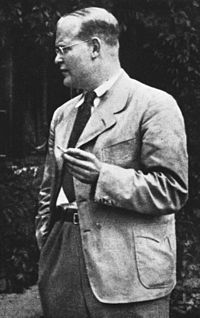 Passiontide is an appropriate time to reflect on the life and witness of Dietrich Bonhoeffer. Charles Marsh’s book A Strange Glory is a great resource for this.
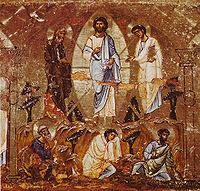 We celebrate the Transfiguration of Jesus at the end of Epiphany to prepare ourselves for Lent. This is a joyous feast where the Light of Mount Tabor should inspire us for the days of penance and then entering into the Paschal Mystery of Christ. However, there is a discordant element in the reading from St. Paul that I want to focus on. He, too, writes of the inspiring light of the Transfiguration, but he also writes about the veil over Moses’ face. This refers to the story in Exodus where Moses put a veil over his face when he came down from Mount Sinai with the tablets of the Law because his face shone too brightly for his fellow Israelites to look upon. (Ex. 34: 29–34) Paul goes on to say that the Jews remain veiled when they hear the words of the Law. In light of Holocaust, this verse causes much uneasiness, all the more so as it has been used to justify anti-Semitic attitudes and behaviors.
 Paul’s famous Hymn of Love zeroes in on what love, as agape, is all about: “Love is patient; love is kind; love is not envious or boastful or arrogant or rude. It does not insist on its own way; it is not irritable or resentful; it does not rejoice in wrongdoing, but rejoices in the truth.” (1 Cor. 13:4–6) In these qualities, we can see love as a deep renunciation of mimetic rivalry. Insisting on our own way, being resentful, rejoicing in the shortcomings of others, are all ways of putting ourselves on top of other people. Surely this short list is meant to stand for any attempt to put ourselves above other people. As long as we try to “win,” we lose at love. When we are willing to “lose,” we win at love.
 At his baptism, Jesus heard a voice from Heaven saying: “You are my Son, the Beloved; with you I am well pleased.” (Luke 3: 22) These words ring out in Psalm 2, addressed to the king, the Messiah, who is being singled out from the nations that are raging together and rising up against the Lord and his anointed. Similar words are spoken to the Servant of Yahweh in Isaiah 42:1. Throughout these songs of the Suffering Servant, he is being called out of a violent society to become instead the victim of that society’s violence. Unlike the Psalmist who threatens the raging nations with a rod of iron, the Suffering Servant does not retaliate against the violence inflicted on him. Jesus begins his mission, then, with a powerful acclaim of unconditional love from his Heavenly Father, a sense of unconditional love he will offer to all who will listen.
 The angels say to the shepherds: “Do not be afraid.” (Luke 2:10) They say the same to us today. What are we afraid of? The shepherds were afraid of the glory of the Lord shining about them. That sounds like a good thing, but most of us aren’t used to glorious light filling the night sky any more than the shepherds were. Even the most devout of us would at least be startled if such a light shone around us. When Herod heard of the birth of a child destined to be a king, he was afraid. Caesar Augustus would have been as afraid if he had been told about Jesus’ birth. His successors were sufficiently afraid to persecute the followers of Jesus for three centuries. What were they afraid of?
 Imaginary Visions of True Peace