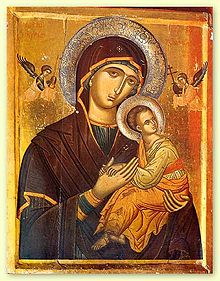
Few words of Mary, the Mother of Our Lord, are recorded in scripture. Among these few words, the most momentous are: “Let it be to me according to your word.” With these words, Mary accepted the conception of the Christ Child in her womb. It is a deep wonder that God, the Master of the Universe, would deign to be dependent on a human being in order to enter the world. It is this same deep wonder that God continues to depend on us to let the Christ Child continue to be born and live in the world that God has made.
In his poem The Blessed Virgin compared to the Air we Breathe, Gerard Manley Hopkins explores this mystery among many others with these lines:
Of her flesh he took flesh: He does take fresh and fresh, Though much the mystery how, Not flesh but spirit now And makes, O marvellous! New Nazareths in us, Where she shall yet conceive Him, morning, noon, and eve; New Bethlems, and he born There, evening, noon, and morn Bethlem or Nazareth, Men here may draw like breath More Christ and baffle death; Who, born so, comes to be New self and nobler me In each one and each one More makes, when all is done, Both God’s and Mary’s Son.
Note that Hopkins is telling us that saying Yes to God is not something done once and for all; saying Yes is something that must be said time and time again, every day, every hour, without ceasing. The New Self, the nobler us takes time.
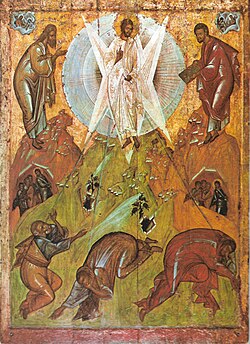
The story of the Transfiguration of Jesus on Mount Tabor is as disorienting as it is blinding. It was also disorienting and blinding for the three apostles Jesus had taken up with him. Obviously, Peter didn’t know what to say, so we shouldn’t feel bad if we don’t know what to say, either.
One of the more fascinating and powerful reflections on this story is at the heart of the theology of the 14th century Greek theologian St. Gregory Palamas. He suggested that the light of Tabor was the working of the uncreated energies of God. This energetic light, the Light of Tabor, embodies God’s self-giving to us, a giving of Godself, that is deification. Not human self-deification, but deification as a gift from God who gives us everything that God has. This concept hasn’t gained much traction in Western Christianity, partly because it doesn’t compute well with many forms of Western theology. However, for those who find traditional Western theology problematic, the Palamite notion is perhaps an attractive alternative. For what it’s worth, I think the clash between Western and Palamite notions explodes into a powerful mystery which is deeper than one set of concepts alone.
There is much more to the radiance than blinding brilliance. The Hebrew word kabod, also means glory in the sense of honor. This is also true of the Greek word doxa that translates the Hebrew. When we glorify a human being for great accomplishments, there is a sort of radiance we put around them. Saints are often painted with a nimbus when portrayed in art. However, there is a tension at the root of glorification. It almost always seems to be accompanied by derision and dishonor. In fact, the Greek word doxa means dishonor as much as it means honor. The people we honor by putting on a pedestal are knocked over in a heartbeat if they don’t meet our expectations. Artists like Igor Stravinsky and Bob Dylan have both been greatly honored, but both were denigrated when they changed their artistic visions away from projected expectations. This is what happens when fans make idols of the people they adore; they create little boxes to put them in.
What about Jesus? Jesus had received much glory and honor from his numerous followers, not least the three disciples who Jesus took up the mountain with him. But the more some praised Jesus, the more energetically others denounced him. In all three synoptic Gospels, the Transfiguration marks a turning point where Jesus heads towards Jerusalem where he will be denounced, mocked, and crucified. The honor given Jesus turns to dishonor. What about the disciples who experienced the Transfiguration? When Jesus told them what was coming, they resisted Jesus’ resolve and argued among each other as to who was the greatest. I can’t help but suspect that they were basking in the derived honor given Jesus up to that point and, rather than receiving glory from God, wanted to receive glory from the other followers of Jesus. Like modern day fans of celebrities, they were putting Jesus into boxes of their own making, turning Jesus into an idol. The disciples were blinded by their warped understanding of honor at least as much as they were blinded by the brilliance of Jesus’ shining garments.
We can gain more insight into glory by reflecting on the presence of Moses and Elijah with Jesus on the mountain. They were the two most glorified figures in Jewish history. Moses, by receiving the Law on Mount Sinai from God himself shone with the reflection of God ‘s light to the extent that he had to wear a veil. Elijah was the greatest of prophets. Both, however, also experienced dishonor. Several times the people threatened to stone Moses, and Elijah was a fugitive from royal power. Both were implicated in violence, especially Elijah in his contest with the prophets of Baal. They were in the position to know well what was going to happen to Jesus. Moses’ best moments, when he was most Christlike, was when he was interceding for the people to turn God’s wrath from them, even when the same people were directing wrath at him. Elijah, alone in a cave, heard God in the sheer silence of the wilderness. As for Jesus’ disciples, the Book of Acts shows them breaking out of the idolatrous boxes they had made and acting like their Master in self-giving, preaching, and healing, the divine energies clearly working through them.
There is reason to believe that the Transfiguration of Jesus was, at least in part, to prepare the disciples for the suffering Jesus would have to endure, and that they, too, would have to endure. At a deeper level, they were being prepared for the challenges of the Resurrection Life of Jesus that would energize them when the time came. As we prepare for Lent, perhaps we can make it our Lenten project to let the light of the transfigured Christ reveal our own warped notions of honor and dishonor so that the divine energies championed by Gregory Palamas can energize prayer on behalf of other people, especially those who dishonor God, a prayer enveloped in sheer silence.
There is much puzzlement about the parable of the mid-manager who is dismissed from his office. (Lk. 16: 1–9) Not least is the question as to whether we should called him “the Dishonest Manger,” as does the NRSV, or the “unjust manager” as many other English translations have it. The Greek word here is adikaios. This is in the dikaios word group which normally is translated as “justice “ or “righteousness.” Here, it is preceded by the alpha privative so that literally it means a manager without justice or righteousness. Dishonest mangers do have that lack, but since the word dikaios occurs frequently in the New Testament meaning justice and/or righteousness, I think it is preferable to say that the manager is unrighteous rather than dishonest. The unjust Judge who would only do justice for the widow when pestered by the widow was also described by the word adikaios, which is clearly best translated as “unjust.” (Lk. 18: 6) There is a significant difference in the two English terms and since this parable is very opaque, we can use all the clarity we can get. This understanding of the word gains more credence when we note that the unrighteous manager is not accused of embezzlement but of squandering the property of the rich man who had hired him. There is also the matter of the rich man acting on hearsay without apparently doing any independent investigation.
The unrighteous manager’s inner dialogue is realistic and pragmatic. He is quite clear about the ulterior motive behind his scheme of lowering the debts of his former boss’s clients: that these people will welcome him into their homes for what he has done for them. It appears that the unrighteous manger is cheating his former master, but it is possible that he was receiving a commission on the notes and was deducting what would have been his share. That the former master chuckles over what his fired employee has done suggests that he had not suffered further loss over these transactions. It’s hard to see how the Kingdom of God can be like this sort of moral muddle, and Jesus does not, in fact, say the Kingdom of God is like this. So what does a parable like this have to do with the Kingdom of God?
The parable suggests that handling money is intrinsically problematic, and the greedier one is, the more problematic it is. Both the rich man and the people who owe the rich man material goods come across as wanting best value for their money. Almost all of us do that and that is why this parable mirrors our involvement with money and other material goods. Calling the wealth “unjust” rather than “dishonest” better captures the systemic injustice of the world’s economic system. The unrighteous manger is the only one in the parable who acts generously even if that is only under duress: unless the “squandering” of the rich man’s property involved being generous with the goods he was responsible for. Given recent events, I can’t help but think of the refusal of some politicians to “squander” money on helping those most in need of assistance.
Indeed, Jesus shifts the focus from handling money in this world to the relationship between how generous we are with money in terms of our eternal destiny: “And I tell you, make friends for yourselves by means of dishonest wealth so that when it is gone they may welcome you into the eternal homes.” (Lk. 16: 9) Jesus then goes on with a few other comments, the most pertinent being “No slave can serve two masters, for a slave will either hate the one and love the other or be devoted to the one and despise the other. You cannot serve God and wealth.” (:Lk. 16: 13) The rich man and the clients who owe the rich man goods are caught in serving wealth, while the unrighteous manager seems to have freed himself from it to some extent. By mirroring the morally chaotic life of pursuing wealth, Jesus alerts us to the need to escape this rat race by aiming for “the eternal homes.” So where is the Kingdom of God? It isn’t here unless we all practice the generosity of the unrighteous steward which disrupts the system he was living in up to the time he was fired.
Jesus’ teachings of love for one’s enemies and returning good for evil (Lk. 6: 27–31) are deeply inspiring and edifying as long as one doesn’t live by them. There is a tendency to regard these teachings as one regards a beautiful work of art: wonderful to look at but not something to guide my life. In any case, this teaching suddenly becomes not so beautiful when somebody maliciously wrongs me. All of a sudden, revenge is as compelling as it is sweet. That is to say, forgiveness is very difficult when the wrong is serious, when one has suffered badly on account of what another person has done. People who suffered serious abuse as children struggle with the pain all their lives and understandably have great difficulty forgiving their abusers. Pressuring such a person to do the “Christian” thing tends to amplify the pain of the abuse.
Taken in isolation, the moment Joseph forgives the brothers who had sold him into slavery (Gen 45: 4–9) seems to work smoothly, making forgiveness seem simple. But if one considers the whole story of which this moment is the climax, it is clear that the forgiveness did not come easily. The ordeals that Joseph subjected his brothers to once he recognized them may possibly be a calm and calculated attempt to test their moral fibre, giving them a chance to show improvement, but the ordeals come across to me as vengeful and punishing. Would Joseph have kept Benjamin in Egypt and sent the other brothers away if nobody protested the orchestrated framing of Benjamin? Who knows? It is Judah’s offer to take his brother’s place that breaks down the hostility Joseph had shown up to then. And when their father dies, the brothers still fear that Joseph will take revenge on them and Joseph has to reassure them.
The Anglican theologian Sarah Coakley noted that in the Hebrew Bible, forgiveness is considered to be the prerogative of God alone. The only verb besides the Hebrew verb “to forgive” which was reserved to God alone is bara, “to create.” Creation and forgiveness make a powerful pair of prerogatives. This is why when Jesus pronounced the forgiveness of sins, he was accused of claiming to be God. Perhaps it is as impossible for humans to forgive as it is impossible for humans to create a world out of nothing. But if it is not our place to forgive sins, why does Jesus tell us to forgive even our enemies? If we are not capable of forgiving them, which often seems to be the case, is Jesus asking us to do the impossible?
Paul’s powerful proclamation of the resurrection of the body in 1 Cor. 15 doesn’t seem to be relevant to the question of forgiveness, but maybe we should examine the question in case it is relevant after all. Paul makes it clear that the resurrection body is a gift from God. (1 Cor. 15: 38) We are not capable of giving ourselves a resurrection body and nobody is telling us that we should try. Is forgiveness as impossible as giving ourselves a resurrection body? If the resurrection body is a recreation, then maybe the answer is Yes. Later on, Paul tells us that the physical body is created out of the dust, as was the body of Adam, and we are created in that image. But the heavenly body is created according to the image of “the man from heaven,” which is Christ. Could it be that Jesus, in claiming the divine prerogative of forgiveness, is passing on that prerogative and ability to us as fundamental to the our re-creation in Christ? Joseph forgives his brothers in the context of divine providence. Such discernment makes forgiveness much more possible. For myself, I have experienced forgiveness, not as an accomplishment, but as a gift from God. I did not forgive another person; God forgave that person through me.
Let us return to the notion that Jesus’ teaching on love of enemies is like a beautiful work of art. Are we really unaffected by a work of art that we admire deeply? No. A work of art may not seem to have any practical value, but it has an effect on one who encounters it. Over time, the effect of a work of art can sink down into a person to the extent that it brings about a small transformation. How much more could the beauty of Jesus’ teaching of forgiveness and love of enemies sink more and more deeply into us over time, bringing us closer and closer to what Paul called “the Mind of Christ?”
During the governorship of Nehemiah, when the walls of Jerusalem were rebuilt to protect the returning exiles from Babylon, the scribe Ezra read the Law of Moses to the people.(Neh. 8: 1–12) The Law of Moses taught the Jews how they were to live together in community under the God who had first delivered them from Egypt and latterly, from Babylon. The people wept. Was that because they realized how short they fell from what the Law of Moses required of them? Or did they weep for joy because they knew what was asked of them and knew what to do? In any case, Ezra told the people to go and have a great feast to celebrate the reading of the Law. Touchingly, Ezra told them to send portions “to those for whom nothing is prepared, for this day is holy to our Lord.” (Neh. 8: 10) Clearly, such sharing is what the Law of Moses is all about.
In his First Letter to the Corinthians, Paul teaches the values of Christian community through the analogy between the human body and the Body of Christ. (1 Cor. 12: 12–31) Both are one while composed of many members, each with a distinctive function for the benefit of the whole. Each member has need of all the other members, even, rather especially, the supposedly weaker members of the body. If a member of the body were to be considered foreign and so expelled, the whole body would suffer the loss.
Luke inaugurates Jesus’ ministry with his appearance at the synagogue in Nazareth. While Ezra read the Law of Moses, Jesus read from the prophet Isaiah, after which he said: “today this scripture has been fulfilled in your hearing.” (Lk. 4: 21) This implies that Jesus himself has been anointed by the Spirit and that he is bringing about what Isaiah had prophesied. That is, Jesus is bringing good news to the poor, proclaiming release to the captives, recovery of sight to the blind, freeing the oppressed, and proclaiming the year of the Lord’s favor. Quite a lot to proclaim in a society where many people were imprisoned in many ways, blind in many ways, and poor in many ways. One could say that Jesus has put the table sharing enjoined by Ezra and the caring of one part of the body by the others enjoined by Paul on steroids. Given this prominent placing in Luke’s Gospel, we should rank this brief teaching alongside the Sermon on the Mount in Matthew as a baseline teaching for a life devoted to Jesus.
The political implications are enormous, both in Jesus’ time and in the present day. However, we should not leave the implementation of this program to the politicians, especially at a time when many politicians are going in the opposite direction. We ourselves should seek out those who are imprisoned in any way, perhaps in hatred or fear, and try to free them. Likewise, we should heal our own blindness so as to heal the blindness of others in whatever way we and others are blind. And so on with the other items in this list. That is to say, we need to accept healing and freedom in order to heal and free others.
When we speak of freeing captives and healing the blind, we tend to think that some people are captured and others are captors. Some people are blind and some are blinded by others. When we think in those terms, our own fear of being blinded or captured tempts us to join the blinders and captors. But that is only an alternate form of imprisonment and blindness. That is, those who capture others, imprison others, blind others, are just as imprisoned and captured and blind as the victims. One could say it is an inverted body where, instead of each part of the body caring for the others, each part tries to capture and imprison the others. What a way to have a complete breakdown in the health of the body!
This inaugural sermon of Jesus is a challenge to begin anew, which is what the year of the Lord’s favor, the Jubilee, is all about. The Jubilee year in the Law of Moses is God’s way of periodically offering all of us a new start by canceling debts and returning land to those from whom it had been alienated. Captives are freed to get a new start. So far, the people who think they are the captors and imprisoners have, at least for the most part, resisted efforts to implement this biblical teaching. Can we ever learn that nobody is free unless everybody is free? Can we learn to desire true freedom for ourselves which entails giving freedom to others? Can we open our eyes so that we can help others open their eyes?
During the Christmas season, we celebrate the Incarnation: the mystery of God becoming a human being. For such a thing to happen, there must be an intersection of time and Eternity. Understanding time is easy, Or is it? I think we can all sympathize with St. Augustine of Hippo when he said he understood time until you asked him to explain it. Maybe we can’t explain time but it has familiarity in that we live in it the way a fish lives in the water. Eternity is something else. We don’t live in it and we really can’t conceive of living in it. We might be tempted to say that Eternity is the opposite of time, but that isn’t right. My theology professor said that Eternity has nothing to do with time. That means Eternity can’t even be the opposite of time as that would be to relate the two and that is what can’t be done. We could say that Eternity is for God and time is for us and leave it at that. But once Jesus was born, time is for God as well as for us. Does this mean that Eternity will be for us some day? But if Eternity should be a future possibility, it would be connected with time after all. Does that mean Eternity won’t be Eternity any more? Maybe we just haven’t begun to grasp what Eternity is all about.
God’s being eternal is one of the reasons that God is usually thought to be unchanging and unchangeable. But to consider the notion of God changing, or not changing, relates God to time yet again. More to the point, there is the Biblical record of God’s interacting with time bound creatures such as we. So whatever it might mean for God to be unchanging, it doesn’t mean that God is some cosmic blob that never does anything. The first chapter of Ephesians offers us a powerful vision of what an unchanging but dynamic God is like. The “God and father of our Lord Jesus Christ” has “blessed us in Christ with every spiritual blessing in the heavenly places.” (Eph. 1: 3) Moreover, we have been chosen “before the foundation of the world” and destined for adoption as God’s children “according to the good pleasure of his will.” (Eph. 1: 4-5) A God who blesses and chooses us from the foundation of the world is infinitely active rather than infinitely motionless. But Paul is also telling us that this will of blessing and choosing is constant. It may be active, infinitely active, but it is steady, unchanging.
We have a powerful example of the effect of God’s active, steady blessing and choosing in the 31st chapter of Jeremiah. Israel’s experience in time has been nothing short of catastrophic. Babylon invaded Jerusalem, destroyed the temple, and deported the more important people to Babylon, leaving Jerusalem in ruins. Jeremiah himself proclaimed Yahweh’s presence in the midst of this disaster because of the sins and apostasy of the people. But in the 31st chapter, Jeremiah is prophesying the return from the Babylonian exile: “See, I am going to bring them from the land of the north, and gather them from the farthest parts of the earth, among them the blind and the lame, those with child and those in labor, together; a great company, they shall return here.” (Jer. 31: 8) With God interacting in time, a great new thing is about to happen, but what, in time, is great and new, and unheard of, is a result of a steady act of blessing and choosing on the part of God. This steady and unchanging will shows itself both in bringing Israel to repentance and restoring Israel to its homeland.
On Christmas Day, we celebrated the birth of Jesus. The Logos who was with God in the beginning, became a human baby as vulnerable as any other baby. (Jn. 1: 1) On this second Sunday after Christmas, we see Jesus at the age of twelve, talking with the elders in the temple and asking them questions. That is, we are seeing a child asking questions about life and seeking answers as children are apt to do as soon as they are old enough to think about such things. This brings us into the paradox of an unchanging God developing in time as a human being. That God would do such a thing tells us that for us, living in time as we do, developing over time by asking questions is a good thing to do. We are also alerted to the significance, in the context of Eternity, of every little thing we do now in time. Here, we are at the beginning of Jesus’ life, but over the next few months, we’ll follow him to the end and beyond. Indeed, Paul says that it is through Jesus Christ that we are adopted as God’s children in God’s unwavering will and choice. That is, Paul is presupposing both the Cross and the Resurrection when he proclaims the destiny chosen for us by God. It is good for us that God’s will is not changeable, but what about us who are changeable? Insofar as our will isn’t so good, it is a good thing that it is changeable with a chance of a change for the better. This is what Israel needed when the consequences of their apostasy brought about the Babylonian Exile. Asking questions and listening to the answers as Jesus did can help bring us to abiding in God’s will that will not change in relation to any one of us or in relation with anybody else.
The shepherds adoring the Christ Child are a staple presence at Christmas time, so much so that we perhaps take them for granted. Most manger scenes and the Christmas Gospel make them seem respectable. Well, real shepherds weren’t the sort that respectable people invited to come and ooh and aah over their newborn babies.
Some of the recent writings I read about Christmas toned down the alleged marginality of shepherds. One writer pointed out that a famous Talmudic statement citing the dishonesty of shepherds was made several centuries after Jesus’ life. Even so, I doubt that shepherds had been respectable bourgeois gentlemen who went downhill a few centuries later. More important, though, these writers drew our attention to the symbolism of shepherds and the biblical allusions in Luke’s Gospel, suggesting that marginality wasn’t such an issue.
Most importantly, the shepherds in the field who, prompted by the host of angels, came to visit the Christ Child point to Jesus’ ancestor King David. They were just outside the city of David, after all. The story of David’s anointing as king is particularly interesting in this regard. (1 Sam. 16) Samuel asked Jesse to bring all of his sons before him. When he brought seven sons, one would thing he had brought them all. After all, seven sons is quite a few, and seven is often taken to be a number of completion in a way that six or eight are not. And yet God told Samuel that not one of the seven sons who passed in front of him was the one chosen to be the king in place of Saul. So Samuel asked Jesse if there is yet another son and finally Jesse admitted that there was one more, the youngest, who was with the sheep. When David was fetched, Samuel knew that this was the one.
The point is, the shepherd boy had been marginalized out of existence until God called for him. This is just one of many, and one of the more subtle, examples of God’s trick of bringing something out of nothing. David then did become something and was, figuratively speaking, the shepherd of Israel for many years. To this day, he is the archetypal king, even if he wasn’t always the best of shepherds. Interestingly, the prophet Nathan used the parable of a sheep to speak a condemnatory word to the king when he acted wrongly in regards to Bathsheba. (2 Sam. 12) Later in his Gospel, Luke contrasts this episode with Jesus’ Parable of the Good Shepherd who left the ninety-nine sheep to seek out the one stray. (Lk. 15: 1-7) The Davidic symbolism, then, actually highlights the marginality of the shepherds, of King David, and therefore, of Jesus himself. In fact, in a more literal way, Jesus has come out of nothing, as Luke tells us that Mary, who had not known a man when Jesus’ birth was announced to her, yet gave birth to this child.
After two thousand years plus, the Christmas story is a part of world culture, although its appropriation by some, maybe even all cultural groups, sometimes seems far-fetched from its beginnings. But do we really adore Jesus as our true king? The news feeds on the Internet raise serious doubts about this. Perhaps Jesus is still as marginal as he was when he was placed in a manger because there was no room for him anywhere else. Can we let the marginal shepherds shepherd us to the manger where the even more marginal child lies? Can we keep our ordered and apparently complete lives open for the One conceived by the Holy Spirit to enter? Do we really have room for Jesus today? Given the troubles in the world, can we open our hearts for God to bring something out of the nothing that surrounds us in our time?
There is indeed much distress among nations and the roaring of seas and waves happening right now. We are all faint with fear and foreboding and we feel that the very heavens are shaken. (Lk. 21: 25–26) In such a state, it’s hard to get our “sea legs” that keep us on our feet in the storms surrounding us.
It is easy to see the current situation as signs of the End Times. That could be, since both the Bible and science tell us that the world will end some time, but there are some unhealthy aspects to preoccupation with the end times. Most unhealthy is the tendency to gloat over the violence and chaos. This approach is conducive to affirming, even actively abetting the violence and chaos. Worse, this attitude tends to slide into the notion that God is violent and that God wants the world to fall apart in violence. Not a flattering portrait of God, and not an accurate one when one compares this portrait with the Jesus of the Gospels who went about healing people and casting out demons so as to bring order into peoples’ lives.
If we take a historical perspective, we can see that wars and rumors of wars are normative, something that happens almost all the time. People are always faint with fear and foreboding and they feel that the heavens are shaking on account of what is happening. For the past two thousand years, many people have thought they were living in the End Times, but the times didn’t end, although some catastrophic events made it feel as if the world had ended. So why should we think that the chaotic and violent events of today are the End Times? I don’t say this to make fun of people who think we are living in the End Times. After all, the Bible has a strong eschatological thrust with promises of a divine fulfillment in the midst of the chaos and anxiety we experience in the present world. It’s just that there is something screwy about trying to force God’s hand by blowing up the world or courting ecological disaster.
Many biblical scholars suggest that passages such as Luke 21 are not about cosmic End Times, but are referring to contemporary events in Jerusalem. That is, Jesus is warning the people of the impending catastrophe to which they are headed if they persist in the unrest and violence that has engulfed their lives. As we know, Jesus’ warning was not sufficiently heeded, and the temple was destroyed in A.D. 70. Does this mean that such eschatological passages are no longer relevant to the present day? By no means. Just as there were wars and rumors of wars in Jesus’ time, there have been wars and rumors of wars in every time since. That means that the warnings of the catastrophic effects of violence are as urgently relevant today as they were when Jesus spoke these words.
Jesus then says that we shall see “the Son of Man coming in a cloud with power and great glory.” (Lk. 21: 27) Some people seem to be inclined to think Jesus is coming with a sledgehammer like Thor’s to smash the heads of all the bad guys. But Jesus says nothing of the Son of Man doing anything at all except “standing.” The image of Jesus standing is actually a powerful and deep one. It suggests that Jesus is standing with us in deep solidarity in the midst of the violence and chaos, a steady presence that is not shaken, one who doesn’t lose his sea legs. Remember, this standing Jesus was crucified soon after he spoke these words, the ultimate renunciation of violence, and is now risen and ascended, vindicated by His Heavenly Abba in his renunciation of violence to the point of death. If a returning Jesus acts violently, then the crucifixion loses its central focus in Christianity and violence gets the last word.
Jesus then shifts to a radically different image: leaves sprouting on a fig tree. (Lk. 21: 29) This is radically different from wars and rumors of wars and violence and chaos. Here is order emerging out of nature, something benign and constructive. So it is that in the midst of the violence and chaos, there are small, and sometimes not so small, acts of kindness. We can see such sprouting leaves in the healing people give to other people, so as to participate in the healing ministry of Jesus. It is in the midst of such healing gestures, not in the violence, that Jesus is standing with us. Such acts of kindness leave us as vulnerable as Jesus was in this world, but they also share in the hope of sharing in Jesus’ vindication.
Jesus concludes with a warning to avoid dissipation and drunkenness. (Lk. 21: 24) Such vices are common human failings in all circumstances, but the intensification of violence and chaos leads many to cope through sensual pleasures that give poor, or negative returns. If we indulge in such escapism, we will not be alert to the signs of God’s kingdom, the leaves sprouting on the fig tree. What kind of day might we be missing by letting it close in on us like a trap? I suggest that we could be missing the kind of day when we might be able to offer some healing and strengthening to another person and receive the same from others. The Day of the Lord is any day and every day.
It is tempting to treat the Trinity as a mathematical problem. How can three be one at the same time? I don’t know much about math but I doubt that any mathematicians have solved that one. Let’s try imagery. St. Patrick is said to have used the shamrock to illustrate the Trinity. You have three leaves but it’s one plant so. . . well, historians have found no evidence that St. Patrick tried that trick anyway. Paintings with an old man, a dead Jesus and a dove may be moving at times but are crude theologically. Rublev’s famous icon, however, does succeed in making the three angels form a unified shape. More sophisticated is St. Augustine’s notion that the Trinity is implanted in human beings through the faculties of memory, intellect, and will. That’s one human with three faculties, but with our sense of individuality, not so say individualism, this analogy stresses the unity over/against the threeness. The classic formula of three persons in one substance is pretty abstract but at least it has a decent balance of Three and One.
As an alternate route, it might be worth thinking a bit about the dialectic of unity and diversity among humans. Each person is a separate entity but there are many instances where a deep unity is felt between two or more people. Marriage is the most obvious example where the two are said to be one flesh. The two are a couple. People talk about a couple being an “item.” But you still have two people. Friendship is another obvious example and here we could easily have three friends being closely united with one another. This analogy, too, is far from perfect as it veers towards plurality, especially in our individualistic age. Even so, what unity people experience with one another seems likely to be a faint but true indication of the Trinity. After all, if the Trinity teaches us anything, it teaches us that persons don’t have relationships, people are relationships. We shouldn’t give individualism the last word.
The mystery of diversity in unity at the heart of the Trinity speaks to what is arguably the biggest human challenge: learning how to encounter the other, the stranger, and to reconcile with enemies. One might object that since the three Persons are somehow one God, they surely aren’t strangers to one another. Presumably not, but sometimes the strangest strangers and bitterest enemies are those closest to us. Aren’t civil wars the most uncivil of all? What about the infighting within various church groups? And then there is what happens when two people who are “one flesh” tear each other apart. Offspring of a marriage may presumably be like the parents, but all too often these offspring become total strangers. Young Sheldon, an autistic child highly advanced in physics and math, is as strange as they come to his otherwise normal family. With the series having just ended, we see that the family, most profoundly his father, rose to the challenges of raising such a stranger for the most part, contrary to snippy remarks by the older Sheldon in The Big Bang Theory. One could interpret the Young Sheldon series as a long parable of struggling to meet the stranger, a stranger who at times is incomprehensible and at other times willfully difficult.
So, the persons of the Trinity. presumably far from strangers to each other, are the perfect example of close relations abiding in love without rivalry. Unbelievably more than that, they collaborated in the immense Act of creating a world of strangers to meet with and love and cherish. Not only that, but incredibly, these Persons seek to enter into deep union with all created strangers and continue to love these strangers when they become enemies. We aren’t left alone with our challenges to welcome the stranger and reconcile with enemies. We have Three Divine helpers and we have each other.









 Imaginary Visions of True Peace