
Renouncing Resentment

buddingTree1Since resentment keeps us locked into the groups and individuals who feel have hurt us, it behooves us to let go of our resentments, as I suggested at the end of my post “Resentment: the Glue that Keeps us Stuck Together.” As everyone who has tried it knows, letting go of resentments is one of the greatest challenges in life. Concentrating on letting go of our resentments is counter-productive as this technique keeps us focused on the very thing we are trying to get rid of. It is like the childhood game: Try to get through one minute without thinking of strawberry shortcake. Obviously, all one can think of for the next minute is strawberry shortcake.

The thing to do is think of something else, and/or think of the sources of our resentments in a new way. At the end of my last post, I gave an example of the latter by bringing in St. Paul’s recurring admonition to think of others and their needs ahead of our own. We can often gain a degree of sympathy of the people we resent if we see some of the brokenness they suffer and see our own brokenness mirrored in them. (It is this mirroring effect that often makes us wish to escape this truth through projecting it on to others.) The something else that is most effective for redirecting focus is, at least for a Christian like me, Jesus the Forgiving Victim. The emphasis here is on “forgiving victim.” Far too many Christians have used the memory of Jesus’ death as a cause for resentment with tragic results.

Actually, thinking isn’t really the way to handle resentment because resentment isn’t a matter of thought; it’s a much more visceral phenomenon. It isn’t that we decide to be resentful because it’s a nice thing to do and we can decide to stop being resentful at the drop of a wish. Resentment is something that grabs us before we know it has grabbed us and resentment does not loosen its hold on us easily. It is as if resentment, like a virus infecting one’s body, has its own blind urge for survival no matter what damage it does to anything else. So, when I talk about redirecting attention to Jesus the Forgiving Victim and to the people we resent in the light of Jesus who has forgiven them as much as He has forgiven us, I mean that we have to undergo a revolution of the whole, embodied person. I didn’t say that we should initiate the revolution; I said we should undergo it. That is, we have to let go in a very deep way so that the Desire of the Forgiving Victim can become our visceral desire, a desire much deeper than the desire of resentment which is locked into the same resentful desire of other people.

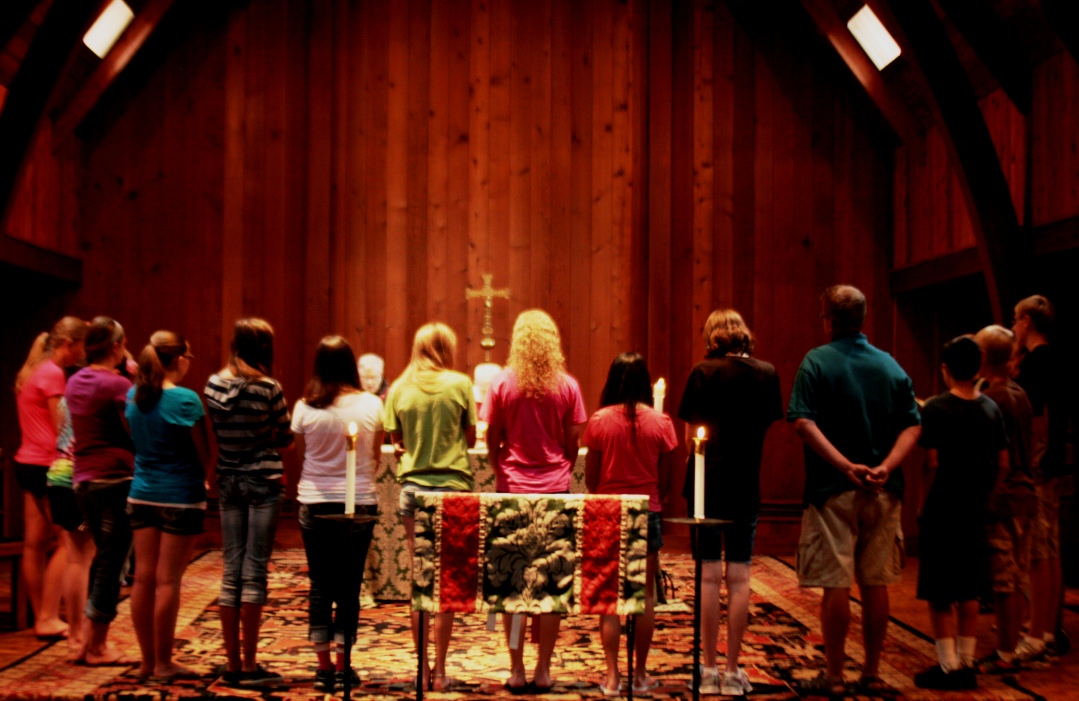
Basic spiritual practices such as liturgical prayer, deep reading of scripture and meditation (contemplative prayer) are, or should be, practiced at this same deep visceral level so that they can open us up to being filled with the Desire of the Forgiving Victim. Praying with others is a means of being in a group that gains cohesion by praying without resentment rather than persecution, which breeds resentment. The more solitary practice of meditation is still made in solidarity with others, thus seeking to relate us to God and other people without resentment. In a short blog post, renouncing resentment sounds like a simple matter. Well, it is simple, but it takes years of devoted practice.

Each time we allow the Forgiving Victim to remove any resentment we harbor, we glimpse a bit more of the new Heaven and the new Earth coming down from Heaven into the midst of our lives.

[I discuss spiritual practices in reference to the Rule of St. Benedict in my book Tools for Peace]

The Communal Good Shepherd

goodShepherdThe parable of the lost sheep crystallizes the Gospel as only a few others do.  It reverses our usual outlook that naturally tends to think along utilitarian lines where, as Caiaphas suggested, it is better for one person to die than the whole nation should perish. From the dawn of time, sacrificial logic has worked the same way: one person dies so that the community can be at peace, at least for a time. Jesus coyly asks the question: “which of you, having a hundred sheep, wouldn’t leave the ninety-nine to look after the lost one?” The honest answer would be: Nobody. A lone shepherd couldn’t leave the ninety-nine without losing them and probably failing finding the lost one as well. And yet Jesus asks the question in such a way as to ridicule our normal way of thinking and then goes on to rhapsodize about the extravagant joy and celebration at finding the one lost sheep. It’s the same with the woman finding her lost coin. She throws a party that probably cost all ten of her coins.

This rejoicing over the lost sheep and the lost coin and the lost sinner shakes us up into realizing that it is not enough to renounce the sacrificial logic of Caiaphas. If we stop sacrificing people we think are expendable that is something but much more is asked of us. We are to actively and sacrificially care for the ones who are lost, who are considered expendable by society. In his Rule, Benedict writes powerfully about this parable in the context of a community dealing with a delinquent member. As I say in my book Tools for Peace, “Benedict captures the inner spirit of the Gospel by picturing the abbot throwing off any sense of abbatial dignity in much the same way the father of the prodigal son throws off his dignity by running out to greet the son he sees from afar.”

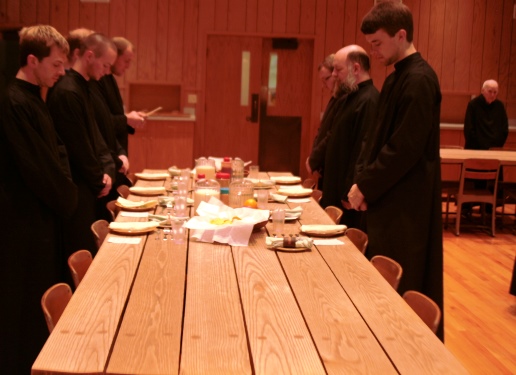
One might think that the good shepherd is sacrificing the ninety-nine sheep for the sake of the one. Maybe. But what really needs to happen is for the shepherd plus the ninety-nine to go after the lost sheep. In his chapters on dealing with a delinquent member of the community, Benedict turns the whole community into shepherds. Paradoxically, one of the ways (and a problematic one) is excommunication where all members must cooperate. It is important to realize this is intended as a means to reconciliation; sort of like a time out in a family which gives a trouble child an opportunity to reflect on his or her behavior. Moreover, the whole community shares the pain of the alienation. Benedict doesn’t leave it at that. He suggests that the abbot send wise monastics to comfort the excommunicated member and reason with him. Benedict then encourages the best remedy of all: prayer. This is a communal effort with the whole community praying for the one who is temporarily lost in the hope that this member will soon be found again. Reconciliation takes place in the monastic church, making this also a communal event.

Benedict gives us one example of living out a difficult scenario. In each instance, we have to find different means to the same end although Benedict’s techniques give us a sense of direction. In the Body of Christ, all of us are called upon to act the part of the good shepherd.

Essay on spiritual renewal

buddingTree1I have just posted the text of a talked that I gave at a Theology & Peace conference in Chicago a few years ago called Living by the Breath of God: a Spirituality of God’s Desire. It collects many of the ideas of I have working with on my recent blog posts & it might help some of you get a more coherent view of the vision I continue to develop. You can read this essay here.

Connecting our Desires

vocationersSayingGrace1If mimetic desire, grounded in our mirror neurons, holds us all together whether we like it or not, why are we human beings so far apart and alienated from each other? Perhaps the catch is: “whether we like it or not.” If we don’t like being connected with the desires of other people, we will either claim ownership of our desires and dare anybody to challenge this ownership or try to expel the other. Both claiming ownership or expulsion only lock us tightly in rivalry with them so that our desires don’t connect. Instead they crash into each other into a soup boiling over so that nobody gets anything except more rivalry for the sake of rivalry. [See Mirroring Desires below if you haven’t read it already.]

In the history of race relations between blacks and whites in the U.S., from the standpoint of while people, we have had ownership through the institution of slavery and expulsion through segregation such as Jim Crow Laws or what one might call “social custom.” Those of us who deplore such attitudes and their results tend to expel racists, convinced that they deserve it. There is a dangerous tendency to believe that rivalry is a good thing in a righteous cause. Unfortunately, righteousness with this attitude is self-righteousness and rivalry in a good cause still makes that cause disappear in through over-involvement with our rivals.

There is an even more insidious problem here, however. It is well-known that the people who most strongly deplore others for certain actions or attitudes are often disturbingly prone to at least the temptations to the same actions and attitudes. Although statistics consistently estimate that roughly six times as many white people than blacks commit drug offenses, ten times as many blacks are sentenced to prison for drug offenses. All the while, there is consistent denial from those involved in the justice system that there is any racial bias affecting this situation. If these denials are as sincere as, to a chilling degree, I fear they are, then there is a lot of preconscious racial bias circulating like a plague. Speaking for myself as I confessed in Recovering Racists, I think that we all have a serious need of becoming more aware of our preconscious attitudes.

This post isn’t just about race relations; it’s about human relations. Our connections to the desires of other people can attract us to some but repel us from others. We tend to find ways to feel righteous about being repelled by some people but we are often rationalizing our preconscious reactions without ever actually thinking about them. Other posts on this blog and my book Tools for Peace look at spiritual practices for living with mimetic desire constructively. On technique is what moral theologians traditionally call a moral examen. This examen needs to be focused on our preconscious reactions to people so as to make them more conscious. This gives us the chance to do something constructive with them. One thing I find helpful is to look a person in the eye. That can easily transform the person before us.

Contemplative Prayer as a Pearl of Great Price

indwellingcover_tnBecoming conscious of mimetic desire, our inborn and pre-conscious tendency to copy the desires of other people (See Human See, Human Want) poses a large challenge to our daily living. When we bring in the tendency to fall into rivalry with other people and how that can lead to collective violence (see Two Ways of Gathering) then we need tools to live with this challenge.

I wrote Tools for Peace to suggest ways that the spiritual practices from the monastic tradition and the Rule of St. Benedict in particular can help us with this challenge. Contemplative Prayer, although important in monastic practice, has a small place in the Rule of St. Benedict and so there is not a detailed discussion of the practice in this book, although I have a few comments about it.

Many years ago, I wrote a pamphlet called “The Indwelling God” to introduce the practice of contemplative prayer and give practical suggestions for initiating and sustaining this practice. Last year, I wrote an article for our Abbey Letter called “Resting in God’s Desire” which discusses contemplative prayer specifically in connection to mimetic desire. The Divine Office is indeed the heart of Benedictine spirituality, but praying in silence, just being before and with God, allowing God to contemplate us, as Saint Gertrude and other writers have suggested, is a pearl of great price, a pearl worth some of our valuable time and worthy of much room in our hearts.

This pamphlet has been available in hard copy and is still available in that form, but I have just had a eBook made of it to make it available in that form since many readers are using that medium. I have coupled the pamphlet with the essay “Resting in God’s Desire” as they make good companion pieces.

“The Indwelling God” with its companion article can be purchased on the abbey’s website at http://www.saintgregorysthreerivers.org/digitalpubs.html   A hard copy version which has only “The Indwelling God” is available at http://www.saintgregorysthreerivers.org/orderpage.html

May we all give of ourselves to receive this pearl of great price.

Hospitality Initiative

WilliamGuestsChurch1On May 3-4 I will be attending the Hospitality Initiative hosted at Oakland University in Oakland, MI. The convener is Charles Mabee, a scholar who works with the thought of René Girard. This is a multi-faith gathering where papers from a wide variety of spiritual traditions will be represented by the presentation of papers. I will be presenting a brief paper called “Mimetic Hospitality: Guests and Community in the Rule of St. Benedict.” Some of the content overlaps with my blog post Cleaning up our Unclean Acts which introduces some of the thoughts I develop in this paper. You can read my paper here.

Selling Postcards of the Cross

crucifix1“They’re selling postcards of the hanging
They’re painting the passports brown.”

White boys like me mostly didn’t know what Bob Dylan was singing about when “Desolation Row” first came out on “Highway 61 Revisited.” James Cone’s book The Cross and the Lynching Tree tells us it was about lynching. Lynching was a public spectacle where people took pictures and made postcards out of them.

Cone goes on to argue that the lynching tree was a series of grisly re-enactments of the crucifixion of Jesus. He also demonstrates on how very difficult it has been and still is for Americans to see this truth. Reinhold Niebuhr, arguably the greatest American theologian was, in spite of his social concerns, blind to this reality. Even black people have had trouble seeing this connection, though Cone shows how some black women, especially Ida B. Wells articulated it powerfully. He contrasts Niebuhr and all white liberals with Martin Luther King, Jr. who put his life on the line.

The dynamics of lynching as analyzed by Cone provide powerful confirmation of the theory of collective violence of René Girard. (See my article Violence and the Kingdom of God.) Girard argues that perpetrators instinctively fail to see what they are going. Cone shows us this truth in a powerful manner.

Dylan goes on to sing that “the circus is in town” and then catalogs Western Civilization turned topsy-turvy, suggesting that lynching does this, thanks to the “blind commissioner.”

Cone is right about whites’ blindness to this truth, but Dylan did write “The Ballad of Emmett Tell” in 1963, telling the story in stark terms, though without any Christian reference except to complains that the human race has fallen “down so god-awful low.” Then there is Mark Twain who wrote “The United States of Lyncherdom,” calling lynching for what it was and clearly discussing the human mimesis just as Girard was to do half a century later.

Cone’s book is written calmly, even gently. There is no mincing of words, yet the words are somehow full of forgiveness. The forgiveness in Cone’s words, the forgiveness proclaimed by Jesus, should be enough to undermine our trust in ourselves and our ability to see what we are doing. We must repent not only of lynching, but of our collective hatred of enemies today.

Crying out with Palm Branches in our Hands

AndrewPalmSunday1Jesus entered Jerusalem to the acclaim of crowds strewing branches before him and proclaiming him the king. A few days later, the same crowd gathered before Pilate to cry out for Jesus’ crucifixion. What happened?

Before answering this question, it is helpful to recall another crowd that went out into the desert to see John the Baptist. “What did you come out to see?” John asked them. “A reed blowing in the wind?” John suspects that people have come out in droves because people were coming out in droves. That is, it was the “in” thing to do. Fast forward a few months and we have a crowd at Herod’s palace supporting Salome’s request for John’s head on a dish. What did they come to see?

The post Ignominious Glory—Glorious Ignominy: a Doxology goes a long way in explaining this phenomenon. One can’t help but suspect that people are crying out because everybody else is crying out, no matter what the outcry is about. Advertising usually does not advertise the product but its alleged popularity. Political campaigns do the same thing. What would happen if people stopped to listen to what people were actually saying instead of crying out what they think everybody else is crying out?

It so happens that the Gospels do precisely this. The suggestion that the Gospels are Passion narratives with long introductions gives short shrift to what the Gospels are about. What these “long introductions” do is tell us at great length what Jesus actually said and what he taught. They also tell us what Jesus did before he was nailed to the cross, i.e. he healed people and cast out demons and he unilaterally forgave sins. These “long introductions” also tell us why the power brokers in Judea and Jerusalem wanted Jesus dead. By reading these “long introductions” to the Passion narrative, we are drawn away from crying out what everybody else is crying out and waving signs that only proclaim what the current fashion is believed to be. Instead, we are drawn into a very different social mimetic process, a process that builds up mutual respect between people, seeing people as they really are and as they really can become when they receive the unilateral forgiveness that Jesus gives them, a social process of not retaliating for wrongs done, a socially mimetic process of forgiving debts, of sharing what we can, of offering healing to others.

It is instructive that the Palm Sunday liturgy begins with everybody playing the part of the crowd welcoming Jesus with palms and then, a bit later, we hold these palms while acting the part of the crowd in crying out for Jesus’ death during the reading or chanting of the Passion. What we need to do afterward is return to the “long introductions” to see what the fuss was about and hopefully, hear the cock crow as did Peter.

I develop these ideas in my book Tools for Peace.

Gathering to Give Life to Victims

eucharist1Since the dawn of humanity, humans have gathered most quickly and powerfully around a victim. (See Two Ways of Gathering and Violence and the Kingdom of God.) Just think of how quickly we gravitate around whoever is currently seen to be to blame for whatever is going wrong in the world today. This gathering, however, is always at the expense of at least one person or group of people. A similar and yet very different gathering around a victim occurred when the eleven disciples saw the risen Jesus in Galilee and “worshiped him.” (Mt. 28:17) The huge, even infinite difference in this gathering is that the victim is alive and is gathering people around victims, “the least of those who are members of [his] family.” (Mt. 25:40) Ever since, Christians have gathered in worship around Jesus and his fellow victims, primarily in the Divine Office and the Eucharist.

The Divine Office is structured prayer that is uses the Psalter and other biblical canticles as the primary vehicle of prayer. Much can be said of the psalms but the thing that jumps out at anyone who prays them with any frequency is the many outcries of victims. “They surrounded me like bees; they blazed like a fire of thorns; in the name of the Lord I cut them off!  I was pushed hard, so that I was falling, but the Lord helped me.” (Ps. 118: 11-13) Verses such as these raise the question of whether we gather “like bees” around another person, or if we are entering the circle of bees in solidarity with the victim. Being a victim tempts us to anger, bitterness and violence. “Cutting off” our assailants in “the name of the Lord” is the reflex reaction, but is the opposite of what Jesus himself did in the same position. These rough verses help us renew our awareness of our own violent reactions to being victimized, even (especially!) petty matters such as being slighted by another. If we focus on Jesus when we are in the place of the victim, we find that the Lord has made the rejected stone the “chief cornerstone” that is “marvelous in our eyes.”

In the Eucharist, we gather around an altar which has been transformed into a table where, instead of laying out a sacrificial victim for slaughter, we place a piece of bread and a cup of wine to share among those present. We do this in memory of Jesus’ Last Supper, suffering, death, and Resurrection. The Greek word anamnesis does not mean a mere memory but to make present. That is, we enter the place of the victim with Jesus when we gather around the table. In so gathering, we feed on Jesus’ forgiveness of us for our own victimization are our challenged by this forgiveness to give this same life to others, both in terms of physical needs and emotional and spiritual sustenance. (See Miserable Gospel)

In his Rule, St. Benedict says that prayer should be made with “utmost humility and sincere devotion.” Entering the place of the victim with Jesus leads to both humility and devotion, attitudes that allow us to follow Benedict’s admonition that we sing the psalms (and also break bread in the Eucharist) “in such a way that our minds are in harmony with our voices.” (I develop these thoughts on the Divine Office in Tools for Peace)

Turning on Ash Wednesday

altarDistance1As we begin the season of penitence on Ash Wednesday, we do well to put penance in a context beyond our individual selves. René Girard’s concept of mimetic desire tells us that our “individual selves” are merely an illusion; our desires are unavoidably caught up in the desires of other people. (see Human See, Human Want) With that being the case, cleaning up our “own” desires simply does not do the job.  Instead, we must clean up the desires we share with others, and that means relating to others.

Early in his great poem “As Wednesday,” T.S. Eliot zeroes in on healing shared desire by following the first lines about hoping to turn his life: “Desiring this man’s gift and that man’s scope/I no longer strive to strive towards such things.” That is, the tenth commandment about coveting includes coveting the God-given gifts of others and their insights. If we turn from our entanglements with the desires of others, we will affirm and rejoice in their gifts and insights and in doing so, will awaken to the gifts and insights that we have within us to give to others.

In Matthew’s Gospel, Jesus follows his teaching on renouncing mimetic rivalry (turn the other cheek, etc.) with a solemn caution against using “good” actions such as repenting, fasting, almsgiving, and praying as occasions for competing with others so as to desire gifts and insights of others.  If we practice piety “in order to be seen by others,” then our piety is locked in our competition with others and not on God. That is why God cannot reward such piety which isn’t piety at all. The Desert Monastics also found themselves falling into the trap of competitive asceticism. On of the reasons Benedict, in his Rule, asks his monastics to tell the abbot about their Lenten disciplines is to put the practice of each into the context of building community. All this is compiling treasure on earth just as much as fattening our bank accounts.

The alternative to “praying in secret” may seem to be individualistic but it is really a matter of being an individual before God, which is a different thing. (An individualist flaunts his or her individuality over/against others—another thrust in a life of fencing.) Rather, “praying in secret” grounds each of us in God so that we can rejoice in God’s giftedness of others and ourselves. More important, it is precisely in the midst of these admonitions against flaunting our piety that Jesus teaches us the Our Father which reaches its climax with the petition that God forgive us as we forgive others.

As we turn again back to God, let us look at the turnings we must do in our relationships, realizing that unhealthiness in our relationships is not the same thing as the unhealthiness we may see in ourselves as individuals, although there is a relationship between the two. With T.S. Eliot, let us not even try to want the gifts of others but instead turn to the gifts we have to give to others.

For more about Lent in the Rule of St. Benedict in dialogue with Girard, read Tools for Peace