
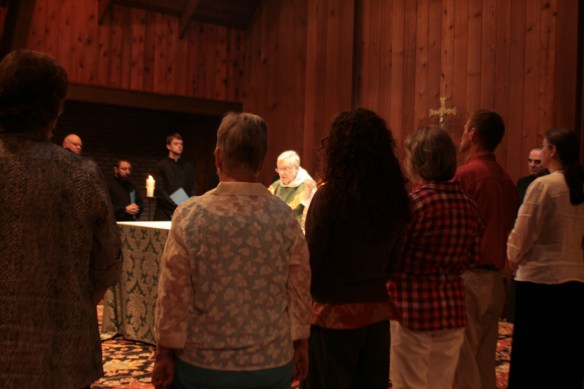
The custom of imposing ashes on our foreheads as a sign of our mortality on Ash Wednesday, the beginning of the penitential season of Lent, has the potential to encourage us to think that mortality is something we should repent of. The opposite is the case. We are not asked to repent of our mortality, we are asked to remember our mortality. Remembering our mortality is an important way to repent and to amend our lives. Since God made us mortal, mortality is not the problem. The problem, a huge problem, is the tendency to deny our mortality, to think that death should not apply to us. Clinical studies inspired by Ernest Becker show that denial of mortality leads to violent and insensitive behavior while some measure of acceptance leads to a much more humane way of relating to others, of connecting to others. I can’t help but reflect that in a great many fantasy novels, the villain tries to gain immortality which can only be achieved by stealing the life substance of others; an extreme example of how denial of mortality inevitably leads to victimization of other people. Such villains are always so deeply isolated as to be living deaths, no matter how many years they survive in this world. But if we accept our mortality, we put our trust in the crucified and Risen Lord, the true giver of life. When we accept our mortality, the time we have to repent becomes precious and we are ready to spend this precious gift wisely in the way we live so that others, too, may live.
Category Archives: spirituality
What Kind of Spirit was Jesus Casting Out?
When Jesus opened his teaching ministry, Mark says that the people were “astounded” because he taught them“as one having authority, and not as the scribes.” (Mk. 1: 22) Oddly, Mark doesn’t include anything of what Jesus said. The Greek work exousia is much stronger than the English word that translates it. “Powerful authority” would bring us closer to the meaning. That Jesus’ teaching was not like that of the scribes doesn’t give us much more to go on as to the content, but it indicates that this authoritative teaching was distinct from those who were normally considered the teaching authorities.
However, Jesus did something. Dramatically. He cast out an unclean spirit. In our time, we have trouble understanding what this is about and how we might draw any practical teaching from it. We tend to dismiss unclean spirits as coming from a primitive mindset and bring the affliction up to date by considering it a psychological problem which sends the poor man to a treatment facility far way from us.
I suggest that René Girard’s teaching on what he called “mimetic desire” gives us a richer approach. Basically, Girard’s insight is that our desires do not originate from within ourselves but are derived from other people; we all resonate deeply with each others’s desires. This resonance is fruitful if one person’s enthusiasm for a song inspires me to like the song so that we both enjoy the song. This resonance is more threatening if all of my friends hate a song I like so that I begin to doubt that I liked the song after all. This resonance with the desires of another becomes more dangerous if it becomes rivalrous as it does if two people desire to write and sing the best song. Some rivalrous relationships are more or less a fair fight but many times it is not. A strong-willed person, especially one with social power, can impose his or her desire on another in destructive ways. This is what happens in childhood trauma. Girard also teaches that a whole society can unite in a desire to destroy a person which is not a fight at all but a demolition.
However we understand the possession of this man, it is the imposition of something alien and oppressive. This is what a supernatural spirit would have done and maybe that was the case. But Girard’s teaching of mimetic desire shows us how an alien invasion could have afflicted this man and created a state of bondage through human agency. We get an important clue as to the nature of this alien invasion when the unclean spirit says: “I know who you are, the Holy One of God.” (Mk. 1: 24) We often think that Jesus told the unclean spirit to be silent because the spirit was correct and Jesus didn’t want people to know that yet. But Robert Hamerton-Kelly points out that the term “Holy One of God” refers to Israel’s priesthood. One of the main jobs of the priest was to expel anybody who was “unclean.” Jesus’ silences the unclean spirit, then, because the spirit is wrong. Jesus does not represent a priesthood who expels the “unclean.” Quite the opposite. Jesus is expelling the collective attitude that the man is unclean when it is the crowd’s spirit that has invaded the man and declared him unclean. By casting out this spirit, Jesus makes the man clean and so that he can rejoin the community. If the community accepts what Jesus has done.
The crowd confirms that casting out the unclean spirit is Jesus’ teaching when it asks: “What is this? A new teaching—with authority! He commands even the unclean spirits, and they obey him.” (Mk. 1: 27) Jesus is not healing an individual; he is healing a community. Or, Jesus is giving the community the opportunity to be healed. For healing to take place, the community must renounce the rivalry that had been imposed on one vulnerable person. In his stimulating book The Desire of the Nations, Oliver O’Donovan confirms the conflation of teaching and power in Jesus. (O’Donovan, 89) Picking up on the political aspect of exousia. O’Donovan goes on suggest that Jesus is using his authority to liberate Israel while treating “the fact of Roman occupation casually, with little respect and less urgency.” (O’Donovan, 93) That is, Jesus was focused on strengthening Israel rather than attacking the Roman Empire. Mark shows that Jesus’ liberation of Israel includes judging the leadership both of the teachers (the scribes) and the priests. Jesus’ action/teaching caused quite a sensation as word “spread throughout the surrounding region of Galilee..” (Mk. 1: 28) A sensation is not the same as a healing. The excitement could easily be mistaken for a communal healing when it only reproduces the scapegoating process. We are left with the question of whether or not our communities accept the healing of Jesus where the unclean spirits of human persecution are cast out or if we will be swept away on the excitement of the crowd.
For an introduction to René Girard see: Violence and the Kingdom of God.
The Throne of David – Part One
When the angel Gabriel announced to Mary that she was to conceive and bear a son, the angel said that her son “will be great, and will be called the Son of the Most High, and the Lord God will give to him the throne of his ancestor David. He will reign over the house of Jacob forever, and of his kingdom there will be no end.” (Lk. 32–33) However, the prophet Nathan made this same promise to King David: “Your house and your kingdom shall be made sure forever before me; your throne shall be established forever.” (2 Sam. 7: 16) Likewise, Psalm 89 say that David’s “line shall continue forever, and his throne endure before me like the sun. It shall be established forever like the moon, an enduring witness in the skies.” (Ps. 89: 36–37)
But the throne of David’s house came to an abrupt end with the Babylonian conquest and exile. Right after echoing the promise to David, Psalm 89 went on to declare its falsity: “But now you have spurned and rejected him; you are full of wrath against your anointed. You have renounced the covenant with your servant; you have defiled his crown in the dust.” (Ps. 89: 38–39) According to the genealogy that opens Matthew’s Gospel, the line of David continued after the deportation to Babylon, but we know nothing about Salathiel and his descendants until we reach Joseph, the husband of Mary. Joseph was a carpenter, a worthwhile means of making a living, but carpenters are not usually considered royalty. The idea of a carpenter’s son ruling over the House of David forever was absurd. But that was hardly as absurd as God impregnating a young woman who was still a virgin.
From the moment of Jesus’ conception, then, we have the premonition that if the boy is going to grow up to become a king who rules forever, he is going to be a very different king than his ancestor David. He will be raised in a backwater of Galilee rather than in a palace. He will not have glossy magazines printing feature stories about him. His retinue will be a small group of men of humble origins, many of them fishers. The biggest and most crucial difference will be that David replaced Saul as king because he slew tens of thousands to Saul’s thousands, (1 Sam: 18: 7) but Jesus would not wield a sword. Neither did he compete for the kingship with anybody, whether within or without Israel while David competed both against the Philistines and his own king. Rather than running a military operation, he let the Roman military operation run him up against the cross. But this slain king still reigns forever. How can this be? The angel also told Mary that her son would be holy and “be called the son of God.” (Lk. 1: 35) Whereas David, descended from the house of Jesse in Bethlehem, rose up in the world, Jesus came down from heaven to a totally washed up royal house. That’s quite a come down! But after dying on the cross, Jesus was raised from the dead where he does rule forever. And yet we still fight with each other, trying to kill tens of thousands over/against the thousands killed by our competitors. We fight those in our defined out-groups while we struggle against those within our in-groups whose authority we resent. But Jesus reigns without competing and without resentment. As one who became one of us among humans, Jesus is with us, within our hearts just as much as he is at the right hand of his heavenly Abba. Are we willing to be subject to a king as low as this?
See also The Throne of David: Part Two
On Serving the Goats
There are many stories of kings who go about their kingdom in disguise, usually as a beggar. In such cases, whatever a subject of the king should do to that “beggar” would literally be done to the king himself. This may not have happened much in real life but it did happen when God became a true human being. Whatever anyone did for or to a certain itinerant preacher in Palestine was indeed done to God. It is important to note that in neither scenario did anyone consciously see the king or see God; one saw the beggar or the itinerant preacher.
The concluding parable of Matthew 25, the final teaching of Jesus in that Gospel, shows Christ as a king going about in disguise. Or does it? Neither the “sheep” who are welcomed into the Kingdom nor the “goats” who are sent to “the bad place” thought they were either serving or rejecting their heavenly king. What both the sheep and the goats saw—or failed to see—were vulnerable people who were starving or naked or in prison. This teaching has inspired a spirituality of “seeing” Jesus in vulnerable people, the rejects of society, the ones who are normally seen as the “goats,” if seen at all. But what is at stake is seeing the people, seeing their vulnerability, and showing one has seen them by serving them. After St. Martin had famously cut his cloak in half to give half to a freezing man, he had a dream of Jesus wearing that half of the cloak. But at the time, what Martin saw was the freezing man, and that was enough.
In his new book Stranger God: Meeting Jesus in Disguise, the therapist Richard Beck explores the ways of seeing and not seeing vulnerable people. He suggests that Jesus is prodding us to widen our affections beyond the friends and family we are comfortable with and move beyond our comfort zones. Beck covers several obstacles to such expansion, among them disgust, contempt and fear. Then comes the rub: how do we expand our affections? Beck searched through many books on spirituality for an answer until he came across the teaching of the Little Way” in the writings of St. Thérèse of Lisieux. Beck says that this “little way” seems simple until one tries it. The “little way” begins with noticing. Thérèse says that she noticed that some sisters in her Carmelite convent were saintly and popular and other sisters were difficult and ignored as much as possible: a separation of sheep and goats. Thérèse then had to move beyond her comfort zone and seek out the neglected, difficult sisters. It happens that Fr. Anthony, my novice master, taught us the “little way” of St. Thérèse as a means of teaching us how to live the Benedictine life which also depends on attending to the same details of everyday life in community. I particularly remember Fr. Anthony’s reading about Thérèse pushing the wheelchair of a crabby sister who constantly complained about every little bump in the way. When Benedict instructs us to pay particular attention to the sick and the poor in reference to Matthew 25, Benedict is telling us that being obedient to Christ entails being obedient to the needs of vulnerable people.
Edifying as this teaching of serving Christ through serving vulnerable people is, the grim sending away of the “goats” who failed to serve the vulnerable is disturbing. One way to understand this grim ending is to suggest that if our hearts shrink to the vanishing point so that we become permanently blind to the plight of vulnerable people, we end up in our own darkness. This is a salutary warning. But perhaps these “goats,” like the crabby sister in the wheelchair, are people who also need to be served through the “little way.” I wonder if it might be emotionally easier to feed a hungry person than to care for a person who denies food to the hungry. It seems to me that any “sheep,” like the Lamb of God, would want to save all of the “goats.”
[These thoughts are developed in a blog post by Lindsey Lopez-Paris and a sermon in 2014 by Tom Truby titled “The World Makes Sheep and Goats.]
Our Heavenly Father and Teacher
The denunciations by prophets like Micah of the rulers “who abhor justice and pervert all equity” (Mic. 3:9) and Jesus’ denunciations of Pharisees in Matthew 23 tend to curl our mouths in a snide smile as we think about how much better we are than they. But while Jesus is still warming up for his fiery words to come, he slows down and says: “Call no one your father on earth, for you have one Father—the one in heaven. Nor are you to be called instructors, for you have one instructor, the Messiah.” (Mt. 23: 9–10) When Jesus goes on with words of woe for the scribes and Pharisees, we are apt to conveniently shove these words aside, but, I think we should linger over them a bit before enjoying the scolding of “other” people.
That the false prophets and wayward rulers, the Pharisees and the scribes are not worthy of being called “Father” or “Teacher” or Leader” is understandable. The broader implication of not calling other people “father” is that we are all brothers and sisters. That is, Jesus is leveling the field among humans so that all of our relationships are fraternal, including relationships with people we usually think are “higher” or “lower” than we are, such as the relationship between parents and children and leaders and their followers. That is, we are all equal but we have a tendency to try to be more equal than others. And that is where we have problems.
Jesus scoffs at those who want the best places in the synagogues and banquets and who want to be greeted with fawning respect in the marketplace. We scoff at them too since mocking the foibles of our leaders and putting them down is everybody’s favorite blood sport. Which is to say that it is not just false prophets and ruthless leaders and scribes and Pharisees who do these things. We all do them. We all try to be a little more equal than other people in little and big ways. It is this desire to be more equal than others that causes us to lay heavy burdens on the shoulders of others and not “lift a finger to move them.” After all, putting a weight on another makes the person stoop, lowering that person. So why do anything to help the lowered person rise up?
The lectionary spares us the rest of Jesus’ harsh words as he dissects the ways we interpret law and morality to our own advantage and the disadvantage of others. Jesus reaches his climax with the charge that we persecute the prophets and so that “all the righteous blood shed on earth, from the blood of righteous Abel to the blood of Zechariah son of Barachiah” will be on our heads. (Mt. 23: 35) Jesus is warning us that the pushing and shoving to get the best seats at the banquet lead to the violence perpetrated against the prophets sent by God.
Forgotten in all this rivalry is Jesus’ teaching: “The greatest among you will be your servant.” (Mt. 23: 11) This is quite the opposite of laying burdens on other people to make them bow down to us in public places. Jesus is also accepting the fact that some humans naturally take more responsibility for others and do act as leaders. Paul, for example, was called to preach the Good News of Jesus and naturally went on to help people organize their churches. But when preaching in Thessalonika, Paul took the burdens on himself and worked hard so as not to be a burden on others. And he dealt with the Thessalonians like “a father with his children” in trying to lead them in a way worthy of God’s kingdom and glory. (1 Thess. W: 11–12) That is, a leader has to make everyone else more important than oneself.
This is what Jesus did, even to dying on the cross. And this is why Jesus is our teacher and guide to his heavenly Abba.
Tending God’s Vineyard
I have discussed the Parable of the Evil Workers in the Vineyard in my book Moving and Resting in God’s Desire where I suggest that Jesus was warning his listeners of impending collective violence. I also have used this parable as Exhibit A for René Girard’s thesis that humans have a tendency to establish culture in the midst of social crisis through rounding on a victim who is killed or expelled. This time I want to take the parable in a different direction.

The cue for my changed direction is the end of the Parable of the Vineyard in Isaiah 5 on which Jesus’ parable is modeled. In both parables, the owner of the vineyard has taken great trouble to set up the vineyard for maximum productivity, but things still go awry. In Isaiah’s parable, there is not the cycle of violence described in Jesus’ parable, but the well-planted grapes grow wild. The owner (Yahweh) “expected justice, but saw bloodshed; righteousness, but heard a cry!” (Is. 5: 7) Isaiah goes on make it clear that the violence he is complaining about is about those “who join house to house, who add field to field, until there is room for no one but you, and you are left to live alone in the midst of the land!” (Is. 5: 8) We could update this verse by adding those who add company to company and conglomerate to conglomerate.
Bringing this background into Jesus’ parable prods us to understand this parable, too, as referring not only to collective violence such as that threatened against Jesus but the ongoing social violence of the religious and political leaders. Properly tending the vineyard of the Lord is about properly caring for all people in society, especially the poorest and most vulnerable. Jesus was seeing quite the opposite in his time and the Risen Christ continues to see this systemic injustice continuing unabated in our time.
The stone rejected by the builders that Psalm 118 says becomes the cornerstone is rightly taken as referring to the persecuted prophets and then to Jesus who, rejected by the builders of society, has in his Resurrection become the cornerstone of the Church. But when we take into account the concluding parable in Matthew 25, it becomes clear that what is done to “the least of the members” of God’s family is done to Jesus. That is, the weak, the vulnerable, and the poor are the stones rejected by the builders of society, the same builders who put stumbling blocks before those who try to better themselves. But in the eyes of Jesus, it is those rejected by the builders who are the true building blocks of God’s kingdom.
When Jesus asks his listeners what they think the owner of the vineyard will do, they say that the owner “will put those wretches to a miserable death, and lease the vineyard to other tenants who will give him the produce at the harvest time.” (Mt. 21: 41) So it is that those committing social oppression embody an unforgiving attitude. Today, we hear many of the rich and powerful demonize the poor and vulnerable for their situation, blaming the victims of their oppression.
Yet, as Raymund Schwager points out in Jesus in the Drama of Salvation, the risen Christ did not come with vengeance against the evil workers in the vineyard. Instead, the risen Christ came in peace with forgiveness. Those experiencing oppression are often scandalized by the notion of forgiveness, but we see in the unforgiving attitude of the Jewish leaders who are the oppressors that forgiveness is even more scandalizing for them. We often overlook how easy it is to hold unforgiving grudges against those people whom we have wronged in some way. The reason that we blame our victims is because accepting forgiveness from the risen Christ implies acceptance of our own wrong doing. No matter how gentle the Lamb of God is, forgiveness is still an accusation, and accepting forgiveness can only be done in a spirit of penitence. Looked at this way, the gift of forgiveness is not necessarily easy to accept. Yet overcome this difficulty we must if we are to avoid the cycle of violence that the Parable of the Evil Workers warns us against.
[For quotes and references to Moving and Resting in God’s Desire and Raymund Schwager’s Jesus in the Drama of Salvation, see Girardian Reflections on the Lectionary Proper 22A]
[For an introduction fo René Girard see Violence and the Kingdom of God]
Binding and Loosing and The Good Shepherd Revisited
I am not going to write much on this Sunday’s Gospel. I have already done that on my blog post Binding and Loosing. Instead, I am going to preach about the rest of Matthew 18 that did not make the lectionary. This context will shed light on Jesus’ words about binding and loosing which were read today.
I start with the Parable of the Good Shepherd who leaves the ninety-nine sheep and searches out the one lost sheep. We get this parable in the Year of Luke so it makes sense that we don’t get it this year. However, the contexts for this parable are very different in the two Gospels. In Luke, the parable is the first of a trilogy about God’s solicitude in searching out the lost, the other two being the Parable of the Lost Coin and the Parable of the Prodigal Son. In Matthew, the context is much more complicated and disturbing.
Directly preceding this nice pastoral parable in Matthew is Jesus’ admonition to cut off our hands and feet and pluck out our eyes if any of them cause us to stumble. (Mt. 18: 8) This sounds pretty unforgiving, but let’s look at the context of these frightening words. The chapter begins with the disciples asking Jesus: “Who is the greatest in the kingdom of heaven?” (Mt. 18: 1) This seems to be a polite way of fighting over who is the greatest, one of the disciples’ favorite pastimes. Jesus replies by placing a small child among the disciples and telling them to be like that child and to welcome the child. Not the answer the disciples were fishing for. When Jesus warns the disciples that it is better that a millstone be fastened around their necks and they be thrown into the sea rather than cause such a child to stumble, he is warning them of the seriousness of being such a stumbling block. The same applies to cutting off hands and feet. (Paul Neuchterlein develops the relevance of Stumbling blocks on his commentary on this Gospel in his Girardian Reflections on the Lectionary.)
What does this have to do with the Good Shepherd and binding and loosing? Quite a bit. When we, like the disciples, become preoccupied with who is the greatest in God’s kingdom, we are doing a lot of binding without loosing anybody. René Girard has taught us that the stumbling block, skandalon in Greek, is what rivals set before each other. That is, rivals become stumbling blocks to each other. As if that is not problem enough, the rivalry affects other people with the most vulnerable, such as the child Jesus placed before the disciples, bearing the brunt of the rivalry. The sheep that strayed has gotten lost in the shuffle. Which is to say that the lost sheep and the child placed before the disciples have been sacrificed. But what about the hands and feet Jesus would have us cut off? Isn’t that sacrificial? Yes, but with a difference. When we are engaged in rivalry and are placing a stumbling block before others, the rivalry seems as important, as self-defining, as essential to our being as our hands and feet. Jesus then suggests that it is better to enter “life” maimed or blind rather than be cast “into the eternal fire.” The thing is, it is rivalry that maims and blinds us. If we should sacrifice our rivalry, it feels like cutting off our hands and feet and plucking out our eyes. But if we do just that, we are free to walk and see. This freedom to walk and see enables us to see the little child and the lost sheep.
We are faced with the fundamental choice of sacrificing our rivalry or sacrificing other people. If we sacrifice others, we bind them and in so doing, we bind ourselves as well. So we have the power to bind or to loose. We can bind ourselves and others in rivalry, or we can loose others and ourselves by seeking the lost and welcoming the child Jesus places before us.
[For and Introduction to René Girard, see my article Violence and the Kingdom of God.]
Born in the Fullness of Time
Some people question the need to set aside a day to honor Mary, often out of fear that such a remembrance detracts from her son. The ready answer is that it is not possible to focus on Mary without focusing on her son. The title “Mother of God,” exalted as it sounds, does precisely that. Being a mother immediately puts her in relationship with her son and her son in relationship with her. Since Mary was a human mother, Jesus, born of Mary’s womb, was fully a human being. Since Christianity recognizes Jesus to be fully God as well, it follows that being the mother of the human child Jesus entails being the Mother of God.
Jesus, then, was and remains a human being and he is also the one who, as both God and a human being, brought about our salvation. Paul states the matter concretely and succinctly: “When the fullness of time had come, God sent his Son, born of a woman, born under the law, in order to redeem those who were under the law, so that we might receive adoption as children.” (Gal. 4: 4-5) Paul stresses Jesus’ humanity on three counts: 1) That Jesus came in “the fullness of time,” that is, Jesus was born at a particular time in history, 2) Jesus was born of a particular woman. 3) Jesus was born “under the law.” Being a human being necessarily entails being a part of human culture. The Jewish Law was the backbone of the culture Jesus was born into. Like any other human, Jesus was formed by the Jewish Law and it was out of this formation that he redefined the law in his teachings, especially in Matthew’s Gospel.
Sometimes we are tempted to some envious grumbling when somebody else is elevated above other humans as Mary is elevated by the numerous Marian devotions that have developed over the Christian centuries. But if we are going to honor the son of Mary, we must honor his Mother. Jesus could not have come into the world in any other way than through a particular woman, and Mary was that woman.
As it happens, Mary isn’t really raised above the rest of us human beings. Paul goes on to say that God sent his Son in the fulness of time “in order to redeem those who were under the law, so that we might receive adoption as children.” (Gal. 4: 5) In the topsy-turvy world that has received God’s incarnate presence, Jesus’ mother was adopted as a daughter of God so that she could be his mother, and this so that the rest of us, too, can be adopted as God’s children. The truth of Jesus’ humanity that is verified by his particular human mother encourages us to accept the truth of our own humanity rather than try to rise above it on our own. When we honor Mary and honor her humanity, her son raises us also to her exalted level. Renouncing envy in favor of admiration leads us to become what we admire. Becoming like Mary means we become like Christ who received his formation both by his heavenly Abba and his earthly mother.
Jesus’ Yoke
Jesus’ invitation to come to him with our burdens so that he can give us rest and take his easy yoke upon ourselves sounds like an irresistible blessing. But the troubling words skipped by the lectionary suggest that Jesus’ offer is highly resistible. Here, he bemoans the rejection of Chorazin, Bethsaida and Capernaum. Given the horrifying hardness of heart shown in the story of Sodom and Gomorrah’s destruction, it boggles the mind that Jesus thought those people might have responded better than the people of Capernaum who witnessed Jesus’ first miracles of healing.
How can Jesus’ offer to free us of our burdens be so resistible? We get some hint of this in the powerful, if dense, passage in Romans 7 where Paul cries out against the burden of sin that makes him do what he does not want to do. Most of us think the problem is that the burden of sin renders us powerless. There is something to that, especially in the case of addictions. But the deeper problem is that we have great difficulty knowing what we really desire. The French thinker René Girard has helped us greatly towards an understanding of this problem with his insight into what he called “mimetic desire.” That is, although we tend to be addicted to the illusion that our desires originate from within ourselves, Girard suggests that our desires originate from without: i.e. from other people. That is, we copy the desires of other people. Since the same is true of other people, they are imitating our desires as much as we are imitating theirs. No wonder desires are so complicated. It is telling that Paul says: “I would not have known what it is to covet if the law had not said, ‘You shall not covet.’” (Rom. 7: 7) Covetousness is precisely the sin most driven by mimetic desire. This phenomenon can lead to a spiral of desire that reinforces each others’ desires in love. This is what Jesus us getting at in offering to relieve us of our burdens and take his yoke upon us. But usually, we imitate each other in a downward spiral of rivalry, anger, and vengeance. In this spiral, we become more and more convinced that our anger and rage are our own even as the rage and anger of others overtakes us like a flood. When this happens, we are yoked to our rivals and they to us. This is the yoke Jesus would relieve us of.
Girard argues that a society caught in a downward spiral either implodes into mutually assured destruction (MAD) or channels its common rage against a victim who is scapegoated. The latter is the story told in the four Gospels. However, it is not only the story of the Gospels; it is the story told numerous times in the Hebrew Bible starting with the dawn of humanity. The establishment of violence as the engine of society is what Jesus was getting at when he said, in another verse not included in the lectionary: “From the days of John the Baptist until now the kingdom of heaven has suffered violence and the violent take it by force.” (Mt. 11: 12)
Although we are prone to clinging to the illusion of our individuality, Girard has shown us that we are yoked to others through the matrix of our intertwining desires. Where we can take some responsibility for our lives is to choose how we wish to be yoked and to whom we will be yoked. In rabbinic literature, the yoke is used as an image for a Jewish student’s relationship with his or her rabbi. Jesus, as a rabbi, offers such a yoke. Being yoked to Jesus means being yoked to a Messiah who rides on a donkey in fulfillment of Zechariah’s prophecy. The Greek word translated as “gentle” is praus, the same word used in Matthew’s quote from Zechariah to describe Jesus’ entry into Jerusalem.
Jesus’ yoke may be easy but it is challenging. The temptation to give way to fear, anger, and vengeance, especially when that is all around us, is very strong, but the yoke of vengeful anger is very heavy and it entraps us in the power of sin within us that prevents us from doing what we really want to do. Escaping this trap can seem impossible. As Paul discovered, it is impossible without the grace of Christ who offers us his yoke in place of the yoke of sin. The harsh words against Capernaum and neighboring towns actually offer us hope. If Jesus could envision the possibility of Sodom and Gomorrah converting to Jesus’ yoke if they had seen the wonders done at Capernaum, although the people in these towns united to persecute Lot and his guests, surely Jesus can envision the same for our persecutory society. Can we cast the burdens of fear, anger, and vengeance on Jesus and accept the yoke he offers us, a yoke that burdens us with compassion and love?
[For an introduction to René Girard see Violence and the Kingdom of God.]
Feed My Sheep
In the final chapter of John’s Gospel, Jesus asks Peter three times: “Simon son of John, do you love me?” Peter has to answer three times that he loves Jesus and then listen to Jesus tell him three times: “Feed my sheep.” (Jn. 21: 15-17) This three-fold question and response is commonly interpreted as Peter undoing his three-fold betrayal of Jesus in the court of the high priest. I agree, but with the caveat that Peter’s betrayal goes further back. At Gethsemane, when Jesus had been seized by the temple police, Peter drew a sword and cut off the right ear of one of the high priest’s servants. This may look like loyalty to most people, but not to Jesus, who said: “Put your sword back into its sheath. Am I not to drink the cup that the Father has given me?” (Jn. 18: 11) That is, Peter had betrayed what Jesus really lived for and was about to die for. As he had at Caesarea Philippi, Peter had acted as a “satan,” a stumbling block to Jesus’ commitment to non-violence, even at the cost of his life. In declaring his love for Jesus three times, Peter declared his love for what Jesus lived for and died for. It is with this love that Peter was told to feed his sheep.
Paul, whom we also celebrate today, is famous for his conversion experience. Like Peter, Paul had to repent of the violence he had committed in what he thought was in the service of God. The voice from Heaven on the road to Damascus told Paul that he was actually persecuting God by persecuting the followers of Jesus. After hearing this voice, Paul realized that, like his fellow Pharisees denounced by Jesus, he had been committing the social violence of heaping burdens on people and not lifting a finger to lift them. With Paul, this social violence had exploded into physical violence against those very people on whom these burdens had been imposed. (Mt. 23: 4) The voice of Heaven converted Paul into being a lifter of heavy burdens from others so that he and those he preached to could embrace the gift of forgiveness Jesus bestowed on him when he drank the cup given by his heavenly Abba and allowed his Abba to raise him from the dead.
Peter and Paul are often posed as opposites, even antagonists, but they are united in one most important thing: both ministered out of their conversion from violence to living by the free gift of God’s mercy grounded in the cross. Out of their conversions, they preached whether “the time [was] favorable or unfavorable.” (2 Tim 4: 2) In doing so, both of their lives were “poured out as a libation” (2 Tim. 4: 6) as they tended the heavenly Abba’s sheep with special care for the sick and the wounded. In the end, both were led away to where they did not wish to go (Jn. 21: 18) but ended up winning “the crown of righteousness.” (2 Tim. 4: 8) If we are to follow these two great saints, we, too, must hear the voice of Jesus warning us of the violence we commit or benefit from and be converted so that we, too, can feed Jesus’ sheep.