A Sign that will be Opposed

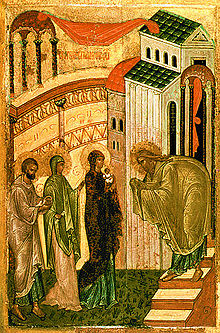
Simeon’s prophecy over the baby Jesus on the occasion of the child’s presentation in the temple, the Nunc Dimittis, has brightened the service of Evensong throughout the Anglican Communion for centuries. It is inspiring to hear that the salvation represented by this child has been “prepared in the presence of all peoples.” It is all the more inspiring that this child is a light to all nations but is also glory for his own people Israel. (Lk. 2: 31–32) That is, this child will unite all people in the embrace of salvation. The countless musical settings of these words magnify their effect, starting with the hushed entrance of “Now lettest thou thy servant depart in peace” then swelling to a brief but overpowering climax with “To be a light to enlighten the Gentiles and to be the glory of thy people Israel,” with the word “glory” often drawn out to dramatic effect. Historians might doubt that an old man made such a prophecy, particularly since it fits the author’s theology so well, but such doubts need not dampen the encouragement these words give us.

But then, Simeon makes a darker and more enigmatic prophecy. The child in his arms is “destined for the falling and the rising of many in Israel, and to be a sign that will be opposed.” (Lk. 2: 34) This seems to be a contradiction and retraction of the first prophecy. How can Jesus unite all people, Jews and Gentiles if he is opposed by, apparently, everybody? Simeon gives us a hint when he says that “the inner thoughts of many will be revealed.” But this hint is far from self-explanatory. We can begin to make sense of this tension when we think about our reactions to suggestions that we try to get together with other people and learn to get along. The idea sounds great until we think of some of the people we have to get together with. What often happens in such situations is that the people who hate each other unite and gain up on the person who suggested they get together. It is worth noting that, for all the musical settings of the Nunc Dimittis, these following words have been rarely set to music, if at all. As my comments about the fate of one who would unite people suggests, this prophecy points to the cross, which is the culmination of Jesus being opposed, and yet it is from the cross that Jesus becomes a light to the nations and the glory of Israel. There are, once again, many ;powerful musical settings of the Passion. This second prophecy also embodies Luke’s own theology. John, in his Gospel, articulates this tension with his use of the word doxa which means both honor and shame. As with John’s Gospel, Luke uses the prophecies of Simeon foreshadow the end of the Gospel where glory and shame are closely intertwined.

We can see all these themes laid out in Luke’s narrative of Jesus’ inaugural sermon. As soon as Jesus finished speaking, Luke says: “All spoke well of him and were amazed at the gracious words that came from his mouth.” (Lk. 4: 22) But then immediately some people murmur that he is just the carpenter’s son. Jesus responds by reminding his listeners of foreigners who were healed by Elijah and Elisha. Next thing we know, all of the people who had just been admiring Jesus try to hurl him over a cliff. The suggestion that some Gentiles might have received grace from God was apparently unpalatable to them. This incident, of course, is another preview of the end of the Gospel. One could say that the inner thoughts of the people in the synagogue were revealed. What inner thoughts are revealed in each one of us as we ponder the implications of Jesus being both a light to the Gentiles and the glory of his people Israel?

Our Deepest Calling

The calling of Jesus’ first four disciples raises the question of who else Jesus calls. To begin with, after calling the first four disciples, Jesus called eight more to add up to twelve. But there were many others. According to Luke, Jesus sent out seventy-two disciples on a mission. Several women also are mentioned as ministering to Jesus. And then Jesus asked that the children also should come to him and not be hindered. It begins to look like a lot of people are called by Jesus with the growing suspicion that Jesus calls everybody.

The sense of a call from God is quite meaningful to me. While I was at Nashotah House Seminary in Wisconsin, I felt called to be a Benedictine monk. This calling was quite palpable and it became unthinkable that I would do anything else but seek admission to St. Gregory’s Abbey after I graduated. Before I could respond to this call, though, I had to answer a more fundamental call: namely the calling to be a Christian. Long story short: although I was raised in the Episcopal Church and formed by the liturgy while singing in a boys choir, I had fallen away for several years. By hindsight, I can see God drawing me back during all that time even when I was fighting the hardest to resist God.

Many people also feel a calling to holy orders: priesthood or the diaconate, as I did myself several years after having joined the monastery. Although the church is working hard to expand the sense of calling, there is still a tendency to think of certain ministeries as callings but everything else is a job or volunteer work. But these are callings just as much as callings to holy orders or the monastic life. When we go back to the earlier call to be a Christian, we get a sense of God’s call to everybody, not just a few special people, (or better said: everybody is special in some way!) Everybody is called to baptism and from this calling, we each receive a calling to one thing or another. Actually, this preliminary call goes back even further. Each of us is called out of nothingness into being by the God who created all of us.

There are many implications to the fact that we are called. The most fundamental is that we are relational beings. As we become aware of the richness and depth inside each one of us, it is easy to become intoxicated with a sense of self that tries to build a little isolated world. But the notion that this inner world is autonomous in an individualistic sense is sheer illusion. Being called into being and then called to be in a particular way is based on a relationship with God. But note that Jesus did not call an individual here or there; God called several people into a community. Creation and re-creation in baptism are thus calls into community. We are all baptized in the Body of Christ, the Church. Indeed, we are not only called by God, we are called by many other people who also have a strong effect on us. The richness experienced within is in fact derived from other people calling on us from before we were born. With each particular calling, there is not only the inner sense of being called by God but the external call from other people. In my case, many people confirmed a potential call to the monastic life during my time in seminary, not least the dean and my diocesan bishop. And then there was the need for discernment with the abbot and chapter of St. Gregory’s. Likewise, when a person experiences a call to holy orders, there is a communal discernment process in place. From the standpoint of people helping with such a discernment, the question is: Do I want to call this person to minster to me? This question that makes it clear that a calling isn’t about me, it is about us as a community.

The particular calling that each of us has lies in the communal calling of the Church. In our Gospel reading, we have the rudiments of the communal calling through Jesus’ ministry of repenting and “proclaiming the good news of the kingdom and curing every disease and every sickness among the people.” (Mt. 4: 23) What is the Good News? Jesus’ movement into the territory of Zebulim and Napthtali is quite significant and not just an obscure geographical detail. This had been Gentile territory since the Assyrian invasion of Israel and was land occupied by the Romans in Jesus’ time. The history of military violence is the darkness in which Isaiah is prophesying that a “great light” was coming. Jesus was preaching the deliverance from violence based on forgiveness. Forgiveness is the deep healing offered by Jesus as he healed the people who came to him. In various ways, proclaiming the Good News of forgiveness is what each of us is called to through our calling in creation and baptism. The way each of us carries out this fundamental mandate will differ and it is because healing and proclaiming the Good News needs to be done in so many different ways that there are so many vocations in which we serve each other, even if in seemingly small ways.

A calling is not a once-in-a-lifetime done deal. Each calling has to be renewed year by year, day by day, hour by hour. The situation in Corinth that exasperated Paul is the result of failure to renew our communal calling. The disciples, too, fought over who among them was the greatest. Some of the healings by Jesus were exorcisms, the casting out of demons. This belief in possession may seem mythological to some people today, but we can easily become possessed by other people with whom we are in conflict who then draw us away from the call of Jesus to forgiveness and reconciliation. (Note how we say that this or that person gets under our skin.) This is where repentance comes in. Every time we are drawn into conflict, we need to hear anew the call of Jesus to repent and proclaim the Good News of forgiveness and healing.

Fulfilling All Righteousness

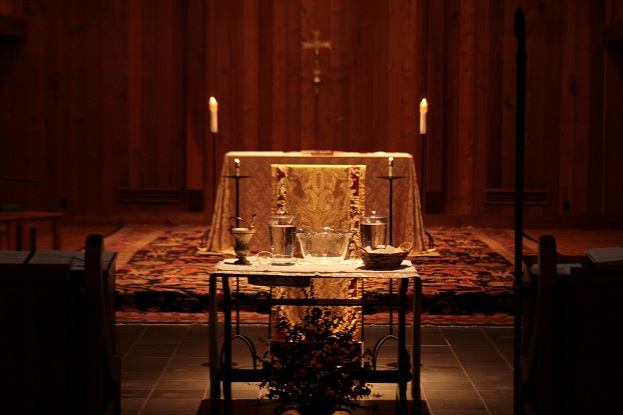
Setup for blessing of holy water celebrated on the Feast of the Baptism of Our Lord

Setup for blessing of holy water celebrated on the Feast of the Baptism of Our Lord

—————————–

The baptism of Jesus is the inspiring event that sets Jesus’ earthly ministry in motion. It is also an event that continues to puzzle us as much as it puzzled John the Baptist.

What did Jesus mean when he told John that it was “proper for us in this way to fulfil all righteousness?” (Mt. 3: 15) Perhaps Jesus was proclaiming full solidarity with all fellow humans in that, although he did not have any sin to repent of, he repented with us who do have sins to repent of. But this way of looking at it presupposes that sin is only a personal matter. It is that, of course, but we should note that in Hebrew anthropology, righteousness is not a matter of individuals being righteous; it is a matter of social justice. That is, all righteousness is not fulfilled until social justice has been established. In Isaiah 42, which this episode in Matthew recalls, the prophet will not rest “until he has established justice in the earth,” (Is. 42: 4) Such justice involves bringing “out the prisoners from the dungeon, from the prison those who sit in darkness.” (Is. 42: 7) Jesus was soon going to teach a whole new way for people to relate to each other that would dismantle our prison system in favor of a whole new way of reforming people and society if ever the teachings were truly followed. In accepting a baptism of repentance in order to “fulfil all righteousness,” Jesus is expressing a deep solidarity with all people at the level of social sin. Maybe Jesus was personally sinless, but as fully human, Jesus was just as compromised from birth by the social matrix as anybody else. Jesus immersed himself in sinful human culture in order to redeem it. That’s solidarity.

As soon as Jesus was baptized in solidarity with us, the heavens opened and the Holy Spirit descended upon him. Jesus’ act of solidarity was opening up new and great possibilities for the relationship of all people with God. The divine voice praising Jesus for what he had done is also offered to each one us: each of us is invited to be sons and daughters of God with whom God is well pleased. It is fitting that this affirmation overflowing like a flood of water should happen at the moment of repentance, for it is repentance that opens up the new possibilities. The two actually happen together as it is God’s affirmation that gives us the strength and courage to repent.

It is also God’s affirmation which reveals the need for repentance. Sadly, God’s affirmation draws our attention to the many failures we all experience in affirming each other. More sadly, it is those who try the hardest to actualize the new possibilities God is opening up who receive the most violent opprobrium as the Suffering Servant did in Isaiah and as Jesus would suffer as well. In the United States, racial injustice continues to be an intractable problem, a problem that imprisons all of us. Black people in the US receive quite the opposite message from the dominant white society than the message God gives each of us, black and white and colored alike. So habitual is the assumption among those of us who are white that blacks are inferior that even those of us who are well-meaning in racial matters have a very hard time seeing the truth of what we are doing and not doing and we need the assistance of others, not least the assistance of persons of color, to begin to see the problem.

The first Christians were faced with a similar challenge with the issue of admitting gentiles into the nascent church. It came as a shock to Peter when he was told in a vision to go to the house of the gentile Cornelius. (Acts 10) The power of his socially-induced prejudice was so great that, despite his declaration that these gentiles were “acceptable” to God after all, he earned the rebuke of Paul at a later time when he held back from table fellowship with gentiles. The story of the Canaanite woman suggests that Jesus himself truly struggled with the social norm of excluding such people. (Mt. 15: 21-28)
.
This consideration is discouraging and hardly sounds like the deep affirmation God offers us through the affirmation of Jesus at his baptism. This discouragement comes from a misunderstanding of what God’s affirmation is all about. In our egocentricity, we tend to think and feel that God’s affirmation is all about ME. It isn’t. God’s affirmation is all about US. By “us,” I don’t mean just me and others like me; I mean all of us, including those who are different from us.

Does this mean that God does not affirm us after all if we don’t affirm others? Let me put it this way. The way of repentance was opened not only by God’s affirmation of us but also by God’s forgiveness as proclaimed by the apostolic preaching. Many times, Jesus connected God’s forgiveness of us with our forgiveness of others. That is not to say that God does not forgive us when we don’t forgive; it is more a case that we fall away from the forgiveness we continue to receive. The same goes for God’s affirmation through Jesus’ baptism. We are all affirmed as sons and daughters with whom God is well pleased, but if we don’t share this affirmation with everybody else, we fall away from the affirmation that God continues to shower on us. None of us likes it of we have to struggle with dis-affirmation to arrive at the truth of God’s radical affirmation of us. So why impose the same struggle on others? Let us instead embrace God’s affirmation of us all so that we can all escape the prisons we have imposed on ourselves. Then, and only then, will we fulfill all righteousness.

Taking Care of God

Children are being born all the time, so one might think there’s nothing special about it. But the birth of a child is special for those involved. Maybe all the other births happening all the time are ordinary, but the birth of one’s own child or the child of someone close to us is indeed special with all the hopes and fears the event arouses.

But the birth we celebrate at Christmas is both more special and unique than all other births. As with all other human births, a human being has into the world, a helpless human being who was totally dependent on the care of other people. If such care is not present, the newborn child will not survive long enough to grow up.

But this time, the human being is also God. That doesn’t compute. God is supposed to be the Master of the Universe, totally in charge and in need of nothing from nobody. If God can and does whatever God wills, as Psalm 135 says, than God could only have become a helpless newborn child by willing to do just that. Why would God do such a thing? Theologians, starting with St/ Paul, say that God became a human being in order to save the world. Indeed, Jesus’ dying on the cross and being raised from the dead is believed to have saving consequences for humankind. But the fact that Jesus was killed by humans in early adulthood makes it clear that, although he was/is God, Jesus was just as vulnerable and killable as any other human being. But what if Jesus had not been nurtured and protected as in infant? What then? Fortunately, we don’t have to explore that question further as we knew that at least Jesus grew up into early adulthood. But only because he was cared for in his most vulnerable years. This vulnerability on the part of Jesus has everything to do with how salvation works

There are many ways in which the Incarnation of our Lord can be said to have turned the world upside down. One of the most startling ways the Incarnation has done this is that, although we all depend on God for our very existence and for sustaining us in being, God has turned the tables by making Godself dependent on us. Mary and Joseph and probably a few other people held Jesus in their arms. In our devotions, we can imagine ourselves holding the baby Jesus in our arms, tenderly consoling him for any discomfort he might feel and trying to make it better. If anybody, such as Herod, should try to harm this helpless child, we would do anything possible to protect him.

The fact that God has entered humanity and become as dependent on other people jas ll other people deepens profoundly the notion that all people depend on other people and all people should cherish and protect everybody else.. That is, God has made every person, every newborn child, special.

Jesus the Helpless Widow

Jesus’ parable of the widow and the unjust judge is puzzling. (Lk. 18: 1-8) Why would Jesus compare God with an unjust judge when everybody knows that God is just, hears our prayers, and answers them in God’s time. But if we think about it, our thoughts may wander into the ways we treat people. Are we ourselves like the unjust judge who takes advantage of people weaker than we? Do we put off helping out those people because it isn’t convenient, and only if the helpless person hassles us will we grudgingly do the helpless person the favor so that we aren’t pestered any more?. If our thoughts move far enough along in that direction, we might realize that we think that God is like us; God does not want to be bothered by our needs and God does not want to be pestered.

In Genesis, we have the mysterious story of Jacob wrestling with the angel until the angel finally gives Jacob a blessing. All his life Jacob had been getting his way through conflict: first getting his brother Esau’s birthright and Esau’s paternal blessing, and then building a prosperous herd after wrangling with his father-in-law Laban for twenty years. If conflict is all Jacob knows, then he”knows” that God won’t give him a blessing unless he fights for it. Jacob walks away from the struggle with the blessing but he is wounded by it. Was it the blessing that wounded him, or was Jacob wounded because conflict was all he knew in life? Are we like Jacob, thinking we have to fight with God to get anything through prayer because we live in conflict with other people?

One could say that each of us has an inner importunate widow and an inner unjust judge. On the surface, we might want to identify with the importunate widow because she is in the right. The problem is, the importunate widow is helpless and we don’t like being helpless. The unjust judge is the one in control and we usually prefer that position, except that it is not the righteous position. Of course, if we struggle like Jacob, we don’t feel so helpless, even if in truth we are. The thing is, if we keep struggling because conflict is our way of life, we end up growing the unjust judge in us. It is worth noting here that Jesus himself was condemned by unjust judges such as the likes of us.

The author of Second Timothy urges us to: “proclaim the message; be persistent whether the time is favorable or unfavorable; convince, rebuke, and encourage, with the utmost patience in teaching” (2 Tim. 4: 2) It sounds as if the apostle would have us act like the importunate widow. If apostolic ministry is about doing the things Jesus did, then it follows that Jesus, the victim of unjust judges, is himself an importunate widow. The apostolic author goes on to warn of people with “itching ears” who don’t like sound doctrine. We tend to assume that those people with “itching ears” are those who happen to disagree with us. We should worry about itching in our own ears. In light of Jesus’ parable, having itchy ears could have to do with thinking God is like the unjust judge when God is much more like the helpless widow just as Jesus was helpless on the cross. That is, God cries out to the unjust judge in each of us day in and day out, pleading for justice. Like this widow, God does not stop pleading, and so we, too should plead in prayer without ceasing and yearn for justice for ourselves and for other people.

The same thoughts are developed in Unjust Judges and Widows.

God’s Economy

Money comes up in the Gospels more frequently than one might expect for writings that are supposed to be “spiritual.” Just last week’s Gospel featured a parable about financial mismanagement on the part of a roguish manager. The Gospel before that included a short parable about a lost coin. Maybe that wasn’t mismanagement, but just carelessness. Sandwiched between those parables was a parable of a son who asked for his share of the inheritance and then lost it all, another case of financial mismanagement. Money and wealth come up yet again today in the parable of the Rich Man and the beggar Lazarus. Since the Rich Man was successful with money, one might think that mismanagement wasn’t his problem, but maybe his wealth itself was the problem. The roguish manager, after all, ameliorated his circumstances by reducing the debts of his master’s clients, which made him more generous than his master, and much more generous than the Rich Man who ignored the poor man at his gate. Actually, the Rich Man didn’t ignore the beggar altogether. After all, he recognized him resting in the bosom of Abraham and apparently was used to giving the beggar orders without giving him anything in return. If so, not paying his errand boy would indeed be a misuse of financial resources.

The writer of the First Epistle to Timothy famously says that “the love of money is a root of all kinds of evil.” (1 Tim 6: 10) More dramatically, the author warns that “those who want to be rich fall into temptation and are trapped by many senseless and harmful desires that plunge people into ruin and destruction.” Amos denounces the wealthy many times, sneering at people who “lie on beds adorned with ivory” and “dine on choice lambs and fattened calves.” (Amos 6: 4,5) Sounds the Rich Man in the parable. In the preceding Parable of the Roguish Manager, Jesus uses the term “dishonest wealth “ several times, suggesting that it is the only kind of wealth there is. That this is so is capped with the warning: “You cannot serve God and wealth.” (Lk. 16: 9-13)

But isn’t money in itself neutral, and it’s a matter of how we use it? After all, God’s creation is good, meaning that material goods are good as and we only need to use them well. Yes, but how do we use money and material goods well? It is our desires, of course, that distort the use of material goods. Desiring so many butterscotch sundaes that one gets sick is a distortion of desire. But more precisely, it is our desires in relation to other people that tend to get distorted, such as “needing” to have more butterscotch sundaes than somebody else. However, money is not a material good in the sense that wheat and lambs are material goods that one might consume. Money is the medium of exchange that connects us to each other as we negotiate our desires. That is., money itself is created straight out of our desires in relation to other people. Transactions can indeed be fair and charitable exchanges, but they easily degenerate into competitions where we each try to outdo the other.

When being wealthy is an end in itself, as it seemed to be for the rich man who wouldn’t even give Lazarus a scrap from his table, then there is indeed a “great chasm” in our human relationships created by the discrepancy of wealth. The rich man’s placement in Hell is not the act of a vindictive god; it is simply the reality of the rich man’s alienation from humanity, not only from Lazarus’s humanity but from his own as well.

It is true enough that one needs some material goods in order to survive and that normally one needs some money to obtain these goods. The warnings in scripture about money are warnings of a lust for wealth, a lust that destroys human relationships. The author of First Timothy suggests that we be content with the necessities of food and clothing. (1 Tim 6: 8) This sort of contentment and a concern for other people go together. When we are content with what we have, it is not necessary to have more than others. On the contrary, our contentment will make us all the more concerned that others also have enough for their basic necessities. As Jesus stresses time and again in the Gospels, serving God is tantamount to serving other people and God’s creation. That is why it is not possible to serve God and wealth. Only if we stop serving wealth as our master will we serve God through serving God’s people. So, it is indeed the case that our use of money has much to do with spirituality.

On Taking the Lowest Place

Jesus’ parable of the important seats is easy to understand. It’s one of the first parables I learned as a young child in Sunday school. It could easily have come from any of the sitcoms I watched at that age. I can imagine Jackie Gleason barging into a dining hall and rushing for the best seat at the table, followed by his spluttering rage when he’s told he has to sit over in a corner.

In this parable, Jesus shows a profound awareness of social contagion, a phenomenon analyzed with much insight by René Girard. What Girard articulates is our human tendency to receive desires from other people. In the case of the banquet, the more some people want the best places, the more other people will want the best places just because other people want them. If some people think some places are the best and rush for those, then other people will desire those places because other people want them.

One way to get some perspective on this parable is to reflect on the kind of person who rushes for the best seat and the kind of person who holds back. The kind of person who holds back is apt to be more kind than the other, or at least not so unkind. The thing is, reaching the best seat can be a kind of pyrrhic victory. One might have the prestige of being a CEO, the president of the United States, or the center of a social set, but if such a one treats people badly, that person will not be liked or respected on a personal level, even if there is respect for the position. It’s a way of saying one might gain the world and lose one’s soul. One has lost one’s soul to the social contagion that blunts concern for the well-being of other people. In fact, although this parable doesn’t speak of darker alternatives, it is easy to imagine the rush for the highest place resulting in a violent free-for-all. This is what Girard says is likely to have happened at the dawn of humanity, and the free-for-all resulted in everybody converging on a victim. It isn’t easy to escape the power of this social contagion but if one takes notice of Jesus, then one sees an alternative.

To begin with, Jesus is not giving us a social strategy for getting the best place by being laid back. Jesus would have us realize that grabbing one of the best places at a dinner party or pushing for social dominance over others is not where our priority should be. Rather than trying to get the highest place, one should be content with the place one happens to have and do the best one can in that place while attending to the needs of others, which is the best way to be given a higher place due to one’s accomplishment. But there is more.

Jesus didn’t just take a middling place; he took the lowest place. His preaching ministry, for all the acclaim it received from many people, gained the opprobrium of those who thought they had the highest places and wanted to keep them. These people sentenced him to a criminal’s death, death on a cross. That was the lowest place there was in the Roman world at the time. But then Jesus was raised from the dead by his heavenly Abba and raised to his Abbas’s right hand in Heaven which is about as far up as one can go. Such is the Christological level of this parable. Who would have thought that a sitcom scenario could outline the story of our redemption?

For more on René Girard, see Violence and the Kingdom of God, Living Stones in the House of the Forgiving Victim, and Living Together with our Shared Desires.

Inside the Host

A Eucharistic host is usually small. At my first communion, it was about the size of a nickle and so thin I thought it was a sticker. The host that goes into a monstrance is closer to the size of a silver dollar but it’s still awfully thin. So why put such a small thing into a fancy monstrance? The word comes from the Latin monstrare meaning to show, indicating that a monstrance shows something hidden in the small host. As if the monstrance in itself were not enough, from medieval times up to recent modern times, the host was carried in elaborate processions through public places. Just a few years ago, I witnessed such a procession in Innsbruck that featured prayers given by the city dignitaries and rifle salutes by the Landwehr.

So what’s the big deal? Many religious thinkers not sympathetic to such devotions have asked the question and with a full heap of scorn and have complained of attempts to imprison Christ in a small piece of bread. This accusation misses the point. It isn’t that some evil bishop kidnaped Jesus and locked him up in the piece of bread. Rather, Jesus himself offered himself to us in the bread at the Last Supper. In a mysterious way, the piece of bead has become the Body of Christ. That really is a big deal.

But how can this be? How can a piece of bread ever become the Body of Christ? Jesus did not explain it, which is as good a reason as any for us not to try to explain it either. I personally find attempted explanations along the line of transubstantiation interesting as I savor the paradoxical reasoning of substance and accident becoming at odds with each other, but I have to admit this is more of a puzzle game than an act of devotion. After all, we aren’t saved by a metaphysical formula; we are saved by Jesus. And it is Jesus who invites us into the tiny home that he has made in the host. The very word expands:” “host” as in sacrifice (from hostias) as well as a host who invites us as a guest. (Any host knows that there is some sacrifice in inviting a guest.)

Just the notion of one person being invited by Jesus to an intimate meal as in George Herbert’s celebrated poem Love III would entail quite an expansion of space inside the a Eucharistic host. But there is much more. Jesus invited all twelve of his disciples to his Last Supper and it is possible that many more attended as well. In any case, Jesus invites not just one person, however individual and focused each invitation might be, but a multitude of people to the meal, so the inside of the host is more the size of an infinite banqueting hall. And the meal offered by Jesus has brought in the whole of creation that made the bread on the altar possible to begin with.

But there is much more. Since it is the person of Jesus who invites us in the sacrament, then we are meeting up with the whole person, not an outward persona such as what a maitre D’ in a restaurant would present us with. Besides meeting the person who healed the sick and the crippled, told mysterious parables, and commended the lilies of the field, we are meeting the person who was crucified on account of the social tensions we humans were not able to solve. The tomb in which Jesus was laid would have been a real prison except that it couldn’t hold him and it exploded inside out as Jesus was raised from the dead. So, inside the Eucharistic host, we are meeting the crucified and risen Jesus who is also glorified in Heaven. The inside just keeps on expanding.

There is still more. The crucifixion of Jesus is not an isolated act of one person: it is an act that absorbs every single unjust act of violence committed against every human being for all time. So all of the horrific atrocities we know of and many more are all included with the crucified Jesus inside the Eucharistic Host. This is the reason that the Eucharist has profound social significance. It isn’t just about me and Jesus; it’s about everybody and Jesus and we share with Jesus the suffering of everybody. And yes, there is still more. If every human atrocity is absorbed in the crucifixion which is present in the little host, then all the more is the redemption of the Resurrection present, a presence to raise every unjust act up to God for God to vindicate every injustice. The crucifixion absorbing all crucifixions is dark and unspeakable. It is all the space of infinite nothingness. (It has been asked if there can be poetry after the Holocaust.) The dazzling darkness of the Resurrection is even more unspeakable in its embrace of all crucifixions. This darkness is more infinite than the first. All of this inside a Eucharistic host no matter how small on the outside. Quite a lot to swallow.

The Risen and Ascended Living Interpreter of Scripture

In Luke’s Gospel, the first thing Jesus does after rising from the dead is explain the scriptures to two of his followers on the Road to Emmaus, explaining how it was “necessary” that the Messiah “suffer these things and then enter his glory.” (Lk. 24: 26) The last thing Jesus does before his Ascension is explain the scriptures to the disciples in the same way. Understanding this “necessity” is a tricky business. For whom was it “necessary?” It is ludicrous to suggest that it was “necessary” for God that the Messiah should suffer. On the contrary, Luke, like the other Gospel writers, tells the story of Jesus’ execution on the cross in such a way as to stress the necessity on the part of humans that Jesus die in order to bring “peace” to Jerusalem. The key to understanding the scriptures that Jesus opened his disciples’s minds to is this human necessity that the Messiah (Jesus) die so that “repentance for the forgiveness of sins. . . be preached in his name to all nations, beginning at Jerusalem.” Lk. 24: 47) So what was “necessary” for God? For God the only thing necessary was to raise Jesus from the dead so that he could continue to open our minds to the true meaning of the scriptures as a living interpreter.

Luke’s Gospel and its sequel, Acts, reveals quite clearly the human tendency to solve social problems through collective violence as theorized by René Girard. But these writings also reveal a deeper and much brighter truth about the human potential for sympathy and empathy. This is where Resurrection and Ascension, repentance and forgiveness, all come in. In announcing the Jubilee in his inaugural sermon in Luke, Jesus proclaims a gathering through sympathy and caring rather than through competitive tensions and violence. This new gathering involves freeing prisoners, giving sight to the blind, and setting the oppressed free. (Lk. 4: 18) In his teaching, Jesus makes the words quoted from Isaiah his own in his famous parables of the Good Samaritan and the Prodigal Son. In opening the scriptures to the disciples, Jesus is not only revealing the truth of collective violence but also the human potential for sympathy that leads to forgiveness and reconciliation as taught in these parables. From there, Jesus leads us even deeper into the self-giving love shown on the cross, a love we too may need to embrace. More important by far, Jesus embodies this teaching and revelation in his own act of forgiveness and thus enables the same in each of us.

A dead Messiah wouldn’t be available to enact and enable repentance, forgiveness and costly self-giving. Only a Messiah who is very much alive can do that. This is why Jesus, having been raised from the dead and now ascended into heaven, is seated at the “right hand in the heavenly realms, far above all rule and authority, power and dominion, and every name that is invoked, not only in the present age but also in the one to come.” (Eph. 1: 20–21) The image of all things placed under Jesus’ feet suggests the earthly rulers who use their fallen enemies as a footstool. (Ps. 110: 1) I suspect this is the image the disciples have when they ask Jesus just before the Ascension if now he is “to restore the kingdom to Israel.” (Acts 1: 6) But Jesus, in opening the scriptures to the disciples, has revealed his kingship to be one of sympathy, forgiveness, and compassion; in short a kingship based on the Jubilee proclaimed at the start of his ministry. Rather than thumping his foot on us, Jesus bends down and raises us up to his seat. In revealing his true kingship, Jesus has not only opened up the scriptures to us, but he has opened up the truth of human history as well, a truth more glorious than the “necessary” violence that we think gives life its “meaning.” As the key to scripture and history, Jesus fulfills Paul’s prayer that “the eyes of [our] hearts may be enlightened in order that [we] may know the hope to which he has called [us], the riches of his glorious inheritance in his holy people, and his incomparably great power for us who believe.” (Eph. 1: 18–19)

The Gentle Resurrection

Luke’s first Resurrection narrative is the quietest of all four Gospels. Matthew is easily the loudest with an earthquake announcing the event. That’s our idea of Easter! Mark is puzzling and a bit of a cliffhanger with the women running away from the tomb out of fright. That’s still a pretty intense reaction. John is almost as quiet with the women finding the tomb empty before Jesus appears to Mary, but Luke is quieter still. The women are puzzled by the empty tomb and the announcement of the two men in dazzling clothes. They do tell the disciples but the disciples don’t believe them, not just because they are women but because the news is too unbelievable. The narrative ends with Peter looking into the empty tomb, amazed, but scratching his head.

There is an air of suspended reality about all this. Much of it has to do with the shock of grief over the death of a loved one. In the shock of grief, nothing seems real, least of all the absence of the loved one. It’s like the person is there and not there. This isn’t what we think Easter is all about but I would argue that this is the most realistic entry into this stupendous event. We are used to thinking of earth-shaking events as–well–events that shake up the world. But these sorts of events don’t really change the world as they are the same old acts of competition and violence and force that have been with us since Cain killed Abel. If the Resurrection were such an earth-shaking event, it would actually have kept the world going in the same old rut of retaliatory violence. That the Resurrection is so low-key, especially in Luke’s version, shows us that the Resurrection does indeed embody a radical act of non-violence, giving us all the space we need, century after century, the discern why it was “necessary” that Jesus be handed over to sinners, crucified and then rise from the dead. The necessity for the death was, of course, a human necessity as Caiaphas affirmed. (Jn. 11: 15) The Resurrection, though, is God’s necessity. It was necessary that God raise Jesus to give us an undying life-giving presence for all time. But this presence needed to be totally without violence, i..e. without force of any kind, just as Jesus’ death had to result from renouncing all violence in the face of evil. Not even the earthquake in Matthew forced Jesus’ resurrected life on anybody.

St. Paul writes about being baptized into Christ’s death before rising with him. (Rom. 6: 3) The initial phase of disorientation described by Luke is very much a feeling of death as the world the disciples had been living in had also been rendered unreal, even if the imperial order continued unabated as it always had done. There is a lot more to dying to the old self than giving up our own personal sins. More than that, we need to die to the culture of violence we are immersed in so as to enter the life-giving nonviolence of the resurrected life. Since there is nothing earthshaking about it, nothing to make headlines, it may not seem like much, but to the contrary, embracing the forgiving life is indeed everything.

We may think that nothing has changed when we read about the virulent racism in our own country and around the world. Even worse is the horrific act of violence in Ukraine, which makes headlines, but is really only a repeat of what Rome was doing in Jesus’ time. But something has changed over the centuries. We now have oppressed people throughout the world arising in non-violent protest, including Martin Luther King Jr and William Barber II. We have a world-wide protest against the invasion of Ukraine and many countries doing what they can to help their stricken neighbor. These are all signs of the Resurrection in the midst of the horror and death that Jesus suffered on the Cross. The Resurrection, though, isn’t just about events on a large scale. It is also about small events of love and concern for the well-being of others day after day with the people right next to us—our neighbors.