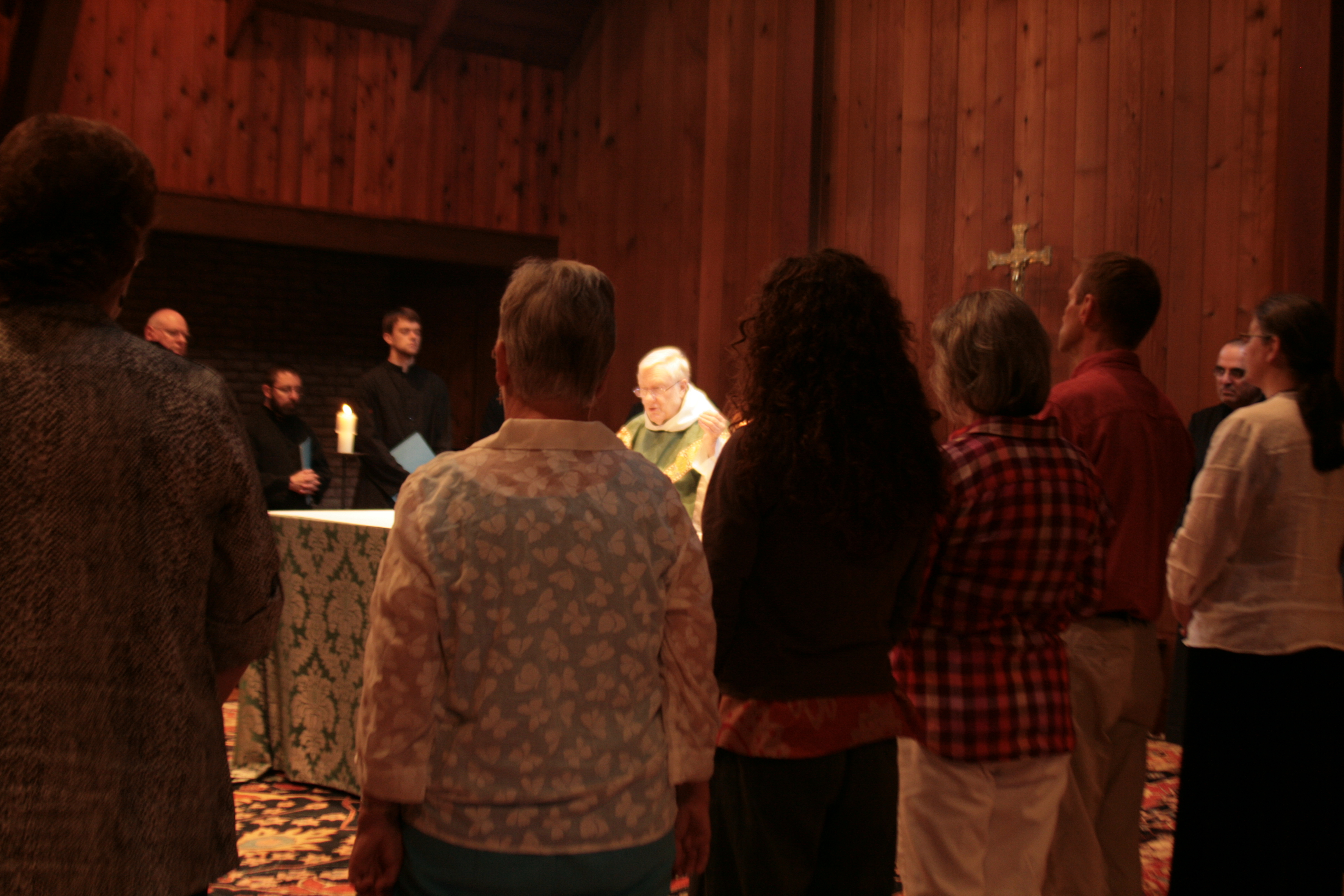
Resurrection in Miniature

One of the oldest instinctual human acts is to reverence the bodies of the dead. Only in the most recent years have there been any signs of attenuation of such customs. There are no pragmatic reasons for it. As Søren Kierkegaard noted, the dead can’t pay you back for what we do for them, which makes reverence for the dead a profound act of disinterested love. Why do we have this instinct? Why was it important to the women to bring spices to the tomb at the dawn of the day after the sabbath at great expense? In answering these questions, it occurs to me that there is something awesome about death. How is it that the life that used to fill this body is no longer there? Where did that life go, if it went anywhere? Finding the tomb empty was bewildering to the women. How could they reverence the body if the body was not there? Worse, what sort of disrespectful act might have been committed on the body of a man who had died a criminal’s death?

Suddenly seeing the two men in dazzling clothes only compounded the bewilderment. These “men,” presumably angels, teased the women for looking for the living among the dead. (Lk. 24: 5) True, if one is looking for a live person, a tomb is not the best place to look, but the women had come to reverence a dead person who had meant much to them, and a tomb is the right place to look for that. As it turns out, the women who came to the tomb are the first to be told that Jesus is risen. They are also derided for not having expected this outcome, but since this is the only time in the history of the world that a dead person has risen bodily from the dead, they can be pardoned for not expecting it, Jesus’ prophesies of dying and rising notwithstanding. After all, the disciples didn’t believe Jesus when he said he was going to be killed. How could such a great man come to such an end? And if they didn’t believe Jesus was going to die, they would hardly have gotten to the notion he would rise again. Given the reaction of the women at the tomb, they hadn’t believed these prophesies any more than the disciples did.

It is highly significant that the first persons to be told about Jesus’ rising were not the disciples, but this small group of women who came to care for a dead body by anointing it with spices. One could say they got a lot more for their kind action than they bargained for. What if nobody had come to the tomb to reverence the body of Jesus? Would the resurrection have been made known? The story following in Luke gives us the first resurrection appearance of Jesus himself, but it isn’t straight-forward. The two disciples on the Road to Emmaus don’t recognize Jesus, but they invite him to stay with them when they come to an inn at eventide. If they had not kindly invited the stranger to stay and share supper with them, would they ever have seen the man as Jesus resurrected from the dead?

When the two disciples run back to Jerusalem to tell the other followers of Jesus, they are told that Jesus had appeared to Simon Peter. Although one would think this appearance the most momentous of all, it is mentioned almost in passing. Even Paul gives it more prominence is his list of appearances. (1 Cor. 15: 5) Luke then concludes with Jesus appearing to all of the disciples. It all seems low-key and very quiet. Hardly earth-shaking as the Resurrection is in Matthew.

I suggest we think further about how closely tied the Resurrection appearances in Luke are to small acts of human kindness. In Brothers Karamazov, Dmitri tells of how a man’s small act of giving him a bag of nuts made a deep impression on him. Such acts may seem to accomplish little, but they are the stuff of the resurrected life that abides.

The Prodigal Parable

The Parable traditionally known as The Prodigal Son (Lk. 15: 11–32) is obviously a story of estrangement and reconciliation and forgiveness. So clear is this message, there should be no diluting or compromising it with violence, discord, or unforgiveness. However, the United States, a country filled with active churches, has the highest rate of incarceration in the world by a large margin. On top of that, we are seeing a spirit of vengeance in politics that seems to keep on growing. Does this parable’s meaning just disappear at the church door on the way out to the “real” world? A lawyer, Preston Shipp, author of Confessions of a Former-Prosecutor is an example of this disconnect. While raised in the church, he dreamed of being a prosecuting attorney from a fairly young age to protect society from the bad guys who victimized the good people. For many years, he fulfilled this dream by working at the state attorney’s office in Nashville. All this time, Jesus’ parable was in a totally alien universe, to judge by his own account. So, somehow, the simple and clear message of the parable is extraordinarily difficult to hear and believe in and act out in life. Why is this? Does the Parable itself give us insights into these difficulties? Let us take a look for ourselves with the help of Preston Shipp.

The elder brother’s relationship with his younger brother is not brotherly, although I suppose a cynic might say that’s what brotherhood is. Given the outrageous way the younger brother left home (demanding, not requesting his half of the inheritance) there are understandable reasons for this attitude. In any case, the elder brother’s calling his younger brother “that son of yours” in speaking with his father, suggests a highly depersonalized relationship with his brother. Preston Shipp writes about how he realized that the justice system is designed to prevent a prosecutor from having any personal awareness of the person he was prosecuting, let alone a relationship. This changed when a professor he had in college asked him to teach some law classes for college credit in a woman’s prison. This experience of bonding with incarcerated persons lead him to leave the prosecutor’s office. He now works for the Campaign for the Fair Sentencing of Youth. Clearly, the way we manage relationships has a lot to do with how forgiving, or not, we might be. The second time Preston taught a course, he was highly impressed by a woman named Cyntoia Brown. She was underage when convicted of murder, but was sentenced as an adult. As he learned of her exposure to sex trafficking from an early age and other factors, he saw a person in a way that a prosecuting attorney is not encouraged to see a defendant. Imagine his shock when he received a copy of a court document he had filed while still working as a prosecutor, showing that he himself had rejected her appeal of a 51-year sentence and had never recollected it after meeting her in class.

Although the elder son is dutiful in the sense of staying home and working on his father’s farm, the way he berates his father for receiving his younger brother suggests he has little love for the work or for his father. Serious dissatisfaction with one’s work and family situation can harden the heart and make one less inclined to forgive. However, when the father tells the elder brother that everything he has, his elder son also has, we gain the suspicion that perhaps the elder brother was surrounded with blessings, like fattened calves, that he did not see or appreciate. Such lack of appreciation also dampens a sense of forgiveness of other people. The elder brother may have stayed with his father geographically, but his mind and heart seem to have been miles away.

The trauma of abuse or violent crime can make it difficult for the victim to forgive. Preston Shipp encountered many such crimes and knows what they cost the victims, although he also realized that the justice system did nothing to assist such victims except to feed any vengeance they might have. There is nothing in the parable to suggest that the elder brother had suffered any such trauma. The father, on the other hand, was surely traumatized by his younger son’s departure, and yet he welcomed him back with open arms. Cyntoia Brown was traumatized when she saw that her appeal had been denied and that Preston Shipp had been the one who reviewed it and rejected it. Preston expected to be skewered by her when he came to the next class, but he found her deeply forgiving, in spite of her hurt. This particular story has a happy ending in that, with the help of some celebrities taking up her cause which brought her into the public eye, Cyntoia was finally released from prison and has become an activist for many social causes, hoping to prevent what happened to her from happening to other people.

Shipp explains in many ways how vengeance is systemic in our judicial system and throughout our country’s cultural system. This system of vengeance is greatly exacerbated by systemic racism that has characterized American culture since colonial times and continues unabated to the present day. Racism, of course, entails much depersonalization of the other. More important, participation in such as system skews our perception of reality where many things taken for granted shouldn’t be. Will we ever bottom out of this collective sin the way the younger brother bottomed out of his sensual sins? On the other hand, this parable depicts a party being celebrated by an entire household, except for the elder brother. We can take this party as an image of a society transformed by forgiveness and reconciliation, an eschatological vision, we might say. Surely this party is an image of God, in Christ, “reconciling the world to himself.” (1 Cor. 19) Does this image attract us in any way, enough for us to desire to enter into it? Or are we more attracted to a society governed by the elder brother as he berates his father for such a celebration?

.When the father says to his elder son that the younger son had been dead and has come to life, (Lk. 15: 32) the story shifts to the Paschal Mystery. Such radical forgiveness makes one vulnerable, as the father was vulnerable. Who would want to be treated as the younger son treated his father? Who would want to be treated the way the older son treated his father? It is sobering to recall that the person who told this beautiful and edifying story was crucified as a criminal. Can we trust that this victim is risen and is still inviting us to the party?

Embracing the Fox

When Jesus calls Herod “that fox,” (Lk. 13: 32) many associations, especially those from childhood, come to mind. In my case, there are the Uncle Remus stories of Br’er Rabbit and Br’er Fox and, of course, Aesop’s Fables. The animal stories by Thornton W. Burgess were among the first story books I heard as a small child, and they were the among first books I read for myself. Would Jesus have heard any such stories as a child? In the case of Aesop, it’s possible. It seems that children everywhere grow up with animal stories with foxes often being prominent.

The quality of being a cunning predator, often transformed as a trickster of sorts, is basic to many of the anthropological portrayals of foxes in the legends. In one of Aesop’s Fables, a fox tells a cock how much it wants to hear the bird sing. Indulging in pride over his voice, he is vulnerable to being carried off for the fox’s next meal. The townspeople, however, chase the fox because the cock belongs to them. So the cock suggests that the fox tell the people the cock belongs to it. Of course, when the fox opens its mouth to say that, the cock escapes. So the fox is outfoxed. Br’er Rabbit is always finding ways to outwit Br’er Fox, most famously by getting Br’er Fox to throw him into the brier patch where he can disentangle himself from the tar baby. In the Burgess books, Reddy the Fox goes from one flamboyant trick to the next. When I was an adolescent and Igor Stravinsky became a favorite composer, I listened to the short dramatic work Renard. Renard, another trickster fox, spanned several European traditions including the Russian version Stravinsky used. One of Renard’s tricks is to dress up as a nun and offer to hear the cock’s confession and give absolution. There seems to be some ecclesiastical confusion here, not least the ongoing problem of a predator posing in clerical garb. The cock makes himself vulnerable by being—well, cocky, and the cock needs to be rescued by the Cat and the Goat. It is not simply a case that a fox, like a rooster, has to eat. Reddy the Fox literally bites off more than he can chew by running off with the farmer’s plump hen, not for his supper, but for bragging rights.

Stories of trickster foxes and other animal tricksters are funny, They certainly tickle the funny bone of small children who feel overwhelmed by the power everybody else has over them. Since these stories reflect human behavior, they give us a chance to laugh at ourselves, if we are wise enough to see when the shoe fits. In the case of the Burgess books, just about every animal gets a story for itself, so that sympathy shifts from one character to another. A child might root for Reddy the Fox when he runs off with a plump hen, but roots for Danny Meadow Mouse when he is chased by an owl.

In short, these stories reflect the rivalrous relationships humans carry on with each other in all their comic dimensions. Not surprisingly, vanity is constantly the downfall of one rival or the other. But there is a sobering side to the comedy if we reflect that it is based on rivalry between predator and prey (and some characters are both.) It is no accident that the same dynamics come up time and again. When human relationships become rivalrous, it becomes a perpetual motion machine that keeps on going, just as the stories keep on coming with Renard up to his old tricks and his rivals up to theirs to outwit him in turn. In calling Herod “that fox,” Jesus is indicating that Herod, certainly a predator if not necessarily a trickster, is perpetuating the same old rivalry game as Renard and all other foxes in the fables. When Jesus laments the destruction of Jerusalem, he is showing us that all Jerusalem is caught in the fox’s game.

But instead of acting like a cocky cock or attacking the fox as the Cat and Goat do, Jesus yearns to gather Jerusalem’s children “as a hen gathers her brood under her wings.” (Lk. 13: 34) But we are not willing. After all, we would have to give up our predator/prey games that seem to give life so much of its meaning. But Jesus has already thrown a monkey wrench into the fox’s game by his gesture. Jesus pushes the monkey wrench deeper into the heart of the cosmos when he opens wide his arms on the cross, like a hen gathering its young.

When Paul tells the Philippians to imitate him, (Phil. 3: 17) he himself is imitating Jesus as the Mother Hen who renounces the fox’s games and makes himself vulnerable. Another example Paul holds up for imitation is Abraham in his act of faith. (Rom. 4: 3–5) When he has no heir and no hope of an heir, it is hard to be consoled by the countless stars in the sky. When we are overwhelmed by predatory foxes, we yearn for the Lion of Judah, not a Mother Hen with wings extended. But Abraham “believed the Lord; and the Lord reckoned it to him as righteousness.” (Gen 1 5: 6) Can we hold steadfast in such faith? There is much need for the embrace of love in the face of so much widespread predatory trickery today. Can we even go so far as to join Jesus’ embrace of all foxes that they, too, may live in the Kingdom?

See also: The Prophet between the Fox and the Hen

On Being the Temple of God

The brief story of the widow putting two small coins into the temple treasury, the only coins she had to live on, has often been touted as an edifying story about sacrificial generosity. I’ve come to seriously doubt that Jesus intends us to see it that way. Yes, the woman is generous and one can think of her many successors who built St. Patrick’s Cathedral in New York with their hard-earned pennies. But just before the woman comes with her two small coins, Jesus has castigated the scribes who “devour widows’ houses.” Moses and the prophets constantly championed the widows and orphans, and yet a person who is supposed to be championed is instead devoured by the system. What Jesus knew and the poor widow didn’t, is that the temple was a lost cause; it was going to be destroyed.

But Jesus also knew that the temple was a holy place. Hence his fury that it had been turned into a den of thieves. When Jesus was a child, he knew that the temple was the place where he should be about his Father’s business. (Lk. 2: 49) Religious anthropologists know very well that there is a human need for sacred space, space that focuses one on God and makes one feel closer to God. Hence the devotion of the poor widow in Jerusalem and the widows and other people with meager resources donating towards the building of St. Patrick’s Cathedral.

The destruction of the temple in 70 A.D. was a shock to both the Jewish and Christian communities and both communities had to build their traditions out of the ruins. After all, the first followers of Jesus also worshiped in the temple when it was still extant. The Jews recreated their tradition by embodying the Temple sacrifices through their daily practice developed in the Talmud. As for Christianity, John, in his Gospel, quoted Jesus as saying that if the temple should be destroyed, he could rebuild it in three days, meaning, as John goes on to say, that Jesus was referring to his body as the real Temple. (Jn. 2: 19–21) The author of Hebrews picks up this theme. By being the once-and-for-all offering for sin, Jesus has replaced the temple where sin offerings were made, with his own body. (Heb. 9: 24–28) For Christians, then, the temple has been replaced by Jesus as the focal point, the sacred space. But if Jesus has entered the heavenly sanctuary not made by human hands, as the author of Hebrews says, then where does a Christian find holy space?

Over the centuries, many church buildings have been built to fulfill this need, some of them overwhelming cathedrals, others storefronts. For me, one of the most moving entries into sacred space was a modest building, unadorned except for a cross strategically placed so as to be hard to notice, with a worn linoleum floor inside. But this is where a small group of Christians had worshiped for years in East Germany. These people had spent their whole lives giving up two small coins in their worship of God.

But, as the Risen Jesus revealing himself in the breaking of the bread shows, Jesus, is not only the true Temple of God but he makes all of us into the Temple that is His Body. That is why Paul, in line with John and the author of Hebrews, says that we are made the Temple of God by and in Christ. (1 Cor. 3: 16) Just as Jesus is the Temple by giving his whole life, we are part of the same Temple when we give all of our lives to God and neighbor. That is, the temple of God is everywhere as is the case in the Book of Revelation, where there is no temple because the Lamb has become the Temple. (Rev. 21: 220 At St. Gregory’s, it strengthens our prayerful focus on God to have the abbey church to go to several times a day, just as it helps to have set times for prayer to help us cultivate an attitude of prayer at all times. When we had a couple of weeks when we couldn’t pray in the church because the furnace had broken down, I missed the sense of focus the church gives us. But it is at least as important not to imprison our prayerful focus on God in a church space, but to keep the walls permeable to the rest of the world so that we are always in God’s Temple because we are God’s Temple. As the true Temple, Jesus broke bread at an inn just as we break bread at the Eucharist in the church.

See also: God’s Kingdom in Two Small Coins

Dwelling in the Land of the Suffering Servant

The passage from Isaiah known as the Song of the Suffering Servant (Is. 53: 4–12) takes us to a foreign country where we have difficulty finding our way and understanding the language. The itinerary is too long and complicated to attempt a thorough tour, but the overall ambience is one of crushing suffering. The Servant is “struck down,” “wounded,” and “afflicted.” But not just struck down and wounded and afflicted as, say, a person dying of cancer might be, but somebody “wounded for our transgressions.” Perhaps one could say that there are a few familiar sights that remind us of normal life. We know that people sometimes suffer for the wrong-doing of others, and perhaps we feel we have ourselves suffered on account of others, but we don’t normally encounter the suffering inflicted on a person in so concentrated a form. But what is particularly foreign and strange is that the afflicted one “did not open his mouth,” but rather was “like a lamb led to the slaughter.” (Is. 53: 7) Some people can be resigned and dignified when suffering, but it is difficult not to protest when one is so seriously wronged. And this isn’t just somebody being blamed for what somebody else did. This is somebody stricken for the transgressions of a whole people. And yet, “he had done no violence, and there was no deceit in his mouth.” Such willingness to suffer for the wrongs of others without protest is more than most of us can comprehend. The whole notion that such a thing could happen so intensively is as easy to comprehend as a totally unintelligible language. But there is another strangeness as well. The speaker, one we could call our guide, expresses remorse for the suffering of this innocent person. Our guide admits to being guilty of the sort of transgression that resulted in the suffering. Moreover, the guide admits to guilt over allowing the suffering and thinking the suffering was justified, was God’s will. This guide now sees the suffering as “a perversion of justice.” (Is. 53: 8) Sometimes we feel guilt over small matters such as putting ourselves before others and not stepping up in times of need. But such a fundamental move of repentance is rare in so serious a matter. Again, the language is virtually unintelligible.

But just as a foreign land can take on some familiarity for a frequent visitor, so visiting the foreign land of this text can take on the beginnings of familiarity the more we visit it. If we follow the Church calendar, we have at least a yearly visit. And now, outside of the usual time, we have another visit to the text we normally come across on Good Friday. If we gain the beginnings of familiarity, we can begin to ask ourselves if we have, in our own ways, added to the sufferings of this innocent servant, and whether or not we should repent of the burdens we have laid on other people. Perhaps we can begin to learn the language of this land and take the language to heart.

The Epistle to the Hebrews is not the same land as that of the Suffering Servant. It is not as drawn out and intense in the suffering as in Isaiah, but the language is a close variant of that of the Suffering Servant. First, we have a normal high priest who offers sacrifices for sins on behalf of the people. (Heb. 5: 1) It looks like a routine job, though one requiring penance on the part of the priest who sins like all of the other people. (Heb. 5: 2–3) But then suddenly, we have a High Priest who does not make an offering of a lamb led to the slaughter, but makes an offering of himself. This Priest is the lamb led to the slaughter, as was the Suffering Servant. Like the Suffering Servant, this Priest did not protest, but he did make his self-offering with “loud cries and tears to the one who was able to save him from death.” (Heb. 5: 7) Again, we see a radical self-giving that is hard to understand, but the more we visit this land and learn the dialect, the more our hearts move in this direction, leading us to trust the One who heard the cries of the Priest who offered himself.

In Mark’s Gospel, we find ourselves in a much more familiar world where it is much easier to understand the language and customs. Two followers of a charismatic religious leader ask their leader if they can be given the best places at the right and left hands of the leader. (Mk. 10: 35–37) Not surprisingly, the other followers are incensed at this initiative, presumably because these are the places they would rather have for themselves. This kind of jockeying for position is much more like normal life than like visiting a foreign land. The odd thing, though, is that the charismatic leader in question, Jesus, isn’t in their territory at all. Perhaps his body is there with them, but his mind is thoroughly ensconced in the Land of the Suffering Servant, a land where he speaks the language fluently. It is the world of his followers and of ourselves that is unintelligible to him. In fact, when Jesus does speak, he speaks in the language of the Suffering Servant, a foreign tongue to the disciples and to us. Fortunately, Jesus’ teaching is relatively simple, like using a primer for beginners. In this regard, this Gospel fits in well during ordinary time, when we are following Jesus and his disciples and learning for ourselves how to be disciples. Rather than talking about bearing the burdens of other peoples’ transgressions, Jesus simply tells us that the leader must be a servant of all. (Mk. 10: 43) This is the first baby step for learning the language of the Suffering Servant. One can go from there to the more advanced matters of the Suffering Servant’s world, which is Jesus’ world.

We are here presented with two worlds, two universes, even. Perhaps some of us have one foot in both worlds. Since the two worlds don’t mix very well, this would make us be what James, In his epistle, called “double minded.” (James 1: 8) The world of the Suffering Servant, is, however, what Paul called the “mind of Christ.” (1 Cor. 2: 16) The question is whether we will occasionally visit the world of the Suffering Servant as uncomprehending tourists, or make frequent visits and become fluent in the language where the words penetrate the heart. If we become attentive to serving others, there isn’t time to ask for the best places because we are entering the only place that matters.

A Cup of Cold Water

Jesus’ words about cutting off hands and feet and plucking out eyes in order to avoid unquenchable fire are pretty grim and can leave us feeling traumatized. (Mk. 9: 43–48) It is enough to make a preacher look for ways to make everybody feel better. For starters, I think I can safely say that this business of cutting off hands and feet and plucking out eyes is hyperbole and Jesus doesn’t expect or want us to do any such things. Even so, even if we take these words metaphorically, they are clearly metaphorical about giving up something that feels like a part of us, so we aren’t in for a free ride by any means.

Why the talk about stumbling blocks that lead to sin and the drastic solution of dismemberment? The French thinker René Girard is helpful for understanding what a stumbling-block is all about. The Greek word is skandalon. It refers to offense, scandalizing other people by our conduct or our words. In the preceding verses read as last Sunday’s Gospel, the disciples had argued about who was the greatest. Jesus then put a child among them and told them to become like this little child. (Mk. 9: 33–37) At the beginning of today’s reading, the disciples are complaining about somebody casting out demons in Jesus’ name, another example of arguing about who is the greatest, as they see this exorcist as a competitor while Jesus sees him as somebody else doing what needs to be done. (Mk. 9: 38–40) Girard suggested that when people become rivals, they become stumbling blocks to one another. They become entangled with one another, tripping and falling over each other. Children, such as the child Jesus placed among the contentious disciples, are very vulnerable to such a competitive environment in many ways. If they feel they have to compete to get attention in order to have their needs met, they copy the behavior that is modeled to them. More tragically, children are often “collateral damage” in the conflicts waged by their elders, whether it is in the family or large-scale warfare. A society permeated by people arguing and fighting about who is the greatest is hellish. It is a fire that never goes out. So we don’t have to think in terms of an afterlife, but it is worth mentioning that there can be no such rivalry in heaven so we do have to give it up if we are going to find heaven heavenly. Besides, the word translated as “hell” is Gehenna. Far from referring to the afterlife, Gehenna refers to a valley outside Jerusalem that Jeremiah and other prophets said was used for child sacrifice. (Jer. 19: 2–5) This image is most apt for the vulnerability of the “little ones” or “the least of these.” This term does not necessarily refer to children, although because Jesus had recently placed a child among the disciples, it is easy to think that. There is no question, however, that Jesus is referring to all vulnerable people, which certainly includes children.

These considerations would suggest that we need to cut off our rivalrous desires and throw them away so as to avoid the hell of rivalrous contention. The trouble is, we can’t really cut off our desires and throw them away. We are still human if we have one hand or one foot or one eye, but we aren’t human if we don’t have desires. And it isn’t that we have some bad desires we can throw away and some good desires that are keepers. We have desire. Period. So it isn’t a case of cutting off desire but directing it and, when necessary, redirecting it. Such redirection can feel like an amputation for those of us who are addicted to fighting over whether we are the greatest. We have a simple but powerful example of redirecting desire away from rivalry towards charity in the words sandwiched by the apostles’ complaint about the “unauthorized” exorcist and the exhortations to cut off hands and feet if they cause us to stumble. Here Jesus urges us to give a cup of cold water to anyone who bears the name of Christ. (Mk. 9: 41) Such redirection leaves us vulnerable to those who continue to play the hellish game, but Jesus has told us that the kingdom is about being among the least of all people, the most vulnerable. The more we are in touch with our own vulnerability, the more sympathy we have for the vulnerability of others, including the vulnerability of those who try to hide their vulnerability through rivalry. We need these cups of cold water to put out the fires.

Hungering and Thirsting for God

When Jesus says “I am the bread of life,” (Jn. 6: 48) he taps deeply into a basic human need. The obvious metaphor unmistakably raises the question of whether we need God as much as we need food. Am I as hungry for God as I am hungry for food?

We naturally desire food. Many thinkers, among them St. Thomas Aquinas, also think that we desire God just as naturally. For what it is worth, that is my experience. Both desires are implanted in us by virtue of creation. Since God gives us these needs, God also provides for them. God provides food for the body, sometimes miraculously, as God did for Elijah in the wilderness or at the feeding of the multitude in the wilderness, but normally, God feeds us as God feeds the birds of the air. (Mt. 6: 26) The natural longing for God is God’s provision for fulfilling the deeper need it creates. To some extent, this longing is itself God’s provision of God’s presence, but it is also a foretaste of what is to come.

In the case of food, a lack of appetite is a sign that something is wrong and we seek medical help. If that doesn’t solve the problem, we try psychiatry or pastoral counseling for matters of the heart. Sometimes, people lose their appetites because table fellowship breaks down, in which case there is need to repair the social fabric. But what if we don’t desire God, or think we don’t? Is that a sign of bad spiritual health? If it is true that we all have a natural longing for God, and it stands for reason that it is so if we are created by God, than the answer is Yes. However, it isn’t our business to worry about whether other people are properly hungering and thirsting for God. We should attend rather to our own appetites

With physical health, there are several factors that are considered as indications as to whether a person is healthy or not. The same is true for spiritual health. The fourth chapter of Paul’s Letter to the Ephesians is a good checklist. Not stealing and earning an honest living is a start. Not letting evil talk come out of our mouths is a stronger indication, while speaking evil of others suggests lack of health. “Bitterness and wrath and anger and wrangling and slander, together with all malice” all need to be put away. (Eph. 4: 31) Such is junk food that is most unhealthy. On the other hand, being tender-hearted and forgiving in imitation of Christ is healthy food indicating spiritual health. People who show this kind of health are longing for God whether they know it or not. As Jesus said that doing the will of the one who sent him was his food and drink, (Jn. 4: 34) the good dispositions and actions listed in Ephesians should be our food and drink. Unfortunately, God’s provision does not keep us from spurning what God provides. Like petulant children who won’t eat their vegetables, we complain about the manna in the desert, especially if the spiritual journey feels like a desert. When such petulance on our part leads to hateful speech and insensitive treatment of others, it can dampen other peoples’ appetite for God and the things of God. So we have a responsibility to feed others with food that is healthy and nourishing. We must keep before us these questions: Do we long to taste the love and good works that Jesus embodied? Do we taste and see that the Lord is good? (Ps. 34: 8) These are questions to ask ourselves when we receive the Body and Blood of Jesus in the bread and wine.

Brought Near by the Blood of Christ

In the second chapter of Ephesians, Paul presents a powerful vision of human unity and reconciliation: a household of God with Jesus the cornerstone. What beautiful words for sore ears, ears sore from the discord and violence breaking out in the world even as we celebrate the Holy Mysteries of the altar. This fact of discord and violence makes it clear that we have not reached this vision. Moreover, there is more than a hint of violence in the fact that the reconciliation has been brought by the blood of Christ. (Eph. 2: 13) The blood of Christ is often skimmed over as a formula to set up something more pleasant, but it refers to a death by torture on a cross of a man who spent a life trying to offer healing and reconciliation.

The French thinker René Girard suggested that from the dawn of history, human society has had a tendency to resolve social tensions through focusing on one person who is blamed for the social tensions. When the person is put to death, things are more peaceful—for a time. The root problem, the entanglement of human desires that leads to violence when it is believed that the objects of desire cannot be shared, does not change, so the cycle starts all over again until, once again, the shared desire reaches concord through focusing the blame on one person, or a group of persons. Girard called it “unanimity minus one.”

This is precisely the story that the Gospels tell: the story of a society ripped apart by many tensions until, suddenly, miraculously, all of the parties that are at each others’ throats suddenly come to an agreement that Jesus must die. But the Gospels proclaim this victim to be innocent, not the one who tore society apart, but the one who tried to bring reconciliation. Indeed, the tensions in Jesus’ time were not resolved with the result that Jerusalem was destroyed in A.D. 70. That this was so was not by chance. The cycle of collective violence only “worked” because the truth was covered up and denied. The Gospels blew the cover, making sure that it will never “work” again, no matter how hard we try.

And yet Paul proclaims a cosmic reconciliation as a result of this violent death. Why? Because Jesus was raised from the dead as the forgiving victim. Paul himself experienced Christ’s forgiveness in a powerful way on the road to Damascus. Jesus did not just preach about forgiving one’s enemies; Jesus practiced it as the risen victim. In so doing, Jesus inaugurated what Paul calls a new creation, a new humanity, a chance for humanity to start over and get it right this time. But when we look at the discord and violence, it is clear we haven’t gotten it right yet. There is some good news inspired by the Good News that is the Gospel, however, namely the massive amounts of charitable work done around the globe to build up dignity for people who are ground down by the discord and violence.

In Mark, we see Jesus having compassion on the people “because they were like sheep without a shepherd.” (Mk. 6: 34) Jeremiah castigated the shepherds who destroy and scatter the sheep. (Jer. 23: 1) When there is no shepherding or bad shepherding, humanity falls into the cycle of violence that resolves on a victim, the scapegoat. Jeremiah conveyed God’s promise of real shepherds who will care for them. (Jer. 23: 4) Paul insists that Christ is this shepherd, but not a shepherd who nags and scolds but one who shepherds through forgiveness. As the Gentiles and Jews had united in putting Christ to death, Paul says that Christ unites Jews and Gentiles through forgiveness as the risen victim. So Jesus has reconciled Jew and Gentile “to God in one body through the cross, thus putting to death that hostility through it.” (Eph. 2: 16)

Throughout his preaching, Paul proclaimed this reconciliation of Jew and Gentile, hoping and believing it could happen soon and be the consummation of creation. Yet, that did not happen. Jewish persecution of Christians embittered the early church and anti-Jewish attitudes wrecked havoc on the Church, culminating in the Nazi Holocaust.

Although Gentile-Jewish relations continues to be a burning issue, in the U.S., relations between white and black people is front and center. Black people have been victimized beginning with the slave trade, but it is important to realize that committing such atrocities destroys the humanity of those of us who perpetrate it just as the persecution of Jews destroyed not only Jews but persecutors. Julia Robinson Moore, a black historian and theologian who uses Girard’s thought, has found evidence that the enslavement and suppression of blacks correlates with increased tensions between white people. So it is that blacks become collective victims of social problems among whites. As the Afro-American theologian James Cone said, Jesus is most present on the lynching tree.

In many ways it is frustrating to have Paul’s great vision of reconciliation when the reality of the present time hits us in the face. But it is important to be profoundly grateful for the vision. Proclaiming peace to those who are far off and those who are near is a guiding star, a way for us to be oriented. This vision gives us something to aim for, to hope for. Among other things, this vision gives us a means to test the shepherds who would lead us. Who is more apt to gather and build up? Who is more apt to scatter and destroy? Jesus became such a shepherd by getting all the people to sit together and eat together with what seemed very few loaves of bread and fishes. Such a vision challenges us to want it, really want it. Since this vision means that all of us will be changed, even changed radically, it can be frightening enough for us to hold back. All the more reason to pray to want to want this vision of reconciliation.

This vision can also point to both big and small ways to live it out. Julia Robinson Moore leads a reclamation project for the graves of enslaved persons. She takes students on field trips to spruce up the slave graveyards and she bring the descendants of slaves and enslavers together when they are ready for that move, giving all a chance to affirm the full humanity of the other and to seek mutual healing.

For an introduction to the thought of René Girard see: Living Stones in the House of the Forgiving Victim and Living Together with our Shared Desires.

True Greatness

It is natural and good to have an affection for the place where one was raised and where one lives. Caring for one’s family, one’s community, one’s city, one’s country is all good. Such affection is the basis for caring for other people. Caring for other people. That is the key. Do we indeed make local affections the basis for caring for people of other cities, of other countries?

In Deuteronomy, Moses grounds his love for his people in God’s love for his people. It is God who has delivered the people from Egypt and is leading them to a new land for them to settle in. Therefore one should fear God for what God has done. (Deut. 10: 21) Moses then expands God’s love for God’s own people by saying that they are commanded to love the stranger. Why love the stranger? Because the Israelites were strangers in Egypt. They should remember their own vulnerability as strangers and care for the vulnerability of other strangers. America is a continent of immigrants, which is to say, strangers. This even goes for those we call Native Americans. For that matter, we find histories of migration for just about any group of people that we know anything about. All of us are vulnerable strangers and all of us should care for vulnerable strangers.

In the Sermon on the Mount, Jesus presupposes the legitimate and right love one has for one’s own people, then, in the tradition of Moses and going beyond it, stretches this love for the stranger to one’s enemies. (Mt. 5: 44) That is to say, God raises the sun, not only on one’s own people, but on all people. After all, caring for one’s own people is the least we can and should do. Isn’t it caring for the stranger that makes a country great? Isn’t it caring for one’s enemy that makes a country greater still?

There is much talk about making America great again. The anniversary of the founding of our country is a good time to reflect on what made America great, or if it actually needs to be made great in the first place. Since penitence is central to the Christian life, repenting of the ways we fall short of greatness is part of the celebration of our country. Noting failures to care for the stranger, the widow and the orphan, let alone loving our enemies, can lead us to greater efforts. If we can do these things, America will indeed be great.

The author of Hebrews takes up the theme of migration with an added depth. Abraham demonstrates his faith by setting forth to a place that he is to receive as an inheritance, (Heb. 11: 8) but actually Abraham and his descendants were seeking “a better country, that is, a heavenly one.” (Heb. 11: 16) We are all migrants seeking a better country that is grounded in God’s love for all people. One’s own land, one’s country, is important, but it is not of ultimate importance. God is of ultimate importance and God has prepared a better homeland for all of us, one that nobody will have to fight over.

On Being a Mustard Shrub

The Parable of the Mustard Seed is one of the most famous parables of Jesus, one that gives us hope that a small beginning can have an impressive ending, or so we think. This notion of an impressive ending comes from the versions of this parable in Matthew and Luke. ((Mt. 13: 31–32; Lk. 13: 18–19) There, the mustard seed grows into a tree, although Matthew does call it a shrub that turns into a tree. Mark, most likely the earliest version, and closest to Jesus, simply says that the mustard seed grows into the “greatest of all shrubs.” (Mk. 4: 3-32) A shrub, even a sizeable one, doesn’t seem so impressive, especially when we realize that mustard shrubs were considered intrusive weeds in Jesus’ time. What is Jesus getting at? We can get a lot of help by looking at some contexts for the parable.

This parable seems almost certainly to be inspired by a similar parable in Ezekiel: “This is what the Sovereign Lord says: I myself will take a shoot from the very top of a cedar and plant it; I will break off a tender sprig from its topmost shoots and plant it on a high and lofty mountain. On the mountain heights of Israel I will plant it; it will produce branches and bear fruit and become a splendid cedar. Birds of every kind will nest in it; they will find shelter in the shade of its branches. (Ezek. 17: 22-23) With the prophet, we have Yahweh taking something small, a twig, and making something great and impressive out of it: a tree on a mountaintop that shelters birds. So it is easy to see why later versions of Jesus’ parable would move in this direction. But in Mark, the seed is smaller and less impressive than a twig, and the mustard shrub is much less impressive than the splendid cedar. Moreover, cedars are cultivated for their wood; mustard shrubs are weeds. A triumphalist vision in Ezekiel has been downsized quite a bit by Jesus. So again, what is Jesus getting at?

In Mark, the Parable of the Mustard Seed is immediately preceded by The Parable of the Growing Seed where, after seed is scattered on the ground, “the earth produces of itself, first the stalk, then the head, then the full grain in the head.” (Mk. 4: 26-29) In this parable, the growth seems natural, something that happens by itself. We sense the mystery of God’s creation that brings plants into being and makes them grow. The mustard shrub also grows naturally, but it is an intrusion that is planted intentionally, perhaps an image of the intrusiveness of God’s kingdom. And yet the mustard shrub is also an image of welcoming, a place for birds to build their nests, an image of inclusiveness from what we might call an outcast plant.

The two parables of plant growth are preceded by a more elaborate parable with much the same imagery: the Parable of the Sower. Although analogies of natural growth are there, the emphasis is on failure. Most of the seeds fall on rocky soil or among thorns or on the roadside and bear no fruit. This parable coincides with the disciples’ first signs of failure; they do not understand the parable. As the Gospel progresses, the failures of the disciples increase, culminating in the desertion at Gethsemane, Peter’s denials, and then the women running from the empty tomb, saying nothing to nobody. The seed falling on paths, rocky ground, or thorns looks like the disciples. We don’t even have a mustard shrub; we only have scattered seeds that don’t grow at all.

But God can create out of nothing. God did this in the beginning, and God does it again after Jesus’ Resurrection. (Note that the first word of Mark’s Gospel is arche, beginning.) And St. Paul says that, in Christ, “the new creation has come.” (2 Cor. 5: 17) In Jesus’ parables, what little seed did fall on good soil yielded thirty, sixty or a hundredfold. The mustard shrub was just enough for the birds of the air to come and make their nests. How did even this much come from such massive failure? We have a hint at the New Creation when, in the face of the disciples’ failures to accept his coming death, Jesus tells his disciples that they will be handed over to councils and beaten in synagogues and will stand before governors and kings because him. (Mk. 13: 9) This prophecy leaps out of the frame of the Gospel narrative to the witness of the apostles recorded in Acts. The Parable of the Mustard Seed leaps even further out of the frame. In the face of our human failure, there will still be an intrusive, unimpressive kingdom that most people don’t want, a kingdom like a shrub which opens its branches to God’s people to further, with Paul, Christ’s ministry of reconciliation. (2 Cor. 5: 18)

See also Sowing Parables in our Hearts