
 Jesus’ insistence that we deny ourselves and take up our crosses and follow him (Mk. 8: 34) jolts us into thinking about what our priorities in life should be. Without being so jolted, we tend to deny other people, take up our favorite pastimes and follow whoever takes our fancy. However, we encounter a serious problem if and when we do take Jesus’ words to heart. We tend to get muddled over what constitutes a “cross” and how we should carry it. Because of this muddle, there is the danger that the cross will be trivialized. Carrying our own crosses is not about being a good sport if we catch the flu.
Fundamentally, the cross is about persecution. Jesus is telling his disciples that he expects to be crucified for the way he is confronting the religious and imperial authorities. The Servant in Isaiah was also persecuted by people who smote his back and plucked out his beard. (Is. 50: 6) More importantly, the cross is about not retaliating if one is persecuted, so being patient with Great Aunt Hattie who complains about every act of service is not so trivial. The combination of not retaliating and setting our faces like flint (Is. 50: 7) is precisely what Peter missed when he called Jesus the Messiah. That is why Jesus shut him up.
The biggest problem of waxing eloquently about carrying our crosses is that we overlook the danger, the likelihood, of being crosses for other people. We easily fool ourselves into thinking we are not persecuting others as long as we aren’t pulling beards or driving nails into someone’s hands and feet. But, in his epistle, James shows us how easy it is to be a persecutor. He says that the tongue, small as it is, is a fire that can set a whole forest ablaze and it even “sets on fire the cycle of nature.” (Jas. 3: 5–6) We both bless and curse others with this little member. (Jas. 3: 10) James is warning us how the contagion of collective violence such as that afflicted on Isaiah’s Servant and Jesus can afflict anyone by the agency of anyone through such use of the tongue. Language, the sign of civilization, is compromised from the start by its role in persecution. The more “civilized” we become through writing, the printing press, newspapers, the Internet and Twitter, the more quickly and efficiently peoples’ reputations are destroyed by firestorms set off by the tongue and its extensions the pen and the computer keyboard.
Instead of boasting about carrying crosses, we most need to busy ourselves with relieving others of the crosses we lay on them. Manipulating others into persecuting us to make them feel bad while making us feel good is really another way of persecuting others. As Isaiah’s Servant and Jesus show, crosses can come to us quickly if we speak out against persecution, since that is everybody’s favorite blood sport. Jesus warned the people of his time and us of our persecutory tendencies with his parable of the evil workers in the vineyard. (Mk 12:1-12) and by driving the money changers from the temple whose officials were exploiting the poor. (cf. Mark 12:41-44)
Following Jesus, then, is about both taking up our crosses and renouncing them. We take up our crosses by doing everything we can to stop persecution even if we suffer for it. But before going after other persecutors, we need to take the logs out of our eyes before taking the splinters out of the eyes of others. (Mt. 7: 5) Otherwise, our witness against persecution is likely to turn into persecution of the persecutors. This is why we can only take up the cross if we renounce using it as a weapon but rather use it as a Tree of Life for others.
 Eating is among the most fundamental activities of civilization, perhaps the most fundamental. It is the practice that brings people together to share in nourishment and social nurturing. And yet, throughout the animal kingdom, sustenance requires feeding on other living beings. Sometimes it is other animals, sometime plants. That is, a group bonding through eating inevitably bonds at the expense of other living beings.
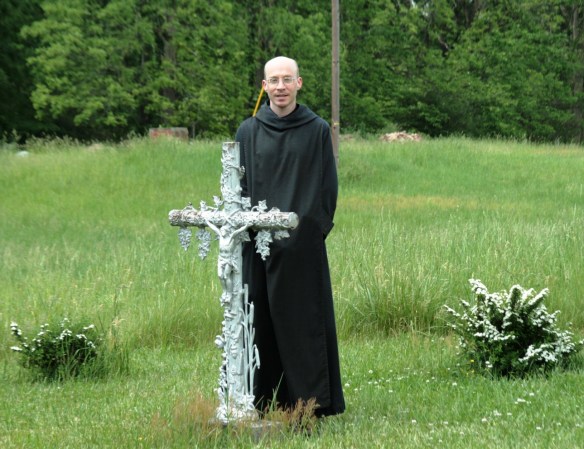 The Trinity is a fundamental doctrine for Christianity but Christianity is a story of salvation before it is a set of doctrines. The Trinity is no exception. If we get the story right, we might get the doctrine right, but if we get the story wrong, then we get the doctrine wrong for sure.
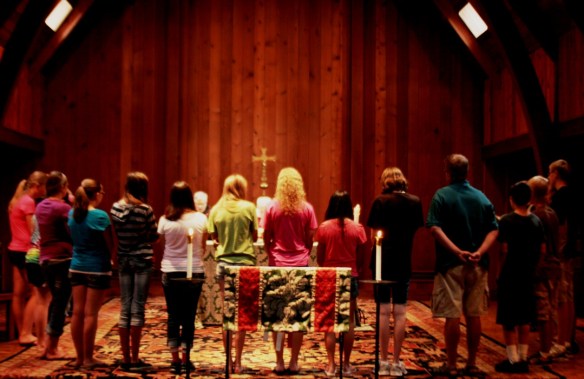 The image of the vine and the branches in John 15 gives us a powerful image of closeness both between ourselves and God and also with each other through our grounding in God.
 St. Paul proclaims the Resurrection of Jesus as a radical game changer. It is a passage from death to ourselves to a new life in Christ. This proclamation is often understood as an individual conversion. It is that but it is much more. During his life, Jesus proclaimed the kingship of God. A kingship, of course is social, not individual, much as we like to fancy ourselves kings and queens of our little castles. The kingship of God looked like a lost cause when Jesus died, but after being raised from the dead, Jesus leads us into the kingship that we rejected when we crucified him. It is important to note that Paul was not writing to an individual but to a community, indeed, the community that at the time represented all humanity as Paul knew it. St. Paul proclaims the Resurrection of Jesus as a radical game changer. It is a passage from death to ourselves to a new life in Christ. This proclamation is often understood as an individual conversion. It is that but it is much more. During his life, Jesus proclaimed the kingship of God. A kingship, of course is social, not individual, much as we like to fancy ourselves kings and queens of our little castles. The kingship of God looked like a lost cause when Jesus died, but after being raised from the dead, Jesus leads us into the kingship that we rejected when we crucified him. It is important to note that Paul was not writing to an individual but to a community, indeed, the community that at the time represented all humanity as Paul knew it.
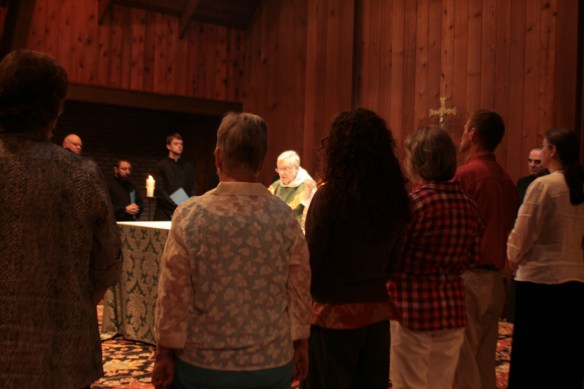 The Passover is the formative event for Jews, the event that constitutes them as a culture. The Last Supper, the Eucharist, is as formative for Christians. Although there is debate as to whether the Last Supper was a Passover meal, the association with that feast is clear enough for Jesus’ supper to have incorporated and redefined Passover. The big question is: What is the culture that these events are intended to form?
 Mark tells us that immediately after his baptism, the Spirit drove Jesus out into the wilderness where he was tempted, or tested, by Satan.
 The custom of imposing ashes on our foreheads as a sign of our mortality on Ash Wednesday, the beginning of the penitential season of Lent, has the potential to encourage us to think that mortality is something we should repent of. The opposite is the case. We are not asked to repent of our mortality, we are asked to remember our mortality. Remembering our mortality is an important way to repent and to amend our lives. Since God made us mortal, mortality is not the problem. The problem, a huge problem, is the tendency to deny our mortality, to think that death should not apply to us. Clinical studies inspired by Ernest Becker show that denial of mortality leads to violent and insensitive behavior while some measure of acceptance leads to a much more humane way of relating to others, of connecting to others. I can’t help but reflect that in a great many fantasy novels, the villain tries to gain immortality which can only be achieved by stealing the life substance of others; an extreme example of how denial of mortality inevitably leads to victimization of other people. Such villains are always so deeply isolated as to be living deaths, no matter how many years they survive in this world. But if we accept our mortality, we put our trust in the crucified and Risen Lord, the true giver of life. When we accept our mortality, the time we have to repent becomes precious and we are ready to spend this precious gift wisely in the way we live so that others, too, may live.
 When Jesus opened his teaching ministry, Mark says that the people were “astounded” because he taught them“as one having authority, and not as the scribes.” (Mk. 1: 22) Oddly, Mark doesn’t include anything of what Jesus said. The Greek work exousia is much stronger than the English word that translates it. “Powerful authority” would bring us closer to the meaning. That Jesus’ teaching was not like that of the scribes doesn’t give us much more to go on as to the content, but it indicates that this authoritative teaching was distinct from those who were normally considered the teaching authorities.
 When the angel Gabriel announced to Mary that the child she was about to conceive in her womb would be the heir of the House of David, making him a second David, one might have thought that the child would be named David after his forebear. But the angel said the child should be named “Jesus” and he was given that name when he was circumcised on the eighth day.
 Imaginary Visions of True Peace