A Way of Meeting with Others

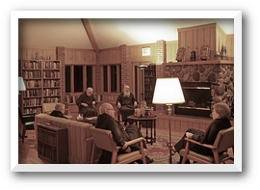
commonRoomOne of the more remarkable and attractive chapters in the Rule of St. Benedict is Chapter Two: “Summoning the Brothers [and Sisters] for Counsel.” Although Benedict was not so democratic as to have matters put up to a majority vote (as most modern monastic constitutions are), Benedict considered it essential that the abbot listen to all members of the community before making a decision. In my time as abbot of my community, I am profoundly grateful for the suggestions and cautions from my fellow monks on numerous occasions. Most writings on the Rule remind us that the first word is “Listen.” Much is made of the need to listen to God and to then to others, especially the superior, as a means of listening to God. Here, Benedict reminds the abbot to listen to the community. Given the toxic atmosphere of much debate in political and religious matters, I cannot stress enough to importance of listening as a first principle to healing the exchange of thoughts and opinions.

We can make it easier for others to listen to us by expressing ourselves in a way that makes it easier for them to listen. Benedict says that we will do this if we “express [our] opinions with all humility, and not presume to defend [our] own views obstinately.” If we take a moment to think about how hard it is to listen to a person who does the opposite of what Benedict enjoins here, we will see the importance of this admonition. More important, when we express our views humbly and without obstinacy, it is easier to be focused on the issue rather than our relationships with other people which, in the course of debate, tend to become more competitive than constructive. Benedict would have us discern the right thing to do, not strive to gain the most debating points.

Even more startling than the foregoing: Benedict says that the reason the whole community should be called together is because “the Lord often reveals what is better to the younger.” This is not an over-idealization of young people, but is a salutary reminder that the points of view of marginal people, which includes the young, may prove to be vital to a right discernment. Our tendency is to push those we consider marginal to the margins, usually while assuming that we are not marginal.

Issues such as gun control and immigration reform being debated right now are complicated and require careful thinking and expression that is most fruitfully done humbly with a heart that listens to ourselves, to others, and to God.

These ideas are developed at greater length in my book Tools for Peace.

Strange Wedding

wineTableFeast1The Wedding at Cana of Galilee is a beautiful story of celebration. The only problem is the story makes no sense, perhaps because celebration is infinitely beyond sense.

Foremost among the oddities is the scarce presence of the groom and no mention of the bride. The effect of Jesus being at the center of the story and no bride mentioned has the effect of putting us into the position of the bride of Jesus as Isaiah said: “As the bridegroom rejoices over the bride, so shall your God rejoice over you. (Is. 62:5)” The scarcity of wine (probably humanly created—Cana was a poor village—looks ahead to the scarcity of bread in the wilderness. Both times, Jesus counters scarcity with extravagant abundance.

The six stone jars are supposed to hold water for purification. That would be a lot of purity, but the jars are empty. Well, purity laws and rituals tend to divide humans arbitrarily into clean and unclean. That is, purity always creates a scarcity of purity, especially of pure people. Quite the opposite of God’s marriage with all God’s people.

The water with which the attendants fill the jars suggests baptism, as does the water at the well in Samaria, another story with nuptial overtones. The wine is a festive drink but it also looks toward Jesus’ death as does the bread in the wilderness. The story of Jesus driving the money changers out of the temple, the event that drove the Jewish leaders in Jerusalem to plot the death of Jesus, further suggests that the water and wine refer to the Passion.

Dostoevsky makes powerful use of this story in Brothers Karamazov. The great staretz (spiritual father) Zossima has just died. When his corpse follows the normal course of nature and creates a stink, many of the people are scandalized, including Zossima’s youthful follower, Alyosha. Late at night, the stricken Alyosha  is praying in the hermitage where the body lies in state. Another monk is reading the story of the Marriage of Cana. The room expands to take in a vast celebration. Then Alyosha sees Zossima rejoicing. The elder says to him: “We are rejoicing . . . we are drinking new wine, the wine of great joy. See how many guests there are?” “He [Jesus] became like us out of love, and he is rejoicing with us, transforming water into wine, that the joy of the guests may not end. He is waiting for new guests, he is ceaselessly calling new guests.”

Cana was a backwater in a backwater, a place of no significance. The temple in Jerusalem was the center of Jewish religion and culture. As with the outcasts at the manger, the party is in the backwater, not the center. In this new center, Jesus calls all of us to the party, the party that transforms the body and blood of Jesus into bread and wine of feasting and rejoicing, a party open to all of us. . Jesus has indeed saved the best wine until last.

See blog posts Humanly Created Scarcity, Divinely Created Abundance, and Outcasts at the Manger and article Violence and the Kingdom of God for more comments on Brothers Karamazov.

Arachne, Athena, and a Thousand Princes

Xenia1Imagine a world where competitiveness is that world’s foundation, where it is nothing but mimetic rivalry all the way down. (See my post Human See, Human Want.) Actually many people have, but I am going to focus on a couple of recent fantasy novels I’ve just read which do that.

The Mark of Athena is the latest volume in Richard Riordan’s second series about adolescent demigods, Heroes of Olympus. These books can be a fun way to learn about Greek and Roman mythology, but if ever these gods are real and they really (mis)rule the universe, we’re in trouble. The positions of Zeus and the other Olympians, for example, are the result of earlier conflict. In Riordan’s novels, Cronos and Gaia make comebacks that fuel the divine in-fighting.

This latest book Riordan makes the millennia-old resentments come alive in their tense paralysis. Arachne who offended Athena by weaving a better tapestry than Athena could. Arachne is imprisoned under Rome as a giant spider with a monstrously bad attitude. Beth, a daughter of Athena, has to take from Arachne the Athena Parthenos that was stolen by the Romans and restore it to the Olympians. We see frozen resentments such as Arachne’s in human experience all the time. What if God really were like Athena instead of a God who generously brings us into being and even more generously saves us from follies such as that of Athena and Arachne?

The other books is A Confusion of Princes by Garth Nix. Prince Khemri is one of countless youths raised in privileged but inhuman conditions to serve the inter-galactic empire as a prince. Each prince is connected to the imperial mind upon coming of age (if he or she is not assassinated first) and is plunged into a system fueled by rivalry and nothing but rivalry. Material goods and programed courtesans are furnished in abundance so there is nothing to fight over except power and position. Nix does a superb job of showing us what such a system looks like, a system that is totally sacrificial. Khemri is singled out for a unique assignment that forces him to live with normal human beings. He is quite bewildered when he finds himself instinctively defending a woman when all his training taught him to use a human as a shield for himself. Is it a shock to us if ever we discover something in the world that isn’t rivalry all the way down, but is grounded instead in love that reaches out to others?

See Baptizing the Imagination for an essay on religious aspects of fantasy literature. See Violence and the Kingdom of God for more about mimetic rivalry and religion.

Outcasts at the Manger

altarXmasStar1We like to be insiders and hate to be outsiders, don’t we? Well, let’s look at some insiders and outsiders in the Christmas story. The people who stayed at the inn in Bethlehem were insiders. A betrothed couple and their newborn baby were outsiders. Shepherds were outsiders, hated and distrusted by all. So why would the angel of the Lord show such bad taste in revealing the birth of the Savior to them?

The Magi were highly-placed insiders in their own country, most likely top advisors of royalty. So why would they travel to another land where they were outsiders? If the star was up there for all to see, why did these foreigners from without and outcasts from within Jewish society respond when others did not?

The Magi, used to being insiders, went straight to the top, to the ultimate insider, King Herod, to inquire about which newborn child the star was indicating. Ironically, Herod was an Idumean, not a full-blooded Jew. He had power, but he was an outsider. Herod’s reaction to the Magi’s inquiry showed Herod to be an outsider to humanitarian feelings once he thought his power was threatened. Mixed racial background aside, being rich and powerful pushes one to the margins of society as much as the poverty of the despised shepherds.

These days, we easily see Herod as an outsider, an intrusive foreign element entering the story only to stir up trouble and grief. The shepherds and the Magi are insiders, like us. How did that happen?

There is a certain sleight of hand that turns us and certain chosen others into insiders when it suits us. Not only do we not wish to be outsiders, we don’t like to be challenged by outsiders. If we realize that the shepherds and Magi and the Holy Family themselves are outsiders, our identities are shaken at a deep level. If it is outsiders who appreciated the richness of the Christ Child, maybe the same thing happens today. After all, some nonbelievers care more about the poor than rich Christians and a Hindu early in the twentieth century believed in the Sermon on the Mount more than the Christians of his time.

The greatest irony is that Christ was born to save all people, to make insiders of all of us. The problem is, we don’t want to be insiders with those who are outsiders and we certainly don’t want outsiders to join us. After all, what would we do if there were no outsiders?

The Word Became Vulnerable Flesh

creche1When St. John says that the Word became flesh and dwelt among us, he is sharing a mystery so deep that we don’t know what to say. The mystery only deepens when we recall that the Word was with God “in the beginning” and without the Word, nothing was made. What is more, the Word was God. Which is to say, the Word is God for all time.

So why would the Word enter into the Creation that the Word shaped? Isn’t that a case of ultimate downward mobility? Later in his Gospel, John says that God so loved the world that He gave his only begotten Son who died on the cross. Suddenly, the Word who in the beginning was with God and was God is much more concrete and understandable. Except why would God and the Word love us so much that they would do that? Looking around at ourselves, there seems to be no accounting for taste.

What is so amazing is that God, who we might think is the ultimate in invulnerability, chooses to be vulnerable. God’s vulnerability is attested by the prophets who spoke of God’s distress over human waywardness and infidelity. But even then, “the boots tramped in battle” in Isaiah didn’t trample the Word who was with God and was God. But once the Word was born in the flesh of a human mother and laid in a manger, the Word had become just as vulnerable to trampling boots and automatic rifles as the children at Sandy Hook School in Newtown, Connecticut and the children slaughtered in Bethlehem by order of King Herod.

Here is where the mystery deepens so profoundly as to escape comprehension. It goes against what we think are our deepest instincts. We do everything to make ourselves less vulnerable from putting on plated armor, to hardening our feelings to buying weapons to defend us for the “slings and arrows of outrageous fortune,” to quote Hamlet. If the Word without whom nothing was made that was made is willing to be so defenseless, than perhaps it isn’t really our deepest instinct to defend ourselves so aggressively after all.

Perhaps if we, like Mary, would treasure these things and ponder them deeply in our hearts, we will find within ourselves a Love created by God that loves so abundantly that it melts all our defenses and we no longer worry about accounting for God’s taste in so loving the world.

Celebrating the Prince of Peace

snowKatrinaCrossBW1This year’s rejoicing over the birth of the Christ Child is darkened by the recent murders at Sandy Hook School in Newton, CT. Lest I be accused of being a killjoy by keeping these two events together, let me remind you that Saint Matthew is just as much of a killjoy when he tells the story of the Holy Innocents who were killed in Bethlehem. Christmas has been darkened by human violence from the start.

When a tragedy like this strikes, it is only responsible to find ways to prevent it happen again, or at least lower the chances of it. The problem with prevention is our tendency to fall into a blame game. Some of it is absurd, such as blaming homosexuals or the banning of prayer from public schools, never mind the countless attacks on schoolchildren that predated that Supreme Court decision. Then there is the NRA. There is unquestionably a long overdue need to re-examine the ubiquity of firearms in our country but we have to dig deeper.

Which gets me to what we need to learn from the baby laid in a manger on a cold winter night. When this child grew up, he became the victim of collective violence in a tense city, the one blamed for that tension. And yet God raised this victim to prove his innocence. When Jesus encountered human problems, he did not blame people, he healed them. Even when he spoke strongly, as he did to the Pharisees, he was trying to heal them. When threatened with violence, Jesus told the disciple who drew a sword to put it back in its scabbard and stay there.

The killing of the children at Sandy Hook was violent, but the casting of blame is also violent. Hacking the Internet pages of the Westboro Baptist Church, egregious though its actions are, is only a further escalation of violence. The problem with the blame game, even when there is some truth to the charges, is that it always distracts us from other factors that are at least as important.  We all need to look at the logs in our own eyes, at the resentments within ourselves that fuel the violent tensions in our society.

The angels appearing to the shepherds sang of peace for all people. Not peace orchestrated by a violent empire, but peace emanating from the human heart that wants to protect not only Jesus from Herod, but all children from all who would hurt them, most of all, ourselves. By taking responsibility for ourselves, we make ourselves responsible to all. Then we can really celebrate Jesus as the Prince of Peace.

See also Two Ways of Gathering

The Need for New Hearts: an Advent Meditation

wreckedTrees1The traditional apocalyptic Advent themes of Death/Judgment/Heaven/Hell fuse in the recent mass shootings, especially the one at Sandy Hook School in Connecticut. A traumatic event like this at this time of year gives us occasion to wonder about the end of the world.

In a memorable poem, Robert Frost mused over whether the world will end in fire or ice. His first thought is that from what he has “tasted of desire,” he holds with “those who favor fire.” The violence of shooting deaths and terrorist attacks is filled with gunfire, suggesting that we should favor fire. René Girard has warned us that with the breakdown of the scapegoating mechanism as a way to hold a violent society together, we run the risk of apocalyptic violence spinning out of control. (See Violence and the Kingdom of God and Human See, Human Want.)

But Shakespeare’s Julius Caesar questions how fiery this violence really is. The opening rebuke of the people: “You blocks, you stones, you worse than senseless things” applies to all of the characters in the play. The ominous oracle of the beast without a heart provides the play’s central image. The heartless violence that drives the plot from civil war to assassination to civil war is all as cold as blocks and stones as well as senseless.

The violence of mass killings and terrorist attacks is frigid.  Frost says he thinks he knows enough of hate to know “that for destruction ice/Is also great/And would suffice.” The powerful understatement is all the more chilling.

There is another way the world could end in ice than cold, heartless violence. Jean-Pierre Dupuy, warns us that our modern economy creates victims through indifference. We literally do not know what we are doing. The final story in my book From Beyond to Here, “Buyer of Hearts,” explores an apocalyptic of ice and indifference. Danny Melton, a boy already bummed out because his father has left the family, suddenly begins to see ghosts floating around the school. He becomes all the more creeped out when he discovers that the people are still alive in the flesh, although “living and partly living,” in the words of T.S. Eliot, is more like Danny discovers that many of his classmates and teachers have sold their hearts for large sums of money. The selling and buying of heart gains more and more momentum as more and more people become hopelessly depressed over what is happening to their families and friends. My story, Dupuy’s warning, and Frost’s poem show us that God gives us humans the responsibility let God create new hearts within us to keep the world from ending “not with a bang, but a whimper.”

A leaky Basket: Judging Judgmentalism

guesthouse1A desert monastic said that contempt and reproaching another person in thought will prevent us from seeing the divine light. The monastic pioneers of the fourth and fifth centuries were constantly admonishing each other to stop judging each other judgmentally. This admonition sounds good until we realize that we always have good reasons for our own judgmental attitudes toward people we know or know about.

In one of my favorite stories about the desert monastics, one of their number had committed an unspecified sin and the other monastics gathered to pass judgment on him. The wisest and most respected elder was slow to come and when he arrived, he carried a leaky basket full of sand. The puzzled monastics asked him what he was doing and the elder replied: “My sins are falling out behind me where I cannot see them, and you would have me judge this brother.” End of trial.

This story warns us that judging another person entails losing awareness of our own sins. The other person’s sins distract us from our own. René Girard’s mimetic theory helps us zero in on an even deeper problem. Reflecting on the shortcomings of others hooks us into a rivalrous relationship with them. Our judgmentalism hooks us into the desires that lead the other to that sin. Perhaps this is why we are often warned that we judge most harshly those people who do what we secretly want to do or maybe actually secretly do them. As with every rivalrous relationship, judging another makes that person an obstacle to self-understanding and, as the elder quoted above warns us, also creates an obstacle between us and God.

It isn’t enough to just look the other way as the desert monastics often did. What is needed is an involvement with the other that is not judgmental but loving. In another story, an elder is called to join other monastics in raiding the cell of a monastic who was harboring a woman. When the elder entered the cell, he saw a hamper and sat on it while the others searched the cell without finding the woman. After the elder sent the other monastics away, he stood up, opened the hamper where the woman was hiding and said to his brother and the woman: “Take care for your soul.”

The convoluted chapters about punishment in Benedict’s Rule (analyzed in Tools for Peace) hint at mimetic traps in dealing with delinquent monastics. Finally, he throws up his hands and says that prayer is the greatest remedy of all. In prayer, we make ourselves the equal of whomever we are inclined to judge and we open ourselves up to God.

Prepare a Way for the Lord: an Advent Meditation

field1John the Baptist calls out to us with Isaiah’s words: “Prepare the way of the Lord, make his paths straight.”  Isaiah here was referring to the return of God’s people to their rightful home from which they had been uprooted by the Babylonians. Even today, we live in exile, not living our lives in God as we ought. The call to repentance (metanoia) in John’s baptism means, literally, to turn our minds. This does mean just filling or minds with new books; it means turning our whole embodied selves in a new direction to see and live in a different way.

Isaiah prophecies a leveling process where the valleys are filled in, the mountains are brought low, and the crooked ways are straightened. That is, the obstacles within ourselves and within our culture that prevent God from coming to us must be removed. The image of leveling seems to suggest a social upheaval where the mighty are brought low and the lowly are raised up so that all are on the same level. This would be to overlook the real obstacle to God: our tendency to compare ourselves with one another without reference to God, preoccupied with being better than others or fretting that others are better than us. This preoccupation and the resentments they foster maintain the isolating barriers of valleys and mountains and block the way to God.

The repentance that Isaiah calls for is the renunciation of our rivalrous entanglement with others and allow for God’s leveling process that holds everybody in the same regard without exalting some or lowering others. Unfortunately, while God is smoothing out the way for us, we prefer to maintain the barriers that we think protect us. Opening a highway for God makes us vulnerable, not only to God but to all of God’s people. Take out the valleys and mountains and anybody could come deeply into our lives! Isaiah gives us fair warning by declaring that “all flesh shall see the salvation of God.”

Like all analogies, the analogy of smoothing out the landscape has its liabilities. Flat ground makes for boring scenery. Valleys and mountains make for beautiful scenery. God doesn’t destroy the landscapes God has made. That means, if we turn our embodied minds, we see that God’s leveling process is to rejoice in the valleys and mountains and twists of the road without rivalry or resentment.

Imitating Saint Andrew Following Jesus

AndrewRefectory1Mimetic desire, especially when it is good mimesis, is easily overlooked. Usually it’s jousts and fisticuffs that get our attention. Mimetic rivalry drives the plots of novels. Mimetic sharing only drives the plots of lives lived well. (See Human See, Human Want)

When it was time for me to be clothed a novice, I chose Andrew as my religious name because of the example Andrew set by promptly answering Jesus’ call. I hoped, and still hope, that my patron would and will inspire me to listen for Jesus’ call every day, every hour, and follow that call. As a bonus, Andrew was the patron saint of Scotland and my Marr ancestors came from there.

As I listened to the Gospel at Mass this morning, I was struck by the communal aspect of the following. It wasn’t just Andrew who heard the call and followed Jesus; Andrew heard the call and brought his brother Peter with him. That is, Andrew entered the mimetic process of following Jesus and drew Peter into that same mimetic process. The next day, James and John were drawn into the same good mimesis of following Jesus, a rerun of yesterday’s story. That’s what good mimesis does. Like mimesis of any kind, it is contagious and it replicates itself.

Curiously, Andrew drops out of the Gospel accounts after his dramatic call except for noticing the boy with the loaves and fishes in the wilderness that touched off the greatest bonanza of good mimesis in world history. It is the other three, Peter, James and John who form the inner group of disciples who witnessed the raising of Jairus’ daughter, were present at the Transfiguration, and then fell asleep at Gethsemane. It is tempting to feel that my patron was slighted, but that would be bad mimesis.

It is more encouraging to notice that Andrew was also curiously absent in the fights among the disciples as to who was the greatest. This in-fighting helps make the Gospels “interesting” as it drives the plot until the mimetic issues in Jerusalem take over. Maybe Andrew just wasn’t “interesting” enough to mention. Maybe Andrew wasn’t pushy enough.

The point to being a follower of Jesus is not to be part of the inner circle of the inner circle. The point is to hear the call of Jesus and to listen to the way Jesus is calling others. This way, everybody and nobody is the greatest in the greatest story ever told.