Essay on spiritual renewal

buddingTree1I have just posted the text of a talked that I gave at a Theology & Peace conference in Chicago a few years ago called Living by the Breath of God: a Spirituality of God’s Desire. It collects many of the ideas of I have working with on my recent blog posts & it might help some of you get a more coherent view of the vision I continue to develop. You can read this essay here.

Human Swords, God’s Peace

vocationersAtTable1Jesus’ words that he came not to bring peace but a sword (Matthew) or division (Luke) are startling, coming from a man who is commonly referred to as “the Prince of Peace.” Does this mean that Jesus is a war-god of some sort after all? Since Jesus never used a sword and rebuked Peter from using one at Gethsemane, and died rather than call on legions of angels to defend him and beat up his enemies, and approached his disciples and even the persecutor Paul with forgiveness after rising from the dead, it is fair to assume that Jesus is not in the least encouraging swords and divisions, but is warning us that we will have both as long as we experience the world in terms of us vs. them.

The approach to scripture inspired by René Girard and colleagues such as Raymund Schwager and James Alison is strongly committed to an unequivocally loving God who seeks only peace as opposed to any two-faced Janus-like deity who is capriciously loving one moment and wrathful the next. This approach tends to interpret “wrath” associated with God as human projections that distort the truth of God’s unconditional love. Basic to Girard’s thinking is the conviction that humans tend to unify conflictive societies through scapegoating vulnerable victims with collective violence. Society has regained peace—for a time—but at a cost to at least one person. This sort of a peace simply has to be disrupted once and for all by a God who is unequivocally loving and who wishes that not even one person be lost. According to Girard, this is precisely what Jesus did by dying on the cross and exposing the reality of collective violence for what it is.

As a result, we now have a world where there is an ever heightening awareness of victims, but a serious lack of anywhere near a corresponding awareness of the need for forgiveness. Without forgiveness, awareness of victims increases resentment and escalated conflict. Since the awareness of victims does not allow collective violence to bring peace to a society, there is nothing to stop the escalation of violence. As resentment grows rampant, it infects every level of society including the family so that family counselors are in great demand to try and talk people into giving up their resentment against those closest to them. They often fail as much as conflict mediators in political hotspots and for the same reason. Resentment becomes a defining factor of many lives and defining factors are not easily given up. So it is that the coming of Jesus the forgiving victim has brought swords and divisions.

The offer of peace and forgiveness, for all of the divine love behind it, inevitably causes division between those who accept it and those who don’t. There are two possible reactions to such a choice and a unanimous conversion to God’s peace wasn’t in the cards then any more than it is today. (Of course we humans stack the deck heavily against peace.) For those of us who seriously try to choose peace, it is tempting to think we are on the “peaceful” side of this division but we need to realize that the Word, the forgiving victim, is a divisive two-edged sword “piercing to the division of soul and spirit” and “discerning the thoughts and intentions of the heart” as the author of Hebrews puts it. That is, the pure forgiveness of the divine victim shows up the least bit of resentment we allow ourselves to harbor in the farthest, darkest, corners of our souls.

The escalation of violence occurring right at the time of this writing is a sure cause of discouragement. What we can do is take hope, primarily for ourselves, but also for our personal relationships and for humanity as a whole that the offer of peace from the forgiving victim remains open to all of us at every time of day and night and this offer will never end no matter what we do with our swords and divisions.

Transfiguration of the Material World

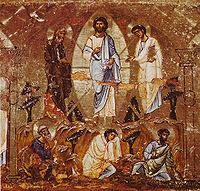
transfigurationThe Transfiguration of Jesus on Mount Tabor is celebrated twice in the Church Year. The celebration on the last Sunday before Lent stresses the event’s preparation for the death and resurrection of Jesus. The celebration in August, being a standalone feast, can be seen as a celebration of Creation in all its materiality. Since there is no feast of the Creation, any celebration that points to our origins in God’s creative Desire is for the good.

That Jesus’ body and his clothing should be transfigured by a dazzling light is about as powerful a sign of the goodness of the material world as anything could be. The only fly in this primordial ointment is the suspicion that if the material world needed to be transfigured, then it wasn’t all that perfect to begin with. That is, the material world is impure, at least to some extent, and needs to be purified. Eastern Orthodox writers, however, suggest that it wasn’t that Jesus was transfigured on Mount Tabor, but that the disciples’ eyes were opened so that they could see the transfiguration that, for Jesus, was an ongoing reality.

The powerful and startling story of the transfiguration of Seraphim of Sarov emphatically illustrates this truth. Seraphim was discussing spiritual matters one night with his disciple Nicholas Motovilov when suddenly Nicholas saw his staretz engulfed in transfiguring light. When Nicholas remarked on this, Seraphim said he had not changed but Nicholas’ ability to see had changed. Not only that, but Nicholas, unknown to himself, was also shining in the same transfiguring light.

If we can see all of the material world from the simplest atoms to the grains of dirt to squirrels and cats to humans in the transfigured light in which they, we, are all created, we will not reach out to grasp anything out of a lust for ownership or push anything or anyone away with expulsion. (See Connecting our Desires.) The catch is that we must be transfigured ourselves in this same light in order to see the transfigured glory all about us.

This need brings us back to the second and more fundamental meaning of the Transfiguration: the redemption of the groaning created world (Rom.8) by the cross and resurrection of Jesus. If our vision of reality is occluded by society’s tendency to hold itself together through the victimization of others through ownership and/or expulsion as Egypt was under Pharaoh, then we will not see the transfigured truth of the world under the Risen forgiving Victim breathes the Paraclete through our eyes and mirror neurons to show us the truth. (See Mirroring Desires.)

Yes, God’s act(s) of Creation is the beginning of the universe but Creation is also each present time of the universe up to and including the present moment and Creation is the End of the universe in the sense of being its goal. It is God’s creative work in redemption all along that has alerted us to the truth of Creation, starting with the deliverance of a ragtag group of slaves expelled from Egypt, continuing with the return of the Jews from their Babylonian exile to the Resurrection of Jesus where Mary Magdalene enters a garden to recalls the Garden of Eden and mistakes the risen Jesus for the gardener.

May we open our eyes to see this renewed glory within ourselves and around us, a glory filled with God’s Desire for all Creation.

Dispossessing a Town Possessed: The Gerasene Demoniac

peacePole1The story of the Gerasene demoniac and the herd of pigs running off a cliff bewilders modern readers. In his book The Scapegoat, René Girard offers an anthropological interpretation based on the concept of mimetic desire. According to this theory, the desires of all the people in any town, not just Geresa, are intertwined. That is all of the people are possessed by each other. If one person stands out as being “possessed,” that person is possessed by mimetic rivalries in the town that have reached (or sustain) a crisis level  that is pushed into one victim, the “designated patient,” to use the term of Ed Friedman.

When Jesus and his disciples arrive on the scene, they are not greeted by the mayor or any of the “normal” people; they are greeted by the demoniac who begs Jesus not to torment him (them). That the demon(s) gives its name as “Legion” confirms that this man is possessed by the community, including political possession of the Romans as possession by an invader increases the tensions within a local community. The demoniac is regularly chained but regularly breaks free in a pattern that mimics the repetition of ritual. That is to say, this pattern represents the town’s sense of stability, much as the incarceration of multitudes of black youths from the ghettos gives the US a similar sense of stability today. 

Jesus sends the demons into the herd of pigs that then runs off a cliff into the sea. We have here an interesting reversal of the scapegoating mechanism since usually it is the town that drives a single victim off the cliff, a fate Jesus has narrowly avoided himself. Upon seeing the formerly possessed clothed and in his right mind, the townspeople ask Jesus to leave. One would think that they would be happy to see a sick person cured and would ask Jesus to stay and cure everybody else of whatever ails them. But they don’t. Why? Because the people of the Gedarene region are not happy over being robbed of their victim. The demons requested that they not be expelled from the town because the people, possessed by their rivalries, wanted to remain possessed. When robbed of their victim, the possessed town implodes in its collective violence and becomes the sacrificial victim.

The anthropological dimension of this story can be seen more clearly by comparing it with the Samaritan woman at the well, which has none of these mythological trappings. It is the woman at the well, and not any of the other people of Sychar, who greet Jesus. The woman is alone at the most social place in town, an indication that the woman is the town’s scapegoat. There is no exorcism but the woman eventually becomes possessed by Jesus when she drinks the water he has to give, just as the Gerasene demoniac became possessed by Jesus. The woman goes to tell the townspeople about Jesus as the Gerasene demoniac was told to spread word of what Jesus had done in his own area. The story in Sychar has a happier ending in that the people come out to listen to Jesus, a mimetic process where they give up their collective victim in exchange for the water of rebirth that Jesus has to give. Perhaps this foretells a happier ending for Gerasa someday and a happier ending for our own society.


Contemplative Prayer as a Pearl of Great Price

indwellingcover_tnBecoming conscious of mimetic desire, our inborn and pre-conscious tendency to copy the desires of other people (See Human See, Human Want) poses a large challenge to our daily living. When we bring in the tendency to fall into rivalry with other people and how that can lead to collective violence (see Two Ways of Gathering) then we need tools to live with this challenge.

I wrote Tools for Peace to suggest ways that the spiritual practices from the monastic tradition and the Rule of St. Benedict in particular can help us with this challenge. Contemplative Prayer, although important in monastic practice, has a small place in the Rule of St. Benedict and so there is not a detailed discussion of the practice in this book, although I have a few comments about it.

Many years ago, I wrote a pamphlet called “The Indwelling God” to introduce the practice of contemplative prayer and give practical suggestions for initiating and sustaining this practice. Last year, I wrote an article for our Abbey Letter called “Resting in God’s Desire” which discusses contemplative prayer specifically in connection to mimetic desire. The Divine Office is indeed the heart of Benedictine spirituality, but praying in silence, just being before and with God, allowing God to contemplate us, as Saint Gertrude and other writers have suggested, is a pearl of great price, a pearl worth some of our valuable time and worthy of much room in our hearts.

This pamphlet has been available in hard copy and is still available in that form, but I have just had a eBook made of it to make it available in that form since many readers are using that medium. I have coupled the pamphlet with the essay “Resting in God’s Desire” as they make good companion pieces.

“The Indwelling God” with its companion article can be purchased on the abbey’s website at http://www.saintgregorysthreerivers.org/digitalpubs.html   A hard copy version which has only “The Indwelling God” is available at http://www.saintgregorysthreerivers.org/orderpage.html

May we all give of ourselves to receive this pearl of great price.

Recovering Racists

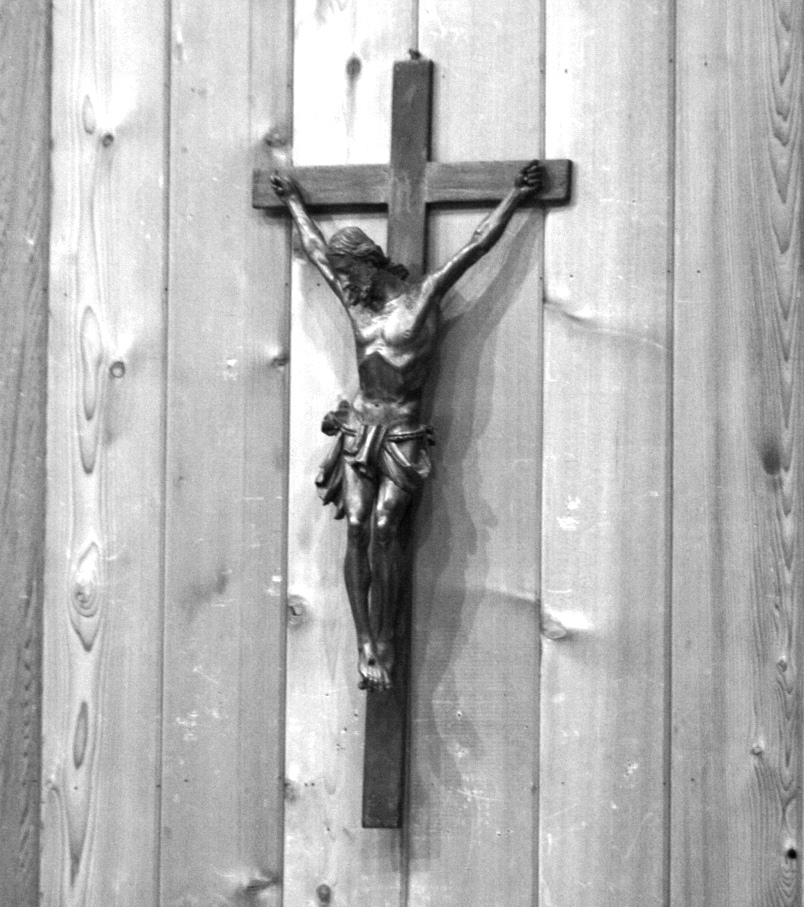
crucifix1I have just returned from the 2013 Theology & Pace conference held in Chapel Hill, NC on “Lynching, Scapegoating and Actual Innocence.” The subject is difficult to work with but becoming aware of what we have done in our own country is a necessary step to finding ways to preventing the same kind of thing happening again. Two factors were particularly important to making the workshop a positive experience. One: a sense that we were exploring the issue as a group and coming to terms with it as a supportive group. Two: the forgiving tone of the speakers. Julia Robinson, who read a paper specifically on the history of lynching and the violent atonement theology that supports it, delivered her presentation in a gentle but firm voice, embodying forgiveness not only in word but from the depths of her being. Such an approach is modeled on the Gospel where Christ the victim forgives us so that we can begin to see our sin clearly and turn from it.

Paul Nuechterlein, the one speaker who was white, confessed to being a racist. This might sound strange, coming from a man who is active in race relations, but it echoed the same admission of a biology professor I had in college many years ago. As it happens, I have never heard a person who actually did show a racist attitude make this admission. It is sobering, but important, that it is not until we repent that we begin to see what we are repenting of and enter into recovery.

The most important thing about repenting and recovering is that we take personal responsibility for ourselves. We cannot take responsibility for the attitudes of others whom we consider racist. I remember telling a person what I had learned about the effect of racial discrimination on a daily basis and that person countered by telling me about a company run by black people who won’t hire whites. I cannot take responsibility for that company but that does not absolve me of taking responsibility for myself.

In entering into recovery from racism and sustaining that recovery, I need to become aware of small things where my own blindness emerges. An example of this blindness on my part came in an earlier entry on this blog post called “Selling Postcards of the Cross” where I wrote about James Cone’s book The Cross and the Lynching Tree. I used the phrase ‘”Cone shows us this truth in spades.” (I have now edited that sentence.) Of course, using this phrase about any writer who is not black would be the complement I intended it to be. I suppose one could say that some people are too sensitive about these things, but I have come to the conclusion that the important thing for me is to be more aware and sensitive and let other people take care of their own sensitivities.

Taking personal responsibility for being a recovering racist can only be done by increasing our awareness of the interaction of our own desires with those of others. Insofar as racism continues to be a strong element in our society, racist desires continue to seep into us at a pre-conscious level. On a more hopeful note, the desires of others to overcome racism also sink into us at this same pre-conscious level. By watching our thoughts, we can become more aware of what desires we are importing and seek to affirm the desires that seek to overcome prejudice, the desire to feel superior to some people, and complacency with misuse of power that keep some people down. Most of all, we must support one another.

See also: Knowing the Wild Things Between Us

The Infinite Round Dance

churchDistanceBlossoms - Copy

Imagine an endless round dance of three persons dancing in and out of each other, dancing with a Desire they share infinitely with each other with such intense love that the three dancers are one, yet so strong is their love for each other that they desire that there also be three. The persons are not personas, as in fake faces of actors or hypocrites, neither are they rugged individualists believing in every person for oneself. These persons are pure relationship through their shared Desire of love.

This round dance could have gone on forever with nobody the wiser except for one amazing thing: the love of these three persons was so ecstatic, so explosive, that it overflowed into a world of galaxies and stars and planets and flowers and giraffes and humans with teeming brains filled with desire, all with the intent of making countless beings much the wiser for the infinite round dance.

The overflowing love of the infinite round dance required that all desires to dance be free so that humans could look at a tree and desire that tree’s fruit before receiving the fruit as a gift from the infinite dancers. When the desire flowing through humans turned into rivalry with the infinite dancers and with each other, suddenly countless trees disappeared in the conflagration, leaving only centered the few trees that drew the humans ‘desires.

As humans fought over their crossed desires and gathered only to share a desire to kill or expel a victim blamed for the violence overcoming them, the infinite dancers continued to dance through the human desires, inspiring desires to share the trees and fruits and poems and songs in tune with the Desire of the infinite dancers.  The infinite dancers poured their Desire into humans who proclaimed the Desire to others, even when they were stoned or ridiculed or cut off from the land of the living.

So strong was the Desire of the infinite dancers that with the fire and love of the other two persons, one person entered into humanity and became vulnerable to all the shared rivalrous desires that spread like a plague among humans. The Son, conceived in a human womb by the Holy Spirit, gave up his spirit when the humans he came to save chose to kill him. The Son received the spirit back as he was raised from the dead, and then forever after sends that spirit into the desires of all humans.

And so the endless round dance continues with the overflowing love of dancers’ shared Desire that all humans be ecstatically the wiser for the dance.


Jesus’ Escape to the Kingdom

crosswButterfliesThe Ascension is among the most puzzling festivals in the church calendar. The contradictory accounts of the event are a puzzle but one thing the accounts by Luke and John’s Gospel share is to connect Jesus’ departure with his sending the Holy Spirit. Jesus said the Holy Spirit would come to lead them into the truth. What truth did the disciples need that they hadn’t learned already from their teacher? Did Jesus have to leave before the disciples could hear the Holy Spirit?

During his ministry, Jesus warned his disciples three times that “he would be rejected by the elders, the chief priests, and the scribes, and be killed, and after three days rise again.” These warnings came precisely at the times the disciples thought that a Maccabean-like revolution against the Romans was just around the corner: when Peter proclaimed Jesus to be the Messiah, right after the Transfiguration, and when James and John asked if they will sit at Jesus’ right and left in his kingdom.

After his Resurrection, Jesus tried again to get across to the disciples what his kingdom was really all about. When Clopas glumly said that he and his companion had hoped that Jesus “was the one who was to redeem Israel,” Jesus, not yet recognized by them, rebuked them for their slowness of heart in believing what “the prophets have declared.” Then he “interpreted to them all the things about himself in all the scriptures.” Later, Jesus appeared to the twelve and explained that everything written about him in “the law of Moses, the prophets, and the psalms must be fulfilled. “Since the phrase “the Law and the Prophets” was used to refer to the whole Hebrew Bible, the special mention of the psalms is significant. The psalms include many laments over persecution from the standpoint of the victim. Jesus went on to say that when the scriptures say that the Messiah was “to suffer and to rise from the dead on the third day,” it means that “repentance and forgiveness of sins is to be proclaimed” in Jesus’ name to all nations, beginning from Jerusalem. Proclaiming repentance and forgiveness is a very different proposition from starting a revolt to restore the kingdom to Israel.

When, in spite of hearing this teaching for forty days, the disciples asked their Risen Lord: “Is this the time when you are going to restore the kingdom to Israel?” Jesus must have banged his head against the nearest tree and cried out: “I’m out of here!” This repeated question may have convinced Jesus that the disciples were never going to stop asking him to restore kingdom of Israel as long as he was walking on the earth with them. Maybe Jesus was planning all along to leave after forty days; maybe he planned to stick around indefinitely but this question was the last straw.

Jesus’s Ascension put paid to any notion of his leading a second Maccabean-type revolution. The disciples were left with no choice but to try doing what Jesus told them to do when he breathed on them and said: “Receive the Holy Spirit. If you forgive the sins of any, they are forgiven them; if you retain the sins of any, they are retained.” Jesus’ kingdom is to preach repentance and forgiveness to the whole world until everybody has repented, been forgiven, and has forgiven everybody.

Hospitality Initiative

WilliamGuestsChurch1On May 3-4 I will be attending the Hospitality Initiative hosted at Oakland University in Oakland, MI. The convener is Charles Mabee, a scholar who works with the thought of René Girard. This is a multi-faith gathering where papers from a wide variety of spiritual traditions will be represented by the presentation of papers. I will be presenting a brief paper called “Mimetic Hospitality: Guests and Community in the Rule of St. Benedict.” Some of the content overlaps with my blog post Cleaning up our Unclean Acts which introduces some of the thoughts I develop in this paper. You can read my paper here.

How Are We Saved?

yellowTulips1The New Testament and two thousand years of Christian preaching has consistently proclaimed that the death and resurrection of Jesus Christ has opened the way of salvation for all humanity. Precisely how this mysterious, earthshaking event has done that   has raised more questions than answers. It is understandable that the focus would tend to be on the death of Jesus since the event is so dramatic and creates intense emotional effects in Jesus’ followers. However, understandings of the atonement of Jesus through this route have raised long-standing problems that cry out for a fresh approach. The growing realization that the killing of Jesus was just plain wrong on the part of many Christians, and not just those influenced by the thought of René Girard,  opens a way for a re-thinking of atonement theology that can support a deep spirituality grounded in God’s unconditional love for all people. As article I wrote for the Abbey Letter Saved By the Life of Jesus contributes to this re-thinking that actually reclaims the Gospel for us. It is included in the collection of articles in Come Let Us Adore. You can read it here.