Prepare a Way for the Lord: an Advent Meditation

field1John the Baptist calls out to us with Isaiah’s words: “Prepare the way of the Lord, make his paths straight.”  Isaiah here was referring to the return of God’s people to their rightful home from which they had been uprooted by the Babylonians. Even today, we live in exile, not living our lives in God as we ought. The call to repentance (metanoia) in John’s baptism means, literally, to turn our minds. This does mean just filling or minds with new books; it means turning our whole embodied selves in a new direction to see and live in a different way.

Isaiah prophecies a leveling process where the valleys are filled in, the mountains are brought low, and the crooked ways are straightened. That is, the obstacles within ourselves and within our culture that prevent God from coming to us must be removed. The image of leveling seems to suggest a social upheaval where the mighty are brought low and the lowly are raised up so that all are on the same level. This would be to overlook the real obstacle to God: our tendency to compare ourselves with one another without reference to God, preoccupied with being better than others or fretting that others are better than us. This preoccupation and the resentments they foster maintain the isolating barriers of valleys and mountains and block the way to God.

The repentance that Isaiah calls for is the renunciation of our rivalrous entanglement with others and allow for God’s leveling process that holds everybody in the same regard without exalting some or lowering others. Unfortunately, while God is smoothing out the way for us, we prefer to maintain the barriers that we think protect us. Opening a highway for God makes us vulnerable, not only to God but to all of God’s people. Take out the valleys and mountains and anybody could come deeply into our lives! Isaiah gives us fair warning by declaring that “all flesh shall see the salvation of God.”

Like all analogies, the analogy of smoothing out the landscape has its liabilities. Flat ground makes for boring scenery. Valleys and mountains make for beautiful scenery. God doesn’t destroy the landscapes God has made. That means, if we turn our embodied minds, we see that God’s leveling process is to rejoice in the valleys and mountains and twists of the road without rivalry or resentment.
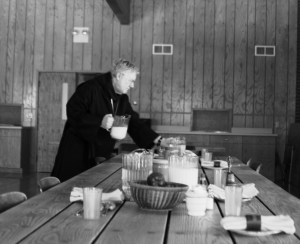

Imitating Saint Andrew Following Jesus

AndrewRefectory1Mimetic desire, especially when it is good mimesis, is easily overlooked. Usually it’s jousts and fisticuffs that get our attention. Mimetic rivalry drives the plots of novels. Mimetic sharing only drives the plots of lives lived well. (See Human See, Human Want)

When it was time for me to be clothed a novice, I chose Andrew as my religious name because of the example Andrew set by promptly answering Jesus’ call. I hoped, and still hope, that my patron would and will inspire me to listen for Jesus’ call every day, every hour, and follow that call. As a bonus, Andrew was the patron saint of Scotland and my Marr ancestors came from there.

As I listened to the Gospel at Mass this morning, I was struck by the communal aspect of the following. It wasn’t just Andrew who heard the call and followed Jesus; Andrew heard the call and brought his brother Peter with him. That is, Andrew entered the mimetic process of following Jesus and drew Peter into that same mimetic process. The next day, James and John were drawn into the same good mimesis of following Jesus, a rerun of yesterday’s story. That’s what good mimesis does. Like mimesis of any kind, it is contagious and it replicates itself.

Curiously, Andrew drops out of the Gospel accounts after his dramatic call except for noticing the boy with the loaves and fishes in the wilderness that touched off the greatest bonanza of good mimesis in world history. It is the other three, Peter, James and John who form the inner group of disciples who witnessed the raising of Jairus’ daughter, were present at the Transfiguration, and then fell asleep at Gethsemane. It is tempting to feel that my patron was slighted, but that would be bad mimesis.

It is more encouraging to notice that Andrew was also curiously absent in the fights among the disciples as to who was the greatest. This in-fighting helps make the Gospels “interesting” as it drives the plot until the mimetic issues in Jerusalem take over. Maybe Andrew just wasn’t “interesting” enough to mention. Maybe Andrew wasn’t pushy enough.

The point to being a follower of Jesus is not to be part of the inner circle of the inner circle. The point is to hear the call of Jesus and to listen to the way Jesus is calling others. This way, everybody and nobody is the greatest in the greatest story ever told.

Ignominious Glory—Glorious Ignominy: a Doxology

Since when is glory ignominious ? Probably since humans first became concerned about what others thought of them. Seeking glory from others is a sure way to get its opposite as  celebrities know all too well. In the New Testament the Greek word doxa is sometimes translated as “glory,” sometimes with “shame.” How can one word mean two opposite things. James Alison says that is because the word means “reputation.” What kind of reputation? Any kind of reputation.

The Harry Potter books give some interesting examples of the double-edged meaning of doxa. Harry arrives for his first year at Hogwarts as a celebrity, not for anything he had done but because he had survived Voldemort’s attack when his mother gave her life to save him. In his second year at Hogwarts, Harry is blamed by many for an epidemic of people turning into stone although he had done nothing to earn this ignominy than he had done to earn his celebrity status. In the fourth book, when Harry’s name is entered in the competition in a questionable way but through no fault of his own, there is bad feeling towards him from students of all three schools involved. (Spoiler alert!) His defeat of Voldemort has no external fireworks and he ends up with a quietly respectable position in the wizard world without celebrity status.

Bob Dylan has been praised as one of the greatest poets and songwriters of our time but he has also been the object of much ignominy with every turn in his career. He did not receive it for drugs or sex, but for using electric guitars instead of a simple acoustic guitar like a true folk singer. Then he got it for seeming to relax and live an ordinary life, as if living an ordinary life is a scandal! The worse ignominy was for turning to Christ and doing some Gospel albums.

Speaking of Christ, in his Gospel, John plays with both sides of the meaning of doxa in relation to Christ. Jesus seeks doxa from his Father while the people who put him to death or keep their sympathy for him a secret because  they seek doxa from other people. So it is that doxa inevitably falls into sacrificial violence if reputation is sought from people instead of from God. The raising of the cross is Jesus’ doxa. That is why God has such a bad reputation nowadays. Where do we look for our own reputations?

Humanly Created Scarcity

Scarcity is often believed to be part of the natural order, but is it? It is true that material goods in the world are finite and in times of famine they are more finite than usual. But let us revisit the story in Human See, Human Want. In a house filled with balloons, all of the children suddenly started fighting over one balloon when one child made claim to it and that balloon alone. Suddenly, where there was abundance, there was scarcity. It is as if a magician had waved a magic wand to make all the other balloons in the house disappear. The image of a magician is not so far-fetched. Mimetic desire, the tendency to copy the desires of other people is an enchantment as Shakespeare’s Midsummer Night’s Dream demonstrates. The four besotted and confused young people were enchanted before Puck engaged in his pranks. When two or more people fight over one lover, then lovers suddenly disappear.

This is to say: rivalrous mimetic desire creates scarcity where there was abundance and increases scarcity in times of famine. Our desires are not linked directly to objects of need and intrinsic desire, but are linked to our rivals. It seems so natural to want to keep up the same standard of living as our peers or, better yet, surpass them. When rivalry rules the day, there will always be victims.

Now that the political campaigns are over, at least for a few days, maybe we can see how the rivalry involved creates scarcity that other people cannot afford. The amount of money donated to the political campaigns was massive. As soon as one side got more money it was imperative for supporters of the other side to give at least as much money. All so that more ads tearing down the opponents could pollute the air waves. Just think of all the infrastructure and educational aid and health care could have been bought for all that money! Not to mention having money for the victims of Hurricane Sandy. It’s interesting that health care has come to be seen as a rare commodity to fight over.

The alternative to mimetic rivalry can be stated quite simply: Pay more attention to what you really need and care for and wish for other people to have what they need and really care for. Why is this so hard? As the example of the children and the balloons shows us, mimetic rivalry seems to be natural. The creation of world narrated in Genesis Chapter One says otherwise. What is natural is God’s abundance and care for all creation. Why is it so hard for all of us to desire that?

Life of Benedict

The only biography of St. Benedict is by St. Gregory the Great. Gregory highlights the ways Benedict’s life was lived in imitation of the great figures in Scripture and most importantly of Christ himself. I have posted an article called Imitating Elisha that analyzes Gregory’s Life of Benedict with René Girard’s concept of mimetic desire. The result is a rich vision of the spiritual life for any Christian.

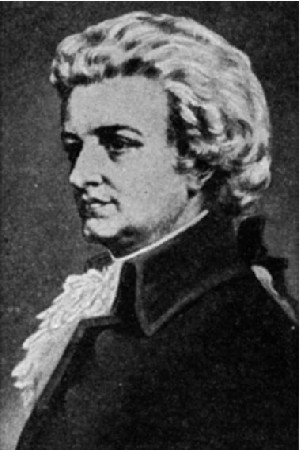
Marriage of Figaro

I watched Mozart’s Marriage of Figaro while in New York this week, and was impressed with the deep insights into mimetic desire this opera offers. (cf. Human See, Human Want) The opera centers on Count Almaviva’s desire for his servant Susanna who is betrothed to the count’s servant Figaro. For all of his roaming for women, the Count seems not to have desired Susanna until Figaro desired her and wished to marry her.

Meanwhile, Marcellina, a servant of Dr. Bartolo, wishes to marry Figaro and Dr. Bartolo, wishing revenge for Figaro’s helping the count marry Rosina when he himself had desired her, supports his servant’s claim based on Figaro’s unpayable debt to her. This triangle becomes farcical when it turns out that Figaro is Marcellina’s son begotten by Dr. Bartolo himself, who had done with his servant what the count wants to do with Suzanna.

The adolescent servant Cherubino provides a comical mirror image of the count in that he also desires all women, especially the countess, the only woman the count does not desire. This infatuation does not make him a serious rival to the count, but he becomes entangled with Rosina and Susanna’s plot against the count.

The count only shows any desire for his wife when he believes (mistakenly) that she is desired by another. In Act 2, he believes Cherubino was flirting with his wife and was hiding in the closet (which he was until Susanna helped him escape). When it is Susanna who emerges from the closet, an uneasy forgiveness ensemble ensues that foreshadows the opera’s finale, but then unravels when the gardener complains about somebody (Cherubino) jumping into the flower garden.

The abortive plans of Act 2 to trick the count come to fruition in the last two acts where Rosina and Susanna disguise themselves as the other and so entrap him so that the count has no choice but to drop to his knees and ask his wife’s forgiveness, which se freely gives.

The disguises and mistaken identities throughout the opera dissolve the characters into the indifferentiation of mimetic desire. At a deeper level, Mozart’s music weaves a unity out of the passions of all these characters so as to unite them in the mimetic desires, a unity transcending the class differences of the characters and creating a vision more subversive than the play by Pierre Beaumarchais used by the librettist Lorenzo Da Ponte.

The noble forgiveness scene is as fragile as it is beautiful; a fragile fleeting vision that can be blown away by the next breath of mimetic desire.