
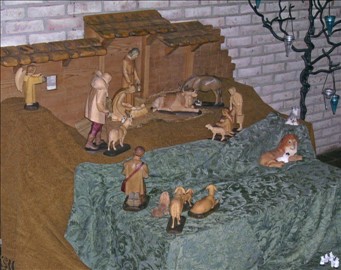
At Christmas, we celebrate the birth of a baby. Babies are born all the time but this one is different. The baby we celebrate this night is God incarnate. What’s so special about that? Don’t we tend to treat babies like little gods, revolving our lives around them? Weren’t the shepherds oohing and aahing the way people do when they see a pretty baby? Such is the appeal of Christmas.
However, the startling claim made by various church fathers, Irenaeus probably being the first and Athanasius another early witness, is that God became human so that humans could become God. The antiphon for the Feast of the Holy Name is: “O marvelous exchange! [Our] Creator has become [human], born of the Virgin. We have been made sharers in the divinity of Christ who humbled himself to share in our humanity.” It’s like a billionaire offering a person living homeless on the streets his or her bank account for the few coins the street person has collected that day. Who would do such a thing? The divine exchange is infinitely more lopsided that this. What kind of God would think of giving God’s divinity for the sake of our humanity? I suppose the answer is that only an infinitely and unbelievably generous god would do such a thing.
What these church fathers and the author of this antiphon are proclaiming is that our humanity has been radically altered for all time by this glorious exchange. There is a divine presence in each of us waiting for us to allow it to unfold in unbelievable and mysterious ways. Some people get the impression that the notion of humans becoming God leads to blurring distinctions between humans and God, or humans even supplanting God. There have been thinkers who have made suggestions along those lines, but in sound Christian doctrine that is not the case. In 2 Peter 1: 4, the phrase that inspired Irenaeus and Athanasius is “partakers of the Divine Nature.” That is, we participate in the divine nature. This leaves our humanity fully intact, just as Jesus’ humanity is fully intact even though he is fully divine. Moreover, this partaking of the divine nature is a gift from God, not an accomplishment on our part.
Before getting too excited about partaking of the divine nature, it behooves us to reflect on what we’re getting into. Since we don’t have any experience of being God, we don’t know much about it. All of us have fantasies about what we would do if we were God. For myself, I would readjust the social and political structures worldwide to my satisfaction. Never mind that everybody else with similar fantasies would do the same thing and we’d have an in infinite mess. However, the fact that God would exchange God’s divinity for our humanity does give us an important clue as to what being God, the true God, is about. The billionaire in the analogy who traded his or her bank account for the coins of a street person is amazingly generous, but God is infinitely generous. If I’m not so sure about being as generous as this fantasy billionaire, then maybe I’m not up to being as generous as God.
Partaking of the divine nature has some far-reaching consequences for our sense of identity. If I am inclined to clutch at what I think my identity is, I won’t want God coming in to mess with that and throw me off course; never mind that my own course is out of the ballpark. In order to partake of God’s nature, receiving it as a gift, I have to empty myself of all my favorite illusions about who I think I am. Mary pondered the mystery of her son’s birth in her heart. We, like Mary, need to spend time in stillness, pondering God’s Christmas gift to us, letting it sink into our depths with the new life it brings. As we ponder, we might think ahead to where the story of this birth took Jesus in a few years and where it will take us in a few months. Partaking of the divine nature entails partaking of the divine generosity of the Paschal Mystery.
 Imaginary Visions of True Peace