
Unfinished Story

We all like a story that ends happily with the loose ends tied together in satisfying ways. It makes us feel good, especially if the good guys had to overcome the machinations of the bad guys and the bad guys got what they deserved. Likewise, a symphony that ends triumphantly raises our spirits. The only thing wrong with these things is that real life isn’t like that. Yes, there are happy and satisfying moments and what we might call mini-happy endings, but happily ever after isn’t a sure thing, as Sondheim showed in his musical Into the Woods where we see just how grim the ever after can be. (Among many other things, Cinderella’s marriage with Prince Charming is on the rocks.) These thoughts suggest that the feel-good happy endings are illusory. The hard reality of real life can feel all the harder for it. A more positive way to look at it is to take the happy endings eschatologically. In God’s good time, everything really will be worked out. There is much comfort in this hope and it is fundamental to the Christian vision, but sometimes we need more direct and realistic encouragement and hope along the way. Sometimes an ending to a story that doesn’t resolve everything or even anything, or a symphony that ends with chords that hang in the ear, is actually more comforting (The sixth and ninth symphonies of Ralph Vaughan Williams are good examples of this.)

Easter Sunday tends to be celebrated as the ultimate happy ending. Yes, Jesus suffered a horrible death, but he came through alive and well and happy and the gates of eternal life have been opened to everybody. But with a lectionary that gives us Mark’s Resurrection story every three years, we get something very different. It ends with a group of frightened women running away from the empty tomb in spite of the angel’s announcement of Jesus’ Resurrection. All this after a totally bleak account of a god-forsaken Christ dying on the cross. What kind of happy ending is this? From the earliest Christian centuries to the present day many have had trouble believing Mark would end his Gospel this way. That is why there are a couple of additions clumsily attached to the end that don’t even remotely match the style of Mark’s writing and outlook.

For those of us who feel better with a happy ending, Mark is a real downer. But the advantage of an unresolved ending is that it can give us pause to think about some things we might not think about if blinded by a happy ending. The frightened women running from the empty tomb make it clear that the strife indeed isn’t over and the battle isn’t done as many horrifying current events make clear. The women thought they would anoint the dead body of Jesus, but that didn’t happen. Ending the Gospel with the women anointing the body to match the anointing of Jesus’ head at the house of Simon the Leper just before the passion would have been a satisfying bittersweet ending. But we don’t ever get that. So what hope do we get from the frightened women?

For one thing, a big thing, if we don’t really know what to make of the Resurrection, if we aren’t sure what it really means for our lives, we can take heart from these women who also didn’t know what to make of it. If we feel flat-footed and flat-brained about the Resurrection, these women in their awkward, frightened flight were obviously flat-footed and flat-brained themselves. This can give us space to ask ourselves what it really does mean that Jesus is risen from the dead. How do we live with a Jesus who died but who isn’t dead after all and is very much alive here and now? When we ask ourselves these questions, the answers are hardly obvious and we are then in a position to let the questions linger rather than prematurely clutching at a fully resolved happy ending.

Mulling over these questions can help us notice that the other Gospels also leave unresolved cracks in their narrations of the Resurrection. In Matthew and Luke, where the women are reported to have told the other disciples about the empty tomb and the angel’s message, the disciples think the women are out of their minds. Nobody seems to recognize Jesus at first when he appears. Why? The moving story of the journey to Emmaus is especially illuminating. The two disciples on the road are downcast, not the least cheered up by the rumors of what the women had said. But at least they are asking questions and this gives Jesus the opportunity to lead them into further insight as to what has happened. The story of Jesus becoming recognizable in the breaking of the bread and then disappearing leaves us hanging, but it leaves room for more to come. These disciples who listened to Jesus as he opened the scriptures to them have much more to learn and to look forward to, even if they don’t know what all of it is.

The ending in Mark is so abrupt because it isn’t really the end. It is the beginning. Galilee is where the story began. The disciples are told to go back and make a new start and we are told to do the same. The obtuseness and cowardice of the disciples throughout the Gospel aren’t the last word after all. Jesus isn’t finished with them and he isn’t finished with us either. Forgiveness is sneaking in right when we weren’t expecting it. With the stage cleared of Jesus, the disciples, the women, we are all that is left with the angel to prod us on. This Gospel is our story now and it will never have an end any more than the Risen Christ has an end. Will we return to the beginning of the story and live it ourselves? Let us sit quietly with the risen Christ with all our puzzlement and disorientation and prayerfully let the Risen Lord fill our hearts and minds with the Risen Life.
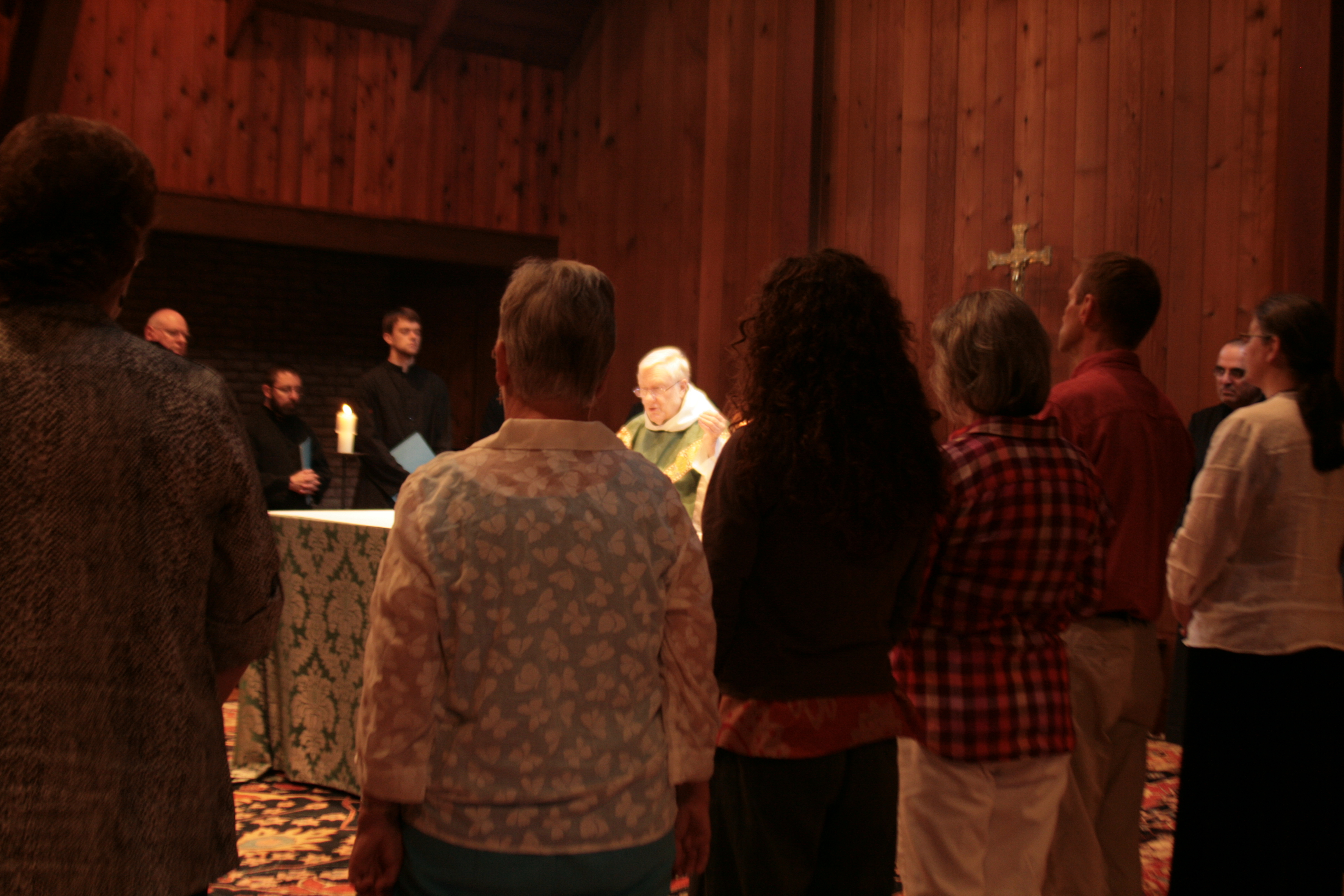

The Passion in the Eucharist

The Eucharist makes present the death and Resurrection of Jesus at each celebration, regardless of the occasion. So it is that we don’t even celebrate the birth of Jesus without celebrating his death as well. But in commemorating the Last Supper of Jesus, the Eucharist on Maundy Thursday is particularly close to the Passion, being the meal during which Jesus was suffering the anxiety he was soon to express at Gethsemane.

While reflecting on this matter, I came across a few lines on this very theme by Gerard Manley Hopkins, one of my favorite poets. They made up an epigraph of a chapter in Brian Zahnd’s new book The Wood Between the Worlds,” a powerful meditation on the Cross, Not only was I moved by the lines, but I was surprised to come across some lines by Hopkins that I didn’t recognize since I thought I had studied all of his poems multiple times. That little mystery was solved when I found out that it is an early work, one written while still a student at Oriel College in Oxford, and still an Anglican. So it is only included in the most complete collections of his works. I might have read it before without it registering, but the few lines singled out in Zahnd’s book really caught my attention, as I’ve said.

The poem is called “Barnfloor and Winepress” and it pulls together the Passion of Jesus and the Eucharist into an inextricable knot, making it most appropriate for Maundy Thursday. With wrenching, sometimes violent imagery embodied in hard sounds that put Hopkins, even in this early work, decades ahead of his time, the poem provides a powerful example of how the ugliness of Jesus’ crucifixion permanently affected the aesthetic possibilities in all of the fine arts as the ugliness is sublated in the moral beauty of Jesus’ self-sacrifice and his vindication in the Resurrection. The first stanza includes these lines that use the Eucharistic imagery of the making of bread:

Thou that on sin’s wages starvest,
Behold we have the joy in harvest:
For us was gather’d the first fruits,
For us was lifted from the roots,
Sheaved in cruel bands, bruised sore,
Scourged upon the threshing-floor;
Where the upper mill-stone roof’d His head,
At morn we found the heavenly Bread,
And, on a thousand altars laid,
Christ our Sacrifice is made!

And in the second stanza, lines using grape and wine imagery to the same effect:

Thou whose dry plot for moisture gapes,
We shout with them that tread the grapes:
For us the Vine was fenced with thorn,
Five ways the precious branches torn;
Terrible fruit was on the tree
In the acre of Gethsemane;
For us by Calvary’s distress
The wine was racked from the press;
Now in our altar-vessels stored
Is the sweet Vintage of our Lord.

We have in these powerful stanzas a kind of transubstantiation, not only of the Eucharistic elements that Hopkins was clearly believing in as a high-church Anglican, but a transubstantiation of the suffering of Christ into the Eucharistic elements. The violent human sacrifices throughout human history, both before Christ and after Christ up to the present day, are transmuted into the bloodless sacrifice on the altar. (The phrase “terrible fruit” reminds me of Billy Holiday’s “Strange Fruit.”) No wonder Brian Zahnd refers to this poem in a chapter that argues that the crucifixion of Jesus is the ultimate center of human history. Even while humans continue to commit the same old same old violence as we see most painfully in Ukraine and Gaza right now, God has transformed all of it for all time. Hopkins expresses this insight in poetry:

In Joseph’s garden they threw by
The riv’n Vine, leafless, lifeless, dry:
On Easter morn the Tree was forth,
In forty days reach’d heaven from earth;
Soon the whole world is overspread;
Ye weary, come into the shade.

And then the profoundest transubstantiation of all: the transubstantiation of us into partricipation in the divine nature, one not untouched by the sufferings of Christ supporting our own:

The field where He has planted us
Shall shake her fruit as Libanus,
When He has sheaved us in His sheaf,
When He has made us bear his leaf. –
We scarcely call that banquet food,
But even our Saviour’s and our blood,
We are so grafted on His wood.

The World God Loves

John 3: 16: “God so loved the world that he gave his one and only son” seems to be almost everybody’s favorite Bible verse. I don’t mind being a non-conformist when called to be and I have been known to get a conceited pleasure out of being one, but this is among my favorite verses too. However, the very popularity and familiarity of the verse can perhaps dull us to its power to impact our lives.

I will work with what seems an innocuous question: What is the world that God loved enough to send the Son into it? The word kosmos in normal usage had a neutral connotation, meaning the world in general, the world that happens to be. This corresponds to normal usage in English. In John’s Gospel, however, the word has a highly negative connotation, closer to the negative connotations of “worldly,” only much stronger than that. Most New Testament scholars interpret the word as John uses it as “the world-against-God, the world in rebellion against God,” as I learned it in seminary. Curiously, much preaching on this particular verse, including my own, seems to make it an exception; thinking of the world in a neutral way. But what if this isn’t an exception? What does this verse look like then? What does the world hostile to God look like, and what kind of deity would want to get messed up with it?

The reading from Numbers gives us a snapshot of the world against God. One would think that their deliverance from Egypt would earn some gratitude on the part of the Israelites, but all they do is grumble angrily about the hardships in the wilderness. (Num. 21: 5) When attacked by poisonous snakes that image their poisonous behavior, they repent. That’s something, but they Israelites show a pattern of turning against God time and time again when things get tough. The snake Moses puts on a pole saves the people. This smacks of sympathetic magic but surely God is telling us something here. What we have is poison driving out poison. Many medicines operate on the same principle; the Greek word pharmakon from which we get the word “pharmacy” means both medicine and poison. Somehow, God uses the poison of rebellion to cure the rebellion, perhaps because the plague reveals the truth of the poison of their rebellion. Paul writes that to the Ephesians that they “followed the ways of the world”—using “world” in much the way John does—following the desires and thoughts of “the flesh.” (Eph. 2: 2–3) One could say they were deserving of wrath because they embodied it.

In the John’s Gospel, we see much of “the world” in the sense of the rebellious world. The debates between Jesus and the enemies John calls “The Jews” are very intense. Their accusations that Jesus is possessed of a demon when he offers them freedom from sin make them look demon-possessed themselves. (Jn. 8: 48) These debates make painful reading on account of their ferocious character. In contrast to the frenzied emotive outburst of rebellion in these debates, John also shows us the cold calculating style of rebellion. When Lazarus is raised from the dead, they react to the resurrected life with a plot to kill Lazarus as well as Jesus since people are following Jesus because of this resurrection. And then there is the cold calculation of Caiaphas who says that it is better that one man die for the people than that the whole people perish. (Jn. 11: 50) John seems to have no love for these enemies of Jesus. Surely God can have no love for them. John’s dramatic portrayal of their enmity tends to reinforce our own rejection of these enemies. But these enemies are the kosmos. They are the kosmos God loved deeply enough to send his beloved son into it.

Right before John declares this love on God’s part, Jesus alludes to the serpent in the desert: “Just as Moses lifted up the snake in the wilderness, so the Son of Man must be lifted up, that everyone who believes may have eternal life in him.” (Jn. 3: 14–15) Jesus has turned this unsettling and cryptic gesture into a prophecy. The poison of rebellion on the part of Jesus’ enemies leads to Jesus being raised on a cross and the poison of this rebellion becomes the cure for the very same rebellion. In Ephesians, Paul, who himself had been a rebellious enemy of Jesus, experiences this very same love that motivated God to give God’s only begotten Son to make him, and us, who were dead in transgressions, alive in Christ. Not only alive, but raised up with Christ and seated with him in the heavenly realms. (Eph. 2: 4–6)

All of this sounds great–and it is beyond great–but John warns us of the judgment that the Light came into the world and we preferred darkness to light. (Jn. 3: 19 ) As the kosmos works to protect its rebellion to this blinding light, it falls into blinding darkness. How? If we slip into the default neutral understanding of “world” in the great verse proclaiming God’s love, we think this “world” is us—the good guys, and the world in rebellion is some other world—the bad guys who rebelled against Jesus. Paul had no illusions of this sort after his Damascus experience. But do we see the truth of our own grumbling in the deserts in life? Do we see ourselves as part of the kosmos Jesus loves in spite of our rebellion? Asking ourselves these questions as honestly as we can is a fundamental Lenten practice. Further on in Ephesians, Paul stresses that Christ’s raising us to His life has destroyed the barrier that had polarized Jew and Gentile–the ultimate embodiment of an us vs. them spirituality in Paul’s day. If we think this love is intended for us and not for them, we have fallen deeply into the darkness, preferring it to the Light that came into the world. Being among those who believe and have eternal life, then, is not a mental act of thinking something is true; it is about opening our eyes to the light, letting that light blind us, and then stumbling in the light instead of in the dark. It is this bumbling and stumbling that leads into the quality of life that is eternal life where there are many rooms in the Father’s house. (Jn. 14: 2)