
When I read Mircea Eliade as a college student, one of the first things I learned from him was the importance of sacred space, of a designated space being the center of the world. The designation might seem arbitrary in that it could be any space, sort of like Winnie-the-Pooh and Christopher Robin planting a pole in the ground and proclaiming it the North Pole. But once a space was designated as sacred, it truly was sacred ground and treated as such. Although the sacred space could be anywhere to begin with, there is a tendency to see certain landscapes, such as tall mountains and luminous lakes, as more likely to be considered holy space than others.
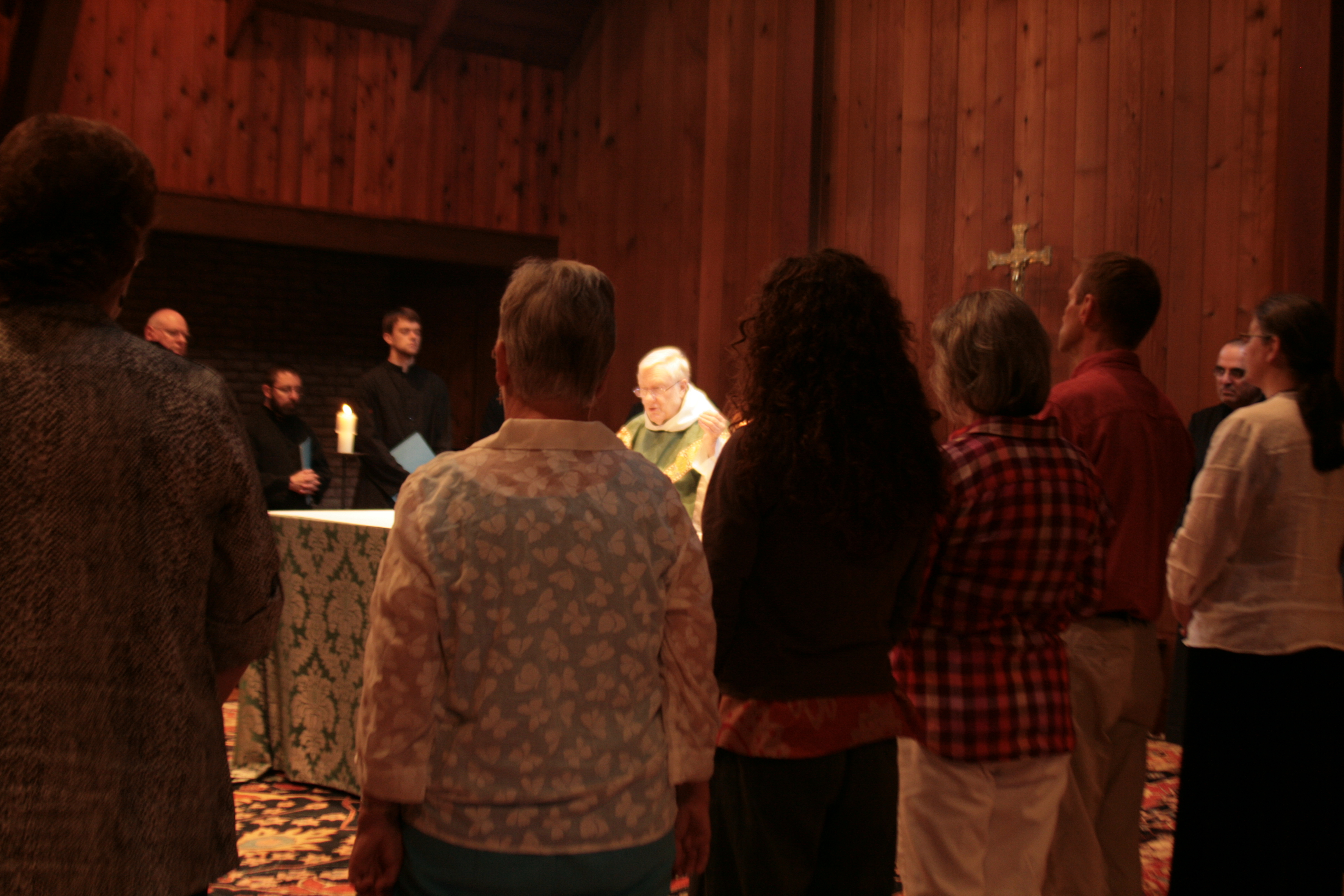
The early humans who designated sacred space didn’t have any notion of confining God to a certain spot. They instinctively knew that God is everywhere, but they also felt the need to focus. Solomon shares the same insight in his prayer at the dedication of the Temple in Jerusalem when he says: “But will God indeed dwell on the earth? Even heaven and the highest heaven cannot contain you, much less this house that I have built! “ (1 Kings 8: 27) Although the Israelites knew that God is everywhere, the temple was a focal point for Jewish piety. The Psalmist exulted in dwelling in the temple with God and longed for it desperately when torn away from it when taken into exile. I have the same sort of experience with the churches I worshiped in while growing up and with the Abbey Church where I have worshiped for more years than I can count. During the Eucharist, I keep getting the sense that the Abbey Church has become the center of the world as the bread and wine is consecrated. Not that the abbey is the only center of the world. There are countless more. As a practical matter, it is much easier to appreciate the fact that God is everywhere and act accordingly when a particular place is entered at a specific time to focus on God. By practicing decorum and reverence in a designated place, we are more apt to practice decorum, and reverence elsewhere.
Stemming from the insight of early humans and Solomon that the Temple cannot contain God are the various prophetic critiques of misuses of the temple for personal advantage of one sort or another. Jeremiah, for example, warned against trusting in words such as “This is the temple of the Lord! The temple of the Lord! The temple of the Lord.” (Jer. 7: 4) Hosea insisted that God preferred mercy to burnt offerings. (Hos. 6: 6) Jesus’ act of driving out the money changers was a climax of such prophecies. In Matthew’s version of this story, Jesus then heals the blind and the lame, (Mt. 21: 14) suggesting that such healing is much more in line of what the temple is for than changing money to keep the sacrifices going. Matthew’s placing of these acts of healing seem out of context, but they allude to an odd incident when David attacked the Jebusites and took the city. The defenders taunted David by saying that even the blind and the lame would be able to stop him. (2 Sam. 5: 6) David was believed to hate the blind and the lame as a result of the taunt, but it is more likely that David hated the able-bodied defenders who taunted him. One could say that Jesus was fulfilling David’s conquest of Jerusalem by healing the blind and the lame. In the end, nobody is going to stop Jesus.
John adds that Jesus implied that he himself is the Temple when he said that if the Temple is destroyed, he can rebuild it in three days. (Jn. 2: 19) St. Paul and St. Peter famously extended the human temple to everybody. St. Paul said that each of us is God’s temple, (1 Cor. 6: 10) and St. Peter said we are all living stones “built into a spiritual house.” (1 Pet. 2: 5) Jesus was a particular person who lived on earth at a particular time and place, but he has extended his sanctity as a temple to each of us, not least the blind and lame whom he cured in the temple. In his climactic teaching in Matthew, Jesus said that what we do and don’t do for the “least” of people is done, or not done, to him. (Mt. 25) Peter adds depth to this teaching by reminding us that Jesus was the stone rejected by the builders which has become the cornerstone. (1 Peter. 2: 7) God continues to build God’s house, God’s temple with stones rejected by those who would build human culture.
Just as sacred space can be, and is, anywhere and everywhere, everybody can be, and in fact is, a temple of God. We should treat ourselves and each other accordingly with decorum and reverence.
 Imaginary Visions of True Peace