

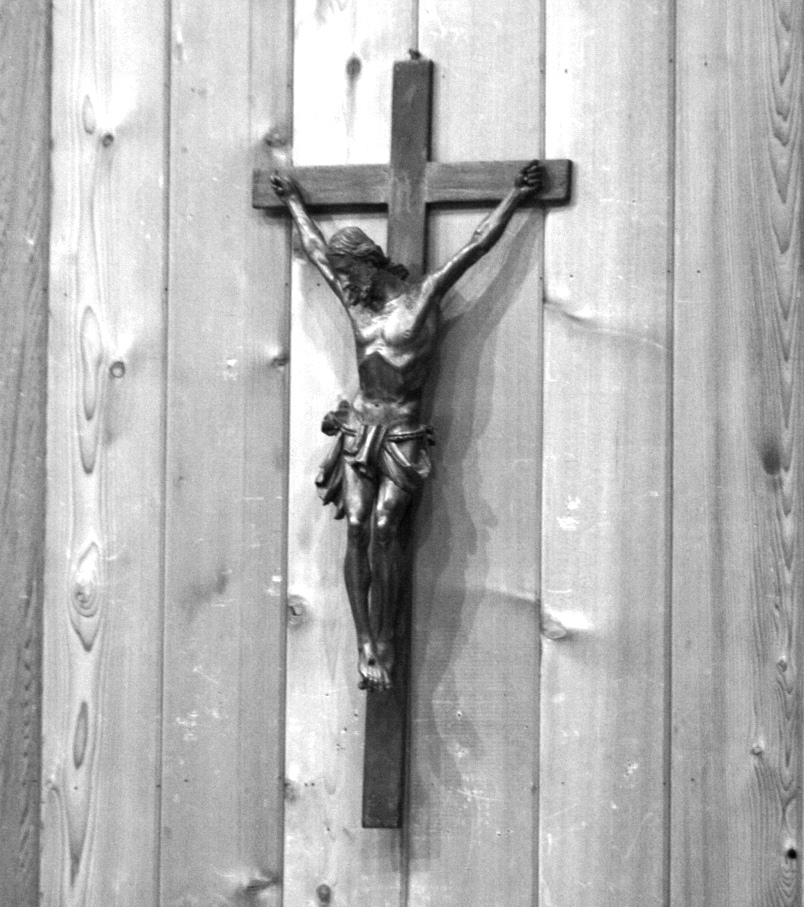
In the second chapter of Ephesians, Paul presents a powerful vision of human unity and reconciliation: a household of God with Jesus the cornerstone. What beautiful words for sore ears, ears sore from the discord and violence breaking out in the world even as we celebrate the Holy Mysteries of the altar. This fact of discord and violence makes it clear that we have not reached this vision. Moreover, there is more than a hint of violence in the fact that the reconciliation has been brought by the blood of Christ. (Eph. 2: 13) The blood of Christ is often skimmed over as a formula to set up something more pleasant, but it refers to a death by torture on a cross of a man who spent a life trying to offer healing and reconciliation.
The French thinker René Girard suggested that from the dawn of history, human society has had a tendency to resolve social tensions through focusing on one person who is blamed for the social tensions. When the person is put to death, things are more peaceful—for a time. The root problem, the entanglement of human desires that leads to violence when it is believed that the objects of desire cannot be shared, does not change, so the cycle starts all over again until, once again, the shared desire reaches concord through focusing the blame on one person, or a group of persons. Girard called it “unanimity minus one.”
This is precisely the story that the Gospels tell: the story of a society ripped apart by many tensions until, suddenly, miraculously, all of the parties that are at each others’ throats suddenly come to an agreement that Jesus must die. But the Gospels proclaim this victim to be innocent, not the one who tore society apart, but the one who tried to bring reconciliation. Indeed, the tensions in Jesus’ time were not resolved with the result that Jerusalem was destroyed in A.D. 70. That this was so was not by chance. The cycle of collective violence only “worked” because the truth was covered up and denied. The Gospels blew the cover, making sure that it will never “work” again, no matter how hard we try.
And yet Paul proclaims a cosmic reconciliation as a result of this violent death. Why? Because Jesus was raised from the dead as the forgiving victim. Paul himself experienced Christ’s forgiveness in a powerful way on the road to Damascus. Jesus did not just preach about forgiving one’s enemies; Jesus practiced it as the risen victim. In so doing, Jesus inaugurated what Paul calls a new creation, a new humanity, a chance for humanity to start over and get it right this time. But when we look at the discord and violence, it is clear we haven’t gotten it right yet. There is some good news inspired by the Good News that is the Gospel, however, namely the massive amounts of charitable work done around the globe to build up dignity for people who are ground down by the discord and violence.
In Mark, we see Jesus having compassion on the people “because they were like sheep without a shepherd.” (Mk. 6: 34) Jeremiah castigated the shepherds who destroy and scatter the sheep. (Jer. 23: 1) When there is no shepherding or bad shepherding, humanity falls into the cycle of violence that resolves on a victim, the scapegoat. Jeremiah conveyed God’s promise of real shepherds who will care for them. (Jer. 23: 4) Paul insists that Christ is this shepherd, but not a shepherd who nags and scolds but one who shepherds through forgiveness. As the Gentiles and Jews had united in putting Christ to death, Paul says that Christ unites Jews and Gentiles through forgiveness as the risen victim. So Jesus has reconciled Jew and Gentile “to God in one body through the cross, thus putting to death that hostility through it.” (Eph. 2: 16)
Throughout his preaching, Paul proclaimed this reconciliation of Jew and Gentile, hoping and believing it could happen soon and be the consummation of creation. Yet, that did not happen. Jewish persecution of Christians embittered the early church and anti-Jewish attitudes wrecked havoc on the Church, culminating in the Nazi Holocaust.
Although Gentile-Jewish relations continues to be a burning issue, in the U.S., relations between white and black people is front and center. Black people have been victimized beginning with the slave trade, but it is important to realize that committing such atrocities destroys the humanity of those of us who perpetrate it just as the persecution of Jews destroyed not only Jews but persecutors. Julia Robinson Moore, a black historian and theologian who uses Girard’s thought, has found evidence that the enslavement and suppression of blacks correlates with increased tensions between white people. So it is that blacks become collective victims of social problems among whites. As the Afro-American theologian James Cone said, Jesus is most present on the lynching tree.
In many ways it is frustrating to have Paul’s great vision of reconciliation when the reality of the present time hits us in the face. But it is important to be profoundly grateful for the vision. Proclaiming peace to those who are far off and those who are near is a guiding star, a way for us to be oriented. This vision gives us something to aim for, to hope for. Among other things, this vision gives us a means to test the shepherds who would lead us. Who is more apt to gather and build up? Who is more apt to scatter and destroy? Jesus became such a shepherd by getting all the people to sit together and eat together with what seemed very few loaves of bread and fishes. Such a vision challenges us to want it, really want it. Since this vision means that all of us will be changed, even changed radically, it can be frightening enough for us to hold back. All the more reason to pray to want to want this vision of reconciliation.
This vision can also point to both big and small ways to live it out. Julia Robinson Moore leads a reclamation project for the graves of enslaved persons. She takes students on field trips to spruce up the slave graveyards and she bring the descendants of slaves and enslavers together when they are ready for that move, giving all a chance to affirm the full humanity of the other and to seek mutual healing.
For an introduction to the thought of René Girard see: Living Stones in the House of the Forgiving Victim and Living Together with our Shared Desires.
 Imaginary Visions of True Peace