Article Introducing Girard’s Thought

I have posted on the “Articles” page an introductory article on René Girard called Violence and the Kingdom of God. Actually, Girard is sort of the catalyst for what is called “Mimetic Theory” as it is centered on the human tendency to imitate desires. (See Human See, Human Want) It is more accurate to say that there is a constellation of thinkers of whom René is one. It is my observation that Girard does not have followers; he has colleagues, of which I am one. Those wishing for a more in-depth discussion of the ideas I am working with on this blog may wish to read the article.

Living with the Dead” Thoughts for Halloween

For many in North America, Halloween is a day for children to dress up, have fun, and get lots of candy from indulgent neighbors. Skeleton suits and witch’s makeup are all in fun. Not as fun is the background to Halloween that goes back to rites, such as the Celtic Samhain festival, designed to allay anxiety over blurring the distinction between the dead and the living and make sure the dead stay dead. This anxiety causes some people to try to suppress modern Halloween, although the people who sentenced witches to burning should be more horrifying than girls running about in black dresses with candy bags.

Blurring distinctions between the living and the dead raise horrifying issues. To begin with, it calls into question what life and death really are. Zombies and vampires are very popular today as creatures haunting us with this blurred distinction. The idea of being “undead” is a haunting but unattractive possibility.

Rites of and against the dead, encountered by anthropologists worldwide, express fear that the dead envy the living and, if they get a chance to break into the land of the living, they will destroy the life we cherish. That is, the dead are set up as rivals for life that has been made scarce. These anxieties project rivalry experienced with other living persons on those same persons when they are (hopefully) departed this life. Cf. “Human See, Human Want.”

The execution of Jesus followed by his Resurrection, where Jesus appeared not as a vengeful ghost but the forgiving victim, opened up a whole different paradigm of the dead. Christian martyrs who gave up their precious lives to witness to Christ were believed by the early church to be, not vengeful ghosts, but saints in Heaven actively seeking our good. Dante’s Divine Comedy is a particularly powerful vision of those living on earth and those living in Heaven supporting each other in prayer without resentment or rivalry. Cf. “Two Ways of Gathering.”

Many people like to have their spines titillated at Halloween. My stories “Ghost of Swiss Castle” and “The Dark Window” in Beyond to Here might chill the spine a little bit, but they also invite the reader to think of lending a ghost a helping hand and receiving some healing in this life as well.

Rivalry and Competition (Or, the World Serious)

The time of the World Serious, as Bullwinkle and others called it, is a good time to reflect on why someone like me who doesn’t like rivalry is a baseball fan. I was raised in the Detroit era when Al Kaline was a star, so maybe that has something to do with it. Obviously, I can’t expect God to favor one team or another. More obviously, we need to keep games in perspective. Winning the World Serious is not as important increasing social justice for economically challenged people I have come to see a distinction between rivalry and competition. Rivalry is centered on the rival, making the rival an idol, in an attempt to win at the rival’s (and other people’s) expense. Competition can be undergirded by a deeper cooperation. For example, competitors in a game collaborate to create a well-played game that is fun for the participants, such as playing tennis or golf with friends, or playing professional baseball games that give fans pleasure along with some agony when my team blows a big lead in the last inning. Perhaps this distinction is of some use in economic issues as well. Capitalist theory tends to encourage completion as beneficial to the public good because companies that try to have the best product at the best price will deliver quality to the consumer. It is hard to see how as many useful and fun innovations would have been created without the spur of competition. I am skeptical, though, about Adam Smith’s contention that an “invisible hand” makes selfish motifs contribute to a sound and fair economy. Divine Providence surely is about a benevolent God fostering divine benevolence in humanity. However, the line between constructive competition and destructive rivalry can be very thin. Baseball games sometimes descend into brawlgames where pitchers throwing at opposing batters tit-for-tat. Likewise, competition can be cutthroat when companies only want to destroy other companies. I could go on with quite a rant about the toxic atmosphere of American politics when politicians should be collaborating to discern how to work for the public good, but aren’t. If it is all about winning, then it is toxic rivalry. If it’s about having fun with others, then it is healthy competition. When we fall into the middle, we have some spiritual work to do.  We need to remember the words of St. Paul that we don’t run for a wreathe that will wither, but for a prize that never fades.

The Failed Quarrel

The stories of the desert monastics of the fourth and fifth centuries in Egypt are the bedrock of monastic lore that continue to inspire all who attempt to live by monastic spirituality.

In one charming story, a monastic who has shared his cave with another, notes that they have never had a quarrel and proposes that they try to have one, like all other people. The other monastic says he doesn’t know how to start a quarrel. The first monastic puts a block of wood on the ground between them and says” “This block is mine. Now you say the same thing.” The second monastic said, “This block is mine.”  “No, this block is mine,” insists the first monastic. “Okay, it’s yours,” says the other. And so they failed to have a quarrel.

Would these monastics have quarreled if the first had put a gem between them instead of a block of wood? The story about the children and the balloons in “Human See, Human Want,” suggests that question is whether any article at all is given worth by the desire of the other. A block of wood can become as desirable as a gem if somebody else desires it and another person gets caught up in that desire.

If these two monastics were not quarreling, what were they doing? The desert literature tells us they would have spent large amounts of time in prayer, much of that in psalmody, and then the rest weaving baskets they would sell to give the money to the poor. That is, they were not focused on each other but were opening themselves to God’s Desire and to the needs of other people. Prayer and helping other people does not guarantee there will be no quarrelling, but the two combined surely help quite a lot.

My story “Haunted for a Time” in From Beyond to Here offers a counter-example to these two desert monastics. At the beginning of the story, Murray is so absorbed in his possessiveness of his comic books at the expense of others that he cannot see anything beyond that. Some unsettling apparitions from a ghostly figure challenge him to reconsider his ways.

My book Tools for Peace examines Benedict’s teachings on stewardship of material goods in the monastery that build on the insights of this simple story of the two desert monastics who failed to be movers and shakers in the world, but also failed to have a quarrel.


Human See, Human Want

At a children’s party, the house was filled with balloons and the children were all happily playing with them until one child suddenly grabbed one balloon and yelled: “This balloon is mine!” Suddenly, all the children forsook the other balloons and fought over the one balloon. This story, told me by an eye witness, is a classic example of what René Girard calls “mimetic desire.” Just as we imitate each other in actions, dress, etc., at a deeper level, we imitate each other’s desires. That is, once one child voiced a desire for one particular balloon, all the other children instantly desired that one balloon and none other.  Later in life, one youth’s desire for a certain girl triggers a desire for the same girl in another youth who had ignored her up to that point. So deep is mimetic desire that we often do not realize it is there and we claim our desires for ourselves alone.

This conflict, what Girard calls “mimetic rivalry,” might give the impression that mimetic desire is, in itself, a bad thing. That is not the case. Mimetic desire can easily be benign and non-conflictual. For example, my father shared his love of pizza and butterscotch sundaes with me and I desire them to this day. Likewise, a teacher who loves Shakespeare will try to instill the same desire for Shakespeare in his or her students.

In his book The Four Loves, C.S. Lewis suggests that the mark of a friendship is that the two friends are focused on a common interest more than on each other. This is mimetic desire working in a positive way. On the contrary, when two or more people fall into a mimetic conflict, they are focused on each other to the exclusion of anything else, most of all whatever it is they think they are fighting about.

We cannot avoid mimetic desire. We are tied into a sea of mimetic desire as soon as we are born. Mimetic desire connects us with other people whether we like it or not. So much for individualism. The question is whether we will be connected through expansive sharing or connected through constrictive conflict. Most important, we are born into God’s mimetic desire for us and for all other people. We are constantly faced with the choice of which direction we are willing to go with the mimetic desire we share with all others. Do we make war or do we make peace?

See also Two Ways of Gathering & Tools for Peace

An Imaginary Garden

Some of you might have seen in the title of my blog a parody of the famous line in Marianne Moore’s famous poem Poetry: “Imaginary gardens with real toads in them.” As an aspiring writer with a lot of imagination, I was strangely stirred by that line when I studied it in high school and it has stuck with me ever since.

Obviously, this line suggests a turning and twisting and re-turning and re-twisting relationship between imagination and reality. The two are not the same but they are intertwined one with another. These words also suggest that any attempt to explain the relationship will fail.

My title ties together the fantastical imagination with the yearning for peace, a yearning that seems more fantastical than flocks of dragons and herds of unicorns. But it is precisely because peace is so elusive that he must open our imaginations toward it. If we do not imagine peace, we will never get it. At the same time, if we do not pay close attentions to current human realities, we will never find peace.

In his Rule, Benedict was a down-to-earth person, grounded in reality. He never thought his community was made up of certified saints with immaculate records. He knew that community life requires living with the weaknesses of others each member prods the other to do better. When it is time to rise early in the morning for prayer, the monks need to “quietly encourage each other, for the sleepy like to make excuses.” At the same time, Benedict hopes that his monks will compete “in obedience to one another,” quite a vision of peace.

Benedict directed his heart toward heaven, but he knew that imagining peace begins with tending a real garden with real plants in it and sharing the produce with real human beings.

Two Ways of Gathering

A strange gathering of devout Jews from every nation took place a little over two thousand years ago in Jerusalem. These Jews were bewildered to hear a group of Galileans speaking in each of their languages. A new and exciting gift of understanding was unfolding in their midst. In their perplexity some thought the Galileans were drunk.

Peter explains this strange gathering by telling his fellow Israelites about a very different gathering that had taken place just a few weeks earlier where everybody conspired to crucify an innocent man. The Pharisees, Sadducees and the Roman authorities, constantly at loggerheads about just about everything, suddenly and miraculously came to an agreement to put Jesus to death.

Peter goes on to say that this man was “handed over to you according to the definite plan and foreknowledge of God” and killed “by the hands of those outside the law.” That Jesus was killed unjustly, by those outside the law, indicates that God’s plan and foreknowledge should not be equated with God’s will. To the contrary, Peter insists that the execution of Jesus was contrary to God’s will. Peter’s next announcement was even more startling: “God raised him up, having freed him from death.” The risen victim, “sitting at the right hand of God” has poured out the Holy Spirit that everybody was seeing and hearing. In declaring that the crucified and risen Jesus was the Messiah, Peter was claiming that a radically new understanding of life was being given through the Holy Spirit.

Quotations from the psalms that accompany the apostolic preaching indicate that the story of people at enmity making peace by agreeing to persecute a person is then blamed for the discord in the community is actually an old story. The opening verses of Psalm two express this old story succinctly: “Why did the Gentiles rage . . . . the rulers have gathered together against the Lord and against his Messiah.” Children do the same thing on the playground every day.

What was truly strange about the gathering by the Holy Spirit was that people were being gathered without creating a victim. Instead, the victim of just a few weeks past has risen from the dead to gather God’s people in a radically new way based on sharing God’s love for every person.

 Tools for Peace explores how Benedictine spirituality helps us live in the gathering in the risen forgiving victim.

Welcoming the Strange Stranger

We all become at least slightly disoriented when we meet a person who is different. This disorientation is often mixed with fear and distaste, maybe even disgust. If we encounter someone really strange, such as a visitor from another planet or a ghost, our fear can easily turn into panic. Although most daily strange encounters are less drastic than that, we often find that we react with fear and disgust before thinking rationally when meeting even a mildly strange person. If we get to know the stranger, however, we often find that person to be a gift to us.

Fantasy stories give us the opportunity meet with the strange, the weird and the frightening and learn to overcome our fears enough to see the potential giftedness in these encounters. In “Merendael’s Gift,” the opening story in the collection From Beyond to Here, a boy named Eddie encounters a very strange creature with an elusive and frightening appearance, yet the creature communicates to Eddie a desire to give a gift that is very important. As the story unfolds, Eddie has deal with his fears, not only of the creature, whose name is Merendael, but of losing his social standing with the boys he hangs out with. Each story in Creatures We Dream of Knowing brings together one or more allegedly fantastical creature and one or more children. In “The White Tree,” for example, a mysterious white plant growing quickly where four backyards meet frightens some people but offers great musical gifts to those open to receive them.

As a Benedictine monk, I follow a monastic rule that enjoins hospitality as a major apostolate, second only to the ministry of prayer. We are constantly challenged to open our hearts to strangers, some of whom seem strange and some of whom really are difficult to deal with. Hospitality, of course, is a Christian virtue. The author of the Epistle to the Hebrews reminds us that, like Abraham, we may entertain angels unawares when we offer hospitality. I discuss Benedictine hospitality in my book Tools for Peace.

The story “Merendael’s Gift” and the others in From Beyond to Here and in Creatures We Dream of Knowing can help readers of all ages reflect on the challenge of welcoming the truly strange stranger into our lives and learn what God would have us learn from them.

A Bit About Me

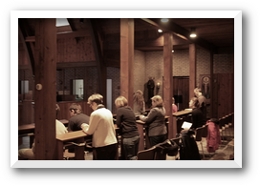
A Benedictine monk in the Episcopal Church who writes fantasy fiction? How did that happen? The short answer is: God knows. As for myself, all I can say that the fantastical has always fascinated me and matters of faith have always been a consuming interest. The first two books to have my name written in them were that tales of Hans Christian Andersen and Grimm’s fairy tales. I started writing fantasy stories as a child and I haven’t stopped since. My religious journey took many twists and turns during my youth, including detours in Hinduism and Buddhism, although I consistently believed that religion dealt with the most important things in life. This journey led me back to the Episcopal Church in which I was raised and then to St. Gregory’s Abbey in Three Rivers, Michigan.

Another interest that caught me and has never let me go is music. Singing in a high quality church choir as a boy introduced me to great choral masterpieces and music has been woven with my religious interests ever since. These days, I sing plainsong in the monastic church and listen to music of all kinds in my spare time. Along with my religious convictions, music is a major strand in many of my stories.

Another swirl running through all of these major interests is a concern for peace and for alternatives to violence. In my stories and other writings, seeking peace within oneself and, more important, within social relationships, has become one of the major themes I deal with. Tools for Peace engages in a dialogue between the Rule of St. Benedict and the thought inspired by René Girard, a thinker preoccupied with the social dimensions of violence while my stories take the reader through enchanted but sometimes troubling pathways in search of visions of peace.

I suppose I could sum up my outlook in life as: Saint Benedict in Fairyland. In their various ways, St. Benedict and fairy tales combine an earnest moral and spiritual drive with a delight in God’s goodness. For me, monastic discipline and the freedom of the fantastical imagination reinforce each other. Both my religious writings and my stories witness to my conviction that, contrary to the violence humans perpetrate, God has created a friendly universe grounded in God’s love for all of us.