How my Story “The Rainbow Butterfly” Came to Be

creatures coverThe writing of my story “The Rainbow Butterfly” has a complicated history. My first inspiration came from a short story by Nathaniel Hawthorne called “The Artist of the Beautiful.” In it, a craftsman creates a very delicate and beautiful butterfly that has a numinous quality. In Hawthorne’s grim imagination, this fragile work falls victim to insensitive people.

In my imagination, this image got hooked into an idea of a story about a town at war with another town to the extent that the war defined the town’s life at every level.  An underground group, devoted to finding an alternative to war, was engaged in a project of constructing a rainbow butterfly that would take on a transcendent life of its own. The project succeeded and the rainbow received a mixed reception depending on the dispositions of each person.

A few years later, at the time of the civil wars in the Balkan Peninsula, I got the idea of writing a story about a city in the state of civil war where occupation of the city was roughly divided between each side. The children too young for combat (starting at age twelve) spent their time getting a piecemeal education with the result they learned of a possible to stop the war, but one requiring self-sacrifice. (I used the Welsh legend of the black cauldron that turns dead bodies into zombies until a live person jumps into the cauldron voluntarily which breaks the cauldron. As you can guess, it was a pretty dark story.

Over time, I continued to feel there was a lot to like in both stories but at the same time some fundamental problems that kept either of them from working. After puzzling about this for some time, I got an inspiration to take elements of each story and create a whole new story using the same themes about war. The result was “The Rainbow Butterfly.” Basically, it combines the inter-city civil war scenario with that of an underground resistance group seeking peace. This time, there was no attempt to create the rainbow butterfly; finding a cup that had the butterfly’s life in it was enough.

I created a whole new character as the protagonist who tells the story, twelve-year-old Darren Forty-Third. His vocabulary is limited because linguistic skills are limited to the pragmatics of perpetual war. That already tells the reader a lot about what a culture is like when it is so totally focused on war.

Want to see how Darren and his friends and the Rainbow Butterfly fare? Read the story in Creatures We Dream of Knowing.

Stumbling blocks in the Desert: the Temptations of Jesus

freshBread1When Jesus went out into the desert after his baptism, he became aware of the fundamental temptations he would have to fight throughout his life. James Alison helps us understand the social nature of these temptations by pointing out that “devil” (diabolous) means “divisive obstacle.” Such an obstacle requires two or more people to stumble over it. That is temptations are unavoidably social.

The social implications of the first temptation are spelled out in John 6 where Jesus feeds the multitude in the desert. The feeding is a sign of God’s willing of abundance (see Divinely Created Abundance) but bread, like any material good, exists in a social context.  The temptation presented here is to align bread with economic and political power. The people who have been fed fall into this temptation and try to seize Jesus and make him king (the glory of all the kingdoms of the word–see Ignominous Glory). Jesus had to resist the temptation, go off alone, and then return to preach about bread from heaven, bread that is a gift from God.

In the temptations, the devil taunts Jesus as being the “son of god.” Likewise, when Jesus casts demons out of people possessed by them, the demons call Jesus “the son of god.” Thinking back to the attempt to seize Jesus and make him king, Jesus’ ordering those he has healed to tell nobody makes a lot of sense. Jesus was focused on healing those who had need. The demons tried to politicize the healings to make them part of a thrust for social power. This dimension is particularly apparent in the name of the demon possessing the man of Gadara: Legion.

When Jesus predicts his imminent suffering and death, Peter is called a “satan” when he tries to dissuade Jesus from following that course. As with “devil,” the word “satan” means a stumbling block. Lacking support from his closest followers could only have multiplied Jesus’ difficulty in holding the course laid out by his heavenly father. How much better would it be to fling himself off the roof of the temple and force his heavenly father’s hand? The devil was right to quote the verses from Psalm 92. God would bear up the son of man, but not until the son of man had truly and deeply put himself into the unforced hands of the heavenly father by allowing himself to be handed over into the hands of angry sinful humans.

Like Jesus, we must be alert to where the stumbling blocks are in our relationships with other people and with God. Like Jesus, we must learn that the stumbling blocks are too heavy for human hands to lift and toss away. Like Jesus, we must turn to our heavenly father who is always waiting for us to ask him to toss the stumbling blocks away.

Turning on Ash Wednesday

altarDistance1As we begin the season of penitence on Ash Wednesday, we do well to put penance in a context beyond our individual selves. René Girard’s concept of mimetic desire tells us that our “individual selves” are merely an illusion; our desires are unavoidably caught up in the desires of other people. (see Human See, Human Want) With that being the case, cleaning up our “own” desires simply does not do the job.  Instead, we must clean up the desires we share with others, and that means relating to others.

Early in his great poem “As Wednesday,” T.S. Eliot zeroes in on healing shared desire by following the first lines about hoping to turn his life: “Desiring this man’s gift and that man’s scope/I no longer strive to strive towards such things.” That is, the tenth commandment about coveting includes coveting the God-given gifts of others and their insights. If we turn from our entanglements with the desires of others, we will affirm and rejoice in their gifts and insights and in doing so, will awaken to the gifts and insights that we have within us to give to others.

In Matthew’s Gospel, Jesus follows his teaching on renouncing mimetic rivalry (turn the other cheek, etc.) with a solemn caution against using “good” actions such as repenting, fasting, almsgiving, and praying as occasions for competing with others so as to desire gifts and insights of others.  If we practice piety “in order to be seen by others,” then our piety is locked in our competition with others and not on God. That is why God cannot reward such piety which isn’t piety at all. The Desert Monastics also found themselves falling into the trap of competitive asceticism. On of the reasons Benedict, in his Rule, asks his monastics to tell the abbot about their Lenten disciplines is to put the practice of each into the context of building community. All this is compiling treasure on earth just as much as fattening our bank accounts.

The alternative to “praying in secret” may seem to be individualistic but it is really a matter of being an individual before God, which is a different thing. (An individualist flaunts his or her individuality over/against others—another thrust in a life of fencing.) Rather, “praying in secret” grounds each of us in God so that we can rejoice in God’s giftedness of others and ourselves. More important, it is precisely in the midst of these admonitions against flaunting our piety that Jesus teaches us the Our Father which reaches its climax with the petition that God forgive us as we forgive others.

As we turn again back to God, let us look at the turnings we must do in our relationships, realizing that unhealthiness in our relationships is not the same thing as the unhealthiness we may see in ourselves as individuals, although there is a relationship between the two. With T.S. Eliot, let us not even try to want the gifts of others but instead turn to the gifts we have to give to others.

For more about Lent in the Rule of St. Benedict in dialogue with Girard, read Tools for Peace

A Miserable Gospel

sideAltarsIcons1Victor Hugo had turned away from the Catholic Church because of its indifference to the poor when he wrote Les Miserables and the book was condemned by the Church when it was published. Yet the novel is deeply imbued with the Gospel and some Church figures are strong witnesses to it. Go figure. Better yet, go see the movie of the musical if you haven’t already.

Jean Valjean, rejected by all as an ex-con, is invited to eat and sleep in the bishop’s house, but still embittered and desperate, he runs off with a silver plate. When brought back by the police, the bishop says the plate was a gift and orders the police to release him. The bishop presents this act of mercy to JV as a challenge to make the most of his second chance at life. The self-sacrifices required of JV to live up to this challenge make it clear that the forgiven life is far from easy or soft. Meanwhile, the police officer Javert, deeply scandalized by the bishop’s forgiveness, makes a career of tracking down the criminal in the name of justice.

A successful factor owner under an assumed name, JV inadvertently fails to protect his employee Fantine from being driven out by her co-workers and corrupt foreman when it is discovered she is an unwed mother. To atone for this, he takes responsibility for Fantine’s daughter while Fantine is dying. This entails bargaining with the venal Thénardiers to take the girl Cosette away to a better life. With JV’s past exposed by Javert, JV and Cosette escape to a convent that gives them sanctuary.

During the 1832 uprising in Parish, two mimetic triangles form around the grownup Cosette when she and Marius, a rich young man turned student revolutionary, fall in love. JV fears losing his daughter and at first hopes the street violence will lead to the young man’s death. But JV quickly realized he must put his daughter’s interests first and he then sees in Marius the son he might have had.  More complex is the triangle of the two lovers with Eponine, oldest daughter of the Thenardiers. Having fallen in love with Marius only to be politely turned away, Eponine protects Cosette and JV from a police raid led by Javert and her father but encourages Marius to join his fellow students in the revolt with the hope she and Marius will be killed. When fatally wounded by a bullet intended for Marius, she repents and tells Marius where he can find Cosette. Renouncing mimetic rivalry is shown to be possible, but costly.

Meanwhile, Javert infiltrates the rebels, is exposed by the street urchin Gavroche (a castoff son of the Thenardiers), sentenced to be killed, then handed over to JV who has joined the rebels to save Marius if he can. With the chance to exact his revenge, JV frees Javert, doing for the self-righteous officer what the bishop had done for him so many years ago. When, after the tragic street battle, JV drags the wounded Marius through the sewers of Paris (a Christ-like descent into hell if there ever was one) Javert ambushes him but can’t bring himself to arrest the convict. Totally disoriented by the prodigal forgiveness offered him, the legalist representative of the law throws himself into the Seine, a tragic demonstration that forgiving love is a tough challenge.

The musical strengthens the Gospel theme considerably in comparison with the book. The streamlining of the convoluted plot of the book puts the law/grace and revenge/mercy dichotomies front and center. The vulnerability of women and children to personal (the Thenardiers) and institutionalized (Javert) violence is stressed through Fantine, Cosette, and Gauvrache. Javert sings a song that betrays his warped mirror-imaging of the Gospel: declaring JV to be “fallen from God/fallen from grace” he reveals himself as a man so fallen. Musically, the singing of JV, Marius, and Cosette (especially as a child) is very soft while Javert is loud and assertive and the Thénardiers boisterous. (Strength in weakness.)  In the finale, JV dies and is brought by Fantine and the good bishop to a heavenly barricade turned into a heavenly chorus of revolutionaries who sing, in a song filled with biblical allusions: “Somewhere beyond the barricade/is there a world you long to see?”

A miserable, offensive Gospel if there ever was one.

A Way of Meeting with Others

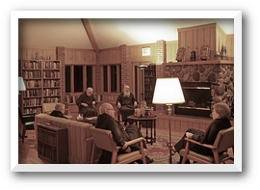
commonRoomOne of the more remarkable and attractive chapters in the Rule of St. Benedict is Chapter Two: “Summoning the Brothers [and Sisters] for Counsel.” Although Benedict was not so democratic as to have matters put up to a majority vote (as most modern monastic constitutions are), Benedict considered it essential that the abbot listen to all members of the community before making a decision. In my time as abbot of my community, I am profoundly grateful for the suggestions and cautions from my fellow monks on numerous occasions. Most writings on the Rule remind us that the first word is “Listen.” Much is made of the need to listen to God and to then to others, especially the superior, as a means of listening to God. Here, Benedict reminds the abbot to listen to the community. Given the toxic atmosphere of much debate in political and religious matters, I cannot stress enough to importance of listening as a first principle to healing the exchange of thoughts and opinions.

We can make it easier for others to listen to us by expressing ourselves in a way that makes it easier for them to listen. Benedict says that we will do this if we “express [our] opinions with all humility, and not presume to defend [our] own views obstinately.” If we take a moment to think about how hard it is to listen to a person who does the opposite of what Benedict enjoins here, we will see the importance of this admonition. More important, when we express our views humbly and without obstinacy, it is easier to be focused on the issue rather than our relationships with other people which, in the course of debate, tend to become more competitive than constructive. Benedict would have us discern the right thing to do, not strive to gain the most debating points.

Even more startling than the foregoing: Benedict says that the reason the whole community should be called together is because “the Lord often reveals what is better to the younger.” This is not an over-idealization of young people, but is a salutary reminder that the points of view of marginal people, which includes the young, may prove to be vital to a right discernment. Our tendency is to push those we consider marginal to the margins, usually while assuming that we are not marginal.

Issues such as gun control and immigration reform being debated right now are complicated and require careful thinking and expression that is most fruitfully done humbly with a heart that listens to ourselves, to others, and to God.

These ideas are developed at greater length in my book Tools for Peace.

Strange Wedding

wineTableFeast1The Wedding at Cana of Galilee is a beautiful story of celebration. The only problem is the story makes no sense, perhaps because celebration is infinitely beyond sense.

Foremost among the oddities is the scarce presence of the groom and no mention of the bride. The effect of Jesus being at the center of the story and no bride mentioned has the effect of putting us into the position of the bride of Jesus as Isaiah said: “As the bridegroom rejoices over the bride, so shall your God rejoice over you. (Is. 62:5)” The scarcity of wine (probably humanly created—Cana was a poor village—looks ahead to the scarcity of bread in the wilderness. Both times, Jesus counters scarcity with extravagant abundance.

The six stone jars are supposed to hold water for purification. That would be a lot of purity, but the jars are empty. Well, purity laws and rituals tend to divide humans arbitrarily into clean and unclean. That is, purity always creates a scarcity of purity, especially of pure people. Quite the opposite of God’s marriage with all God’s people.

The water with which the attendants fill the jars suggests baptism, as does the water at the well in Samaria, another story with nuptial overtones. The wine is a festive drink but it also looks toward Jesus’ death as does the bread in the wilderness. The story of Jesus driving the money changers out of the temple, the event that drove the Jewish leaders in Jerusalem to plot the death of Jesus, further suggests that the water and wine refer to the Passion.

Dostoevsky makes powerful use of this story in Brothers Karamazov. The great staretz (spiritual father) Zossima has just died. When his corpse follows the normal course of nature and creates a stink, many of the people are scandalized, including Zossima’s youthful follower, Alyosha. Late at night, the stricken Alyosha  is praying in the hermitage where the body lies in state. Another monk is reading the story of the Marriage of Cana. The room expands to take in a vast celebration. Then Alyosha sees Zossima rejoicing. The elder says to him: “We are rejoicing . . . we are drinking new wine, the wine of great joy. See how many guests there are?” “He [Jesus] became like us out of love, and he is rejoicing with us, transforming water into wine, that the joy of the guests may not end. He is waiting for new guests, he is ceaselessly calling new guests.”

Cana was a backwater in a backwater, a place of no significance. The temple in Jerusalem was the center of Jewish religion and culture. As with the outcasts at the manger, the party is in the backwater, not the center. In this new center, Jesus calls all of us to the party, the party that transforms the body and blood of Jesus into bread and wine of feasting and rejoicing, a party open to all of us. . Jesus has indeed saved the best wine until last.

See blog posts Humanly Created Scarcity, Divinely Created Abundance, and Outcasts at the Manger and article Violence and the Kingdom of God for more comments on Brothers Karamazov.

Arachne, Athena, and a Thousand Princes

Xenia1Imagine a world where competitiveness is that world’s foundation, where it is nothing but mimetic rivalry all the way down. (See my post Human See, Human Want.) Actually many people have, but I am going to focus on a couple of recent fantasy novels I’ve just read which do that.

The Mark of Athena is the latest volume in Richard Riordan’s second series about adolescent demigods, Heroes of Olympus. These books can be a fun way to learn about Greek and Roman mythology, but if ever these gods are real and they really (mis)rule the universe, we’re in trouble. The positions of Zeus and the other Olympians, for example, are the result of earlier conflict. In Riordan’s novels, Cronos and Gaia make comebacks that fuel the divine in-fighting.

This latest book Riordan makes the millennia-old resentments come alive in their tense paralysis. Arachne who offended Athena by weaving a better tapestry than Athena could. Arachne is imprisoned under Rome as a giant spider with a monstrously bad attitude. Beth, a daughter of Athena, has to take from Arachne the Athena Parthenos that was stolen by the Romans and restore it to the Olympians. We see frozen resentments such as Arachne’s in human experience all the time. What if God really were like Athena instead of a God who generously brings us into being and even more generously saves us from follies such as that of Athena and Arachne?

The other books is A Confusion of Princes by Garth Nix. Prince Khemri is one of countless youths raised in privileged but inhuman conditions to serve the inter-galactic empire as a prince. Each prince is connected to the imperial mind upon coming of age (if he or she is not assassinated first) and is plunged into a system fueled by rivalry and nothing but rivalry. Material goods and programed courtesans are furnished in abundance so there is nothing to fight over except power and position. Nix does a superb job of showing us what such a system looks like, a system that is totally sacrificial. Khemri is singled out for a unique assignment that forces him to live with normal human beings. He is quite bewildered when he finds himself instinctively defending a woman when all his training taught him to use a human as a shield for himself. Is it a shock to us if ever we discover something in the world that isn’t rivalry all the way down, but is grounded instead in love that reaches out to others?

See Baptizing the Imagination for an essay on religious aspects of fantasy literature. See Violence and the Kingdom of God for more about mimetic rivalry and religion.

Outcasts at the Manger

altarXmasStar1We like to be insiders and hate to be outsiders, don’t we? Well, let’s look at some insiders and outsiders in the Christmas story. The people who stayed at the inn in Bethlehem were insiders. A betrothed couple and their newborn baby were outsiders. Shepherds were outsiders, hated and distrusted by all. So why would the angel of the Lord show such bad taste in revealing the birth of the Savior to them?

The Magi were highly-placed insiders in their own country, most likely top advisors of royalty. So why would they travel to another land where they were outsiders? If the star was up there for all to see, why did these foreigners from without and outcasts from within Jewish society respond when others did not?

The Magi, used to being insiders, went straight to the top, to the ultimate insider, King Herod, to inquire about which newborn child the star was indicating. Ironically, Herod was an Idumean, not a full-blooded Jew. He had power, but he was an outsider. Herod’s reaction to the Magi’s inquiry showed Herod to be an outsider to humanitarian feelings once he thought his power was threatened. Mixed racial background aside, being rich and powerful pushes one to the margins of society as much as the poverty of the despised shepherds.

These days, we easily see Herod as an outsider, an intrusive foreign element entering the story only to stir up trouble and grief. The shepherds and the Magi are insiders, like us. How did that happen?

There is a certain sleight of hand that turns us and certain chosen others into insiders when it suits us. Not only do we not wish to be outsiders, we don’t like to be challenged by outsiders. If we realize that the shepherds and Magi and the Holy Family themselves are outsiders, our identities are shaken at a deep level. If it is outsiders who appreciated the richness of the Christ Child, maybe the same thing happens today. After all, some nonbelievers care more about the poor than rich Christians and a Hindu early in the twentieth century believed in the Sermon on the Mount more than the Christians of his time.

The greatest irony is that Christ was born to save all people, to make insiders of all of us. The problem is, we don’t want to be insiders with those who are outsiders and we certainly don’t want outsiders to join us. After all, what would we do if there were no outsiders?

The Word Became Vulnerable Flesh

creche1When St. John says that the Word became flesh and dwelt among us, he is sharing a mystery so deep that we don’t know what to say. The mystery only deepens when we recall that the Word was with God “in the beginning” and without the Word, nothing was made. What is more, the Word was God. Which is to say, the Word is God for all time.

So why would the Word enter into the Creation that the Word shaped? Isn’t that a case of ultimate downward mobility? Later in his Gospel, John says that God so loved the world that He gave his only begotten Son who died on the cross. Suddenly, the Word who in the beginning was with God and was God is much more concrete and understandable. Except why would God and the Word love us so much that they would do that? Looking around at ourselves, there seems to be no accounting for taste.

What is so amazing is that God, who we might think is the ultimate in invulnerability, chooses to be vulnerable. God’s vulnerability is attested by the prophets who spoke of God’s distress over human waywardness and infidelity. But even then, “the boots tramped in battle” in Isaiah didn’t trample the Word who was with God and was God. But once the Word was born in the flesh of a human mother and laid in a manger, the Word had become just as vulnerable to trampling boots and automatic rifles as the children at Sandy Hook School in Newtown, Connecticut and the children slaughtered in Bethlehem by order of King Herod.

Here is where the mystery deepens so profoundly as to escape comprehension. It goes against what we think are our deepest instincts. We do everything to make ourselves less vulnerable from putting on plated armor, to hardening our feelings to buying weapons to defend us for the “slings and arrows of outrageous fortune,” to quote Hamlet. If the Word without whom nothing was made that was made is willing to be so defenseless, than perhaps it isn’t really our deepest instinct to defend ourselves so aggressively after all.

Perhaps if we, like Mary, would treasure these things and ponder them deeply in our hearts, we will find within ourselves a Love created by God that loves so abundantly that it melts all our defenses and we no longer worry about accounting for God’s taste in so loving the world.

Celebrating the Prince of Peace

snowKatrinaCrossBW1This year’s rejoicing over the birth of the Christ Child is darkened by the recent murders at Sandy Hook School in Newton, CT. Lest I be accused of being a killjoy by keeping these two events together, let me remind you that Saint Matthew is just as much of a killjoy when he tells the story of the Holy Innocents who were killed in Bethlehem. Christmas has been darkened by human violence from the start.

When a tragedy like this strikes, it is only responsible to find ways to prevent it happen again, or at least lower the chances of it. The problem with prevention is our tendency to fall into a blame game. Some of it is absurd, such as blaming homosexuals or the banning of prayer from public schools, never mind the countless attacks on schoolchildren that predated that Supreme Court decision. Then there is the NRA. There is unquestionably a long overdue need to re-examine the ubiquity of firearms in our country but we have to dig deeper.

Which gets me to what we need to learn from the baby laid in a manger on a cold winter night. When this child grew up, he became the victim of collective violence in a tense city, the one blamed for that tension. And yet God raised this victim to prove his innocence. When Jesus encountered human problems, he did not blame people, he healed them. Even when he spoke strongly, as he did to the Pharisees, he was trying to heal them. When threatened with violence, Jesus told the disciple who drew a sword to put it back in its scabbard and stay there.

The killing of the children at Sandy Hook was violent, but the casting of blame is also violent. Hacking the Internet pages of the Westboro Baptist Church, egregious though its actions are, is only a further escalation of violence. The problem with the blame game, even when there is some truth to the charges, is that it always distracts us from other factors that are at least as important.  We all need to look at the logs in our own eyes, at the resentments within ourselves that fuel the violent tensions in our society.

The angels appearing to the shepherds sang of peace for all people. Not peace orchestrated by a violent empire, but peace emanating from the human heart that wants to protect not only Jesus from Herod, but all children from all who would hurt them, most of all, ourselves. By taking responsibility for ourselves, we make ourselves responsible to all. Then we can really celebrate Jesus as the Prince of Peace.

See also Two Ways of Gathering