

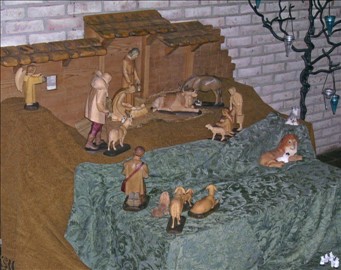
The shepherds adoring the Christ Child are a staple presence at Christmas time, so much so that we perhaps take them for granted. Most manger scenes and the Christmas Gospel make them seem respectable. Well, real shepherds weren’t the sort that respectable people invited to come and ooh and aah over their newborn babies.
Some of the recent writings I read about Christmas toned down the alleged marginality of shepherds. One writer pointed out that a famous Talmudic statement citing the dishonesty of shepherds was made several centuries after Jesus’ life. Even so, I doubt that shepherds had been respectable bourgeois gentlemen who went downhill a few centuries later. More important, though, these writers drew our attention to the symbolism of shepherds and the biblical allusions in Luke’s Gospel, suggesting that marginality wasn’t such an issue.
Most importantly, the shepherds in the field who, prompted by the host of angels, came to visit the Christ Child point to Jesus’ ancestor King David. They were just outside the city of David, after all. The story of David’s anointing as king is particularly interesting in this regard. (1 Sam. 16) Samuel asked Jesse to bring all of his sons before him. When he brought seven sons, one would thing he had brought them all. After all, seven sons is quite a few, and seven is often taken to be a number of completion in a way that six or eight are not. And yet God told Samuel that not one of the seven sons who passed in front of him was the one chosen to be the king in place of Saul. So Samuel asked Jesse if there is yet another son and finally Jesse admitted that there was one more, the youngest, who was with the sheep. When David was fetched, Samuel knew that this was the one.
The point is, the shepherd boy had been marginalized out of existence until God called for him. This is just one of many, and one of the more subtle, examples of God’s trick of bringing something out of nothing. David then did become something and was, figuratively speaking, the shepherd of Israel for many years. To this day, he is the archetypal king, even if he wasn’t always the best of shepherds. Interestingly, the prophet Nathan used the parable of a sheep to speak a condemnatory word to the king when he acted wrongly in regards to Bathsheba. (2 Sam. 12) Later in his Gospel, Luke contrasts this episode with Jesus’ Parable of the Good Shepherd who left the ninety-nine sheep to seek out the one stray. (Lk. 15: 1-7) The Davidic symbolism, then, actually highlights the marginality of the shepherds, of King David, and therefore, of Jesus himself. In fact, in a more literal way, Jesus has come out of nothing, as Luke tells us that Mary, who had not known a man when Jesus’ birth was announced to her, yet gave birth to this child.
After two thousand years plus, the Christmas story is a part of world culture, although its appropriation by some, maybe even all cultural groups, sometimes seems far-fetched from its beginnings. But do we really adore Jesus as our true king? The news feeds on the Internet raise serious doubts about this. Perhaps Jesus is still as marginal as he was when he was placed in a manger because there was no room for him anywhere else. Can we let the marginal shepherds shepherd us to the manger where the even more marginal child lies? Can we keep our ordered and apparently complete lives open for the One conceived by the Holy Spirit to enter? Do we really have room for Jesus today? Given the troubles in the world, can we open our hearts for God to bring something out of the nothing that surrounds us in our time?
 Imaginary Visions of True Peace