Eating a Story

Corpus Christi is an odd feast. Almost all of the other feasts celebrate an event in the life of Jesus or the life of a saint. Corpus Christi is focused on the doctrine and devotion to the Eucharist. Only the Feast of the Trinity has a similar focus insofar as it celebrates a doctrine fundamental to Christianity. The trouble with celebrating either feast as primarily doctrinal is that doctrines in themselves seem lifeless. Who besides mathematicians can get excited about the paradoxes of one and three, and who but scholastic theologians can get excited about what the Real Presence in bread and wine is all about?

The Trinity, of course is not a doctrine, and it isn’t really a mathematical puzzle for that matter. The Trinity is a story of creation and redemption and sanctification. Not that each person of the Trinity is confined to one of those roles. All three Persons do all three and much, much more. The sacrament of the Eucharist also celebrates a story, the same story that is told about the Trinity. (See Trinity as Story and Song.) The Institution of the Eucharist, Jesus’ Last Supper with his disciples, is one important incident in the story of Jesus coming to earth as a helpless child, living a life of a human vulnerable to whatever other humans choose to do to him, dying on a cross when that is what humans chose to do, rising from the dead, and being seated at the right hand of the Father in the heavenly places. We have celebrated this story one step at a time, starting with the expectations of Advent all the way through to the coming of the Holy Spirit at Pentecost. Trinity Sunday puts the whole story together in one big celebration and then Corpus Christ does the same from a different angle.

St. Thomas Aquinas said that God relates to God’s creatures according to their mode of reality. In the case of humans, this means that God relates to us, material creatures that we are, through the material world in time and in history. The Eucharistic rite takes place in time. It incorporates past times, most particularly the times when Jesus suffered and died and then rose again, but also the time when the Israelites were delivered from the Egyptians at the Red Sea, an event recalled at the Passover for the Jews. The Eucharistic rite also takes place in the present moment when it is celebrated. Whatever events on both local and world fronts are incorporated into the celebration and offered to God. Moreover, God’s promises for the future when all will be made one in Christ are present as well. That’s a lot of time and history to be contained in a piece of bread and a sip of wine.

Discussions of real presence and dolling the sacrament up in a monstrance for Benediction both have some danger of reifying the Body and Blood of Christ. However, use of one’s intelligence to perceive some intelligibility in the holy Mysteries is part of what it means to be an embodied human being. This is salutary as long as one is willing to allow what intelligibility that emerges to remain surrounded by mystery. Dressing up to celebrate is another facet of our embodied way of living. It is the kind of celebration we engage in to honor people we love and respect. The important thing to realize is that we are eating and drinking some powerful stories when we partake of the bread and wine, and we are celebrating these same stories deep in our hearts as we pray before the dressed-up sacrament. These stories of deliverance from slavery and the suffering of the Prince of Peace inform the way we prayerfully incorporate contemporary events and they prepare us for how we should live out our stories as parts of the greater stories embodied in the sacrament. These same stories have prompted many liturgical theologians to stress the importance of social concerns and outreach as necessary outcomes of the Eucharistic celebration.

There is a human expression about eating our words. The implication is that our words come back to haunt us in some way. It is perhaps worth thinking about whether or not what we say is worth consuming for others, let alone ourselves. In any case, eating the words of Jesus is profound nourishment, nourishment to eternal life. When we receive the bread and wine at the altar and consume it, we are swallowing the story of Christ hook, line, and sinker. By swallowing this story, we live our own life stories within the life story given us by the Word made Flesh.

Hungering and Thirsting for God

When Jesus says “I am the bread of life,” (Jn. 6: 48) he taps deeply into a basic human need. The obvious metaphor unmistakably raises the question of whether we need God as much as we need food. Am I as hungry for God as I am hungry for food?

We naturally desire food. Many thinkers, among them St. Thomas Aquinas, also think that we desire God just as naturally. For what it is worth, that is my experience. Both desires are implanted in us by virtue of creation. Since God gives us these needs, God also provides for them. God provides food for the body, sometimes miraculously, as God did for Elijah in the wilderness or at the feeding of the multitude in the wilderness, but normally, God feeds us as God feeds the birds of the air. (Mt. 6: 26) The natural longing for God is God’s provision for fulfilling the deeper need it creates. To some extent, this longing is itself God’s provision of God’s presence, but it is also a foretaste of what is to come.

In the case of food, a lack of appetite is a sign that something is wrong and we seek medical help. If that doesn’t solve the problem, we try psychiatry or pastoral counseling for matters of the heart. Sometimes, people lose their appetites because table fellowship breaks down, in which case there is need to repair the social fabric. But what if we don’t desire God, or think we don’t? Is that a sign of bad spiritual health? If it is true that we all have a natural longing for God, and it stands for reason that it is so if we are created by God, than the answer is Yes. However, it isn’t our business to worry about whether other people are properly hungering and thirsting for God. We should attend rather to our own appetites

With physical health, there are several factors that are considered as indications as to whether a person is healthy or not. The same is true for spiritual health. The fourth chapter of Paul’s Letter to the Ephesians is a good checklist. Not stealing and earning an honest living is a start. Not letting evil talk come out of our mouths is a stronger indication, while speaking evil of others suggests lack of health. “Bitterness and wrath and anger and wrangling and slander, together with all malice” all need to be put away. (Eph. 4: 31) Such is junk food that is most unhealthy. On the other hand, being tender-hearted and forgiving in imitation of Christ is healthy food indicating spiritual health. People who show this kind of health are longing for God whether they know it or not. As Jesus said that doing the will of the one who sent him was his food and drink, (Jn. 4: 34) the good dispositions and actions listed in Ephesians should be our food and drink. Unfortunately, God’s provision does not keep us from spurning what God provides. Like petulant children who won’t eat their vegetables, we complain about the manna in the desert, especially if the spiritual journey feels like a desert. When such petulance on our part leads to hateful speech and insensitive treatment of others, it can dampen other peoples’ appetite for God and the things of God. So we have a responsibility to feed others with food that is healthy and nourishing. We must keep before us these questions: Do we long to taste the love and good works that Jesus embodied? Do we taste and see that the Lord is good? (Ps. 34: 8) These are questions to ask ourselves when we receive the Body and Blood of Jesus in the bread and wine.

The Passion in the Eucharist

The Eucharist makes present the death and Resurrection of Jesus at each celebration, regardless of the occasion. So it is that we don’t even celebrate the birth of Jesus without celebrating his death as well. But in commemorating the Last Supper of Jesus, the Eucharist on Maundy Thursday is particularly close to the Passion, being the meal during which Jesus was suffering the anxiety he was soon to express at Gethsemane.

While reflecting on this matter, I came across a few lines on this very theme by Gerard Manley Hopkins, one of my favorite poets. They made up an epigraph of a chapter in Brian Zahnd’s new book The Wood Between the Worlds,” a powerful meditation on the Cross, Not only was I moved by the lines, but I was surprised to come across some lines by Hopkins that I didn’t recognize since I thought I had studied all of his poems multiple times. That little mystery was solved when I found out that it is an early work, one written while still a student at Oriel College in Oxford, and still an Anglican. So it is only included in the most complete collections of his works. I might have read it before without it registering, but the few lines singled out in Zahnd’s book really caught my attention, as I’ve said.

The poem is called “Barnfloor and Winepress” and it pulls together the Passion of Jesus and the Eucharist into an inextricable knot, making it most appropriate for Maundy Thursday. With wrenching, sometimes violent imagery embodied in hard sounds that put Hopkins, even in this early work, decades ahead of his time, the poem provides a powerful example of how the ugliness of Jesus’ crucifixion permanently affected the aesthetic possibilities in all of the fine arts as the ugliness is sublated in the moral beauty of Jesus’ self-sacrifice and his vindication in the Resurrection. The first stanza includes these lines that use the Eucharistic imagery of the making of bread:

Thou that on sin’s wages starvest,
Behold we have the joy in harvest:
For us was gather’d the first fruits,
For us was lifted from the roots,
Sheaved in cruel bands, bruised sore,
Scourged upon the threshing-floor;
Where the upper mill-stone roof’d His head,
At morn we found the heavenly Bread,
And, on a thousand altars laid,
Christ our Sacrifice is made!

And in the second stanza, lines using grape and wine imagery to the same effect:

Thou whose dry plot for moisture gapes,
We shout with them that tread the grapes:
For us the Vine was fenced with thorn,
Five ways the precious branches torn;
Terrible fruit was on the tree
In the acre of Gethsemane;
For us by Calvary’s distress
The wine was racked from the press;
Now in our altar-vessels stored
Is the sweet Vintage of our Lord.

We have in these powerful stanzas a kind of transubstantiation, not only of the Eucharistic elements that Hopkins was clearly believing in as a high-church Anglican, but a transubstantiation of the suffering of Christ into the Eucharistic elements. The violent human sacrifices throughout human history, both before Christ and after Christ up to the present day, are transmuted into the bloodless sacrifice on the altar. (The phrase “terrible fruit” reminds me of Billy Holiday’s “Strange Fruit.”) No wonder Brian Zahnd refers to this poem in a chapter that argues that the crucifixion of Jesus is the ultimate center of human history. Even while humans continue to commit the same old same old violence as we see most painfully in Ukraine and Gaza right now, God has transformed all of it for all time. Hopkins expresses this insight in poetry:

In Joseph’s garden they threw by
The riv’n Vine, leafless, lifeless, dry:
On Easter morn the Tree was forth,
In forty days reach’d heaven from earth;
Soon the whole world is overspread;
Ye weary, come into the shade.

And then the profoundest transubstantiation of all: the transubstantiation of us into partricipation in the divine nature, one not untouched by the sufferings of Christ supporting our own:

The field where He has planted us
Shall shake her fruit as Libanus,
When He has sheaved us in His sheaf,
When He has made us bear his leaf. –
We scarcely call that banquet food,
But even our Saviour’s and our blood,
We are so grafted on His wood.

A Story Worth Swallowing

When someone believes a tall tale, we say that person swallowed it hook, line and sinker. A more skeptical person, on hearing what sounds like a tall tale might say: “That’s more than I can swallow.” Sometimes we say that a voracious reader devours books. When one goes to church, one often hopes to be fed by the preacher’s sermon. In The Phantom Tollbooth, the boy Milo wanders through a strange world where, upon being invited to a banquet, he starts to make a shallow speech and is dismayed when he has to eat his meager words. When Moses said that God had taught the Israelites that they don’t “live on bread alone but by every word that comes from the mouth of the Lord,” (Deut. 8: 3) he was witnessing to the power of words, of stories, to sustain us just as surely as food feeds and sustains us.

The Passover is a meal where the table fellowship is imbedded in a story, the story of the Angel of the Lord’s passing over the houses of Israel and the subsequent delivery from Pharaoh’s army at the Red Sea. The participants are nourished by the food served and they are also nourished by the story they celebrate. St. Paul reminds the Corinthians of the last meal Jesus had before he died, a meal that Jesus wanted to be repeated in his memory. (1 Cor. 11: 23-26) Like the Passover, with which Jesus’ meal is closely related, it seems to have normally been a meal for feeding the participants as well as celebrating the story of Jesus. Unfortunately, very bad manners on the part of some of the more affluent Corinthians led Paul to recommend separating the meal from the celebration of the story, an impoverishment that persists to this day. John, telescopes the meal and the story into an eternal present, as he does throughout his Gospel. Reliving the violence of Jesus’ passion by gnawing on the bread (such is the force of the Greek verb) and also reliving the Resurrection are made into a tight unity in the climax of Jesus’ discourse after the feeding of the people in the wilderness. (Jn. 6: 51-58)

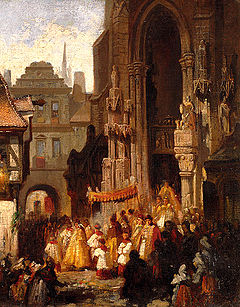
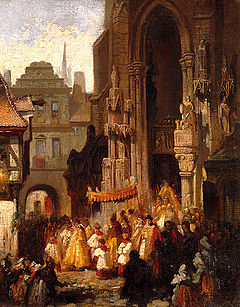
The Feast of Corpus Christi celebrates the Presence of Jesus in the Sacrament of the Body and Blood inspired by the visions of Juliana of Liège, a 13th century Norbertine canoness, and the thought of her contemporary St. Thomas Aquinas. The Thomistic term of “substantial presence” doesn’t seem to excite many people today, but the hymns Thomas wrote for the feast suggest that such terms did inspire a strong sense of devotion in the great Dominican thinker. For Thomas, the term “substance” was powerfully substantial. The elaborate Corpus Christi processions that evolved from this feast look more than a little triumphant when the Person present in the host is an Eternal Loser in the heavens but this is a loser still trying to make all of us winners for losing.

In any case, we need to remember that this presence in the sacrament is a person and a person lives a story. Is this a story we can swallow? It isn’t too hard to believe that a popular person was accused of many crimes and put to death. This is a story that has been told of many people many times, but this sort of story is a bitter pill to swallow. The Resurrection of Jesus sounds to many like a whopper that nobody can swallow, however nice it might be to swallow a story that gives us life. This is not the time or place to argue the truth of the Resurrection. Let it suffice that the death and Resurrection of Jesus is the story we swallow when we partake of the Eucharist. It is a story that touches on our vulnerability, both physical and moral, one that is sobering but also hopeful. It is a story that challenges us to be as life-affirming in the face of human death-dealing as Jesus was. There’s a lot of substance in all that!

Strange Meal

On Maundy Thursday, we celebrate two strange events that occurred at what is called the Last Supper. It was indeed the last supper Jesus had in his human lifetime, but in some ways, it is better called the First Supper.

That Jesus washed the feet of his disciples was startling, as Peter’s reaction makes clear. In the Greco-Roman world, a master would be the one to have his feet washed by those under him. For the master to wash the feet of his followers was to turn the world upside down. I wonder, though, if this was actually the first time Jesus did such a thing. In the synoptic Gospels, Jesus said more than once that the one who would be first of all must be the servant of all. If Jesus, as the master, called himself the servant, it seems likely that Jesus had performed many servile actions before the footwashing at the Last Supper. If this hunch should be correct, than it shows that Peter was having a hard time getting used to his master’s topsy-turvy way of doing things. In any case, John made sure that this action was remembered.

But it is what Jesus said and did during the meal that stretched intelligibility to the breaking point. Blessing bread and a cup of wine and passing them around was normal for a Jewish meal. Nothing strange about that. But when Jesus passed the bread, he said “This is my body.” Who knows what the disciples were thinking when they heard that! They could hardly consult any books on Eucharistic theology to help them with the matter. Even worse, when Jesus passed the cup, he said “This is my blood.” For Jews, this was very disturbing since they followed a Law that forbad consumption of blood with the meat of animals. When Jesus was crucified the next day, they surely did not understand the words any better than they did at the meal.

But somehow, the command to do this in memory of Jesus made enough of an impression that not only did the disciples continue to eat together, but they repeated the strange words Jesus had uttered. Eating together and recalling Jesus’ words became a common practice in the earliest Church as Paul’s reference to the ritual meal, stressing the fact that he is passing on a tradition, makes clear.

What did the followers of Jesus come to understand as they continued to eat bread and drink wine in remembrance of him? We have no way of knowing, but the Eucharistic overtones of the powerful story of Jesus appearing at an inn on the way to Emmaus suggest that the practice led to discerning the presence of the master at these meals, the master who had washed their feet at his last supper with them. It is this continuity of meals that makes the Last Supper the First Supper in the resurrected life in Jesus. Even today, we don’t really understand this presence, not even with the help of tons of books on Eucharistic theology, although all of the attempts to understand it show a strong devotion to the practice. But we don’t have to understand it. In receiving the bread and the wine, we are living a mystery that sustains us with the Resurrected life of Jesus.

Inside the Host

A Eucharistic host is usually small. At my first communion, it was about the size of a nickle and so thin I thought it was a sticker. The host that goes into a monstrance is closer to the size of a silver dollar but it’s still awfully thin. So why put such a small thing into a fancy monstrance? The word comes from the Latin monstrare meaning to show, indicating that a monstrance shows something hidden in the small host. As if the monstrance in itself were not enough, from medieval times up to recent modern times, the host was carried in elaborate processions through public places. Just a few years ago, I witnessed such a procession in Innsbruck that featured prayers given by the city dignitaries and rifle salutes by the Landwehr.

So what’s the big deal? Many religious thinkers not sympathetic to such devotions have asked the question and with a full heap of scorn and have complained of attempts to imprison Christ in a small piece of bread. This accusation misses the point. It isn’t that some evil bishop kidnaped Jesus and locked him up in the piece of bread. Rather, Jesus himself offered himself to us in the bread at the Last Supper. In a mysterious way, the piece of bead has become the Body of Christ. That really is a big deal.

But how can this be? How can a piece of bread ever become the Body of Christ? Jesus did not explain it, which is as good a reason as any for us not to try to explain it either. I personally find attempted explanations along the line of transubstantiation interesting as I savor the paradoxical reasoning of substance and accident becoming at odds with each other, but I have to admit this is more of a puzzle game than an act of devotion. After all, we aren’t saved by a metaphysical formula; we are saved by Jesus. And it is Jesus who invites us into the tiny home that he has made in the host. The very word expands:” “host” as in sacrifice (from hostias) as well as a host who invites us as a guest. (Any host knows that there is some sacrifice in inviting a guest.)

Just the notion of one person being invited by Jesus to an intimate meal as in George Herbert’s celebrated poem Love III would entail quite an expansion of space inside the a Eucharistic host. But there is much more. Jesus invited all twelve of his disciples to his Last Supper and it is possible that many more attended as well. In any case, Jesus invites not just one person, however individual and focused each invitation might be, but a multitude of people to the meal, so the inside of the host is more the size of an infinite banqueting hall. And the meal offered by Jesus has brought in the whole of creation that made the bread on the altar possible to begin with.

But there is much more. Since it is the person of Jesus who invites us in the sacrament, then we are meeting up with the whole person, not an outward persona such as what a maitre D’ in a restaurant would present us with. Besides meeting the person who healed the sick and the crippled, told mysterious parables, and commended the lilies of the field, we are meeting the person who was crucified on account of the social tensions we humans were not able to solve. The tomb in which Jesus was laid would have been a real prison except that it couldn’t hold him and it exploded inside out as Jesus was raised from the dead. So, inside the Eucharistic host, we are meeting the crucified and risen Jesus who is also glorified in Heaven. The inside just keeps on expanding.

There is still more. The crucifixion of Jesus is not an isolated act of one person: it is an act that absorbs every single unjust act of violence committed against every human being for all time. So all of the horrific atrocities we know of and many more are all included with the crucified Jesus inside the Eucharistic Host. This is the reason that the Eucharist has profound social significance. It isn’t just about me and Jesus; it’s about everybody and Jesus and we share with Jesus the suffering of everybody. And yes, there is still more. If every human atrocity is absorbed in the crucifixion which is present in the little host, then all the more is the redemption of the Resurrection present, a presence to raise every unjust act up to God for God to vindicate every injustice. The crucifixion absorbing all crucifixions is dark and unspeakable. It is all the space of infinite nothingness. (It has been asked if there can be poetry after the Holocaust.) The dazzling darkness of the Resurrection is even more unspeakable in its embrace of all crucifixions. This darkness is more infinite than the first. All of this inside a Eucharistic host no matter how small on the outside. Quite a lot to swallow.

The Work of a Slave

When Jesus washed the feet of his disciples, he stressed the importance of what he was doing. Likewise, when he passed the bread and the wine, he stressed the importance of what he was doing. Both acts were to be remembered and done in memory of Jesus. And both are to this day, although the footwashing is not anywhere near as common as the eating and drinking of the bread and wine.

What is it about the footwashing that has put it into a very low second place? Logistics may have something to do with it but a look at its meaning, the sign that Jesus is giving us, probably has a lot more to do with our not even talking about it all that much. In the Greco-Roman world, it was slaves who washed the feet of their masters and their masters’ guests. That Jesus would do the work of a slave must have been shocking at the time and still is, if we consider the implication that imitating Jesus’ act is not confined to literally washing the feet of others but entails acting as a slave to others. Fundamentally, being a slave means to be in the hands of another person. If we are supposed to put ourselves into the hands of others like this, what does this say about trying to enslave another human being? Jesus himself was about to put himself into the hands of others with the result that he would be crucified. If the disciples still remembered the anointing of the feet of Jesus by Mary of Bethany six days ago, that too would have added to their discomfort. This discomfort extends to the parallel versions of this story

The woman ( or women) in the Gospel stories poured out her very substance (the expense of the perfume or oil) in devotion to Jesus. Likewise, Jesus poured out his very self to his disciples in washing their feet just as he was about to pour out his life for all people to put an end to the violence that includes the enslaving of other people. In those Gospel stories, the women were commended as examples of discipleship. If Jesus thought these women were such good examples, it makes sense that Jesus was humble enough to learn from them and do for his disciples what the women had done for him. There is no indication in any variant of the story that the disciples were reconciled to what the women had done. Did Peter take umbrage at Jesus for washing his feet because he associated it with the women as much as he associated it with slavery?

With the bread and wine, Jesus again poured himself into the two elements just as he poured out his life on the cross. So it is that the footwashing and the Eucharist both mean the same thing. We have put up with the Eucharist more than the footwashing because we have been able to sidestep this meaning by arguing about the metaphysics of Jesus’ presence. But the real presence of Jesus is his pouring himself into the hands of others and through them, the hands of his heavenly Abba. Paul knew this very well but we also conveniently forget that the context of his recalling the Last Supper is to upbraid the Corinthians for violating its meaning through denigrating the weaker and poorer members of the assembly.

Jesus rebuked Peter for refusing to have his feet washed, warning him that he would have no share in him. (Jn. 13: 8) This warning converts Peter so powerfully that he goes overboard and asks to be washed all over. He has allowed Jesus to be a slave to him so that he could be a slave to Jesus and all people. This conversion did not prevent him from denying Jesus three times but it allowed him to hear the cock crow and then to affirm his love to the Resurrected Jesus three times. This is what both the footwashing and the Eucharist are all about.

Eating Together

garden1Eating is among the most fundamental activities of civilization, perhaps the most fundamental. It is the practice that brings people together to share in nourishment and social nurturing. And yet, throughout the animal kingdom, sustenance requires feeding on other living beings. Sometimes it is other animals, sometime plants. That is, a group bonding through eating inevitably bonds at the expense of other living beings.
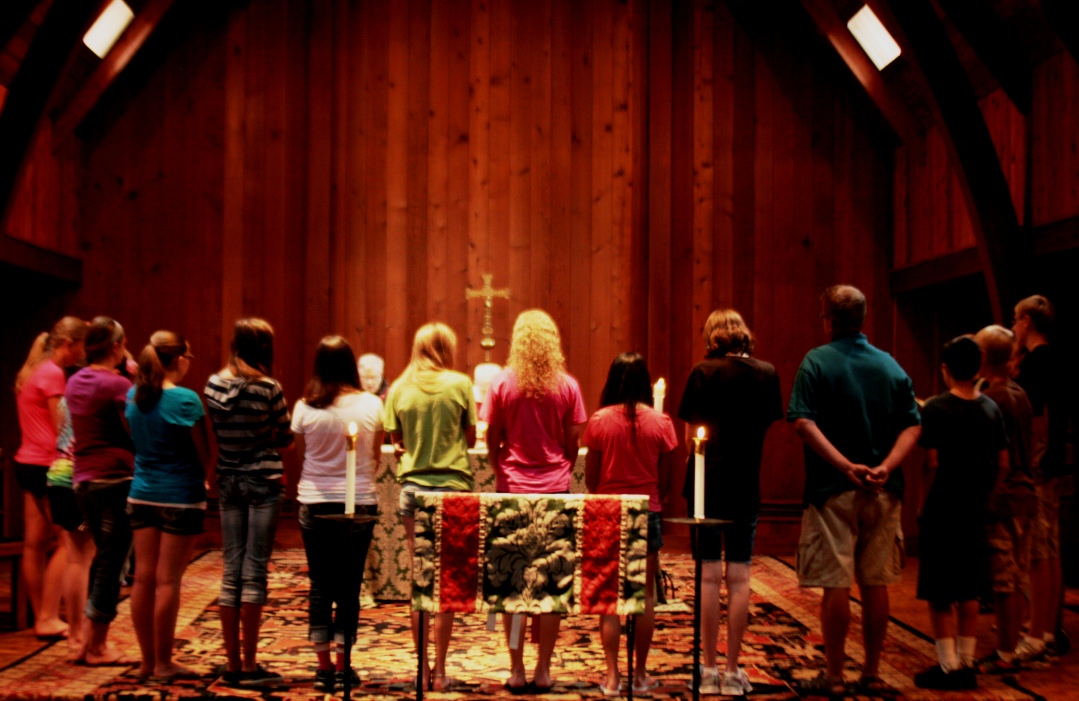
The Christian Eucharist builds on the social bonding with its celebration of a meal that binds people together. Being bound up with the sacrifice of Jesus on the cross, a sacrifice made so that all other people may live, it is a meal of human sacrifice. Yet it is made a bloodless sacrifice by the serving of bread and wine that in some mysterious way are identified with the body and blood of Jesus, thus sanitizing the Eucharist of the violence in the story that is told in the breaking of the bread.

Jesus’ strange words in his long monolog that follows the feeding in the wilderness connects this feeding with the Eucharist in words that are both comforting in that they promise a deep union with Jesus, but disturbing by thrusting the violence of Jesus’ death in our faces. English translations inevitably lose much of the force of the words as there is no English word that catches the connotations of trogein.“Gnaw” comes closest but even that is not strong enough. The German word fressen, which refers to the eating of non-human animals, comes much closer. When I used the word flippantly in conversation with a German acquaintance, his reaction was very strong, about as strong as our reaction to Jesus’ words ought to be. Which is precisely the way “the Jews” react to Jesus’ words.

In reply to “the Jews’s” anger, Jesus promises that his flesh and blood are “real food” and “real drink” without which we have no life in us. Jesus goes on to make the even more audacious claim that his body and blood do not nourish us as meat and vegetables nourish us. Such nourishment is not lasting and needs to be renewed by further eating and drinking as the manna God fed the Israelites in the desert needed to be re-gathered every day. But Jesus’ own flesh and blood feeds us in such a way that we will live forever.

If Jesus can be our food in a way that sustains us everlastingly, then his own life must also be constantly renewed. This is the claim he makes when he says that he abides in his Father and his Father abides in him. This amounts to the astounding claim that it is possible to be nourished in a way that it is not at the expense of any living being. How can this be?

Since Jesus’ promise of everlasting nourishment is tied so closely to his painful death, we might get some understanding by looking at sacrifice. Sacrifice is closely tied to eating. Deities feed on animals or vegetation, or at least the aroma of them, and the sacrificers usually eat the food that was sacrificed. The Passover lamb is sacrificed both to spare the Israelites from the plague that strikes the first-born of Egypt and a sacrifice to physical hunger, and thus a source of nourishment as well. Sacrifices need to be repeated, as the author of Hebrews says. (Heb. 7: 27; 9: 6) In his sacrificial death, Jesus has obtained “eternal redemption.” (Heb. 9: 12) Thus, this author is making the same claim on behalf of Jesus that Jesus is making in John’s Gospel.
René Girard is helpful here. His thesis that civilization is founded on sacrifice and thus needs to be fueled by repetition of the same alerts us to the ongoing “nourishment” civilization receives through the periodic deaths of victims. One sacrifice lasts only for so long and then social tensions require another. Caiaphas intended Jesus’s death to be such a life-giving sacrifice for the people, (Jn. 12: 50–52) but Caiaphas got more than he bargained for. Jesus was raised from the dead and so became empowered to continually offer his life for others while no longer being subject to death himself. This is how Girard would have us understand the Church’s claim that Jesus’ sacrifice is the final sacrifice. There is no longer a need for sacrificial victims because the way has been opened for us to be everlastingly nourished by the life that was given once for all.

The death and resurrection of Christ, then, are a pledge of the heavenly banquet where we will be nourished without need of taking any life, not even that of plants, but in this life, we still need to eat living beings of some sort. Even Lady Wisdom has to slaughter animals for her banquet. What we can do is let Christ nourish us deeply in the here and now so that we do not need to sacrifice other people as we are prone to do, but rather will feed others in anticipation of the heavenly banquet.

Christ’s Dynamically Wild Presence

corpus christi processionThe Feast of Corpus Christi celebrates the presence of Christ’s body in the Eucharistic host. One of the events that inspired the institution of the feast was a vision granted Fr. Peter of Prague in 1263. He had doubted the presence of Christ in the sacrament until he had a vision of blood dripping from the host as he consecrated it. This vision, along with earlier visions of St. Juliana of Mont Cornillon, led Pope Urban IV to order the institution of this feast. Of other Eucharistic visions I’ve heard of, it is better to be silent rather than ruin today’s celebration.

I happen to have a high devotion to the real presence of Christ in the sacrament and the two great hymns that St. Thomas Aquinas wrote for the feast are edifying. But the problem with focusing on the presence of Christ in the Sacrament is that it circumscribes the consecrated host and seems to imprison Christ in it. This is to take the Eucharistic mystery out of context. After all, the phrase Corpus Christi is used in the New Testament to refer to the Church and not the sacrament by itself. Benediction has the danger of re-creating this isolation and its origins aren’t reassuring. It derives from a devotion to see the elevation of the Host at Mass, which is fine, except that this viewing was in place of receiving the Host or even of worshiping in community. There are stories of people who would rove from Mass to Mass to see as many elevations as possible! My theology professor in seminary, Arthur Vogel, railed against Benediction because it treated the sacrament as an object rather than an integral part of a dynamic celebration.

Corpus Christi processions have the same danger, but they do bring a communal aspect to the feast. Just a few years ago I found the custom alive and well in Innsbruck. I attended Mass at the cathedral where it was standing room only. After the Mass, there was a procession throughout the town with devotions read by the mayor and other dignitaries and the Landwehr fired off salutes with their rifles.

In John 6 Jesus speaks of his presence in the bread from Heaven in a dynamic way where those who eat his flesh and drink his blood abide in him as he abides in us. In isolation, these verses suggest a relationship with individual believers but the broader context is the feeding of the multitude in the wilderness, which was a communal event if there ever was one. Jesus, then, does not abide in us on an individual basis but abides in all of us as a sharing community. If we eat the Body of Christ, we are eating the very generosity and self-giving of Jesus. If we don’t give of ourselves, we have missed abiding in the community that abides in Jesus.

St. Paul’s recounting of the Last Supper begins with the solemn words that he is handing on the tradition as it was handed on to him. He then quotes what are called the Words of Institution, the words traditionally believed to change the bread and wine into the body and blood of Jesus. When put this way, we again have the sacrament restricted to a few words and Christ’s presence in the Eucharistic elements. St. Paul, however, provides many more words to the social context of the Eucharist, namely that the Corinthians should be sharing the food they bring to the celebration with the poorer members of the congregation rather than flaunting their feasting in front of those deprived. That is, it is not enough to discern the presence of Christ in the sacrament; it is also necessary to discern the body in all of God’s people.

The leaders of the Liturgical Movement of the last century, Lambert Beauduin in Belgium and Virgil Michel in the United States, grounded their liturgical principles, featuring engaged participation of the laity, with a theology of the Church as the Body of Christ. More importantly, they argued that the Eucharist is a sign and dynamic of social change, especially in ameliorating life for the poor. Dorothy Day and the Catholic Worker Movement worked very closely with Michel to this end. Far from being trapped in the bread and wine or in a monstrance, Christ is running wild throughout the world, changing not only bread and wine, but people and the whole fabric of society.

On Being Branches Connected to the Vine

eucharist1The image of the vine and the branches in John 15 gives us a powerful image of closeness both between ourselves and God and also with each other through our grounding in God.
Each of us is a branch connected to the vine which is Jesus. Jesus is telling us that the desires of each and every one of us must be rooted in His Desire, which is the same Desire as that of his heavenly Father. Between Jesus and his Father, there is no rivalry and Jesus does not enter into rivalry with us. From our side it tends to be a different story. We experience rivalry so constantly that it is very hard to imagine a relationship without rivalry. Just note how political and social debates are saturated with it.

Jesus’ words start to sound threatening when he talks about branches withering, being thrown away, and then burnt. However, it isn’t Jesus who cuts off the branches; it’s branches that cut themselves off. Life rooted in Christ has to be rooted in Christ. This is, or should be, a tautology, but we have a folk saying about cutting off the limb we’re sitting on. People who center their lives on one or more rivals instead of Christ are doing just that. Once cut off from the vine, we are consumed with rage with our rivals, a strife that burns us up.

We often think of union with God as individualistic but that is not so. On the contrary, union with the vine unites us with all of the other branches. This means we share our union with the vine with everybody else’s union with the vine. It is by being united to others through Christ that we have the ability, through grace, to act towards others in God’s Desire rather than through our rivalistic tendencies. Since there is no rivalry in Jesus, there is no way that Jesus would encourage rivalry with others who are connected to him. In his first epistle, John says that we should love one another because “love is from God” and God is love. (1 Jn. 4: : 7–8) Again, God’s love for us is deeply connected with our love for one another. God abides in us insofar as we love one another. If we cut ourselves off from God, we cut ourselves off from other people and if we cut ourselves off from other people, we cut ourselves off from God.

The image of the vine and the branches is, above all, Eucharistic. The Eucharist is a public event. The wine in the Eucharistic celebration is the blood of Jesus that he gave to heal all of us of our violent ways. The blood of Jesus on the altar shared with each of us makes present to us the death of Jesus at the hands of persecutory humans as it also makes present the risen life of Jesus. In exchange for the way we betray Jesus with our violence, we receive the gift of life through deep union with Jesus, a union like that of the branches to the vine. We associate blood with violence, such as with the term “bloodshed,” but blood is the life within us and it is life that the Risen Jesus gives us through his Blood. This is the wine, the blood, that flows from the vine to the branches to connect us to Christ and to each other.