

Resurrection in Miniature

One of the oldest instinctual human acts is to reverence the bodies of the dead. Only in the most recent years have there been any signs of attenuation of such customs. There are no pragmatic reasons for it. As Søren Kierkegaard noted, the dead can’t pay you back for what we do for them, which makes reverence for the dead a profound act of disinterested love. Why do we have this instinct? Why was it important to the women to bring spices to the tomb at the dawn of the day after the sabbath at great expense? In answering these questions, it occurs to me that there is something awesome about death. How is it that the life that used to fill this body is no longer there? Where did that life go, if it went anywhere? Finding the tomb empty was bewildering to the women. How could they reverence the body if the body was not there? Worse, what sort of disrespectful act might have been committed on the body of a man who had died a criminal’s death?

Suddenly seeing the two men in dazzling clothes only compounded the bewilderment. These “men,” presumably angels, teased the women for looking for the living among the dead. (Lk. 24: 5) True, if one is looking for a live person, a tomb is not the best place to look, but the women had come to reverence a dead person who had meant much to them, and a tomb is the right place to look for that. As it turns out, the women who came to the tomb are the first to be told that Jesus is risen. They are also derided for not having expected this outcome, but since this is the only time in the history of the world that a dead person has risen bodily from the dead, they can be pardoned for not expecting it, Jesus’ prophesies of dying and rising notwithstanding. After all, the disciples didn’t believe Jesus when he said he was going to be killed. How could such a great man come to such an end? And if they didn’t believe Jesus was going to die, they would hardly have gotten to the notion he would rise again. Given the reaction of the women at the tomb, they hadn’t believed these prophesies any more than the disciples did.

It is highly significant that the first persons to be told about Jesus’ rising were not the disciples, but this small group of women who came to care for a dead body by anointing it with spices. One could say they got a lot more for their kind action than they bargained for. What if nobody had come to the tomb to reverence the body of Jesus? Would the resurrection have been made known? The story following in Luke gives us the first resurrection appearance of Jesus himself, but it isn’t straight-forward. The two disciples on the Road to Emmaus don’t recognize Jesus, but they invite him to stay with them when they come to an inn at eventide. If they had not kindly invited the stranger to stay and share supper with them, would they ever have seen the man as Jesus resurrected from the dead?

When the two disciples run back to Jerusalem to tell the other followers of Jesus, they are told that Jesus had appeared to Simon Peter. Although one would think this appearance the most momentous of all, it is mentioned almost in passing. Even Paul gives it more prominence is his list of appearances. (1 Cor. 15: 5) Luke then concludes with Jesus appearing to all of the disciples. It all seems low-key and very quiet. Hardly earth-shaking as the Resurrection is in Matthew.

I suggest we think further about how closely tied the Resurrection appearances in Luke are to small acts of human kindness. In Brothers Karamazov, Dmitri tells of how a man’s small act of giving him a bag of nuts made a deep impression on him. Such acts may seem to accomplish little, but they are the stuff of the resurrected life that abides.

On How to Look Forward to Easter

One of the more startling and memorable things Benedict says in his Rule comes towards the end of his instructions for keeping a holy Lent. After listing several acts of self-denial that one might do, he then says “and look forward to holy Easter with joy and spiritual longing.” (RB 49: 7) One can be pardoned for looking forward to not having to keep up these extra acts of self-denial. Perhaps one can even be pardoned for looking forward to eating Easter candy. However, since Easter candy hadn’t been invented in Benedict’s time, it could hardly have been on his agenda. Moreover, looking forward to Easter with holy longing suggests something else than creature comforts, even if they might be included. This looking forward is on a whole different plane than, say, looking forward to three broken ribs healing so that I feel better. Besides, since Benedict says that we really should keep Lent all year long, he isn’t encouraging us to give up the self-denial we practiced during the season. Then there is the matter of what Benedict means by joy. The joy with which we look forward to Easter seems to be a present reality, not just a future one. That is, we experience the joy of Easter in the here and now as we look forward to it. In this short but rich fragment of one sentence, Benedict expresses a profound devotion to the Resurrection of Jesus and the joy we should experience in the risen Lord, even in the midst of self-denial.

We can deepen our perspective on Benedict’s devotion to Easter by taking note of the role of the suffering of Christ in the Rule. This is most strongly expressed in the fourth step of humility where Benedict says that we are obedient “under difficult, unfavorable, or even unjust conditions” at which time we “quietly embrace suffering.” (RB 7: 35) It isn’t that Benedict is in favor of acting unjustly. On the contrary, Benedict wants his monastics to prefer the good of others over one’s own. But if one should suffer injustice, the model of the suffering Christ is the model to follow. Anyone suffering in such circumstances would have all the more reason to look forward to Easter with holy longing even in the midst of such trials

Now that Easter has come and we are celebrating the feast, is this what we were looking forward to? What we have in the Gospel is a far cry from trumpets and dancing in the streets, let alone eating Easter candy. Instead, we have two demoralized women coming to the tomb to do reverence for the body of Jesus. They are shaken by an earthquake, by an empty tomb, and then by the appearance of an angel dressed in dazzling white. The angel tells the women not to be afraid. What are they afraid of? Probably many things, not least the Roman authorities. But probably the greatest fear is that things seems to be taking a most unexpected turn and they don’t know which end is up. From our vantage point, we might think there is no reason to be afraid of the Resurrection of Jesus, and it is hard to put ourselves in their position. Remember, we were looking forward to Easter because we know how this story ends. But the women were in the middle of the story, and even when they met with Jesus himself, they were hardly in a position to understand what was happening and where it would lead. What we have to remember is that the disciples of Jesus were not looking forward to Easter; they were mourning the loss of their leader. That was bad enough, but at least mourning a death is intelligible. Encountering a risen Christ is a different matter. How can anyone make sense out of that?

The disorientation of the women and then of the other disciples can give us some insight into what it means to look forward to Easter. By knowing the ending, or so we think, we think we know basically what Easter is all about, but do we? What does it really mean that Jesus is risen from the dead and lives forever, not only in the heavenly realms but also in the midst of humanity, in each human heart, and in all of nature? How do we live our lives in the risen Lord? Do we really know all that much more than the disciples did at the time? And does Benedict want us to stop looking forward to Easter once Easter Day comes? Surely not! Perhaps, part of living a perpetual Lent is looking forward to Easter all year round, not least during the Easter season. A small but telling liturgical hint is that Benedict would have us say the Easter Alleluia at the Divine Office throughout the year except during Lent. Why should we look forward to Easter all the time? For the simple reason that we don’t and can’t understand it. We only have a sense that something amazing and joyous has happened, something we can’t take in. So the best we can do is reflect deeply on the resurrected life that Jesus is sharing with all of us and keep looking forward to having more of that life to look forward to.

The Shaken Empty Tomb

lightingEasterFire (2)Matthew says there was an earthquake when the angel of the Lord came down, rolled away the stone of an empty tomb and sat on it. Both the earthquake and the empty tomb give us apt images for the way we experience Easter this year.

An earthquake turns the world turned topsy-turvy in a short time and that is exactly what the COVID-19 pandemic has done. Suddenly everything is out of place. Church, the place of refuge in hard times has become a place of danger. Schools are empty. Community is suddenly located on the Internet where social critics have said it is conspicuously absent.

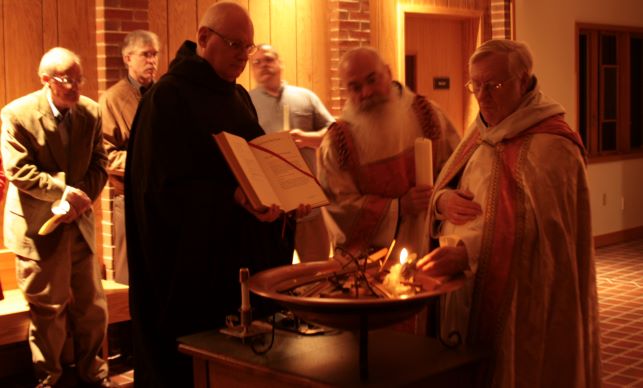
The earthquake has Eastertide, like the tomb, feeling empty this year. The boisterous celebrations with trumpets and choirs aren’t happening. Here at the abbey, we celebrate the Easter Vigil the way we usually do except for simplifying the lighting of the Easter fire and the procession. But we usually have a lot of people join us for the liturgy and this year nobody can come. The church will feel empty. We usually have a party after the Easter Vigil. This year we will not because there is nobody to have a party with.

At Easter, we usually skip the empty tomb and jump to celebrate Jesus’ being raised to life, which is quite a lot to be excited about. The empty tomb is mentioned in all four Gospels but it seems beside the point when Jesus is walking around, still bearing the wounds of his crucifixion yet very much alive.

The earthquake and the empty tomb go together. An earthquake shakes everything up, leaving us with a lot of empty space. And that’s what the empty tomb is: an empty space where the body of Jesus was supposed to be. Since, in Matthew’s Gospel, the angel wastes no time in telling the women that Jesus is risen and the women run into Jesus himself almost immediately on their way to tell the disciples, we are not given time to reflect on the empty tomb. The other evangelists, especially John, give us more time for this.

But let’s linger at the empty tomb just a bit in this time of loss and fear of more loss. The empty tomb is a hole in the Resurrection. How can the Resurrection have a hole in it? Isn’t the Resurrection about the fullness of life? But emptiness and fullness go together when it comes to the spiritual life. We go through life with gnawing desires that can’t be filled and sometimes shouldn’t be. Usually we don’t even realize it. If we stop and reflect, the emptiness stares us in the face. That is why many prefer not to stop and reflect.

When an earthquake like the pandemic strikes, we are so shaken up that it is very hard to avoid thinking about what really matters in life and what doesn’t. Things important yesterday aren’t so important today. The disciples thought they knew Jesus pretty well but when Jesus allowed himself to be handed over to the Jewish and Roman authorities and be crucified by them, they weren’t so sure they knew Jesus after all. Wasn’t he the one who was going to redeem Israel? Doesn’t look like he’s done that.

The earthquake and the empty tomb give us the space to empty out our preconceptions about Jesus, and what it means for Jesus to reveal God to us. One of the preconceptions is the need to organize society around who is “in” and who is “out.” Jesus was cast out of the city and crucified so that society could come together in his absence. But Jesus’ absence, the empty tomb, becomes the center. And in this empty center, Jesus comes to greet us and to tell us not to be afraid. Strange words to hear in the midst of a frightening earthquake and in an empty tomb. Can we hear these words? Can we empty ourselves enough to let the greeting of Jesus fill us with a new life that is beyond our understanding, a new life that will transform the crisis of today and the crises we will face in the future?

It Was Necessary

yellowTulips1Easter is an occasion of great rejoicing with bells, boisterous singing, and feasting. But do we really know what we are celebrating? The Gospel reading, doesn’t exactly ring out with Christmas joy of angels filling the skies with songs of God’s glory. Instead, we get “two men in dazzling clothes” who tell the women who came to the grave to anoint Jesus’ body that Jesus was not there but had risen. They had come to the wrong place.

A small group of confused women running off to stammer the news to the disciples isn’t exactly a celebration either. The disciples’s thinking the news is an “idle tale” may reflect a masculine condescending attitude towards women, but their reaction also shows how totally disorienting the news was. The Gospel reading ends with Peter running to the tomb to take a look for himself, seeing the empty linen clothes lying about, and then going home, “amazed at what had happened.” (Lk. 24: 12) Still no celebration; just a lot of unanswered questions. Luke continues his Resurrection narrative with two followers of Jesus walking to Emmaus with no indication of why they should be going there, implying that they are going the wrong way. Their conversation with a stranger on the way confirms their sense of confusion. Should we, too, be too disoriented to celebrate?

I think the key to understanding the problem lies in the words of the angelic beings: “Remember how he told you, while he was still in Galilee, that the Son of Man must be handed over to sinners, and be crucified, and on the third day rise again.” (Lk. 24: 6–7) The stranger who met up with the two disciples asked them rhetorically: “Was it not necessary that the Messiah should suffer these things and then enter into his glory?” (Lk. 24: 26) The word “must” is the key here. The Greek word dei is often translated “it is necessary.” In this case, for whom was it “necessary” that Jesus be handed over to sinners to be crucified and then rise on the third day? There is a tendency to think the death was necessary for God, but that suggests that God needed to have God’s own son die a painful death. Many people have a problem with that notion, I among them.

I find the French thinker René Girard helpful here. He interprets the available anthropological evidence as indicating a tendency of archaic societies to solve social tensions by a process that transforms competitive relationships throughout the society into a shared desire to focus on one person and then kill that person who is deemed responsible for the social tensions. The ensuing peace (for a time) is so strong that the victim is then worshiped as a deity. It is this social mechanism that convinces people that it is necessary for “god” that the victim be killed. Throughout this process, the truth of the victim is precisely what nobody knows, except possibly the victim.

This truth of the victim was gradually being revealed in the prophetic tradition of the Jewish people, most prominently in the verses about the “Suffering Servant” in Isaiah, whom the people accounted “stricken, struck down by God, and afflicted.” (Is. 53: 4) But then the people realized that they, not the victim, were the guilty ones. God had vindicated the “stricken one,” not the persecutors. It was these passages in Isaiah that most helped Jesus’ followers begin to make sense of what had happened to Jesus.

But on the day of Jesus’ Resurrection, the disciples had not thought to connect Jesus with the Suffering Servant. Jesus had told them many times that it was “necessary” that he be handed over to be crucified, but they could not understand. How could it be “necessary” that the man who they thought was going to restore Israel should be handed over to death? They assumed it was “necessary” that the guilty ones be handed over, not the innocent. Then, at Passover time, Jesus was deemed to be the guilty one who was causing the tumult by both religious and civil authorities, and so he was handed over. But the disciples had thought Jesus was innocent. Had they gotten their man wrong? Their fleeing when Jesus was arrested suggests they weren’t so sure.

The empty tomb was the first hint that Jesus’ death wasn’t business as usual. A tomb was supposed to have the corpse of the guilty one, but this one didn’t. The announcement of the angelic beings to the women was a stronger hint that Jesus was innocent after all. The women were told that it, although it was “necessary” that Jesus be handed over and killed, it was even more necessary that Jesus be raised from the dead. By raising Jesus from the dead, God showed Jesus’ followers that the “necessity” that Jesus die was a human necessity, a necessity of human factors, and that it was Jesus’ rising from the dead that was the true divine necessity. Only then could the disciples have their minds opened to understand the scriptures when the Risen Lord met with them himself. (Lk. 24: 45)

It is gloriously great news and a wondrous cause for rejoicing that we are freed from the human “necessity” to blame a victim who is put to death for the crimes of a society. That is, unless we feel too disoriented about not having scapegoats. Maybe that is why rejoicing in Jesus’ Resurrection is a much greater challenge than rejoicing in the birth of a child who is going to accomplish something great—what, we don’t know. Rejoicing in the necessity that Jesus be raised from the dead requires us to change our minds and hearts in radical ways to take in this news. Most challenging of all, we have to accept and then embody the forgiveness of the Risen Victim when storms of accusation remain the status quo even at this present day. Are we up to the challenge? Will we come to the party?

For an introduction to the thought of René Girard see Violence and the Kingdom of God and Living Stones in the House of the Forgiving Victim

Running Away from the Resurrected Life

yellowTulips1The ending of Mark’s Gospel is abrupt and enigmatic. So much so that the early Christian community added a “completion” that doesn’t connect well with what Mark wrote. There has also been speculation that the ending broke off from the manuscript or that Mark was nabbed by the Romans and thrown to the lions just before he could quite finish it.

The conclusion where the women run away because they are afraid is so strong that it is enough to make us forget that it is preceded by a ringing proclamation that Jesus has been raised and has already arrived in Galilee where he is waiting for them and the disciples. When we remember this proclamation and let it sink in, we realize that this enigmatic ending is not pessimistic or skeptical about the risen life about Jesus, but perhaps it is pessimistic, maybe even skeptical, about the ability of human beings to come to grips with the risen life of Jesus. After all, Mark’s Gospel was pessimistic about the ability of anybody to understand Jesus throughout, not least the closest disciples who made an especially poor showing of themselves with their obtuseness and in-fighting.

Mark is not unique in saying that the women at the tomb were afraid when they found the tomb empty. All of the Gospel accounts say as much. Moreover, whenever the risen Jesus appears to someone, he has to tell them not to be afraid once they recognize him (which they usually don’t at first.) What is unique to Mark is that he only says that the women were afraid as they ran off while Matthew says that the women left the tomb quickly with fear and great joy” (Mat. 28: 8). Moreover, in Matthew they did tell the disciples. What were they afraid of? What are we afraid of? Usually fear is our response to a threat. If I think a big dog might bite me, I am afraid of it. If someone drops some bombs over my house, I am afraid of being blown up. But what about Jesus who never bit anybody or blew anybody up? Well, we can be afraid of having our understanding of the world turned upside down and that is precisely what the Resurrection does. With Easter well-integrated into our yearly cycle of Christian worship, it can seem to be business as usual, but that is an illusion. The great value of Mark’s blunt proclamation followed by women the running off in fear like Goldilocks in triplicate is that it reminds us that the Resurrection is not business as usual; it is the bankruptcy of everything we thought kept us in the business of life.

But the Resurrection is a good thing, isn’t it? What is there to be afraid of? If the Resurrection is just a happy ending to a story we celebrate and then move on to the business of living, then the Resurrection isn’t much to worry about. But then it isn’t much to celebrate, either. There are other excuses for having a party. The women ran away from the tomb, not to have a party, but to get away from what had just broken apart their worldviews. And ours. So what worldview might we run away from? There is over two thousand years’ worth of theology to draw on to answer that question but the women at the tomb didn’t sit down and do a seminar on worldviews. They ran. What was so frightening was that they simply didn’t know what this new meant to them except that all bets were off. Remember, in Mark’s Gospel, nobody understood Jesus and the misunderstandings of him only got worse as the Gospel got on until the story ended with Jesus hanging on a cross. So, how could the women or the disciples understand what was happening to them? Maybe the disciples, maybe even the women who remained faithful to the end in tending to Jesus’ body, were relieved that the man they did not understand was gone. At least they could understand grief and resentment over what had happened. But Jesus wasn’t gone. They were going to have to go back to Galilee where the whole story started and try again.

Being sent back to the beginning suggests that God was giving them, and us, a second chance. They and we have the advantage of knowing the end of the story and we can use that as a key to what led up to it. We learn that the world was broken apart by a God who would choose to die on a cross rather than start a violent revolution but who remains alive in the face of such an appalling event and thus is a God who remains alive in the appalling events we face today. Worse than that, Jesus has broken the cycle of resentment and rage that, though painful, was tight and cozy and predictable. This means we havae to redefine the ways we relate to one another. Worse yet, we are threatened with the challenge of life that just isn’t going to let up now that death is broken apart. This Eastertide, let us go back to Galilee and see what else we can find.

The Earthquake that Saves

abyssIn Matthew’s Gospel, the Resurrection of Jesus causes an earthquake. Just as an earthquake shakes up the earth, the Resurrection shakes us up, fatally undermines the way we have lived our lives, and gives us a radical reorientation. But did the Resurrection have to be an earthquake? Could it possibly have been a smooth transition from a good quality of life to a better one?

According to seismology, an earthquake is caused by one or more faults under the surface of the earth. A fault can hold its position for some time but it is inherently unstable and it will slide sometime or other and cause the earth to shake. The Resurrection could not help but cause an earthquake because there were faults in human culture just waiting to shift when the event occurred. A look at the Old Testament readings we read during the Vigil can point out where the faults were and still are.

The story of the Flood shows us what Cain’s murder of Abel led to: a society overwhelmed with violence. They did not need God to create a flood to carry them away; their own violence had overwhelmed them like a flood. The near-sacrifice of Isaac by Abraham refers to the institutionalization of sacrifice to stave off the meltdown of the Flood. The people were convinced that somebody must die in order that the people might be saved. That is what Caiaphas said to justify the execution of Jesus. Abraham thought somebody must die until an angel (messenger) of God told him otherwise. In Jesus Risen in our Midst Sandra Schneiders points out that God wanted neither Isaac nor Jesus to die, but while Abraham obeyed God, Caiaphas and Pontius Pilate decided otherwise. Pharaoh’s Egypt was a society held together through institutionalized sacrifice: the enslavement of the Hebrews. When plagues struck, Pharaoh blamed the Hebrews and drove them out. God transformed the event into a deliverance from slavery. Like the people in Noah’s time, the Egyptians were overwhelmed by their own violence. (When Jesus welcomed the children that his disciples tried to keep away, he showed for all time that God is not a child killer.) These are the fault lines that could only slip and shake the earth when the angel of the Lord “descending from heaven, came and rolled back the stone and sat on it.” The guards, representatives of the sacrificial culture, became “like dead men.” Death is what sacrificial cultures lead to.

The angel’s words “Do not be afraid” are at least as earthshaking as the earthquake. These words of peace turn us upside down and around in circles. What is the man we killed to stabilize society going to do to us now that he is out and about again? Why would he tell us not to be afraid? What is this world coming to? Two women both named Mary who live on the margin of the society of their time, a society that would not let them testify in court as witnesses, are asked to be witnesses to this momentous news, to the momentous presence of life. They run off with “fear and great joy.” Mary and Mary don’t get far before they meet up with Jesus who greets them and repeats the angel’s words: “Do not be afraid.” Jesus de-centers us once again by taking us from the center of religious and political power to that backwater Galilee where he will start a new life for us. St. Paul says of the Hebrews who were delivered from Egypt that we all “passed through the sea and all were baptized into Moses in the cloud and the sea.” (1 Cor. 10:2) When we renew our baptismal vows, we renewed our commitment to being overwhelmed by God’s deliverance from a sacrificial culture that creates fault lines to a new culture based on the forgiving victim. These words are spoken not just to the two women but to the two guards and to each one of us. Sandra Schneiders says: “In the Resurrection God gave back to us the Gift we had rejected. Can we accept the gift of peace this time around? Can we spread the news to others and, most important, to ourselves that we have been delivered from the flood waters of our violence to a new land, a new way of living where we do not need to be afraid?