It Was Necessary that Jesus Ascend

With the celebrations of Christmas and Easter and, to some extent, Pentecost, the celebration of Ascension seems to get lost in the shuffle, something of an afterthought if it is thought about at all. Part of the trouble is that it isn’t all that easy to get an idea of what the Ascension is all about, so we wonder: What ‘s the big deal? We celebrated Jesus’s birth at Christmas and his rising from the dead at Easter. What more do we need? Isn’t the Resurrection enough? According to Luke and John the answer is: No.

Another part of the trouble is that the Ascension is a downer with Jesus leaving his disciples. The first aria in J.S. Bach’s Ascension Oratorio is a long lament over Jesus’ departure. Hardly a cause for celebration. If Jesus loves us enough to come to earth and spend time with us, why would Jesus leave us?

Distance as well as closeness, however, typifies our relationship with God. It is put succinctly in the Psalm verse: “For though the Lord is high, he regards the lowly.” (Ps. 138: 6) In theological terms, God is radically transcendent, but also radically imminent. God’s immediate presence wouldn’t be all that awesome if God were not transcendent as well, and a god who remains aloof from humans doesn’t exactly catch the heart of humans. Moreover, God’s distance gives humans space to live by decisions humans make while God’s closeness offers guidance to those who are open to it.

Luke describes a forty day period during which Jesus talks about the Kingdom of God and the forgiveness of sins. Most importantly, Jesus opens up the scriptures to the disciples by explaining why it was “necessary” that he suffer and rise from the dead. (As Luke and the other Gospel writers make clear, the “necessity” is human, not divine.) All of these are good thing, such good things that it is puzzling why Jesus would leave rather than continue with them. So what was the problem?

On the road to Emmaus, Cleopas and his companion told Jesus (while not recognizing him) that they had hoped he would “redeem Israel.” (Lk. 24: 21) In opening the scriptures to these two companions, Jesus shifted their lost hope to the need for Jesus to die and rise again. But after opening the scriptures for another forty days, Jesus was still asked: “Lord, is this the time when you will restore the kingdom to Israel?” (Acts 1: 6) At this point, it was clear that, as long as Jesus was with the disciples, they would be distracted from his opening the scriptures to them. The temptation to triangle Jesus into their human agenda seems to have been irresistible as long as Jesus was physically present. Only if Jesus left them would they have the space to let the scriptures be opened to them so that they could understand the need for Jesus to have died and risen again. Jesus’ leaving also left the disciples as vulnerable to other humans as Jesus himself was while on earth, putting them, and us, in the position of suffering at their hands.

A second reason for the need for Jesus to ascend after a relatively brief time after his Resurrection builds on the first reason but also reinstates the dialectic of transcendence and imminence that had been temporarily compromised by Jesus’ Incarnate presence on earth. In John, Jesus says that only if he goes away can he send the Paraclete to guide them in all truth. In Luke, Jesus promises the disciples that the Holy Spirit will soon come if they wait in Jerusalem. Sure enough, ten days later, the Holy Spirit comes in tongues of fire, giving the disciples the gift of tongues so that they can communicate with other peoples. More importantly, the Holy Spirit guides the disciples into understanding the scriptures that Jesus had opened up for them so that not only did they finally understand that Jesus had to die and rise again, they were inspired to preach this truth along with proclaiming the forgiveness of sins.

In Ephesians, Paul proclaims the reality of the crucified, risen, and ascended Lord, seated at God’s right hand “in the heavenly places.” (Eph. 1: 20) Jesus may be exalted, with “all things under his feet,” but this exalted Jesus remains the crucified Lord who had to die before being so highly exalted. That is, we are not under the rule of a powerful deity, we are under the rule of the crucified one who rose with total forgiveness of those who tortured and killed him. It is this crucified, risen and ascended Lord who appeared to Stephen when he was being stoned for preaching what the Holy Spirit had inspired him to preach, and it was the exalted Jesus who filled Stephen with the same forgiveness of his persecutors. The ascended Lord may be infinitely up on high, but this same Lord sends the Holy Spirit deep into our hearts with the same apostolic message of forgiveness he gave to the disciples.

Resurrection in Miniature

One of the oldest instinctual human acts is to reverence the bodies of the dead. Only in the most recent years have there been any signs of attenuation of such customs. There are no pragmatic reasons for it. As Søren Kierkegaard noted, the dead can’t pay you back for what we do for them, which makes reverence for the dead a profound act of disinterested love. Why do we have this instinct? Why was it important to the women to bring spices to the tomb at the dawn of the day after the sabbath at great expense? In answering these questions, it occurs to me that there is something awesome about death. How is it that the life that used to fill this body is no longer there? Where did that life go, if it went anywhere? Finding the tomb empty was bewildering to the women. How could they reverence the body if the body was not there? Worse, what sort of disrespectful act might have been committed on the body of a man who had died a criminal’s death?

Suddenly seeing the two men in dazzling clothes only compounded the bewilderment. These “men,” presumably angels, teased the women for looking for the living among the dead. (Lk. 24: 5) True, if one is looking for a live person, a tomb is not the best place to look, but the women had come to reverence a dead person who had meant much to them, and a tomb is the right place to look for that. As it turns out, the women who came to the tomb are the first to be told that Jesus is risen. They are also derided for not having expected this outcome, but since this is the only time in the history of the world that a dead person has risen bodily from the dead, they can be pardoned for not expecting it, Jesus’ prophesies of dying and rising notwithstanding. After all, the disciples didn’t believe Jesus when he said he was going to be killed. How could such a great man come to such an end? And if they didn’t believe Jesus was going to die, they would hardly have gotten to the notion he would rise again. Given the reaction of the women at the tomb, they hadn’t believed these prophesies any more than the disciples did.

It is highly significant that the first persons to be told about Jesus’ rising were not the disciples, but this small group of women who came to care for a dead body by anointing it with spices. One could say they got a lot more for their kind action than they bargained for. What if nobody had come to the tomb to reverence the body of Jesus? Would the resurrection have been made known? The story following in Luke gives us the first resurrection appearance of Jesus himself, but it isn’t straight-forward. The two disciples on the Road to Emmaus don’t recognize Jesus, but they invite him to stay with them when they come to an inn at eventide. If they had not kindly invited the stranger to stay and share supper with them, would they ever have seen the man as Jesus resurrected from the dead?

When the two disciples run back to Jerusalem to tell the other followers of Jesus, they are told that Jesus had appeared to Simon Peter. Although one would think this appearance the most momentous of all, it is mentioned almost in passing. Even Paul gives it more prominence is his list of appearances. (1 Cor. 15: 5) Luke then concludes with Jesus appearing to all of the disciples. It all seems low-key and very quiet. Hardly earth-shaking as the Resurrection is in Matthew.

I suggest we think further about how closely tied the Resurrection appearances in Luke are to small acts of human kindness. In Brothers Karamazov, Dmitri tells of how a man’s small act of giving him a bag of nuts made a deep impression on him. Such acts may seem to accomplish little, but they are the stuff of the resurrected life that abides.

Unfinished Story

We all like a story that ends happily with the loose ends tied together in satisfying ways. It makes us feel good, especially if the good guys had to overcome the machinations of the bad guys and the bad guys got what they deserved. Likewise, a symphony that ends triumphantly raises our spirits. The only thing wrong with these things is that real life isn’t like that. Yes, there are happy and satisfying moments and what we might call mini-happy endings, but happily ever after isn’t a sure thing, as Sondheim showed in his musical Into the Woods where we see just how grim the ever after can be. (Among many other things, Cinderella’s marriage with Prince Charming is on the rocks.) These thoughts suggest that the feel-good happy endings are illusory. The hard reality of real life can feel all the harder for it. A more positive way to look at it is to take the happy endings eschatologically. In God’s good time, everything really will be worked out. There is much comfort in this hope and it is fundamental to the Christian vision, but sometimes we need more direct and realistic encouragement and hope along the way. Sometimes an ending to a story that doesn’t resolve everything or even anything, or a symphony that ends with chords that hang in the ear, is actually more comforting (The sixth and ninth symphonies of Ralph Vaughan Williams are good examples of this.)

Easter Sunday tends to be celebrated as the ultimate happy ending. Yes, Jesus suffered a horrible death, but he came through alive and well and happy and the gates of eternal life have been opened to everybody. But with a lectionary that gives us Mark’s Resurrection story every three years, we get something very different. It ends with a group of frightened women running away from the empty tomb in spite of the angel’s announcement of Jesus’ Resurrection. All this after a totally bleak account of a god-forsaken Christ dying on the cross. What kind of happy ending is this? From the earliest Christian centuries to the present day many have had trouble believing Mark would end his Gospel this way. That is why there are a couple of additions clumsily attached to the end that don’t even remotely match the style of Mark’s writing and outlook.

For those of us who feel better with a happy ending, Mark is a real downer. But the advantage of an unresolved ending is that it can give us pause to think about some things we might not think about if blinded by a happy ending. The frightened women running from the empty tomb make it clear that the strife indeed isn’t over and the battle isn’t done as many horrifying current events make clear. The women thought they would anoint the dead body of Jesus, but that didn’t happen. Ending the Gospel with the women anointing the body to match the anointing of Jesus’ head at the house of Simon the Leper just before the passion would have been a satisfying bittersweet ending. But we don’t ever get that. So what hope do we get from the frightened women?

For one thing, a big thing, if we don’t really know what to make of the Resurrection, if we aren’t sure what it really means for our lives, we can take heart from these women who also didn’t know what to make of it. If we feel flat-footed and flat-brained about the Resurrection, these women in their awkward, frightened flight were obviously flat-footed and flat-brained themselves. This can give us space to ask ourselves what it really does mean that Jesus is risen from the dead. How do we live with a Jesus who died but who isn’t dead after all and is very much alive here and now? When we ask ourselves these questions, the answers are hardly obvious and we are then in a position to let the questions linger rather than prematurely clutching at a fully resolved happy ending.

Mulling over these questions can help us notice that the other Gospels also leave unresolved cracks in their narrations of the Resurrection. In Matthew and Luke, where the women are reported to have told the other disciples about the empty tomb and the angel’s message, the disciples think the women are out of their minds. Nobody seems to recognize Jesus at first when he appears. Why? The moving story of the journey to Emmaus is especially illuminating. The two disciples on the road are downcast, not the least cheered up by the rumors of what the women had said. But at least they are asking questions and this gives Jesus the opportunity to lead them into further insight as to what has happened. The story of Jesus becoming recognizable in the breaking of the bread and then disappearing leaves us hanging, but it leaves room for more to come. These disciples who listened to Jesus as he opened the scriptures to them have much more to learn and to look forward to, even if they don’t know what all of it is.

The ending in Mark is so abrupt because it isn’t really the end. It is the beginning. Galilee is where the story began. The disciples are told to go back and make a new start and we are told to do the same. The obtuseness and cowardice of the disciples throughout the Gospel aren’t the last word after all. Jesus isn’t finished with them and he isn’t finished with us either. Forgiveness is sneaking in right when we weren’t expecting it. With the stage cleared of Jesus, the disciples, the women, we are all that is left with the angel to prod us on. This Gospel is our story now and it will never have an end any more than the Risen Christ has an end. Will we return to the beginning of the story and live it ourselves? Let us sit quietly with the risen Christ with all our puzzlement and disorientation and prayerfully let the Risen Lord fill our hearts and minds with the Risen Life.

On How to Look Forward to Easter

One of the more startling and memorable things Benedict says in his Rule comes towards the end of his instructions for keeping a holy Lent. After listing several acts of self-denial that one might do, he then says “and look forward to holy Easter with joy and spiritual longing.” (RB 49: 7) One can be pardoned for looking forward to not having to keep up these extra acts of self-denial. Perhaps one can even be pardoned for looking forward to eating Easter candy. However, since Easter candy hadn’t been invented in Benedict’s time, it could hardly have been on his agenda. Moreover, looking forward to Easter with holy longing suggests something else than creature comforts, even if they might be included. This looking forward is on a whole different plane than, say, looking forward to three broken ribs healing so that I feel better. Besides, since Benedict says that we really should keep Lent all year long, he isn’t encouraging us to give up the self-denial we practiced during the season. Then there is the matter of what Benedict means by joy. The joy with which we look forward to Easter seems to be a present reality, not just a future one. That is, we experience the joy of Easter in the here and now as we look forward to it. In this short but rich fragment of one sentence, Benedict expresses a profound devotion to the Resurrection of Jesus and the joy we should experience in the risen Lord, even in the midst of self-denial.

We can deepen our perspective on Benedict’s devotion to Easter by taking note of the role of the suffering of Christ in the Rule. This is most strongly expressed in the fourth step of humility where Benedict says that we are obedient “under difficult, unfavorable, or even unjust conditions” at which time we “quietly embrace suffering.” (RB 7: 35) It isn’t that Benedict is in favor of acting unjustly. On the contrary, Benedict wants his monastics to prefer the good of others over one’s own. But if one should suffer injustice, the model of the suffering Christ is the model to follow. Anyone suffering in such circumstances would have all the more reason to look forward to Easter with holy longing even in the midst of such trials

Now that Easter has come and we are celebrating the feast, is this what we were looking forward to? What we have in the Gospel is a far cry from trumpets and dancing in the streets, let alone eating Easter candy. Instead, we have two demoralized women coming to the tomb to do reverence for the body of Jesus. They are shaken by an earthquake, by an empty tomb, and then by the appearance of an angel dressed in dazzling white. The angel tells the women not to be afraid. What are they afraid of? Probably many things, not least the Roman authorities. But probably the greatest fear is that things seems to be taking a most unexpected turn and they don’t know which end is up. From our vantage point, we might think there is no reason to be afraid of the Resurrection of Jesus, and it is hard to put ourselves in their position. Remember, we were looking forward to Easter because we know how this story ends. But the women were in the middle of the story, and even when they met with Jesus himself, they were hardly in a position to understand what was happening and where it would lead. What we have to remember is that the disciples of Jesus were not looking forward to Easter; they were mourning the loss of their leader. That was bad enough, but at least mourning a death is intelligible. Encountering a risen Christ is a different matter. How can anyone make sense out of that?

The disorientation of the women and then of the other disciples can give us some insight into what it means to look forward to Easter. By knowing the ending, or so we think, we think we know basically what Easter is all about, but do we? What does it really mean that Jesus is risen from the dead and lives forever, not only in the heavenly realms but also in the midst of humanity, in each human heart, and in all of nature? How do we live our lives in the risen Lord? Do we really know all that much more than the disciples did at the time? And does Benedict want us to stop looking forward to Easter once Easter Day comes? Surely not! Perhaps, part of living a perpetual Lent is looking forward to Easter all year round, not least during the Easter season. A small but telling liturgical hint is that Benedict would have us say the Easter Alleluia at the Divine Office throughout the year except during Lent. Why should we look forward to Easter all the time? For the simple reason that we don’t and can’t understand it. We only have a sense that something amazing and joyous has happened, something we can’t take in. So the best we can do is reflect deeply on the resurrected life that Jesus is sharing with all of us and keep looking forward to having more of that life to look forward to.

The Gentle Resurrection

Luke’s first Resurrection narrative is the quietest of all four Gospels. Matthew is easily the loudest with an earthquake announcing the event. That’s our idea of Easter! Mark is puzzling and a bit of a cliffhanger with the women running away from the tomb out of fright. That’s still a pretty intense reaction. John is almost as quiet with the women finding the tomb empty before Jesus appears to Mary, but Luke is quieter still. The women are puzzled by the empty tomb and the announcement of the two men in dazzling clothes. They do tell the disciples but the disciples don’t believe them, not just because they are women but because the news is too unbelievable. The narrative ends with Peter looking into the empty tomb, amazed, but scratching his head.

There is an air of suspended reality about all this. Much of it has to do with the shock of grief over the death of a loved one. In the shock of grief, nothing seems real, least of all the absence of the loved one. It’s like the person is there and not there. This isn’t what we think Easter is all about but I would argue that this is the most realistic entry into this stupendous event. We are used to thinking of earth-shaking events as–well–events that shake up the world. But these sorts of events don’t really change the world as they are the same old acts of competition and violence and force that have been with us since Cain killed Abel. If the Resurrection were such an earth-shaking event, it would actually have kept the world going in the same old rut of retaliatory violence. That the Resurrection is so low-key, especially in Luke’s version, shows us that the Resurrection does indeed embody a radical act of non-violence, giving us all the space we need, century after century, the discern why it was “necessary” that Jesus be handed over to sinners, crucified and then rise from the dead. The necessity for the death was, of course, a human necessity as Caiaphas affirmed. (Jn. 11: 15) The Resurrection, though, is God’s necessity. It was necessary that God raise Jesus to give us an undying life-giving presence for all time. But this presence needed to be totally without violence, i..e. without force of any kind, just as Jesus’ death had to result from renouncing all violence in the face of evil. Not even the earthquake in Matthew forced Jesus’ resurrected life on anybody.

St. Paul writes about being baptized into Christ’s death before rising with him. (Rom. 6: 3) The initial phase of disorientation described by Luke is very much a feeling of death as the world the disciples had been living in had also been rendered unreal, even if the imperial order continued unabated as it always had done. There is a lot more to dying to the old self than giving up our own personal sins. More than that, we need to die to the culture of violence we are immersed in so as to enter the life-giving nonviolence of the resurrected life. Since there is nothing earthshaking about it, nothing to make headlines, it may not seem like much, but to the contrary, embracing the forgiving life is indeed everything.

We may think that nothing has changed when we read about the virulent racism in our own country and around the world. Even worse is the horrific act of violence in Ukraine, which makes headlines, but is really only a repeat of what Rome was doing in Jesus’ time. But something has changed over the centuries. We now have oppressed people throughout the world arising in non-violent protest, including Martin Luther King Jr and William Barber II. We have a world-wide protest against the invasion of Ukraine and many countries doing what they can to help their stricken neighbor. These are all signs of the Resurrection in the midst of the horror and death that Jesus suffered on the Cross. The Resurrection, though, isn’t just about events on a large scale. It is also about small events of love and concern for the well-being of others day after day with the people right next to us—our neighbors.

The Shaken Empty Tomb

lightingEasterFire (2)Matthew says there was an earthquake when the angel of the Lord came down, rolled away the stone of an empty tomb and sat on it. Both the earthquake and the empty tomb give us apt images for the way we experience Easter this year.

An earthquake turns the world turned topsy-turvy in a short time and that is exactly what the COVID-19 pandemic has done. Suddenly everything is out of place. Church, the place of refuge in hard times has become a place of danger. Schools are empty. Community is suddenly located on the Internet where social critics have said it is conspicuously absent.

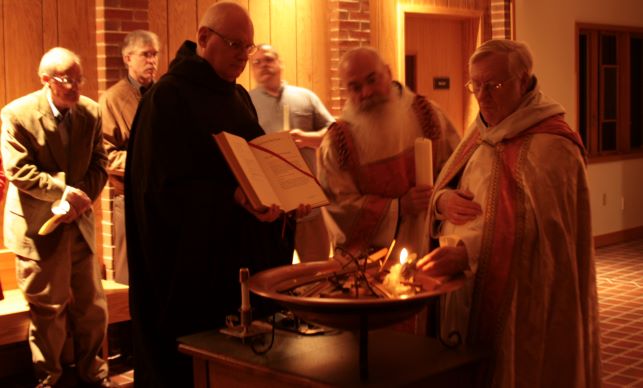
The earthquake has Eastertide, like the tomb, feeling empty this year. The boisterous celebrations with trumpets and choirs aren’t happening. Here at the abbey, we celebrate the Easter Vigil the way we usually do except for simplifying the lighting of the Easter fire and the procession. But we usually have a lot of people join us for the liturgy and this year nobody can come. The church will feel empty. We usually have a party after the Easter Vigil. This year we will not because there is nobody to have a party with.

At Easter, we usually skip the empty tomb and jump to celebrate Jesus’ being raised to life, which is quite a lot to be excited about. The empty tomb is mentioned in all four Gospels but it seems beside the point when Jesus is walking around, still bearing the wounds of his crucifixion yet very much alive.

The earthquake and the empty tomb go together. An earthquake shakes everything up, leaving us with a lot of empty space. And that’s what the empty tomb is: an empty space where the body of Jesus was supposed to be. Since, in Matthew’s Gospel, the angel wastes no time in telling the women that Jesus is risen and the women run into Jesus himself almost immediately on their way to tell the disciples, we are not given time to reflect on the empty tomb. The other evangelists, especially John, give us more time for this.

But let’s linger at the empty tomb just a bit in this time of loss and fear of more loss. The empty tomb is a hole in the Resurrection. How can the Resurrection have a hole in it? Isn’t the Resurrection about the fullness of life? But emptiness and fullness go together when it comes to the spiritual life. We go through life with gnawing desires that can’t be filled and sometimes shouldn’t be. Usually we don’t even realize it. If we stop and reflect, the emptiness stares us in the face. That is why many prefer not to stop and reflect.

When an earthquake like the pandemic strikes, we are so shaken up that it is very hard to avoid thinking about what really matters in life and what doesn’t. Things important yesterday aren’t so important today. The disciples thought they knew Jesus pretty well but when Jesus allowed himself to be handed over to the Jewish and Roman authorities and be crucified by them, they weren’t so sure they knew Jesus after all. Wasn’t he the one who was going to redeem Israel? Doesn’t look like he’s done that.

The earthquake and the empty tomb give us the space to empty out our preconceptions about Jesus, and what it means for Jesus to reveal God to us. One of the preconceptions is the need to organize society around who is “in” and who is “out.” Jesus was cast out of the city and crucified so that society could come together in his absence. But Jesus’ absence, the empty tomb, becomes the center. And in this empty center, Jesus comes to greet us and to tell us not to be afraid. Strange words to hear in the midst of a frightening earthquake and in an empty tomb. Can we hear these words? Can we empty ourselves enough to let the greeting of Jesus fill us with a new life that is beyond our understanding, a new life that will transform the crisis of today and the crises we will face in the future?

It Was Necessary

yellowTulips1Easter is an occasion of great rejoicing with bells, boisterous singing, and feasting. But do we really know what we are celebrating? The Gospel reading, doesn’t exactly ring out with Christmas joy of angels filling the skies with songs of God’s glory. Instead, we get “two men in dazzling clothes” who tell the women who came to the grave to anoint Jesus’ body that Jesus was not there but had risen. They had come to the wrong place.

A small group of confused women running off to stammer the news to the disciples isn’t exactly a celebration either. The disciples’s thinking the news is an “idle tale” may reflect a masculine condescending attitude towards women, but their reaction also shows how totally disorienting the news was. The Gospel reading ends with Peter running to the tomb to take a look for himself, seeing the empty linen clothes lying about, and then going home, “amazed at what had happened.” (Lk. 24: 12) Still no celebration; just a lot of unanswered questions. Luke continues his Resurrection narrative with two followers of Jesus walking to Emmaus with no indication of why they should be going there, implying that they are going the wrong way. Their conversation with a stranger on the way confirms their sense of confusion. Should we, too, be too disoriented to celebrate?

I think the key to understanding the problem lies in the words of the angelic beings: “Remember how he told you, while he was still in Galilee, that the Son of Man must be handed over to sinners, and be crucified, and on the third day rise again.” (Lk. 24: 6–7) The stranger who met up with the two disciples asked them rhetorically: “Was it not necessary that the Messiah should suffer these things and then enter into his glory?” (Lk. 24: 26) The word “must” is the key here. The Greek word dei is often translated “it is necessary.” In this case, for whom was it “necessary” that Jesus be handed over to sinners to be crucified and then rise on the third day? There is a tendency to think the death was necessary for God, but that suggests that God needed to have God’s own son die a painful death. Many people have a problem with that notion, I among them.

I find the French thinker René Girard helpful here. He interprets the available anthropological evidence as indicating a tendency of archaic societies to solve social tensions by a process that transforms competitive relationships throughout the society into a shared desire to focus on one person and then kill that person who is deemed responsible for the social tensions. The ensuing peace (for a time) is so strong that the victim is then worshiped as a deity. It is this social mechanism that convinces people that it is necessary for “god” that the victim be killed. Throughout this process, the truth of the victim is precisely what nobody knows, except possibly the victim.

This truth of the victim was gradually being revealed in the prophetic tradition of the Jewish people, most prominently in the verses about the “Suffering Servant” in Isaiah, whom the people accounted “stricken, struck down by God, and afflicted.” (Is. 53: 4) But then the people realized that they, not the victim, were the guilty ones. God had vindicated the “stricken one,” not the persecutors. It was these passages in Isaiah that most helped Jesus’ followers begin to make sense of what had happened to Jesus.

But on the day of Jesus’ Resurrection, the disciples had not thought to connect Jesus with the Suffering Servant. Jesus had told them many times that it was “necessary” that he be handed over to be crucified, but they could not understand. How could it be “necessary” that the man who they thought was going to restore Israel should be handed over to death? They assumed it was “necessary” that the guilty ones be handed over, not the innocent. Then, at Passover time, Jesus was deemed to be the guilty one who was causing the tumult by both religious and civil authorities, and so he was handed over. But the disciples had thought Jesus was innocent. Had they gotten their man wrong? Their fleeing when Jesus was arrested suggests they weren’t so sure.

The empty tomb was the first hint that Jesus’ death wasn’t business as usual. A tomb was supposed to have the corpse of the guilty one, but this one didn’t. The announcement of the angelic beings to the women was a stronger hint that Jesus was innocent after all. The women were told that it, although it was “necessary” that Jesus be handed over and killed, it was even more necessary that Jesus be raised from the dead. By raising Jesus from the dead, God showed Jesus’ followers that the “necessity” that Jesus die was a human necessity, a necessity of human factors, and that it was Jesus’ rising from the dead that was the true divine necessity. Only then could the disciples have their minds opened to understand the scriptures when the Risen Lord met with them himself. (Lk. 24: 45)

It is gloriously great news and a wondrous cause for rejoicing that we are freed from the human “necessity” to blame a victim who is put to death for the crimes of a society. That is, unless we feel too disoriented about not having scapegoats. Maybe that is why rejoicing in Jesus’ Resurrection is a much greater challenge than rejoicing in the birth of a child who is going to accomplish something great—what, we don’t know. Rejoicing in the necessity that Jesus be raised from the dead requires us to change our minds and hearts in radical ways to take in this news. Most challenging of all, we have to accept and then embody the forgiveness of the Risen Victim when storms of accusation remain the status quo even at this present day. Are we up to the challenge? Will we come to the party?

For an introduction to the thought of René Girard see Violence and the Kingdom of God and Living Stones in the House of the Forgiving Victim

Benedict’s Easter

BenedictChurchStatue1An early Easter throws many things awry, not least the saints’ calendar. St. Benedict’s day is normally celebrated on March 21, but this year, it was transferred to Monday after Easter Week. Thinking about St. Benedict in terms of Easter reminds me of what he said about Lent in Chapter 49 of his Rule.


Why would we want to think about Lent when we have just survived it and are now celebrating Easter? Well, Benedict famously thinks we should practice lent all year round. That means we should practice lent during Easter too. And here we thought we had Lent over with for a year! So why would we want to go back to Lent? For one thing, Benedict thinks that we should “wash away the negligences of other times” during Lent. That’s really a good thing to do all the time, rather than waiting for Lent to do it. Benedict also says that we should “look forward to holy Easter with joy and spiritual longing.” If it’s Easter already, what do we need to look forward to it? But when we realize Benedict wasn’t thinking about looking forward to jelly beans and chocolate, it becomes clear that Benedict has an eschatological yearning in mind.

Longing for Easter, of course, is yearning to actually live the life of the Resurrection. Benedict expresses this Easter yearning at the end of the Prolog to his Rule when he says that we shall run with “our hearts overflowing with the inexpressible delight of love.” Sounds like a good thing to have all year round. It is this Easter Joy that Benedict says we should run toward, not walk and certainly not dawdle. Benedict’s admonition to long for Easter helps us understand why we should run towards Easter even though Easter is already here. It is one thing for Easter to arrive in the course of days. It is another thing for God to inspire us with the life of Jesus’ Resurrection all year round. It is yet another thing for us to be inspired by the Resurrected life of Jesus. Washing away our negligences and running rather than wasting any more time helps us to be inspired by the Resurrected life by opening our hearts to the “inexpressible delight of love.”

treeBlossoming1

Handing Ourselves Over

crosswButterfliesLuke’s version of Jesus’ Resurrection is much the gentlest among the synoptic Gospels. No earthquakes and no women running off so afraid that they can tell nobody what they had seen at the empty tomb. The women were, indeed, terrified of the two men in “dazzling clothes” who appeared to them. But by the time, but before long they have remembered, with prompting from the men in white, Jesus’ words to them.

Among the words the women were reminded of was that “the Son of Man must be handed over to sinners, and be crucified.” (Lk. 24:7) The key word is that Jesus was “handed over.” Jesus was put into the power of the sinners. However, something much deeper had happened than that. If we look back to Jesus’ prayer at Gethsemane, Jesus struggled with the fear that his ministry had come to nothing, but then he handed himself over to his heavenly Abba. (See Gethsemane) It was only after handing himself over to his Abba that he allowed himself to be handed over into the power of sinners.

The death of Jesus is also portrayed more gently in Luke than in Mark or Matthew. Luke does not include Jesus’ anguished cry: “My God, My God, why have you forsaken me!” although Jesus did cry out in a loud voice. What he then said was: “Father, into your hands I commend my spirit.” (Lk. 24: 46) At the last, Jesus in handing himself over to sinners, had really handled himself over to his heavenly Abba. The words, in themselves, seem serene, but, in Gethsemane, where Jesus made his decision to hand himself over, his stress was so great that his sweat became “like drops of blood.” Commending himself to his Abba was not easy.

On Easter morning, Jesus found himself alive because he did not try to grab his life with force, but rather, Jesus had given it up. Grabbing his own life with force would have entailed using force to lead an insurrection against the Roman Empire. In doing so, he could, for a time have thought that his ministry had come to something after all. But by trying to make his life secure, he would have lost it. (Lk. 17: 33) In receiving his life from his heavenly Abba, Jesus had the Abba’s life to give to all. This is why it was futile for the women to look for the living among the dead. (Lk. 24: 5) Jesus, very much alive, was not there. He was among the living, walking on the Road to Emmaus, seeking to make Cleopas and his companion more alive than they were, so that their hearts would burn as Jesus explained the scriptures to them. If Jesus had not given up his life to gain it, he would not have had such overflowing life to give to others.

We too, are called to hand ourselves over to Jesus’ heavenly Abba. As our world grows more violent, we are tempted to do something rather than hand ourselves over to our Abba, but doing something in violent situations tends to keep them violent. Instead, we need to create space for the heavenly Abba to give us the life He gave to His own Son. In this way, we participate in Jesus’s death and in his glorious Resurrection.

Rising to the Life of Christ

crosswButterfliesWhen St. Paul says in Romans that we are baptized into Jesus’ death, what kind of death are we baptized into? An aged person drifting off while asleep? A ritual death with no consequences? No, we are baptized into the death of Jesus. This particular death, the one we are baptized into, is a judicial death resulting from collective violence. This is the shameful death of an alleged insurrectionist at the hands of an Empire. This death was caused by the meltdown of rivalry in the society of first century Jerusalem, exacerbated by the betrayal and cowardice of Jesus’ closest followers.

Once we know what death we are baptized into, we know what life we are raised to. In his risen life, Jesus showed no resentment or vengeance to those who had gathered to put him to death or had dispersed out of cowardice.  Moreover, Jesus was not entangled in any of the rivalrous feuds that are a way of life for most humans. Imagine living without all the entanglements and resentments swirling around and inside of us. Hard to do, isn’t it? That is how radically different the risen life is from the life we live now.

If our “old self” is crucified with Jesus, then we have, like Jesus, died in the place of the victim. That means we have died to our tendency to fuel resentments and resolve these resentments through gathering against the victim, as Paul himself repented of having held the clothes of the men who stoned Stephen and openly approving of what they did.

None of this means that repenting of personal sins and faults doesn’t matter and that becoming free of them is part of the resurrected life. However, Christian teaching has a strong tendency to stress personal renewal to such an extent that horrifyingly sick participation in collective persecution goes unnoticed. That hundreds of thousands of Christians could lynch thousands of black people shows us now, now that the lynching era is over, how easily this sort of group contagion can take over in what is often called an “enlightened” and “civilized” era.

Rather than congratulating ourselves on giving up lynching after roughly a hundred years of the sport, I suggest we take careful note of the growing polarization in our country over social and religious issues. Honest disagreement is not a problem; it’s a good thing, something that keeps us honest. But polarization tends to be conflict for the sake of conflict so that conflict feeds itself and it feeds each one of us. Never mind that polarized conflict is as nourishing to humans as sawdust and glue. What is really dangerous about this polarization is that it easily collapses into collective violence as a way of resolving the tensions.

If we wish to be serious about living the risen life with Christ, we must be baptized by the love and forgiveness of the risen Christ and allow him to gently but firmly remove all the resentments we feed on so as to feed on body and blood of the Lamb of God who reaches out to everybody with vulnerable love.

Can you imagine such a thing? Can you be overwhelmed by such a thing in baptism?