
 Jesus’ prayer in the garden of Gethsemane may well have been the loneliest moment of all for Jesus. His disciples were not able to stay awake with him. Much worse, his disciples still seem not to have understood anything of what Jesus had tried to teach them. At what he knew would be his last meal with his disciples, a meal when he had poured himself into the bread and wine to give his life to his disciples and all others who would follow him, his disciples fought yet again about who was the greatest. (Lk. 22:24–26) As he had done many times before, he told his disciples that the one who would be first would be the one who served, but he must have realized his words had had the same effect as before.
Jesus was alone with his heavenly Abba, but he was having difficulty believing that the path leading to the cross was going to accomplish anything. Jesus prayed that the cup he knew he must drink be taken away from him. Many think Jesus was shrinking from the pain of crucifixion. He probably was, but his anguish went much deeper. Jeffrey B. Gibson, in his book The Temptations of Jesus in Early Christianity, suggests that Jesus was tempted to opt for the restoration of Israel by dominance. It was the same temptation he suffered when he called Peter “Satan” at Caesarea Phillippi, and the same temptation he suffered in the desert right after his baptism. As he prayed in the garden, it appeared to Jesus that his whole ministry had come to nothing and that “the path of suffering will really be effective in achieving the task to which he has been commissioned.” Like us, Jesus felt the pull of the mimetic spiral of violence. It was hard enough that the pull of violence was strong throughout his entire social ambience. It must have been doubly hard that his disciples were still within that social pull of violence and were pulling Jesus in that direction as well. Worst of all, the full wrath of humanity’s rejection of God from the beginning of time had fallen upon Jesus and there seemed to be no way for that human wrath to be quenched. That Jesus accepted the cup anyway shows a profound trust in his heavenly Abba at a time when his Abba’s will was inscrutable to him. It seemed impossible to believe that the heavenly Abba loved Jesus, his Son, and loved all of the people Jesus had come to save, all of whom had turned against him. Impossible, yes, but with God, even these thing s were possible.
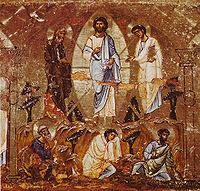 We celebrate the Transfiguration of Jesus at the end of Epiphany to prepare ourselves for Lent. This is a joyous feast where the Light of Mount Tabor should inspire us for the days of penance and then entering into the Paschal Mystery of Christ. However, there is a discordant element in the reading from St. Paul that I want to focus on. He, too, writes of the inspiring light of the Transfiguration, but he also writes about the veil over Moses’ face. This refers to the story in Exodus where Moses put a veil over his face when he came down from Mount Sinai with the tablets of the Law because his face shone too brightly for his fellow Israelites to look upon. (Ex. 34: 29–34) Paul goes on to say that the Jews remain veiled when they hear the words of the Law. In light of Holocaust, this verse causes much uneasiness, all the more so as it has been used to justify anti-Semitic attitudes and behaviors.
 Paul’s famous Hymn of Love zeroes in on what love, as agape, is all about: “Love is patient; love is kind; love is not envious or boastful or arrogant or rude. It does not insist on its own way; it is not irritable or resentful; it does not rejoice in wrongdoing, but rejoices in the truth.” (1 Cor. 13:4–6) In these qualities, we can see love as a deep renunciation of mimetic rivalry. Insisting on our own way, being resentful, rejoicing in the shortcomings of others, are all ways of putting ourselves on top of other people. Surely this short list is meant to stand for any attempt to put ourselves above other people. As long as we try to “win,” we lose at love. When we are willing to “lose,” we win at love.
 At his baptism, Jesus heard a voice from Heaven saying: “You are my Son, the Beloved; with you I am well pleased.” (Luke 3: 22) These words ring out in Psalm 2, addressed to the king, the Messiah, who is being singled out from the nations that are raging together and rising up against the Lord and his anointed. Similar words are spoken to the Servant of Yahweh in Isaiah 42:1. Throughout these songs of the Suffering Servant, he is being called out of a violent society to become instead the victim of that society’s violence. Unlike the Psalmist who threatens the raging nations with a rod of iron, the Suffering Servant does not retaliate against the violence inflicted on him. Jesus begins his mission, then, with a powerful acclaim of unconditional love from his Heavenly Father, a sense of unconditional love he will offer to all who will listen.
 “After eight days had passed, it was time to circumcise the child; and he was called Jesus, the name given by the angel before he was conceived in the womb.” (Luke 2:21)



 Imaginary Visions of True Peace