On Being the Temple of God

The brief story of the widow putting two small coins into the temple treasury, the only coins she had to live on, has often been touted as an edifying story about sacrificial generosity. I’ve come to seriously doubt that Jesus intends us to see it that way. Yes, the woman is generous and one can think of her many successors who built St. Patrick’s Cathedral in New York with their hard-earned pennies. But just before the woman comes with her two small coins, Jesus has castigated the scribes who “devour widows’ houses.” Moses and the prophets constantly championed the widows and orphans, and yet a person who is supposed to be championed is instead devoured by the system. What Jesus knew and the poor widow didn’t, is that the temple was a lost cause; it was going to be destroyed.

But Jesus also knew that the temple was a holy place. Hence his fury that it had been turned into a den of thieves. When Jesus was a child, he knew that the temple was the place where he should be about his Father’s business. (Lk. 2: 49) Religious anthropologists know very well that there is a human need for sacred space, space that focuses one on God and makes one feel closer to God. Hence the devotion of the poor widow in Jerusalem and the widows and other people with meager resources donating towards the building of St. Patrick’s Cathedral.

The destruction of the temple in 70 A.D. was a shock to both the Jewish and Christian communities and both communities had to build their traditions out of the ruins. After all, the first followers of Jesus also worshiped in the temple when it was still extant. The Jews recreated their tradition by embodying the Temple sacrifices through their daily practice developed in the Talmud. As for Christianity, John, in his Gospel, quoted Jesus as saying that if the temple should be destroyed, he could rebuild it in three days, meaning, as John goes on to say, that Jesus was referring to his body as the real Temple. (Jn. 2: 19–21) The author of Hebrews picks up this theme. By being the once-and-for-all offering for sin, Jesus has replaced the temple where sin offerings were made, with his own body. (Heb. 9: 24–28) For Christians, then, the temple has been replaced by Jesus as the focal point, the sacred space. But if Jesus has entered the heavenly sanctuary not made by human hands, as the author of Hebrews says, then where does a Christian find holy space?

Over the centuries, many church buildings have been built to fulfill this need, some of them overwhelming cathedrals, others storefronts. For me, one of the most moving entries into sacred space was a modest building, unadorned except for a cross strategically placed so as to be hard to notice, with a worn linoleum floor inside. But this is where a small group of Christians had worshiped for years in East Germany. These people had spent their whole lives giving up two small coins in their worship of God.

But, as the Risen Jesus revealing himself in the breaking of the bread shows, Jesus, is not only the true Temple of God but he makes all of us into the Temple that is His Body. That is why Paul, in line with John and the author of Hebrews, says that we are made the Temple of God by and in Christ. (1 Cor. 3: 16) Just as Jesus is the Temple by giving his whole life, we are part of the same Temple when we give all of our lives to God and neighbor. That is, the temple of God is everywhere as is the case in the Book of Revelation, where there is no temple because the Lamb has become the Temple. (Rev. 21: 220 At St. Gregory’s, it strengthens our prayerful focus on God to have the abbey church to go to several times a day, just as it helps to have set times for prayer to help us cultivate an attitude of prayer at all times. When we had a couple of weeks when we couldn’t pray in the church because the furnace had broken down, I missed the sense of focus the church gives us. But it is at least as important not to imprison our prayerful focus on God in a church space, but to keep the walls permeable to the rest of the world so that we are always in God’s Temple because we are God’s Temple. As the true Temple, Jesus broke bread at an inn just as we break bread at the Eucharist in the church.

See also: God’s Kingdom in Two Small Coins

Called to Repent

The calling of Jesus’ first four apostles in Mark is inspiring but it doesn’t make a lot of sense when we think about it. A complete stranger calls four complete strangers and they drop everything and follow him. (Mk. 1: 16–20) We can soften the improbability by noting that it is possible, even likely, that Jesus and these four men had sone acquaintance beforehand. but–let’s face it—answering a call from someone like Jesus just doesn’t make sense except maybe to the person who actually receives the call, and even then, the call tends to be a lot more compelling than sensible. At l east that’s what I still how I feel about my call to the monastic life. After all, a call from God tends to be disruptive to the life one has been living such as being a fisher on the shores of Lake Galilee. Does this call have anything to do with us?

We might try to distance ourselves from this calling by thinking that the apostles were exceptional people, but Mark and the other evangelists stress the ordinariness of the people called by Jesus. It’s professional religious people like ministers and monastics who should feel out of place with those first called. This ordinariness raises the suspicion that God, as Creator, calls everybody whom God has made. Such a call, then, is the norm, not an exception. This supposition is confirmed when St. Paul designates those called by God as members of an ekklesia, a word that means: “Those called out.” So all of us are called and the call makes no sense unless we accept that we are grounded in God as our creator, in which case God’s calling makes perfect, divine, sense. What else is involved with God’s calling of us?.

Jesus’ call of the four fishers follows straight upon Jesus call for repentance because the kingdom of God has come near. (Mk. 1: 15) What do we repent from? From fishing? Nothing wrong with that. As one who loves fish and seafood, I wouldn’t want all fishers to stop their work. Mark says that Jesus’ preaching began right after John had been put into prison. So persecuting prophets like John the Baptist is something we might want to repent of. But what if we are peaceful people who don’t persecute prophets, or think we don’t? In the Book of Jonah, the prophet calls on the Ninevites to repent—and they do! Since they were a violent society, one that had attacked Israel and destroyed the Northern kingdom, they had a lot of violence to repent of. But what if we aren’t invading other peoples’ countries? Jonah’s call for the Ninevites’s repentance circles back to Israel and the rest of us in a couple of ways. If Nineveh can repent surely Israel can repent; we can repent. More to the point, since Ninevites were violent enemies to Israel, who wants them to repent and become God’s people like us? Jonah didn’t want them. The call to witness to and welcome such strangers gets to the nub of what repentance is all about. It can be pretty disruptive to what we’re used to.

In his First Epistle to the Corinthians, Paul offers some cryptic directions for how we might repent: “those who have wives should live as if they do not; those who mourn, as if they did not; those who are happy, as if they were not; those who buy something, as if it were not theirs to keep; those who use the things of the world, as if not engrossed in them.” (1 Cor. 7: 29–31) Does this mean we should repent of marriage, shopping, mourning, or being happy? As Paul would say: “Me genoito!”—by no means! We can get some help with this passage by looking at the concept of mimetic desire on the part of the French thinker René Girard. Mimetic desire, as Girard conceives it, is the human tendency to want something, not because I want it but because somebody else wants it. This can lead to peaceful sharing but it can and does lead to violence. In this problematic passage in First Corinthians, Paul is showing his own profound insight into mimetic desire. It is bad enough to want what someone else has got just because that person has it and presumably wants to keep it. This scenario is greatly exacerbated when the person who has something purposely (though sometimes subconsciously) tries to inflame other peoples’ desire for what one has. Dostoevsky understood this problem profoundly. His intensely puzzling novel The Idiot becomes understandable when one realizes how Parfyon Semyonovich Rogozhin is stirring Prince Mjishkin’s desire for Natasha Philppovna in order to vindicate his own desire for her, and Aglaya Ivanova Epanchin, in turn, tries to intensify Natashya’s desire for the Prince, whom she had in hand until she played this game—all of this unfolds with tragic results. Paul would have us steer clear of this pitfall by being detached, not only from what we don’t have, but at least as much from what we do have. This misuse of mimetic desire is what Paul would have us repent of. This sort of detachment transforms the way we experience the world.

As Jesus’ ministry progresses, the disciples don’t look good, and Mark’s portrayal of them is the most negative. Perhaps the most egregious example of the disciples’ obtuseness is the way the disciples fight over who is the greatest in the face of Jesus’ predictions of his upcoming death and resurrection. Such infighting imitates the Ninevites rather than the Lord they are ostensibly following. Constant repentance, then, is needed to help us clarify what following Jesus is all about, and we have to expect it to take time. So let’s not waste any time getting started.

On Being the Pearl of Great Price

The story of Solomon’s encounter with the Lord upon assuming the throne is edifying and inspiring. As the Lord noted, Solomon could have asked for wealth or long life or the death of his enemies but he only wished for a “discerning heart.” One could say that, in this story, at this particular time in Solomon’s life, Solomon was willing to put all his marbles in a quest for wisdom so as to be a just ruler. There follows the powerful story of the two harlots and the two babies (one dead) where Solomon makes a decision out of his “discerning heart.” Other material about Solomon is less edifying. Perhaps one reason he did not wish for the death of his enemies was because he had already killed his brothers who had competed for the throne. Solomon accumulated great wealth later on and became less wise, not least because he married hundreds of women who turned his heart to deities that weren’t capable of giving a discerning heart to anybody. Solomon did build the temple and at the dedication he made a stirring speech full of reverence for the Lord, but unfortunately, he used slave labor to build it. These things tended to go with the territory of Israel becoming a monarchy like the other nations as the prophet Samuel had warned. This story challenges us to decide if we wish to have a “discerning heart” above all other things and, most important, if we are willing to persevere in this wish and not pursue things like wealth and death of enemies which will make the heart less discerning.

The parables of the Treasure in the Field and the Pearl of Great Price present us with the same challenge with greater intensity. They both make clear that the Kingdom of God costs us everything, just as the Rich Young Man was asked to give everything and follow Jesus. What is the Kingdom of God that is so precious as to be worth everything? Surely it has a lot to do with having the “discerning heart” that the young Solomon asked for. It takes a discerning heart to know when a treasure or a pearl really is worth everything, leaving no remainder. Having a discerning heart sounds a lot like having the purity of heart that Jesus says makes one blessed, along with being meek and lowly and willing to mourn and thirst for righteousness as preached in the Sermon on the Mount. Purity of heart requires an uncluttered life that is not filled with the conflicting desires Solomon indulged in as he grew older. Purity of heart is especially important and powerful if and when persecutions come, another blessing, a harder one to accept. Indeed, right after Jesus delivers these parables, Jesus is rejected by the people of his home town. These two parables seem to teach much the same thing but there is a difference. In one, the kingdom of God is like the treasure that is found. In the other, it isn’t the pearl itself that is like the kingdom of God; it’s the merchant who buys the pearl. The two parables progress from desiring to have the kingdom of God to actually being the kingdom. By buying the pearl that costs everything, the merchant becomes the kingdom so that this person, who obviously can’t be a merchant anymore, embodies a discerning heart and the teaching of the Beatitudes.

The parables of the Mustard Seed and the Loaf of Bread that becomes leavened all through suggest an inexorable growth of the Kingdom of God, both in society and within each human heart. If everybody is destined for salvation, than this is true even if it takes a very long time to happen. The wish for a discerning heart to make us pure of heart is the tiny seed and the smidgeon of leaven that starts the process. As Benedict teaches at the end of his chapter on humility, what used to take an effort eventually becomes something of a second nature. However, Paul’s reversal of the image, that a little leaven creates a loaf of malice and wickedness, warns us that the process can work in the wrong direction, as it did for Solomon. The kingdom does not happen automatically; one has to make a fundamental choice in life.

In Romans 8, Paul teaches roughly the same thing when he says that nature, in its groaning and yearning, is on the way to the kingdom so that “in all things God works for the good of those who love him, who have been called according to his purpose.” (Rom 8: 28) This doesn’t mean that God has a plan that involves God’s planting weeds in the garden; it is an enemy who did that as we learned last week and putting God’s son on the cross is something the enemy did. But, given the weeds planted by the enemy, persecutions and all, God inexorably transforms this garden as God transforms the mustard seed and the loaf of bread. Perhaps God does not want the weeds pulled prematurely because God is transforming the weeds to plants. On top of that, the mustard plant itself is actually a weed that threatens to take over the garden. Is Jesus, then, a weed planted to transform the garden? He sure was treated like a weed and weeded out. More important, Paul says that God did not spare God’s own son but gave that son along with all other things besides. The kingdom of God may cost each of us everything, but the kingdom also costs God everything and God gives us everything God has got. If God really is for us, God is for all of us, not just some of us. If God works everything for good in the midst of trials and rejections, God works everything for the good of everybody, not just some of us. Maybe, just maybe, all the fish pulled out of the sea to be sorted by the angels will turn out to be keepers. Surely God hopes so.

See also Sowing Parables in our Hearts

Jesus the Helpless Widow

Jesus’ parable of the widow and the unjust judge is puzzling. (Lk. 18: 1-8) Why would Jesus compare God with an unjust judge when everybody knows that God is just, hears our prayers, and answers them in God’s time. But if we think about it, our thoughts may wander into the ways we treat people. Are we ourselves like the unjust judge who takes advantage of people weaker than we? Do we put off helping out those people because it isn’t convenient, and only if the helpless person hassles us will we grudgingly do the helpless person the favor so that we aren’t pestered any more?. If our thoughts move far enough along in that direction, we might realize that we think that God is like us; God does not want to be bothered by our needs and God does not want to be pestered.

In Genesis, we have the mysterious story of Jacob wrestling with the angel until the angel finally gives Jacob a blessing. All his life Jacob had been getting his way through conflict: first getting his brother Esau’s birthright and Esau’s paternal blessing, and then building a prosperous herd after wrangling with his father-in-law Laban for twenty years. If conflict is all Jacob knows, then he”knows” that God won’t give him a blessing unless he fights for it. Jacob walks away from the struggle with the blessing but he is wounded by it. Was it the blessing that wounded him, or was Jacob wounded because conflict was all he knew in life? Are we like Jacob, thinking we have to fight with God to get anything through prayer because we live in conflict with other people?

One could say that each of us has an inner importunate widow and an inner unjust judge. On the surface, we might want to identify with the importunate widow because she is in the right. The problem is, the importunate widow is helpless and we don’t like being helpless. The unjust judge is the one in control and we usually prefer that position, except that it is not the righteous position. Of course, if we struggle like Jacob, we don’t feel so helpless, even if in truth we are. The thing is, if we keep struggling because conflict is our way of life, we end up growing the unjust judge in us. It is worth noting here that Jesus himself was condemned by unjust judges such as the likes of us.

The author of Second Timothy urges us to: “proclaim the message; be persistent whether the time is favorable or unfavorable; convince, rebuke, and encourage, with the utmost patience in teaching” (2 Tim. 4: 2) It sounds as if the apostle would have us act like the importunate widow. If apostolic ministry is about doing the things Jesus did, then it follows that Jesus, the victim of unjust judges, is himself an importunate widow. The apostolic author goes on to warn of people with “itching ears” who don’t like sound doctrine. We tend to assume that those people with “itching ears” are those who happen to disagree with us. We should worry about itching in our own ears. In light of Jesus’ parable, having itchy ears could have to do with thinking God is like the unjust judge when God is much more like the helpless widow just as Jesus was helpless on the cross. That is, God cries out to the unjust judge in each of us day in and day out, pleading for justice. Like this widow, God does not stop pleading, and so we, too should plead in prayer without ceasing and yearn for justice for ourselves and for other people.

The same thoughts are developed in Unjust Judges and Widows.

On Taking the Lowest Place

Jesus’ parable of the important seats is easy to understand. It’s one of the first parables I learned as a young child in Sunday school. It could easily have come from any of the sitcoms I watched at that age. I can imagine Jackie Gleason barging into a dining hall and rushing for the best seat at the table, followed by his spluttering rage when he’s told he has to sit over in a corner.

In this parable, Jesus shows a profound awareness of social contagion, a phenomenon analyzed with much insight by René Girard. What Girard articulates is our human tendency to receive desires from other people. In the case of the banquet, the more some people want the best places, the more other people will want the best places just because other people want them. If some people think some places are the best and rush for those, then other people will desire those places because other people want them.

One way to get some perspective on this parable is to reflect on the kind of person who rushes for the best seat and the kind of person who holds back. The kind of person who holds back is apt to be more kind than the other, or at least not so unkind. The thing is, reaching the best seat can be a kind of pyrrhic victory. One might have the prestige of being a CEO, the president of the United States, or the center of a social set, but if such a one treats people badly, that person will not be liked or respected on a personal level, even if there is respect for the position. It’s a way of saying one might gain the world and lose one’s soul. One has lost one’s soul to the social contagion that blunts concern for the well-being of other people. In fact, although this parable doesn’t speak of darker alternatives, it is easy to imagine the rush for the highest place resulting in a violent free-for-all. This is what Girard says is likely to have happened at the dawn of humanity, and the free-for-all resulted in everybody converging on a victim. It isn’t easy to escape the power of this social contagion but if one takes notice of Jesus, then one sees an alternative.

To begin with, Jesus is not giving us a social strategy for getting the best place by being laid back. Jesus would have us realize that grabbing one of the best places at a dinner party or pushing for social dominance over others is not where our priority should be. Rather than trying to get the highest place, one should be content with the place one happens to have and do the best one can in that place while attending to the needs of others, which is the best way to be given a higher place due to one’s accomplishment. But there is more.

Jesus didn’t just take a middling place; he took the lowest place. His preaching ministry, for all the acclaim it received from many people, gained the opprobrium of those who thought they had the highest places and wanted to keep them. These people sentenced him to a criminal’s death, death on a cross. That was the lowest place there was in the Roman world at the time. But then Jesus was raised from the dead by his heavenly Abba and raised to his Abbas’s right hand in Heaven which is about as far up as one can go. Such is the Christological level of this parable. Who would have thought that a sitcom scenario could outline the story of our redemption?

For more on René Girard, see Violence and the Kingdom of God, Living Stones in the House of the Forgiving Victim, and Living Together with our Shared Desires.

The Work of a Slave

When Jesus washed the feet of his disciples, he stressed the importance of what he was doing. Likewise, when he passed the bread and the wine, he stressed the importance of what he was doing. Both acts were to be remembered and done in memory of Jesus. And both are to this day, although the footwashing is not anywhere near as common as the eating and drinking of the bread and wine.

What is it about the footwashing that has put it into a very low second place? Logistics may have something to do with it but a look at its meaning, the sign that Jesus is giving us, probably has a lot more to do with our not even talking about it all that much. In the Greco-Roman world, it was slaves who washed the feet of their masters and their masters’ guests. That Jesus would do the work of a slave must have been shocking at the time and still is, if we consider the implication that imitating Jesus’ act is not confined to literally washing the feet of others but entails acting as a slave to others. Fundamentally, being a slave means to be in the hands of another person. If we are supposed to put ourselves into the hands of others like this, what does this say about trying to enslave another human being? Jesus himself was about to put himself into the hands of others with the result that he would be crucified. If the disciples still remembered the anointing of the feet of Jesus by Mary of Bethany six days ago, that too would have added to their discomfort. This discomfort extends to the parallel versions of this story

The woman ( or women) in the Gospel stories poured out her very substance (the expense of the perfume or oil) in devotion to Jesus. Likewise, Jesus poured out his very self to his disciples in washing their feet just as he was about to pour out his life for all people to put an end to the violence that includes the enslaving of other people. In those Gospel stories, the women were commended as examples of discipleship. If Jesus thought these women were such good examples, it makes sense that Jesus was humble enough to learn from them and do for his disciples what the women had done for him. There is no indication in any variant of the story that the disciples were reconciled to what the women had done. Did Peter take umbrage at Jesus for washing his feet because he associated it with the women as much as he associated it with slavery?

With the bread and wine, Jesus again poured himself into the two elements just as he poured out his life on the cross. So it is that the footwashing and the Eucharist both mean the same thing. We have put up with the Eucharist more than the footwashing because we have been able to sidestep this meaning by arguing about the metaphysics of Jesus’ presence. But the real presence of Jesus is his pouring himself into the hands of others and through them, the hands of his heavenly Abba. Paul knew this very well but we also conveniently forget that the context of his recalling the Last Supper is to upbraid the Corinthians for violating its meaning through denigrating the weaker and poorer members of the assembly.

Jesus rebuked Peter for refusing to have his feet washed, warning him that he would have no share in him. (Jn. 13: 8) This warning converts Peter so powerfully that he goes overboard and asks to be washed all over. He has allowed Jesus to be a slave to him so that he could be a slave to Jesus and all people. This conversion did not prevent him from denying Jesus three times but it allowed him to hear the cock crow and then to affirm his love to the Resurrected Jesus three times. This is what both the footwashing and the Eucharist are all about.

On Saving a Fig Tree

Both Matthew and Mark have brief stories of Jesus cursing a fig tree for not bearing fruit even though it is not the season for figs. The story is puzzling and some people think Jesus is just throwing a childish tantrum.

Fig trees, like vines, have much resonance throughout the Bible and the Gospels are almost certainly referring to some of the verses about them. In 1 Kings 4: 21 it says: “During Solomon’s lifetime Judah and Israel lived in safety, from Dan even to Beer-sheba, all of them under their vines and fig trees.” Micah prophesies that “they shall all sit under their own vines and under their own fig trees, and no one shall make them afraid; for the mouth of the Lord of hosts has spoken.” (Micah 4: 4) In contrast to these images of well-being, Jeremiah complains that “there are no grapes on the vine, nor figs on the fig tree; even the leaves are withered, and what I gave them has passed away from them.” (Jer, 8: 13) The fig tree appears to stand for Israel as a whole in these instances and they make Jesus’ curse of the fig tree understandable as a prophetic warning that Israel is on the verge of becoming irremediably fruitless.

In Luke, Jesus refers to two recent disasters:: Pilate’s mingling the blood of some Galileans with his sacrifices, and the collapse of the Tower of Siloam. (Lk. 13: 1–5) He scotches the blame game where we assume the victims deserve what they got, but warns the crowd that all will perish in an equally horrible way if they do not repent. Paul refers to a series of disasters at least as ghastly in First Corinthians: the Israelites fell, were destroyed by serpents, or destroyed by the Destroyer on account of sinful behavior. In both examples, there is a mixture of natural causes and human causes, both of which show Israel suffering disaster for failing to bear fruit, like the barren fig tree.

The small parable in Luke (Lk. 13: 6–9) gives us a different take on the fruitless fig tree. The owner is losing patience after three years without fruit and demands that the tree be cut down, but the gardener pleads for one more chance. The gardener will make an extra effort and see if that makes the tree bear some fruit. One wonders if this gardener will ever stop pleading for one more year, year after year. This is in dramatic contrast to the threatening words of imminent disaster the precede the parable.

Jesus’s cursing the fig tree for not bearing fruit and Jesus’ parable seem to work at cross purposes. Is there a resolution to this tension? The Old Testament reading adds weight to the gentler position in Luke. Yahweh, speaking to Moses out of the burning bush, promises to deliver the Israelites from Egypt and bring them to a land where they will find, among other things, fig trees, as Moses’s sermon in Deuteronomy promises. (Ex, 3: 8; Deut. 8: 8) Hosea spoke of Israel as “like the first fruit on the fig tree, in its first season.” (Hos. 9: 10) This initial commitment suggests that God will not give up on Israel easily, and probably not at all, no matter how barren the tree. We can ask ourselves: Are we like the owner who has given up on the fig tree that is human culture today, or are we like the gardener who will keep on trying when we fail to bear fruit year after year?

In his first Epistle, Peter says that Jesus bore our sins in his body on the tree. (1 Pet. 2: 24). Could this tree be the withered fig tree? In the parable in Luke, the gardener says he will put manure around the barren tree. Manure is considered a waste product, but farmers know that it brings fertility. Is Jesus, the stone rejected by the builders, (Ps. 118: 22; Lk. 20: 17) himself the manure that makes the withered tree bear fruit again as Gil Bailie and Paul Nuechterlein suggest? Are we willing to give of ourselves for the sake of others who seem to be as barren as the fig tree?

As Jesus Grew

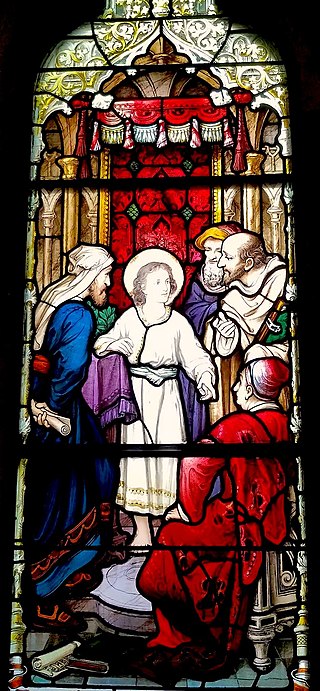
Church window at the Church of the Good Shepherd, Rosemont, PA

The story of Jesus in the Temple at the age of twelve (Lk. 2: 41–41) is unique in the New Testament in that, being the only story about Jesus as an adolescent, it is also the only text that gives us insight into Jesus as a developing person. The infancy narratives show Jesus as a vulnerable baby and stories of Jesus as an adult, thirty years of age, show a pretty steady portrait of Jesus although a few stories hint at some change in Jesus’ perspective, such as the story of the Canaanite woman. (Lk. 18: 1–9). The big turning point in Jesus’ life was the baptism when the heaven’s opened. This was clearly a powerful experience that oriented him for the rest of his life and solidified his identity. It is well-known that early adolescence is a time of transition and a growing sense of identity, and Luke shows us the beginnings of the identity that was firmed up by his baptism.

The biggest transition for an adolescent is to move from parental care and authority to a growing independence in calling the shots for one’s own life. This is a transition that both parents and children have to navigate. That Jesus’ parents assumed that their son had rejoined the caravan for the return trip from Jerusalem (a poor assumption) suggests that they were indeed letting go and giving their son some responsibility for himself. If Jesus had been younger, they would have made sure the boy was with them before the caravan left. As for Jesus, it is obvious that he made an independent decision on his own initiative. This independent choice led to a new dependence beyond his family as Jesus felt drawn to the temple and took advantage of the opportunity to learn and sharpen his own growing insights in conversation with the elders. Although Jesus would, as an adult, have an adversarial relationship with many of the same people, at this time in his life, Jesus asked questions, listened carefully, and weighed the answers for what they could teach him. As often happens with adolescents, Jesus seemed to assume that his parents would know where he would be, another poor assumption..

That Jesus was drawn to the temple and to conversation with the elders indicates that he had a growing sense of a vocation deeply involved with the religious tradition of his people and the time to begin preparing for it had come. When his parents found him, he showed himself to be firm in this growing sense of vocation when he said: “Did you not know that I must be in my Father’s house?” (Lk. 2: 49) Like many adolescents, Jesus failed to make himself understood to his parents. Not wishing to be a rebellious adolescent, Jesus returned to Nazareth and “was obedient to them.” (Lk. 2: 51)

The insights into adolescent psychology are pretty good for a writer who had no opportunity to take a course in developmental psychology, but that is not the point of the story. What is important, and something we should ponder, is that Jesus, as truly and fully human as well as divine, developed as a human being as every human being develops. As with everything else human, Jesus leads us through his own human experience in our own navigating of transitions in life.

The Rock From Which We Are Hewn

KatrinaCrossAbraham1It is significant that Jesus had wandered over to Caesarea Philippi, deep in imperial territory, before asking his disciples who they thought he was. After they repeated a few rumors going round, Jesus asked who they thought he was. Simon Peter piped up: “You are the Messiah, the Son of the living God.” (Mt. 16: 16) Jesus’ commendation showed that Peter had caught on to something important: it was not Caesar, whose neighborhood they were hanging out in, but Jesus, who was the real, true Lord. But what kind of Lord was Jesus?

When Jesus called Simon “Peter,” meaning rock, to honor his correct answer, perhaps Jesus was reminding Simon of the words of Isaiah: “Look to the rock from which you were hewn, and to the quarry from which you were dug. Look to Abraham your father and to Sarah who bore you.” (Is. 51: 1–2) Simon Peter, like all Jews, was hewn from the rock of Abraham, the one called to leave his own idolatrous country for a land God would show him where he would make out of Abraham a great people. If Peter is a rock like Abraham, then Peter, too, will leave the idolatrous imperial culture surrounding him and will allow God to make yet another great, new people out of him and the other disciples. What kind of people? What kind of culture?

In writing to the Romans, Paul admonishes them to follow Abraham out of the idolatrous empire in which they live: “Do not be conformed to this world, but be transformed by the renewing of your minds, so that you may discern what is the will of God—what is good and acceptable and perfect.” (Rom. 12: 2) And what does this transformed people with renewed minds look like? Paul has just told the Romans that such people present their bodies “as a living sacrifice, holy and acceptable to God, which is [their] spiritual worship.” (Rom. 12: 1) The imperial culture is all about using power to make sacrifices of others for the sake of the Empire. The culture of Christ is all about making a sacrifice of self as did Jesus, so as to make all of our lives an act of self-sacrificial worship. Although emperors always think more highly of themselves than they should, Paul warns us not to think more highly of ourselves than we should, “but to think with sober judgment, each according to the measure of faith that God has assigned.” (Rom. 12: 3) Paul then goes on the enumerate the measures of faith as a distribution of gifts of the Holy Spirit so that each of us makes our bodies living sacrifices of worship in various ways, making up the Body of Christ.

Being transformed by the renewal of our minds entails a radical makeover. It’s not just a matter of changing one’s mind about what book to read next. Paul is writing about a radical turnaround in one’s attitude to power. The first step is to be very vigilant about the power we happen to have in relation to other people and how we use it. Even if some of us have rather little power we need to be acutely aware of how we use what little we have. Do we try to get an upper hand against other people one way or another rather than looking for ways we can lay down our selves in service to them?

It turns out that Peter himself hasn’t caught on to the kind of ruler Jesus is. When Jesus talks about laying down his life, Peter resists and is rebuked by Jesus. This turn of events should caution us about the difficulties of the makeover that is being asked of us. Like Peter, we are likely to revert to imperial thinking just as quickly as Peter did. This is not surprising since the default reflex movement is to act like an immovable rock if we are threatened. Yet Jesus says he is going to do the opposite of that. Which is to say, the rock we stand on in the culture of Jesus is the rock of being vulnerable to the forces of Empire. Whether we are going to take the way of vulnerability, the way of giving ourselves for the sake of others, even when such gifts of self are not appreciated or are even actively scorned is a question that presents itself to us day by day, hour by hour, minute by minute. We can easily get tired of asking this basic question so constantly, but if we persevere even when we are weary, we will eventually find that God makes a living but vulnerable rock not only out of Peter but out of each one of us.

The Still Small Voice of the Good Shepherd

lambsThe Good Shepherd is a reassuring image. The shepherd is in charge and the sheep follow the shepherd’s guidance. When thieves and robbers and wolves come to threaten the sheep, the shepherd deals with them in no uncertain terms. Jesus’ claim to be the gate, the way in and out of the fold, gives us another reassuring image: some of us are in and certain other people are out, just the way it should be.

But in my reflections on John 10 from a year ago, I noted that the Good Shepherd is the Lamb of God who lays down his life for the sheep. With this realization, the hierarchical picture breaks down. The Good Shepherd is not above the sheep but is one of the sheep. Whereas even the most compassionate and conscientious shepherds end up eating or sacrificing the sheep, Jesus shares the fate of the sheep by becoming the Paschal Lamb in place of the sheep.

The Lamb of God is also an odd gate. Rather than keeping the lambs inside, he leads the lambs in and out with so much movement that the idea of there being a gated sheepfold ceases to make sense. Rather than keeping the bandits and robbers away, Jesus lays down his life for the flock when the bandits attack. If Jesus is the gate, than his willingness to lay down his life is the way in to this abundant pasture for all who would join his flock.

In an essay on the Eucharistic Christ, James Alison explores these paradoxes with great insight. After taking us through stages where we fixate on the bad shepherds and feel righteous about identifying and hating them, Alison takes us to a stage where the fixations fall away:

There is no definitive inside and outside for the Good Shepherd, there are places of shelter and of feeding, different places to which the door gives access, and which presuppose movement, non-fixity, and confidence in being neither in nor out. It is assumed that the best feeding place might not be one that seems to be “in,” yet the good shepherd is able to make that place available to his sheep.

The mixup that Alison envisages reaches the point where we are all sheep and all wolves, not in a negative sense where each of us supposedly good people find the wolf within, but rather a recreation of abundant life where nobody needs to be a sheep who is devoured or sacrificed or a wolf who does the devouring and sacrificing. This is where our baptism into the death of Jesus leads us further into the abundant life of Jesus.

It is in the space of this abundant life that we hear the true voice of the Good Shepherd as the Lamb of God, which Alison suggests is the still small voice that Elijah heard in the wilderness. When we hear this still small voice, the strident voices of bandits are drowned out and our own voices can take on the same stillness that others need to hear.