
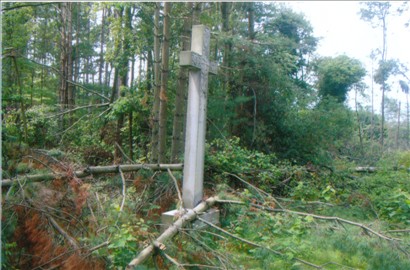
There is indeed much distress among nations and the roaring of seas and waves happening right now. We are all faint with fear and foreboding and we feel that the very heavens are shaken. (Lk. 21: 25–26) In such a state, it’s hard to get our “sea legs” that keep us on our feet in the storms surrounding us.
It is easy to see the current situation as signs of the End Times. That could be, since both the Bible and science tell us that the world will end some time, but there are some unhealthy aspects to preoccupation with the end times. Most unhealthy is the tendency to gloat over the violence and chaos. This approach is conducive to affirming, even actively abetting the violence and chaos. Worse, this attitude tends to slide into the notion that God is violent and that God wants the world to fall apart in violence. Not a flattering portrait of God, and not an accurate one when one compares this portrait with the Jesus of the Gospels who went about healing people and casting out demons so as to bring order into peoples’ lives.
If we take a historical perspective, we can see that wars and rumors of wars are normative, something that happens almost all the time. People are always faint with fear and foreboding and they feel that the heavens are shaking on account of what is happening. For the past two thousand years, many people have thought they were living in the End Times, but the times didn’t end, although some catastrophic events made it feel as if the world had ended. So why should we think that the chaotic and violent events of today are the End Times? I don’t say this to make fun of people who think we are living in the End Times. After all, the Bible has a strong eschatological thrust with promises of a divine fulfillment in the midst of the chaos and anxiety we experience in the present world. It’s just that there is something screwy about trying to force God’s hand by blowing up the world or courting ecological disaster.
Many biblical scholars suggest that passages such as Luke 21 are not about cosmic End Times, but are referring to contemporary events in Jerusalem. That is, Jesus is warning the people of the impending catastrophe to which they are headed if they persist in the unrest and violence that has engulfed their lives. As we know, Jesus’ warning was not sufficiently heeded, and the temple was destroyed in A.D. 70. Does this mean that such eschatological passages are no longer relevant to the present day? By no means. Just as there were wars and rumors of wars in Jesus’ time, there have been wars and rumors of wars in every time since. That means that the warnings of the catastrophic effects of violence are as urgently relevant today as they were when Jesus spoke these words.
Jesus then says that we shall see “the Son of Man coming in a cloud with power and great glory.” (Lk. 21: 27) Some people seem to be inclined to think Jesus is coming with a sledgehammer like Thor’s to smash the heads of all the bad guys. But Jesus says nothing of the Son of Man doing anything at all except “standing.” The image of Jesus standing is actually a powerful and deep one. It suggests that Jesus is standing with us in deep solidarity in the midst of the violence and chaos, a steady presence that is not shaken, one who doesn’t lose his sea legs. Remember, this standing Jesus was crucified soon after he spoke these words, the ultimate renunciation of violence, and is now risen and ascended, vindicated by His Heavenly Abba in his renunciation of violence to the point of death. If a returning Jesus acts violently, then the crucifixion loses its central focus in Christianity and violence gets the last word.
Jesus then shifts to a radically different image: leaves sprouting on a fig tree. (Lk. 21: 29) This is radically different from wars and rumors of wars and violence and chaos. Here is order emerging out of nature, something benign and constructive. So it is that in the midst of the violence and chaos, there are small, and sometimes not so small, acts of kindness. We can see such sprouting leaves in the healing people give to other people, so as to participate in the healing ministry of Jesus. It is in the midst of such healing gestures, not in the violence, that Jesus is standing with us. Such acts of kindness leave us as vulnerable as Jesus was in this world, but they also share in the hope of sharing in Jesus’ vindication.
Jesus concludes with a warning to avoid dissipation and drunkenness. (Lk. 21: 24) Such vices are common human failings in all circumstances, but the intensification of violence and chaos leads many to cope through sensual pleasures that give poor, or negative returns. If we indulge in such escapism, we will not be alert to the signs of God’s kingdom, the leaves sprouting on the fig tree. What kind of day might we be missing by letting it close in on us like a trap? I suggest that we could be missing the kind of day when we might be able to offer some healing and strengthening to another person and receive the same from others. The Day of the Lord is any day and every day.
 Imaginary Visions of True Peace
Thank you, Andrew, for this calming perspective.
It occurs to me that indulging in dissipation would dissipate the energy we might need to respond with peace, and drunkenness chases Prudence, the Quuen of the virtues, out the door.